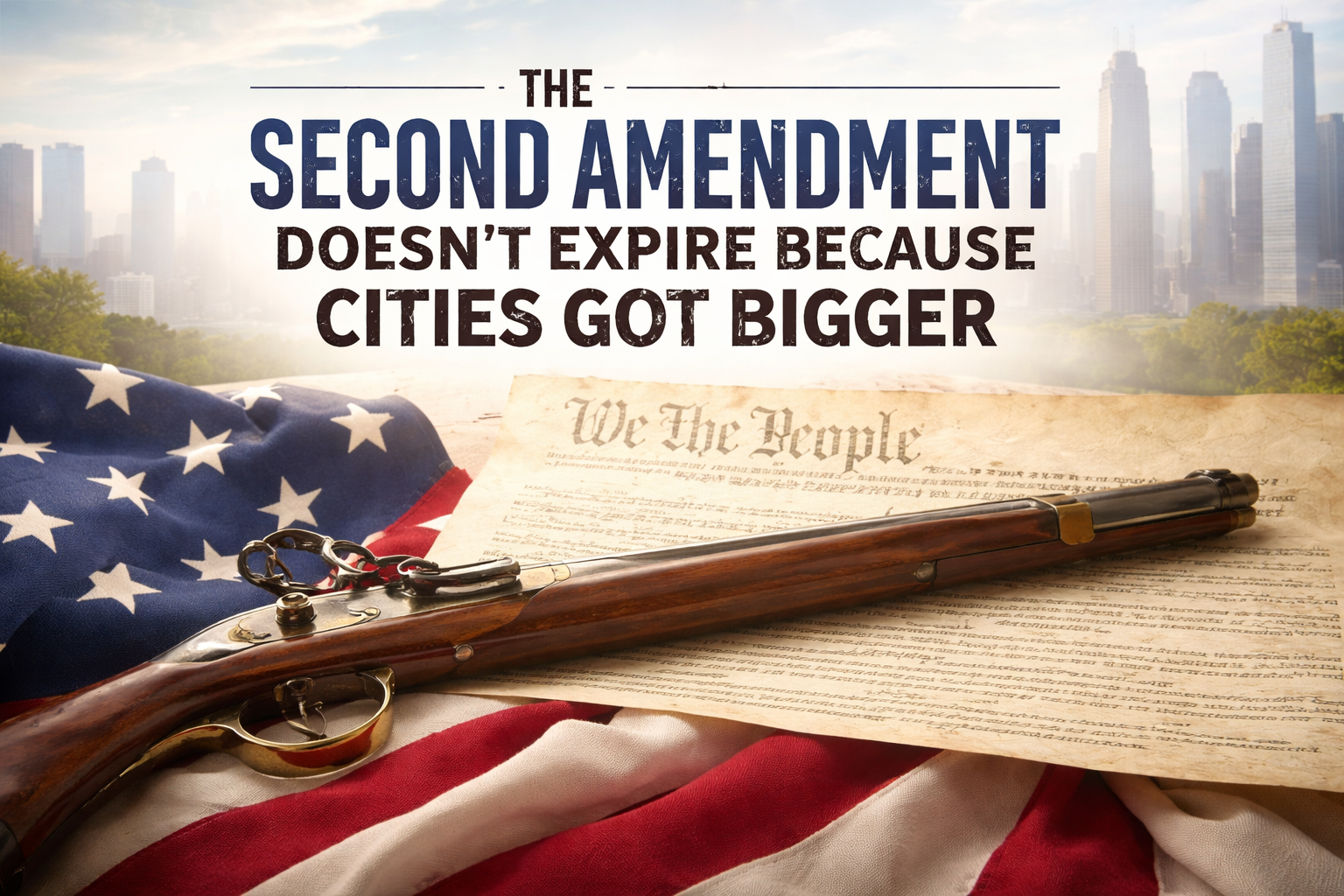
One of the more dishonest modern arguments against the Second Amendment goes like this: yes, the founders protected the right to bear arms, but they lived in a simpler time, a rural time, a militia time, and if they could see modern America they would surely want that right cut down, licensed into irrelevance, or buried under layers of bureaucratic obstruction. That argument is weak. Worse, it is intellectually slippery.
James Madison and Thomas Jefferson were not children. They understood that the country would change. They understood population growth, shifting conditions and future political conflict better than many of the people now pretending the Bill of Rights was written for a museum. The Constitution itself was designed to govern a growing republic, and the Bill of Rights was added because Americans wanted clear barriers against government overreach. The Constitution was not written for a static people frozen in one century. It was written for a nation expected to grow, change and confront new dangers.
So let us clear away the fog. The question is not whether America changed. Of course it changed. The question is whether the right of self-defense, the right of a free people to remain armed and the right to resist being made dependent on the state somehow disappeared. Nothing in the founding record supports that claim.
Madison Wrote the Protection in Plain Language
The soft modern dodge is to treat the Second Amendment like an embarrassing relic that needs to be explained away. But the actual text is not vague: "the right of the people to keep and bear Arms, shall not be infringed."
That matters because the phrase used is "the people," not "the state," not "the government," and not "officially approved security personnel." Madison's own proposed language in 1789 was even more direct: "The right of the people to keep and bear arms shall not be infringed." The amendment was not drafted as a temporary hunting clause. It was framed as a liberty issue.
The text says "the right of the people." Not the state. Not the government. Not officially approved security personnel. The people.
Jefferson Did Not Draft It, But He Pushed the Principle
Thomas Jefferson was not at the Constitutional Convention. He was abroad in France. But his importance is still obvious. In his December 20, 1787 letter to Madison, he argued that a bill of rights is what the people are entitled to against every government on earth. That line matters because it cuts straight through the modern game. Rights were not understood as gifts from officeholders. They were protections against officeholders.
Jefferson did not write the Second Amendment. Madison did the drafting work. But Jefferson clearly stood in the camp that believed liberty needed explicit protection from power. Put those two together and the picture becomes clear: the founding generation did not think rights were favors to be resized by nervous politicians. They thought rights were barriers.
"Times Have Changed" Is Not a Serious Argument
The founders knew times would change. That is why they built amendment mechanisms, representative institutions and a constitutional structure meant to outlive them. Saying "modern life is different" does not prove a right should be hollowed out. Every major liberty in the Bill of Rights now operates in a world the founders never saw.
They did not foresee radio, cable news, social media, the internet or mass digital surveillance either. Yet nobody serious argues that free speech only applies to hand-operated printing presses or that the Fourth Amendment became obsolete because police now use data rather than boots. The same principle applies here. A right does not vanish because the setting changes. If anything, changed conditions can make the right more important.
Self-defense is not outdated. It is permanent. Human aggression did not disappear because America became urban, diverse and crowded. Government failure did not disappear either. Police do not arrive instantly. Criminal violence is still real. Disorder is still real. Citizens are still ultimately responsible for their own immediate survival. That is not extremism. That is reality.
A lot of current liberal interpretation of the Second Amendment starts with a policy preference and works backward. The preference is simple: many on the left do not like widespread private gun ownership, do not trust ordinary citizens with arms and would rather move force and security ever more fully into state hands. The historical argument usually comes later, mainly as packaging.
So we get the usual lines: the founders only meant muskets, or only militias, or only a world without cities. But that argument proves too much. If you applied that same cramped logic consistently, much of the Bill of Rights would become unrecognizable. The founders included the Second Amendment because they understood power, not because they failed to anticipate the future.
The Internet's Favorite Anti-Second Amendment Claims — and Why They Fail
The modern case against the Second Amendment usually arrives dressed as historical sophistication. Strip away the tone and what you find is not serious constitutional reasoning. It is a policy preference looking for a legal excuse. Here is the short version of each major claim and why it fails.
"The Second Amendment only protects a militia-based collective right, not an individual right." That argument has taken a beating for a reason. In District of Columbia v. Heller, the Supreme Court held that the Second Amendment protects an individual right to possess firearms, especially for lawful self-defense in the home. The Court reaffirmed that view in McDonald and again in Bruen. The lazy internet claim that the amendment was only ever about organized military service is not the governing constitutional reading. It has not been for years.
"Well regulated militia means the government can regulate private gun ownership however it wants." This is one of the most common bait-and-switch moves online. The prefatory clause does not erase the operative clause. The militia language announces a purpose. It does not cancel the right of the people to keep and bear arms. And in founding-era usage, "well regulated" often referred to something properly functioning and disciplined, not endlessly restricted by administrative permission slips.
"The founders only meant muskets, so modern firearms fall outside the amendment." Nobody applies that logic honestly to the rest of the Bill of Rights. The First Amendment still covers the internet. The Fourth Amendment still applies to digital searches. The "muskets only" line is not a serious originalist argument. It is a narrowing tactic that asks people to believe one enumerated right grows with technology while another shrinks because the political class dislikes it.
"There is no real right to carry outside the home." That claim was directly weakened by Bruen. The Supreme Court held that the Second and Fourteenth Amendments protect an individual's right to carry a handgun for self-defense outside the home, and it rejected New York's licensing regime because it made ordinary citizens beg the state for special permission to exercise a constitutional right. The right to "bear" arms cannot honestly be reduced to a right that dies at your front door.
"Because crime is serious and cities are crowded, government must have broader power to restrict arms." Fear is always the excuse used to cut rights down. If public-safety claims by themselves were enough, no right would survive for long. Constitutional rights exist precisely because government always has a reason to want more control. Every restriction arrives wrapped in claims about safety, order and expert management. That does not make the restriction constitutional. It makes it politically convenient.
"The Second Amendment is uniquely dangerous, so it should be treated more narrowly than the rest of the Bill of Rights." That is not legal analysis. It is ideological ranking. It says, in effect, that some rights are noble and modern while this one is crude and inconvenient. The Constitution does not create a second-class amendment. It does not begin with the text and reason forward. It begins with discomfort over civilian gun ownership and searches backward for fragments to justify the conclusion already chosen.
Fear is always the excuse used to cut rights down. If public-safety claims by themselves were enough, no right would survive for long. That is exactly why constitutional barriers exist.
Self-Defense Matters More in a Fractured Society, Not Less
There is another point polite commentators often refuse to say out loud: in a large, fractured country with rising distrust, uneven policing, heavy urban crime in some areas and a political class that increasingly views ordinary citizens as subjects to be managed rather than adults to be trusted, the case for private self-defense is stronger, not weaker.
The right to bear arms is not a theatrical frontier symbol. It is a recognition that free people retain a personal stake in their own security. That was true when the republic was young. It is true now. And no, that does not mean every person is wise, trained or responsible. No constitutional right depends on perfect citizens. Free speech protects fools, hotheads and demagogues. Due process protects the guilty as well as the innocent. The answer to misuse is punishment for misuse, not destruction of the right itself.
My Bottom Line
The strongest defense of the Second Amendment is not nostalgia. It is constitutional logic. America changed. The founders knew it would. They still wrote broad protections for core liberties because they understood that human nature, political ambition, criminal violence and the temptation of government overreach do not disappear with time.
The real question is not whether modern liberals can invent a new interpretation that makes them more comfortable. Of course they can. The real question is whether that interpretation is faithful to the text, the founding purpose and the basic idea of a right. It is not.
The Second Amendment was not written as a temporary permission slip for a primitive age. It was written as a lasting protection for a free people. The effort to reduce it to a historical curiosity is not serious constitutional reasoning. It is politics dressed up as scholarship.
Why This Matters
This matters because the fight over the Second Amendment is not just about firearms. It is about whether the Bill of Rights still means what it says when the people in power dislike the right at issue. A society that starts treating one enumerated right as outdated, embarrassing or subject to endless creative reinterpretation is teaching itself a dangerous lesson: that rights are not fixed protections, but temporary permissions managed by cultural fashion and political mood.
Once that lesson takes hold, the rest comes easily. Free speech gets narrowed in the name of misinformation. Due process gets weakened in the name of efficiency. Privacy gets reduced in the name of safety. Every erosion comes with a noble excuse. That is why the Second Amendment matters far beyond the gun debate itself. It is a line in the sand against the idea that government may decide which rights are still respectable.
There is another hard truth here: when seconds matter, the state is usually minutes away. Police do not live in your hallway. Judges do not stop home invasions. Editorial boards do not protect families in the dark. The fantasy that government can monopolize force while ordinary citizens remain secure is just that — a fantasy. Self-defense is not theoretical. It is immediate, personal and sometimes the difference between life and death.
A free country should not have to apologize for the right of its people to defend themselves. And a constitutional republic should not tolerate the constant effort to transform "shall not be infringed" into "subject to revision by every new generation of nervous elites."
References
- Library of Congress. (n.d.). Creating the United States: Demand for a Bill of Rights. loc.gov.
- Monticello. (n.d.). Extract from Thomas Jefferson to James Madison, 20 Dec. 1787. monticello.org.
- National Archives. (2023, April 27). The Bill of Rights: What does it say? archives.gov.
- National Archives. (2025, August 7). The Bill of Rights: A transcription. archives.gov.
- National Archives. (2026, February 6). The Bill of Rights. archives.gov.
- National Archives. (2026, February 18). Meet the Framers of the Constitution. archives.gov.
- National Archives. (2026, February 18). The Founding Fathers: Virginia. archives.gov.
- U.S. Congress, Constitution Annotated. (2022, August 24). Historical background on the Second Amendment. constitution.congress.gov.
Disclaimer: The views expressed in this post are the personal opinions of the author and are offered for educational, commentary and public discourse purposes only. They do not represent the positions of any institution, employer, organization or affiliated entity. Nothing in this post constitutes legal, financial or professional advice of any kind. Political and constitutional commentary reflects the author's independent analysis and constitutes protected expression of opinion. References to public figures, institutions and legal decisions are based on publicly available sources cited in the article. Readers are encouraged to consult primary sources and form their own conclusions. No resemblance to individuals or entities beyond those explicitly referenced is intended.