- Part 1 — The Job Was Never Complicated Until We Made It That Way
- Part 2 — From Meritocracy to DEI: How Hiring Stopped Being About Who Can Do the Job (this post)
- Part 3 — Pay the People: Why Compensation Is the Floor, Not the Ceiling
- Part 4 — The 40-Hour Myth: Who Stole the Boundary and Why It Matters
- Part 5 — The Feedback Problem: Why Honest Management Became a Liability
- Part 6 — The Small Business Owner Nobody Defends
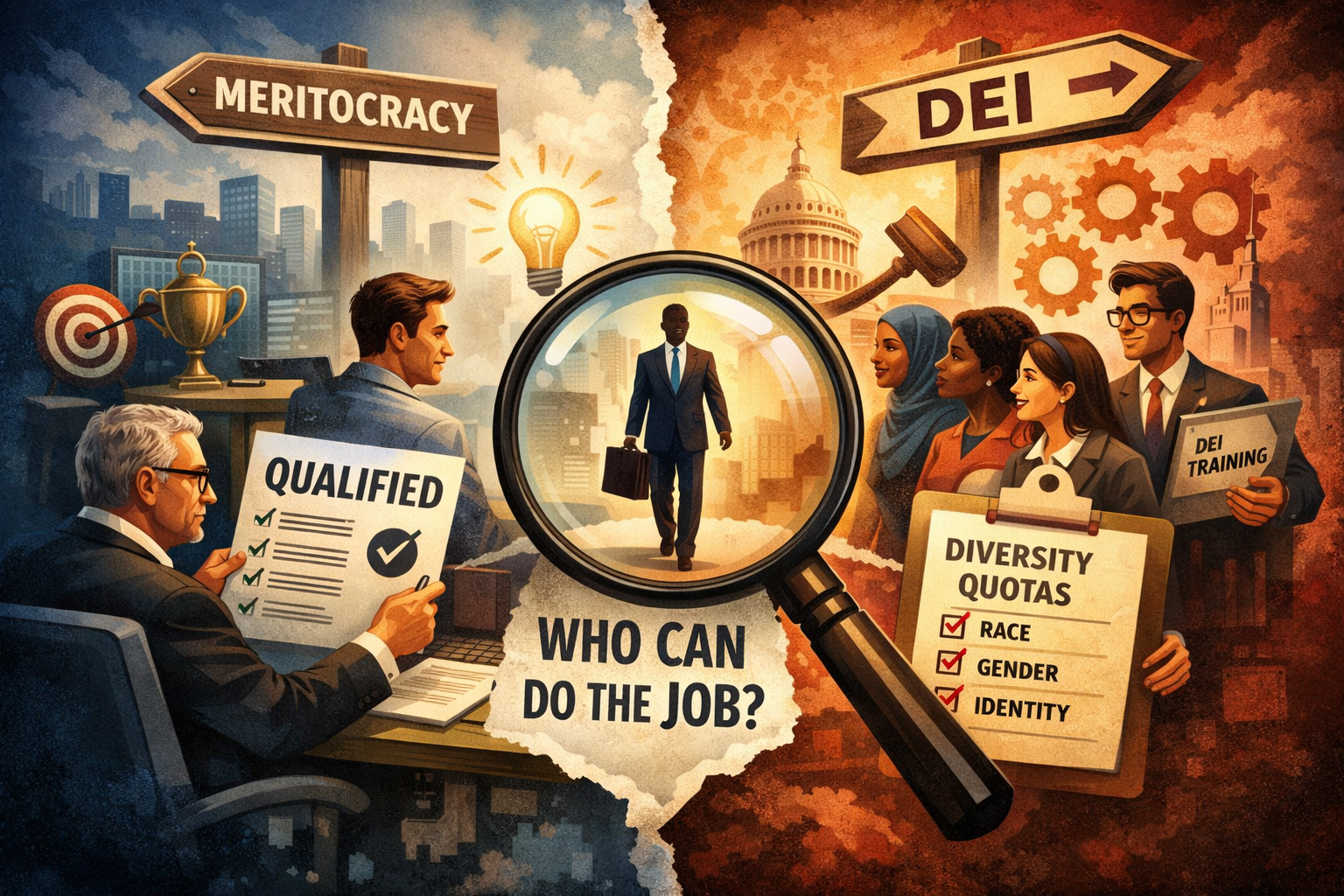
There is a question that used to sit at the center of every hiring decision: can this person do the job? It was not a complicated question. It was not a perfect question. It left room for bias, for favoritism, for the kind of insider networking that kept certain people out for reasons that had nothing to do with competence. Those are real problems worth solving. But the question itself - can this person do the job - was the right one. It kept the focus where it belongs: on the work, on the role, on the organization's need to have things done well by someone qualified to do them. Over the last twenty-five years, that question has been progressively displaced. Not eliminated - no serious person in any serious organization would say qualification is irrelevant. But displaced. Pushed down the priority stack by a layer of demographic objectives, representation targets, equity frameworks and diversity mandates that have inserted themselves between the job and the person who might do it best. The result is a hiring environment that is simultaneously more documented, more procedurally elaborate and more legally defended than it has ever been - and that in many organizations produces less confidence in the people it places than the simpler system it replaced.
What Meritocracy Actually Meant and Why It Was Abandoned
The word meritocracy has taken a beating in recent years, largely because its critics are not entirely wrong. A system that claims to reward merit while operating through networks, institutions and social capital that are unevenly distributed across the population is not a pure meritocracy. It is a meritocracy with a thumb on the scale. The Harvard legacy admit is not competing on merit alone. The candidate who got the internship through a family connection is not in the same merit pool as the one who applied cold. These are real distortions and they have real effects on who gets hired and who gets promoted over time. Acknowledging that is not an attack on the concept of merit. It is a description of how social advantage contaminates the measurement of it.
But the response to an imperfect meritocracy should be to make the measurement more accurate, not to abandon measurement in favor of demographic targeting. What DEI-driven hiring in its more aggressive institutional forms has done is not correct for bias in the evaluation of merit. It has substituted a different set of criteria - group membership, representation ratios, demographic balance - for the evaluation of merit in the first place. That substitution is presented as a correction. It is actually a replacement. The question is no longer "are we measuring the right things accurately" but "are we hiring the right demographic mix." Those are different questions and they produce different decisions, different organizations and different outcomes for the people employed in them.
The response to an imperfect meritocracy should be to make the measurement more accurate, not to abandon measurement in favor of demographic targeting. One is a correction. The other is a replacement.
How DEI Entered the Hiring Process
DEI did not arrive in organizations through a single decision. It arrived through accumulated pressure from multiple directions over roughly two decades. Corporate commitments to diversity following high-profile discrimination lawsuits in the 1990s and 2000s. Federal contractor requirements tied to affirmative action obligations. Academic research on team diversity and decision quality that was widely cited and sometimes oversimplified. The George Floyd protests of 2020, which produced a wave of corporate pledges that translated into rapid expansion of DEI hiring, DEI training, DEI leadership roles and DEI metrics tracked alongside financial performance. By 2022 DEI had become a standard feature of corporate infrastructure at large organizations, with dedicated staff, budget lines, reporting requirements and in many cases explicit hiring goals tied to demographic representation at various levels of the organization.
None of that arrived without legitimate grievance behind it. The historical exclusion of women and minorities from professional employment is not ancient history. The networks through which the best opportunities circulate still advantage people from certain backgrounds disproportionately. The data on pay gaps, advancement rates and leadership representation across demographic groups is real and not fully explained by qualification differences. These are genuine problems. The question is whether the DEI apparatus that grew up to address them actually addresses them - or whether it addresses the appearance of addressing them while producing a different set of problems in the process.
The business case for diversity - the claim that diverse teams outperform homogeneous ones - is frequently cited and frequently oversimplified. The underlying research is more conditional than advocates typically acknowledge. Studies by McKinsey and others have found correlations between demographic diversity at the leadership level and above-median financial performance, but correlation is not causation and the research has been critiqued on methodological grounds by several independent analysts. More rigorous experimental research suggests that cognitive diversity - diversity of perspective, background, problem-solving approach and experience - produces performance benefits, but that demographic diversity as a proxy for cognitive diversity is imprecise. A team of people from different demographic backgrounds who share the same elite educational credentials, the same consulting firm experience and the same ideological formation may be demographically diverse and cognitively homogeneous at the same time. Hiring for demographic representation does not automatically produce the cognitive diversity that drives the performance benefits. It produces demographic representation, which is a different thing.
The Practical Costs in the Hiring Room
I have been in enough hiring conversations to know how this operates in practice. The qualified candidate pool is assembled. Evaluation begins. And then a second layer of assessment arrives that is not about qualification at all: does this slate reflect the right demographic balance, has this search made adequate outreach to underrepresented groups, would hiring this particular finalist raise questions about our commitment to representation, what does the current team composition look like and what does adding this person do to the numbers. These are real questions being asked in real hiring meetings at real organizations, and they operate as a filter on top of the qualification assessment rather than as part of it.
The people who pay the most immediate price for this are the candidates who are displaced by it - the person who was the most qualified finalist and did not get the offer because the organization needed to move a demographic number. But the organization also pays a price, because it has hired someone for reasons that include but are not limited to their ability to do the job. When that person underperforms - and some will, as some people hired on pure qualification also underperform - the organization cannot manage the performance honestly because doing so risks triggering the inference that the DEI hire was a mistake, which opens legal and reputational exposure that the organization has every incentive to avoid. The result is that DEI-driven hiring can create a class of employees who are both harder to hold accountable and simultaneously more likely to feel the quiet resentment of colleagues who drew their own conclusions about why the hire was made. That dynamic is bad for the organization, bad for the team and worst of all for the DEI hire themselves, who may be fully competent and who deserves to be evaluated on that basis rather than carrying the weight of demographic symbolism.
The DEI Industry and What It Actually Produces
By 2023 the DEI industry - the consultants, trainers, software platforms, certification programs and dedicated corporate staff that grew up around the diversity mandate - was estimated to represent a market of several billion dollars annually. That is a significant economic interest with a significant motivation to justify its own existence and expand its own footprint. DEI training programs that have been subjected to rigorous evaluation have produced mixed results at best. A substantial body of research, including work by sociologists Frank Dobbin and Alexandra Kalev, has found that mandatory diversity training often produces backlash effects - increasing resentment toward the groups it is intended to support - rather than the attitudinal change it claims to produce. The interventions that do produce measurable improvements in diversity outcomes, their research found, are structural ones: mentorship programs, transparent promotion criteria, formal sponsorship relationships, blind resume review. Not mandatory training. Not awareness workshops. Not DEI certification.
That finding is significant because it suggests that much of what organizations are spending on DEI produces little benefit to the people it is nominally designed to help. The billion-dollar DEI industry is not primarily producing better outcomes for underrepresented workers. It is producing compliance documentation, reputational cover, legal defensibility and employment for DEI professionals. Those are real benefits to the organizations purchasing them. They are not the same as the stated mission. Acknowledging that gap is not hostility to the goal of fair and open employment. It is basic organizational accountability - the same accountability we should apply to any expensive program that claims to solve a problem and then should have to demonstrate that it does.
Mandatory diversity training often produces backlash rather than attitudinal change. The interventions that work are structural ones. But structural change is harder to sell and harder to invoice than a workshop.
What Happened When the Mandate Reversed
The 2023 Supreme Court decision in Students for Fair Admissions v. Harvard and the University of North Carolina struck down race-conscious admissions in higher education. The subsequent executive orders in 2025 terminating DEI programs across the federal government and among federal contractors accelerated a reversal that was already building in the private sector. Several major corporations that had made high-profile DEI commitments after 2020 - including large retailers, financial institutions and technology companies - had already begun quietly reducing their DEI staff and programs before the legal pressure arrived. The retreat was faster than the advance had been, which itself is informative about how much of the advance was genuine conviction versus institutional signaling.
What the reversal exposed is that a significant share of corporate DEI commitment was performative rather than structural. When the external pressure that had driven the commitments reduced - legal pressure from the Supreme Court, political pressure from the federal government, reputational pressure from a changed cultural environment - the commitments shrank accordingly. Organizations that had built genuine structural change into their hiring and promotion processes did not have to abandon them when the DEI label became a liability. Organizations that had primarily been performing diversity commitment found the performance easy to discontinue. The distinction tells you which organizations were serious and which were not. Most were not.
My Bottom Line
The goal of a hiring system that evaluates people on their ability to do the work, without discounting that ability because of who they are or where they came from, is the right goal. It is the goal that meritocracy, imperfectly applied, was aiming at. It is the goal that DEI, imperfectly applied, was also nominally aiming at. The failure of both systems to fully achieve it does not mean the goal is wrong. It means the implementation has been flawed in different directions at different times. The correction is not to abandon the goal of evaluating people on qualification. It is to be more honest about what gets in the way of doing that well.
What gets in the way is not primarily ideology. It is human bias - the tendency to favor the familiar, to trust the network, to extend benefit of the doubt to people who remind us of ourselves. Correcting for that bias through structural mechanisms - blind review, standardized evaluation criteria, diverse interview panels assessing the same competency dimensions - is legitimate and evidence-based. Correcting for it by substituting demographic targets for competency assessment is not a correction. It is a different distortion. Organizations that want to hire fairly should invest in the structural interventions that research shows actually work, hold their managers accountable for applying consistent standards and then hire the best qualified person for the role. That is what a serious commitment to both merit and fairness looks like. The DEI industry has largely been selling something else.
The question that should sit at the center of every hire is still the right one: can this person do the job? Everything built around that question should serve it. Everything that displaces it should be questioned - regardless of the ideology driving the displacement.
References
- Dobbin, F., & Kalev, A. (2016). Why diversity programs fail. Harvard Business Review, 94(7-8), 52-60.
- Dobbin, F., & Kalev, A. (2022). Getting to Diversity: What Works and What Doesn't. Harvard University Press.
- McKinsey & Company. (2020). Diversity wins: How inclusion matters. McKinsey Global Institute.
- Stojmenovska, D., Bol, T., & Leopold, T. (2017). Does diversity pay? A replication of Herring (2009). American Sociological Review, 82(4), 857-867. (Methodological critique of the diversity-performance correlation.)
- Students for Fair Admissions v. President and Fellows of Harvard College, 600 U.S. 181 (2023).
- Fuller, J. B., & Raman, M. (2017). Dismissed by Degrees. Harvard Business School, Accenture, Grads of Life.
- U.S. Equal Employment Opportunity Commission. (2023). Charge Statistics FY 2023. eeoc.gov.
- Page, S. E. (2007). The Difference: How the Power of Diversity Creates Better Groups, Firms, Schools, and Societies. Princeton University Press. (On cognitive vs. demographic diversity.)
Disclaimer: The views expressed in this post are the personal opinions of the author and are offered for educational, commentary and public discourse purposes only. They do not represent the positions of any institution, employer, organization or affiliated entity. Nothing in this post constitutes legal, financial, medical or professional advice of any kind. References to research, court decisions, surveys and published works are based on publicly available sources cited above. This post critiques specific institutional practices and policy frameworks and does not make claims about the motivations or character of individuals within those systems. Commentary on business and workplace subjects reflects the author's independent analysis and is protected expression of opinion. Readers are encouraged to consult primary sources and form their own conclusions.