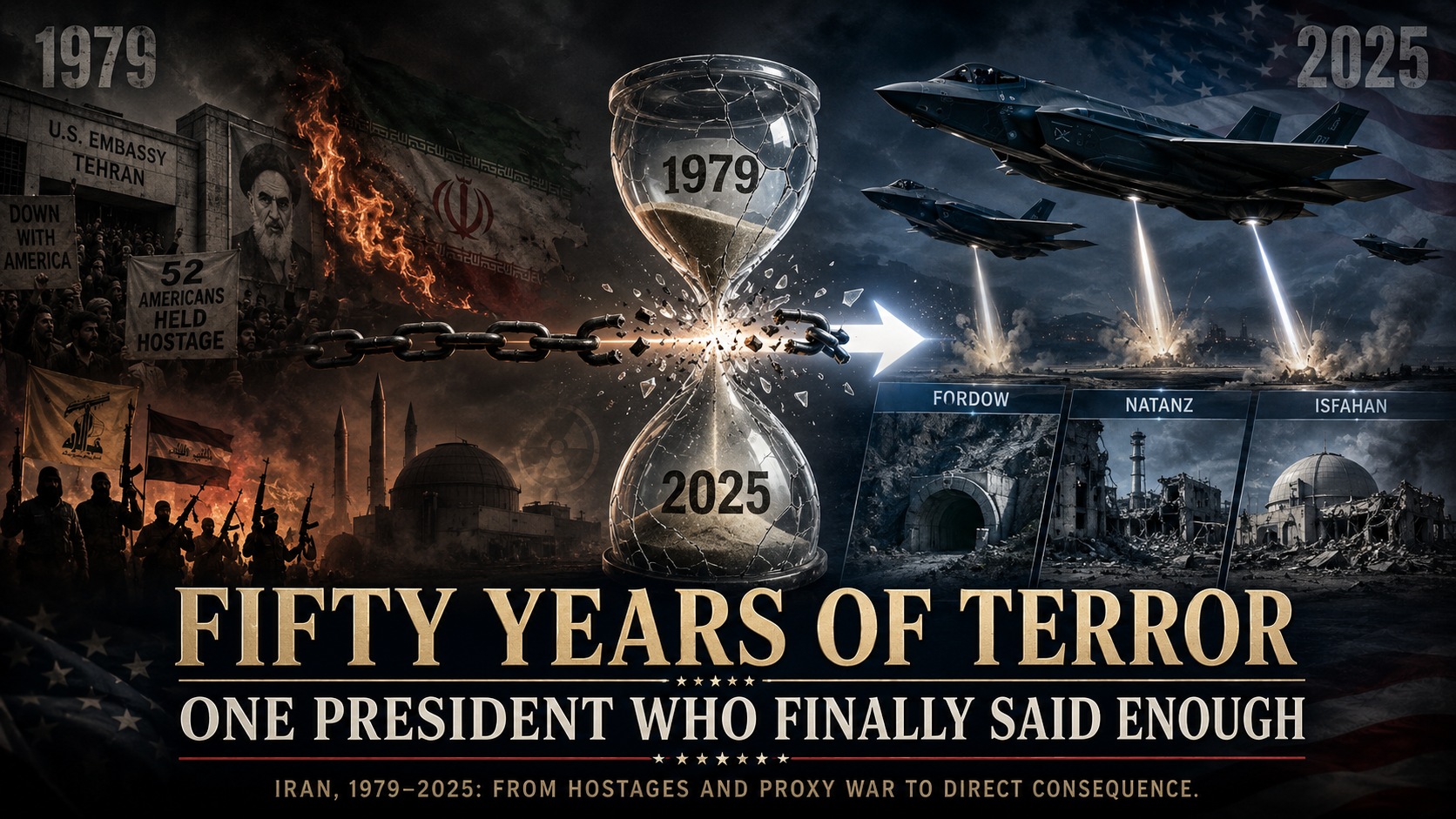
In June 2025, the United States Air Force and Navy struck Iran's nuclear facilities at Fordow, Natanz and Isfahan. Operation Midnight Hammer was the first direct American military attack on Iranian soil since 1988, and the first strike targeting Iran's nuclear infrastructure in the history of the program. The IAEA confirmed the sites suffered enormous damage. The Pentagon assessed that Iran's nuclear program was set back approximately two years. The Twelve-Day War that preceded the strikes, initiated by Israel, ended in a ceasefire four days later. For the first time since November 1979, Iran had paid a direct military price for a half century of aggression, terror sponsorship, hostage-taking, proxy warfare and the patient pursuit of a weapon capable of threatening the entire civilized world. Nine presidents had watched that buildup and responded with diplomacy, sanctions, negotiations, appeasement and strategic patience. Donald Trump responded with aircraft and ordnance. Whatever one thinks of the method, the accountability was long overdue.
What Iran Has Been Doing Since 1979
The Islamic Republic of Iran was established in 1979 when Ayatollah Khomeini's revolution overthrew the Shah and immediately announced its intentions toward the United States and the broader West. On November 4, 1979, Iranian student militants stormed the American embassy in Tehran and held 52 American diplomats and citizens hostage for 444 days. Jimmy Carter's response was a failed rescue mission, a diplomatic humiliation and the signal that America could be attacked without serious consequence. That signal was received and acted upon for the next five decades.
Iran created Hezbollah in Lebanon in 1982, providing the funding, training and direction that turned a local militia into one of the most capable terrorist organizations on earth. Hezbollah, acting with direct Iranian support, bombed the U.S. Embassy in Beirut in April 1983, killing 63 people including 17 Americans. In October of the same year, a Hezbollah truck bomb killed 241 American Marines and 58 French paratroopers at their barracks in Beirut. It was the deadliest single day for the Marine Corps since Iwo Jima. Ronald Reagan withdrew American forces from Lebanon. Iran registered another lesson: attack Americans and they leave.
1979: Embassy seized, 52 Americans held hostage for 444 days. 1983: Beirut Marine barracks bombing, 241 Americans killed. 1996: Khobar Towers bombing, Saudi Arabia, 19 American servicemembers killed. 1990s onward: Iran funds, arms and trains Hamas and Palestinian Islamic Jihad. 2003 onward: Iran provides IEDs, weapons and training to militias killing American soldiers in Iraq. 2006: Iran arms Hezbollah for its war with Israel. 2011: Iran-linked plot to assassinate the Saudi ambassador on American soil. 2019: Iran shoots down American drone over international waters. Ongoing: Iran supports Houthi attacks on international shipping and American naval assets.
Every Administration That Chose to Look Away
Jimmy Carter negotiated the hostages' release through the Algiers Accords and released frozen Iranian assets without extracting any accountability for the seizure. Ronald Reagan withdrew from Lebanon after the barracks bombing and later sold arms to Iran in the Iran-Contra affair, providing the regime with weapons in exchange for hostages, exactly the incentive structure that encourages hostage-taking. George H.W. Bush made quiet appeals for Iranian help in freeing hostages in Lebanon and received limited cooperation without imposing costs for past behavior. Bill Clinton imposed economic sanctions but took no serious action against Iran's growing nuclear program or its continued support for Hezbollah and Hamas.
George W. Bush listed Iran as part of the axis of evil in 2002 and then watched it accelerate its nuclear program throughout his two terms, constrained by the misallocation of American military attention to Iraq and Afghanistan. His administration engaged in back-channel diplomacy that produced nothing. Barack Obama made the Iran nuclear deal, formally the Joint Comprehensive Plan of Action, the centerpiece of his second-term foreign policy legacy. The JCPOA provided Iran with relief from sanctions and the release of approximately $150 billion in frozen assets in exchange for temporary limits on uranium enrichment. Critics noted that the deal left Iran's ballistic missile program untouched, sunset its enrichment restrictions over time and funded the very regime using that money to continue sponsoring terrorism across the region. Trump's first term withdrew from the deal in 2018. The Biden administration spent four years trying to revive it without success. Through all of this, Iran's nuclear program advanced.
Every American president from Carter to Biden understood that Iran was a state sponsor of terror. Most of them said so publicly. None of them made Iran pay a price serious enough to change the behavior. That is not foreign policy. That is institutional tolerance of an ongoing threat.
What Obama's Deal Actually Produced
The JCPOA deserves specific examination because its defenders continue to argue it was the right approach and its failure was Trump's fault for withdrawing. The honest assessment is more complicated. The deal delayed but did not eliminate Iran's path to a nuclear weapon. The sunset clauses meant enrichment restrictions would expire in ten to fifteen years regardless of Iranian behavior. The $150 billion in released assets funded Iranian proxies throughout the region. Hezbollah, Hamas, the Houthis and the militias operating in Iraq and Syria all received increased Iranian support in the years following the deal. Iran used the diplomatic legitimacy the deal provided to continue advancing its ballistic missile program, which the agreement did not address. And when Trump withdrew and reimposed maximum-pressure sanctions, Iran's economy contracted severely, demonstrating that the sanctions pressure Obama had traded away was the most effective tool available.
None of this means the JCPOA had no value. A temporary slowdown in enrichment activity is better than no slowdown at all. But the argument that the deal represented a serious resolution of the Iranian threat requires accepting that a ten-year delay purchased at the cost of $150 billion in Iranian funding for regional terror was a good trade. Most of the countries whose citizens died in Iranian-sponsored attacks during those years would not accept that trade.
What Trump Did and Why It Mattered
In his first term, Trump withdrew from the JCPOA, reimposed sanctions, killed IRGC Quds Force commander Qasem Soleimani in January 2020 and adopted a maximum-pressure strategy that drove Iran's economy into crisis and significantly reduced its available funding for proxy operations. Iran's regional influence contracted. Its proxies received less money. Hezbollah reported budget cuts. The Houthis scaled back operations. None of that stopped the nuclear program, but it demonstrated that American economic leverage, when actually applied, produced measurable results.
In his second term, Trump went further. When Israel launched the opening strikes of the Twelve-Day War in June 2025, the United States joined with Operation Midnight Hammer on June 22, a twenty-five-minute strike by F-35s and F-22s that hit Fordow, Natanz and Isfahan. The IAEA confirmed enormous damage. The Pentagon assessed a two-year setback to the nuclear program. The ceasefire followed two days later. Whatever the permanent extent of the damage, with assessments ranging from two years of setback to significantly longer, the United States had done something it had never done in forty-six years of Iranian provocation: it had hit Iran directly on its own soil for a program that has been building toward a weapon capable of threatening American allies and American interests since the 1980s.
The Critics and What They Get Wrong
The criticism of Trump's Iran policy divides into two categories. The first is procedural: the strikes violated the War Powers Act and were conducted without congressional authorization. This is a legitimate constitutional concern that applies to nearly every military action taken by American presidents since 1973, regardless of party. Obama bombed Libya without congressional authorization. Clinton bombed Kosovo without it. Bush launched operations in multiple countries under broadly interpreted existing authorizations. The War Powers Act concern is real and bipartisan, but applying it selectively to Trump while ignoring identical behavior by his predecessors is not principle. It is politics.
The second criticism is strategic: the strikes may have hardened Iranian resolve to acquire a nuclear weapon as a deterrent, and destroying enrichment infrastructure without eliminating the knowledge, the scientists and the political will to rebuild accomplishes less than it appears. That argument has weight. Iran's nuclear knowledge cannot be bombed away. The regime's determination to achieve deterrent capability may indeed have been strengthened by the demonstration that American airstrikes can reach its most sensitive facilities. Those are real considerations. The counterargument is equally serious: a regime that has spent fifty years killing Americans and advancing toward nuclear capability while paying no meaningful military price needed to learn that the price had changed. Whether deterrence through demonstrated consequence or deterrence through diplomacy and sanctions works better against the Iranian regime is a question the previous forty-six years answered pretty clearly. The answer was not diplomatic engagement.
My Bottom Line
Jimmy Carter negotiated the terms of his own humiliation. Ronald Reagan sold arms to the hostage-takers. George H.W. Bush sought favors. Bill Clinton managed the threat. George W. Bush named it and then did little about it. Barack Obama paid $150 billion to slow it temporarily. The Biden administration tried to revive the payment arrangement. Through all of it, Iran kept building, kept funding proxies, kept killing Americans through intermediaries and kept moving toward the nuclear finish line. The accumulated record of American policy toward Iran from 1979 to 2025 is a masterclass in what happens when a state actor learns that its aggression has no serious cost. Trump changed that calculation. The result is imperfect, incomplete and carries genuine strategic risks. It is also the first serious military accountability Iran has faced from the United States in a generation. That is not nothing. In the context of fifty years of one-sided patience, it is long overdue.
Iran has been at war with the United States since 1979. The United States has been declining to notice for most of that time. That is the real foreign policy failure. Not the strikes, but the half century of restraint that made them feel radical when they finally came.
Why This Matters
The Iran question is not going away. The nuclear program, damaged but not eliminated, will be rebuilt if the regime survives and the political will exists. Iran's proxy network across the Middle East, though degraded by the Twelve-Day War and its aftermath, remains active. The strategic question of how the United States deters a regime committed to regional dominance, nuclear capability and the destruction of Israel is not resolved by one set of airstrikes. But the principle that American power can and will be used to impose real costs on regimes that threaten American interests and kill Americans, directly or through proxies, is one that needed to be reestablished after half a century of its conspicuous absence. That is the foreign policy move that will matter longest, whatever one thinks of the specific execution.
References
- Wikipedia / multiple sourced military records. (2025). 2025 United States strikes on Iranian nuclear sites, Operation Midnight Hammer, June 22, 2025.
- IAEA. (2025). Director General report on Iran nuclear sites damage assessment. iaea.org.
- Pentagon / Defense Intelligence Agency. (2025, July). Assessment: Iran nuclear program set back approximately two years.
- U.S. Department of State. (various). Iran: State sponsor of terrorism designations. state.gov.
- Congressional Research Service. (2023). Iran: Background and U.S. policy. crs.gov.
- Arms Control Association. (2015). The Joint Comprehensive Plan of Action at a glance. armscontrol.org.
- Reuters. (2020, January 3). U.S. kills top Iranian general Qassem Soleimani in Baghdad air strike.
- PBS NewsHour. (2026, February 28). Fact-checking statements made by Trump to justify U.S. strikes on Iran.
Disclaimer: The views expressed in this post are the personal opinions of the author and are offered for educational, commentary and public discourse purposes only. They do not represent the positions of any institution, employer, organization or affiliated entity. Nothing in this post constitutes legal, financial, medical or professional advice of any kind. References to military operations, historical events and current affairs are based on publicly available sources cited above. Commentary on national security and foreign policy reflects the author's independent analysis and is protected expression of opinion. Readers are encouraged to consult primary sources and form their own conclusions.