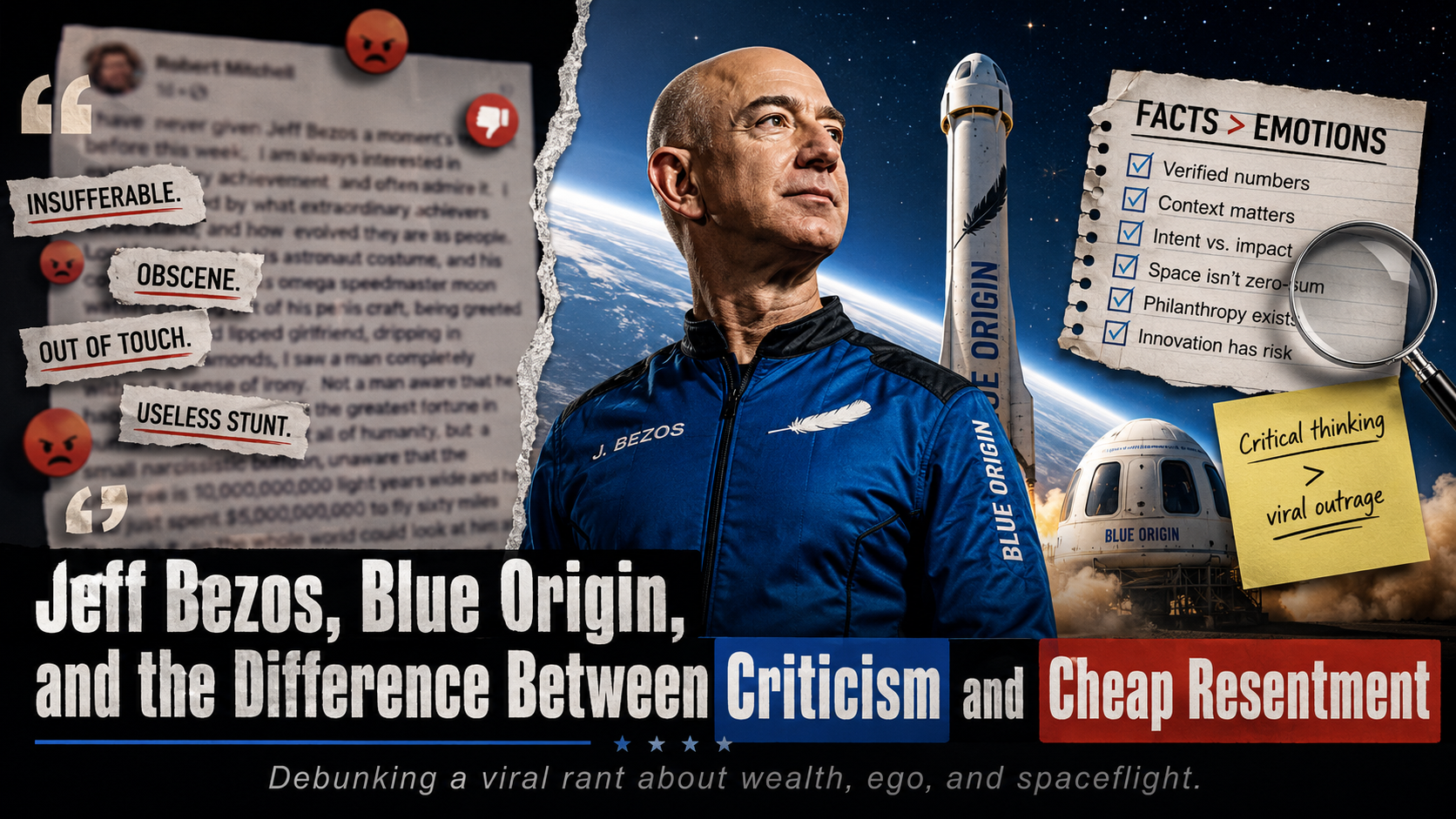
A viral comment about Jeff Bezos and his Blue Origin spaceflight has been circulating as if it were insight. It presents itself as a moral judgment on wealth, ego, space travel and human smallness. Underneath the dramatic wording it is mostly a pile of insults pretending to be a case. It mocks Bezos for wearing an astronaut suit, a cowboy hat and an Omega Speedmaster watch. It ridicules his girlfriend's appearance. It describes the Blue Origin capsule in crude sexual terms. It calls Bezos a "small narcissistic buffoon" and claims he spent $5 billion to fly sixty miles so the world could watch him announce a plan to "pollute space." That may be satisfying to people who already dislike billionaires, Amazon or private spaceflight. It is not a serious argument. It takes a legitimate debate about whether billionaire-funded space tourism is a good use of money and reduces it to name-calling, body-shaming, class resentment and misleading claims. There are fair criticisms to make of Bezos. This comment makes none of them.
The Pose of Objectivity That Lasts One Sentence
The comment opens by saying the writer is "always interested in extraordinary achievement" and often admires it. That framing is supposed to signal fairness. The rest of the comment shows the opposite. There is no discussion of Blue Origin as a company. No discussion of reusable rocket technology. No discussion of private aerospace development. No comparison with SpaceX, NASA or Virgin Galactic. No serious engagement with whether suborbital space tourism can lead to broader technological advances. Instead the comment focuses on clothing, jewelry, physical appearance, voice and crude visual jokes about rocket shapes.
When someone claims to be interested in extraordinary achievement but ignores the actual achievement and spends the post mocking hats and voices and girlfriends, the claim falls apart. The comment is not about understanding success. It is about cutting down someone the writer resents. Those are different projects and only one of them is honest.
The $5 Billion Claim Is a Distortion
The comment claims Bezos spent $5 billion "to fly sixty miles." That framing makes it sound as if he purchased a single absurdly expensive amusement-park ride. Blue Origin was founded in 2000 and spent more than two decades developing rockets, engines, launch systems, human spaceflight systems, lunar technology and commercial aerospace infrastructure. The 2021 New Shepard flight that carried Bezos, his brother, aviator Wally Funk and Oliver Daemen was part of that larger company and testing program. It was not a one-time $5 billion ticket for one man's ego trip.
The flight crossed the Kármán line, the internationally recognized boundary of space at 100 kilometers. You can argue that Blue Origin has underperformed compared with SpaceX. You can argue that suborbital tourism is less impressive than orbital flight. You can argue that billionaire space projects are vanity operations. Those are real arguments. Pretending the whole thing was just one rich man buying a cartoonish trip to the edge of space is not a real argument. It is a sneer wearing the costume of one.
The comment tries to make Bezos look small by invoking the size of the universe, stating it is "10,000,000,000 light years wide." The observable universe is estimated at roughly 93 billion light-years in diameter, not 10 billion. But the bigger problem is the logic. The vastness of the universe does not prove Bezos is uniquely ridiculous. It makes every human being equally small, including the person writing the comment. Using cosmic scale as a moral weapon against one specific person while leaving everyone else out of the frame is not philosophy. It is a rhetorical trick.
The "Pollute Space" Distortion
The comment says Bezos's "big plan is to pollute space." That is a misrepresentation. Bezos has argued that over the long term, heavy and polluting industry should be moved off Earth and into space so that Earth can be preserved as a cleaner residential and light-industrial environment. You can reject that vision as unrealistic, as science fiction or as raising serious questions about space debris, orbital habitats and who controls extraterrestrial resources. Those are legitimate criticisms worth making. But the actual argument is not that pollution is good. It is that Earth should be protected by relocating certain forms of heavy industrial activity away from it. Reducing that to "he wants to pollute space" is the kind of intellectual dishonesty that makes the rest of the criticism easier to dismiss.
The Personal Attacks Prove Nothing
What does Bezos's watch prove? Nothing. What does his cowboy hat prove? Nothing. What does his girlfriend's appearance prove? Nothing. What does the shape of the capsule prove? Nothing. These details are props for ridicule, not components of an argument. This is a familiar pattern in modern commentary. Instead of arguing about policy, economics, technology or morality, the writer creates a cartoon version of the target and attacks the cartoon. It feels powerful because mockery is emotionally satisfying. It is intellectually empty.
If Bezos is wrong, explain why he is wrong. If private spaceflight is wasteful, explain why it is wasteful. If Amazon mistreats workers, make that case. If billionaires should pay more taxes, make that case. If space tourism is morally obscene in a world with poverty and suffering, make that case directly and honestly. Mocking someone's girlfriend and voice is not a moral argument. It is contempt wearing a lab coat.
Bad criticism makes the critic look smaller than the target. The comment set out to humiliate Bezos and ended up demonstrating the poverty of the analytical framework behind it.
The Real Criticism That Got Buried
The frustrating thing is that a legitimate argument is buried under the ugliness. It is reasonable to ask whether billionaire space tourism is tone-deaf when ordinary people are struggling with housing, healthcare and debt. It is reasonable to ask whether billionaires have too much power to shape the future of a resource, outer space, that belongs to no single nation or individual. It is reasonable to ask whether private companies should receive public launch contracts while their founders accumulate fortunes that exceed the GDP of small nations. It is reasonable to debate whether private aerospace investment accelerates or distorts the direction of space exploration.
A serious version of the critique might read something like: Bezos's Blue Origin flight represents genuine technical progress, but it also illustrates the moral imbalance of an era in which billionaires can fund private space programs while many workers cannot afford basic medical care. Even if private spaceflight eventually produces useful innovation, the spectacle of billionaire space tourism understandably feels obscene to people who see urgent problems on Earth going unaddressed. That is a real argument. It may be right or wrong, but it is serious. The viral comment never gets near it.
Achievement Often Looks Strange Before It Looks Important
Early aviation looked dangerous and impractical. Early automobiles looked like toys for the wealthy. Early computers filled entire rooms and seemed irrelevant to daily life. Early internet companies looked overhyped. Early electric cars were mocked. Early rockets were treated by many as fantasy. Some of those early efforts failed and deserved to fail. Some were dead ends. Some were scams. But the fact that a technology begins with rich investors, awkward prototypes and elite early adopters does not prove it will never matter. Many technologies begin as expensive luxuries before becoming cheaper, safer and widely useful. Aviation followed that pattern. Computing followed it. Telecommunications followed it. Private spaceflight may or may not follow the same arc, but dismissing it because Bezos looked silly in a cowboy hat is not technological analysis.
Envy Is Not a Moral Philosophy
A significant share of modern commentary about billionaires blends genuine moral concern with something uglier: resentment that someone else is rich, capable and able to do things most people cannot. That resentment is not automatically wisdom. There is nothing intellectually impressive about mocking people who build things. There is nothing morally serious about reducing every billionaire project to ego. Some billionaire projects are wasteful. Some are useful. Some are both. The task is to tell the difference, and the viral comment has no interest in doing that work. It already knows the answer before it looks at a single fact. That is not criticism. That is a verdict in search of evidence.
My Bottom Line
Jeff Bezos is fair game for criticism. So is billionaire space tourism. So is Amazon. So is the broader question of whether a society with this level of wealth concentration should be celebrating private space programs. But the viral comment is not a serious critique of any of those things. It misrepresents Blue Origin as a single joyride rather than a long-term aerospace company. It minimizes a genuine suborbital spaceflight that crossed the recognized boundary of space. It gets the size of the observable universe wrong. It distorts Bezos's stated argument about moving heavy industry off Earth. And it substitutes personal attacks for reasoning at every step.
A serious person can criticize Bezos without sounding petty. A serious person can question billionaire space projects without mocking someone's girlfriend, voice or hat. A serious person can debate the morality of private spaceflight without turning the argument into a schoolyard insult. The real question is not whether Bezos looked small compared with the universe. Everyone looks small compared with the universe. The better question is whether building difficult things, risking capital on uncertain futures and exploring beyond known limits is still worth doing. That is a serious question. The viral comment never gets close to answering it.
Contempt is not analysis. Mockery is not a moral framework. If the goal is truth, the criticism has to be honest. This one was not.
Why This Matters
The Bezos comment is a symptom of a broader problem in public discourse: the replacement of argument with contempt, the substitution of ridicule for reasoning and the assumption that strong feeling is the same thing as a strong case. When viral resentment gets mistaken for insight, the quality of public debate declines. Real criticisms of real power deserve better than this. The people who might make those criticisms effectively discredit themselves when they reach for mockery instead of evidence. Bezos and Blue Origin can absorb a viral insult. The culture of argument cannot so easily absorb the habit of substituting insults for it.
References
- Blue Origin. (2021). New Shepard NS-16 first human flight summary. blueorigin.com.
- NASA / ESA. (2023). Observable universe size and cosmological parameters. nasa.gov.
- Business Insider. (2021). Jeff Bezos says future generations will be born in space.
- The Kármán Line. Federation Aeronautique Internationale. 100 kilometer altitude as the boundary of space. fai.org.
- Judicial Watch. (2019). Settlement with Los Angeles County over voter roll maintenance.
Disclaimer: The views expressed in this post are the personal opinions of the author and are offered for educational, commentary and public discourse purposes only. They do not represent the positions of any institution, employer, organization or affiliated entity. Nothing in this post constitutes legal, financial, medical or professional advice of any kind. References to public figures and institutions are based on publicly available sources cited above. Commentary on cultural and political subjects reflects the author's independent analysis and is protected expression of opinion. Readers are encouraged to consult primary sources and form their own conclusions.