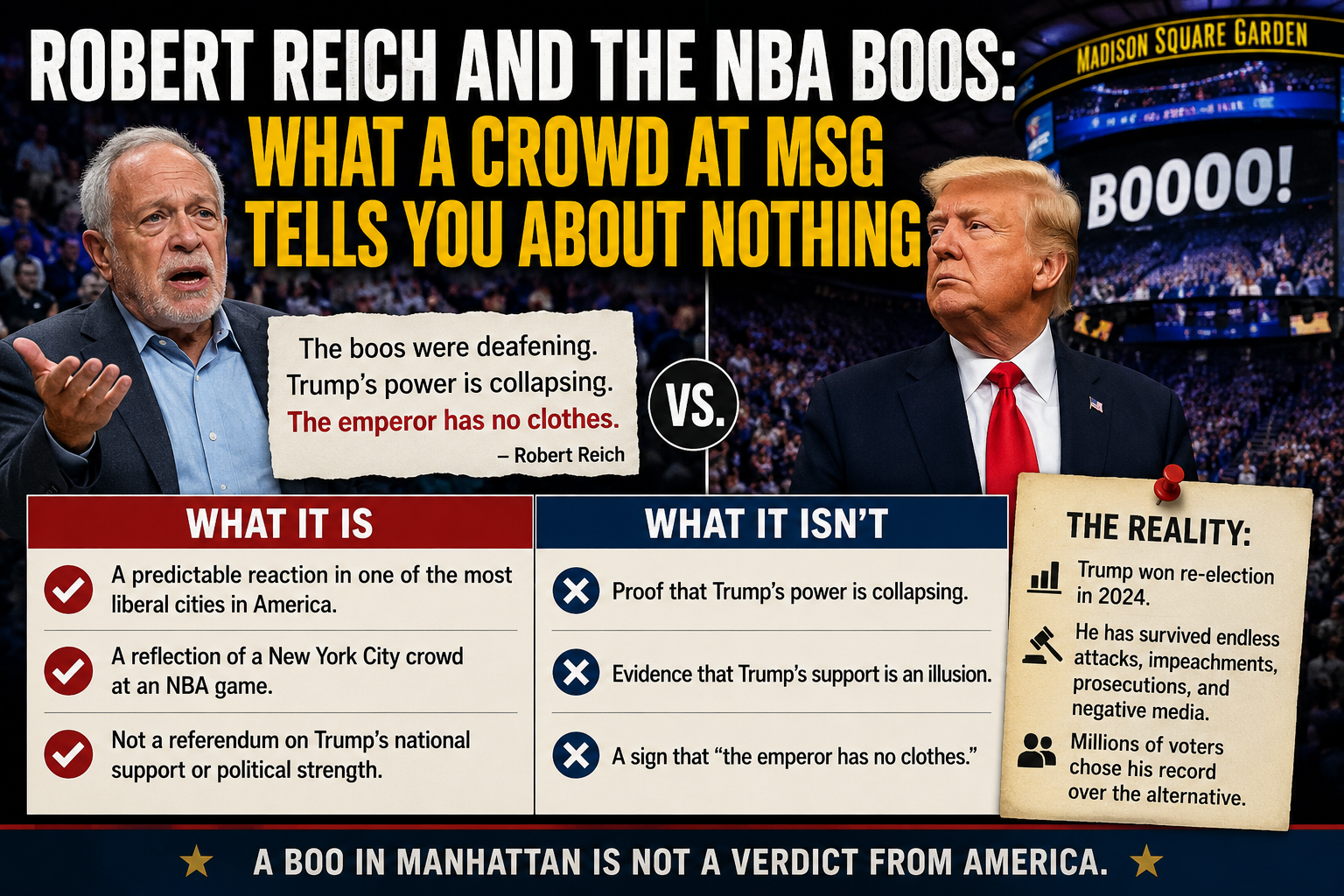
Robert Reich, former Clinton Labor Secretary and full-time anti-Trump content producer, posted on Bluesky this week that Trump's power depends on maintaining the illusion he is all-powerful and that most Americans adore him. He then noted that this illusion is harder to maintain when you are booed by thousands of fans at a basketball game in your hometown. He closed with "The Emperor has no clothes." Three sentences, zero evidence, maximum self-congratulation. Donald Trump was indeed booed at Madison Square Garden during Game 3 of the NBA Finals on June 8. The boos were real, loud and well-documented. What they do not document is anything Reich claims they document. A New York City crowd booing a Republican president at an NBA game tells you exactly what New York City crowds have been doing to Republican presidents at sports events for decades. It tells you nothing about Trump's political standing, nothing about whether the emperor has clothes and nothing that justifies the leap Reich makes from crowd noise to political collapse.
What Actually Happened at MSG
Trump became the first sitting president to attend an NBA Finals game when he appeared at Madison Square Garden for Game 3 of the Knicks-Spurs series. When his image appeared on the jumbotron during the national anthem, the crowd booed loudly. The White House pool report described the reaction as "thunderously booed" and "loud and long." The boos subsided when the camera cut to the American flag and the crowd cheered when Knicks players appeared. People outside the arena booed his motorcade. The boos were genuine and unambiguous. Trump's own response was characteristically detached from reality: he told reporters afterward it was "mostly cheers" and "very enthusiastic." It was not mostly cheers. He was clearly booed.
None of that is in dispute. What is in dispute is what it means. Reich wants it to mean the illusion of Trump's power is crumbling. What it actually means is that Donald Trump showed up in Manhattan to watch a basketball game and Manhattan did not welcome him. That has been true of every Republican president who has appeared in New York City at a public event in living memory. It was true before Trump. It will be true after him. New York City is the most Democratic large city in the country. Madison Square Garden draws from a fanbase concentrated in one of the most reliably left-leaning urban populations in America. Trump getting booed there is the equivalent of Joe Biden getting booed at a truck pull in rural Alabama. It tells you about the venue, not the verdict of the nation.
Trump won the 2024 presidential election with 312 electoral votes. He carried seven of the seven swing states. He increased his share of the Hispanic vote, the Black male vote and the working-class vote compared with his previous campaigns. He won the popular vote. The crowd at a Manhattan NBA game is not a representative sample of the American electorate. It is a sample of people who paid hundreds of dollars to watch basketball in midtown Manhattan on a Monday night. Using that sample to draw conclusions about Trump's standing with the country is the kind of analytical error that a first-year statistics student would be corrected for.
The Worst Press of Any President in Modern History
Reich's argument that Trump's power depends on the illusion that most Americans adore him runs directly into a documented reality: Trump has received the most relentlessly hostile press coverage of any president in modern American history by every measure researchers have applied to the question. A Harvard Kennedy School Shorenstein Center study of Trump's first-term coverage found that news coverage was roughly 80 percent negative across major outlets, far exceeding the negative coverage of any previous president studied. He has been called a fascist, a traitor, a Russian asset, an insurrectionist, a white supremacist, an authoritarian, a criminal and an existential threat to democracy in mainstream publications and by prominent political figures on a near-daily basis for ten years.
This is the context in which Reich's "illusion" argument collapses. A man who has been subjected to the most sustained negative media campaign in presidential history, who has been impeached twice, indicted four times and prosecuted across multiple jurisdictions, whose every statement is analyzed for the worst possible interpretation and whose supporters are routinely described by mainstream commentators as a cult, does not maintain power through an illusion of universal adoration. He maintains it because a significant share of the electorate looks at the record of his presidency, looks at the record of the people opposing him and concludes that he has delivered more of what they want than the alternative. That is not an illusion. That is a political judgment.
Trump Is Not Without Fault. That Is Not the Point.
Some of the negative coverage is earned. Trump's petty arguments, his personal attacks on private citizens, his vindictive social media posts, his casual dishonesty about crowd sizes and election margins, his norm-busting behavior toward institutions that deserve respect even when you disagree with them. All of that is legitimate ground for criticism and some of it is genuinely damaging to the dignity of the office. Acknowledging that is not a concession to Reich's argument. It is an honest accounting. The question is not whether Trump deserves any criticism. He does. The question is whether the volume and character of that criticism bears a rational relationship to his actual record.
The answer is no. A president who closed the border to the lowest crossing levels in decades, who bombed Iran's nuclear facilities for the first time in the history of that program, who forced NATO allies to meet their own defense commitments, who challenged China's trade practices with the first administration willing to absorb short-term pain for long-term positioning and who produced a military recruiting surge to fifteen-year highs does not have a record that justifies the "fascist emperor" framing. Disagree with the methods. Question the costs. Argue the long-term consequences. Those are legitimate debates. Calling him an emperor with no clothes because a Manhattan crowd booed him is not a legitimate debate. It is a post for people who already agree with you.
The most relentlessly covered, most aggressively prosecuted and most publicly condemned president in modern American history won re-election. If the illusion is the source of his power, it is a remarkably durable one. Maybe the illusion is not the explanation.
Reich as a Case Study in Partisan Analysis
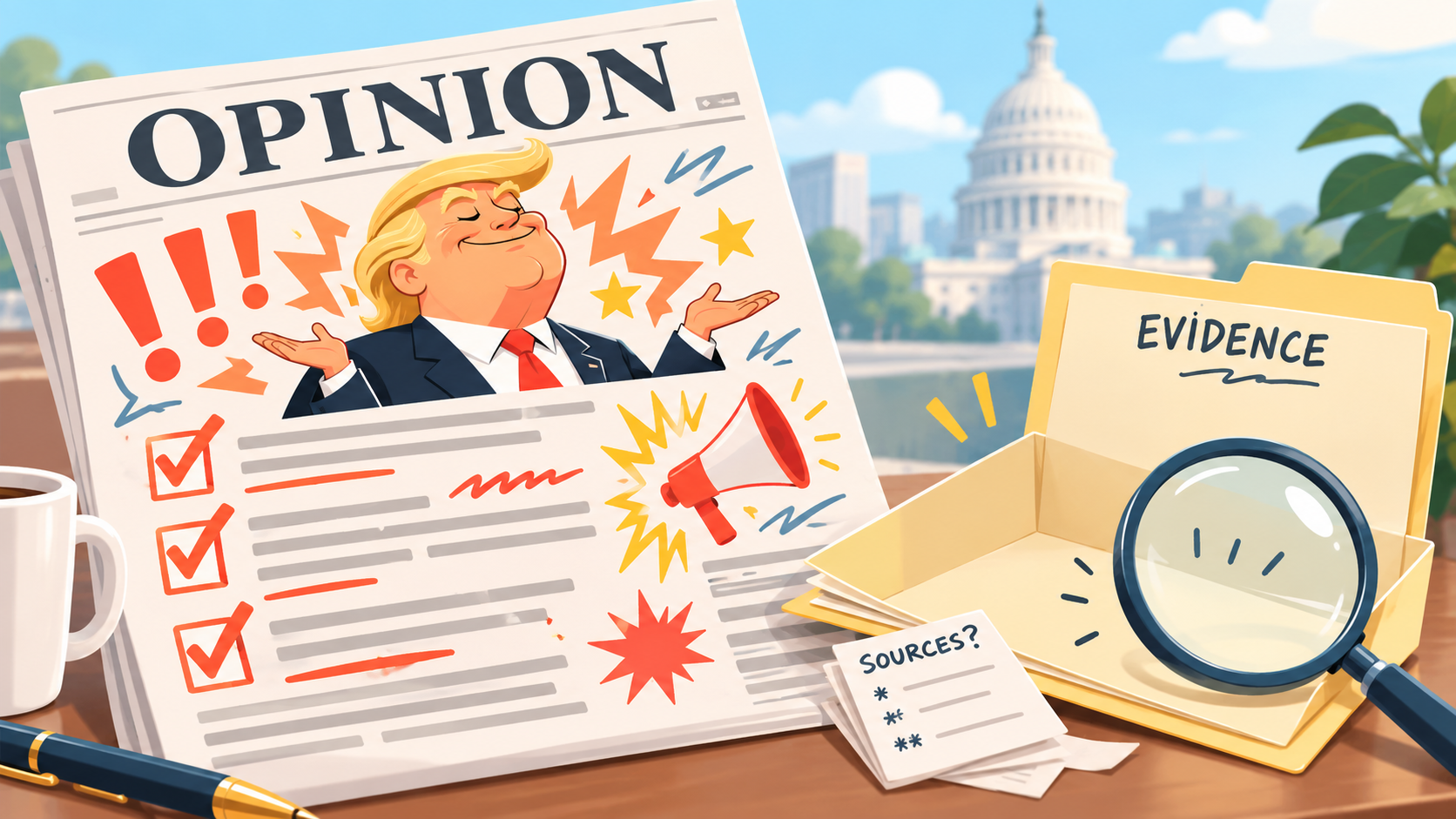
Robert Reich was a credentialed economist and a capable Labor Secretary. He is now primarily a content producer for the anti-Trump media ecosystem, posting daily on Bluesky and Substack to an audience that wants confirmation of what it already believes. His posts follow a consistent pattern: find a data point that feels like evidence of Trump's decline, attach a dramatic conclusion and publish before anyone examines whether the data point actually supports the conclusion. The NBA boos post is a perfect example of the form. The data point is real. The conclusion is unsupported. The gap between them is where the analysis was supposed to go and where Reich consistently does not go.
This matters because Reich still carries the credibility of his academic and government credentials into conversations where he is producing advocacy rather than analysis. People who share his posts are sharing a former cabinet secretary's "analysis" when they are actually sharing a partisan's hot take. The credential launders the argument. The argument does not earn the credential. That is a problem that runs throughout the anti-Trump media ecosystem and Reich is one of its more visible practitioners.
What the Boos Actually Reveal
The MSG boos do tell you something real. They tell you that Trump is a polarizing figure who generates strong negative reactions in Democratic-leaning urban environments. That has been known and documented for a decade. They tell you that New York City, which Trump left for Florida years ago and which has voted Democratic in every presidential election since 1984, does not embrace him at public events. Also known. They tell you that NBA fanbases, which skew younger and more diverse than the general electorate and are heavily concentrated in Democratic-leaning cities, contain a significant number of people who dislike him strongly enough to boo loudly when his face appears on a screen. Unsurprising.
What the boos do not tell you: that most Americans dislike Trump, that his political standing is collapsing, that the "illusion" of his power is fading or that he is an emperor with no clothes. The man won a presidential election seven months ago with more electoral votes than his opponent by a margin that was not close in the states that decided the race. A basketball crowd in Manhattan is not a referendum. Robert Reich knows this. He posted anyway.
My Bottom Line
Trump was booed at MSG. The boos were real. They do not prove what Reich says they prove and a former cabinet secretary with an economics PhD should know the difference between a crowd reaction at a sporting event in the country's most Democratic city and a measure of a president's national standing. The post is not analysis. It is applause-seeking from a specific audience that will reward it generously. Reich got his engagement. He did not produce insight.
The larger problem is the pattern this post represents. For ten years a class of credentialed, well-compensated commentators has been finding daily evidence that Trump's power is illusory, that his support is crumbling, that the emperor has no clothes. For ten years the evidence has not cooperated. He won in 2016. He came close in 2020 against a candidate who never left his basement during a pandemic. He won decisively in 2024. The pattern in the evidence is not what Reich is describing. At some point the people producing the analysis should ask whether the framework is the problem.
Getting booed in Manhattan does not make you an emperor with no clothes. It makes you a Republican who showed up in Manhattan. Those have been generating boos since before most of the people in that arena were born.
Why This Matters
The substitution of crowd reactions for political analysis is not a minor stylistic failing. It is a symptom of a broader collapse in the quality of political commentary from people who should know better. When credentialed figures use their platforms to produce content indistinguishable from social media hot takes and package it with academic credentials, they degrade the currency of expertise. Americans who want honest analysis of where Trump actually stands, what his presidency has actually produced and what the genuine vulnerabilities in his coalition are deserve better than "he got booed at a basketball game, therefore the emperor has no clothes." They deserve the honest work. Reich chose the easy post.
References
- PBS NewsHour / AP. (2026, June 8). Trump booed by NBA Finals crowd prior to Game 3. pbs.org.
- Variety. (2026, June 9). Donald Trump booed at NBA Finals in New York City. variety.com.
- Snopes. (2026, June 9). Was Trump booed during national anthem at Knicks' NBA Finals game? snopes.com.
- White House pool report. (2026, June 8). Game 3 NBA Finals presidential attendance report.
- Patterson, T. (2017). News coverage of Donald Trump's first 100 days. Harvard Kennedy School Shorenstein Center on Media, Politics and Public Policy.
- Associated Press. (2024, November). 2024 presidential election results and electoral vote count. apnews.com.
- Reich, R. (@rbreich.bsky.social). (2026, June 9). Post on NBA Finals crowd reaction. Bluesky.
Disclaimer: The views expressed in this post are the personal opinions of the author and are offered for educational, commentary and public discourse purposes only. They do not represent the positions of any institution, employer, organization or affiliated entity. Nothing in this post constitutes legal, financial, medical or professional advice of any kind. References to public figures are based on publicly available sources cited above and are intended to support analysis and commentary. Commentary on political subjects reflects the author's independent analysis and is protected expression of opinion. Readers are encouraged to consult primary sources and form their own conclusions.