Start with the gym card. In California, a first-time voter who cannot provide a driver's license number or Social Security number when registering can verify their identity using a gym membership card. Also acceptable: an insurance card, an employee ID, a drug prescription label, a public housing card or a criminal pardon document. This is not a rumor. It is documented in California's own election code and confirmed by U.S. Attorney Bill Essayli when he publicly called out the state's registration rules this week. California requires voters to attest under penalty of perjury that they are citizens. It requires no documentary proof of citizenship whatsoever. The entire system runs on what Essayli accurately called the honor code. You promise you are eligible. They hand you a ballot. That is the foundation on which California conducts elections for the largest state in the country — and it is the foundation on which we are supposed to accept that a candidate who trailed by ten points on election night surged ahead a week later through mail ballot counting.
The Voter Rolls Nobody Is Allowed to Audit
In September 2025, the Department of Justice sued California Secretary of State Shirley Weber to compel disclosure of the state's voter registration file. The DOJ wanted the full list of registered voters, including names, addresses, dates of birth and identification numbers, to verify that only eligible citizens were voting in federal elections. Federal law, specifically the National Voter Registration Act, the Help America Vote Act and the Civil Rights Act, gives the attorney general authority to inspect state voter files for exactly this purpose. California refused. It cited state privacy laws. The DOJ argued that those laws do not apply to the federal government in this context. The case went to the Ninth Circuit Court of Appeals, where it sits today.
U.S. Attorney Essayli put it plainly on social media: "If California genuinely wants voters to trust its elections, it should open its records, not fight to keep them closed. What are they afraid of?" That is the right question and California has not answered it. The DOJ was also asking about dead voters not being removed from the rolls in a timely manner, people who have moved out of state remaining on active voter lists and voters convicted of disqualifying felonies still registered. These are not paranoid allegations. They are documented concerns that California refuses to allow a federal audit to either confirm or clear.
The DOJ requested full electronic copies of California's statewide voter registration list and all voter registration applications submitted between December 2023 and July 2025. California declined, offered redacted versions and then litigated the federal government's right to see the records at all. A state with clean voter rolls and nothing to hide does not spend a year in federal court fighting an audit. California has spent over a year doing exactly that.
Ballots Sent to Everyone, Including People Who Should Not Get Them
California mails a ballot to every active registered voter automatically. In theory, inactive voters are flagged and removed from active status after not responding to address confirmation notices. In practice, voter roll maintenance in California has been the subject of documented complaints for years. The Judicial Watch organization reached a settlement with Los Angeles County in 2019 requiring it to remove up to 1.5 million inactive registrations from the rolls after finding the county had more registered voters than it had adult citizens. Los Angeles County complied under the settlement terms. The underlying conditions that produced those inflated rolls did not disappear.
When ballots go to every active registered address and the rolls include people who have moved, people who have died since their last address confirmation and people who never updated their registration after relocating, the universe of ballots in circulation is larger than the universe of currently eligible voters at those addresses. Most of those ballots are never returned. Some are. The system has no reliable mechanism to distinguish a ballot returned by the current resident from a ballot returned by someone using the name of a former one. Signature verification is the only check and California's own cure process weakens that check by allowing voters to fix signature mismatches after the election.
The Math That Does Not Add Up
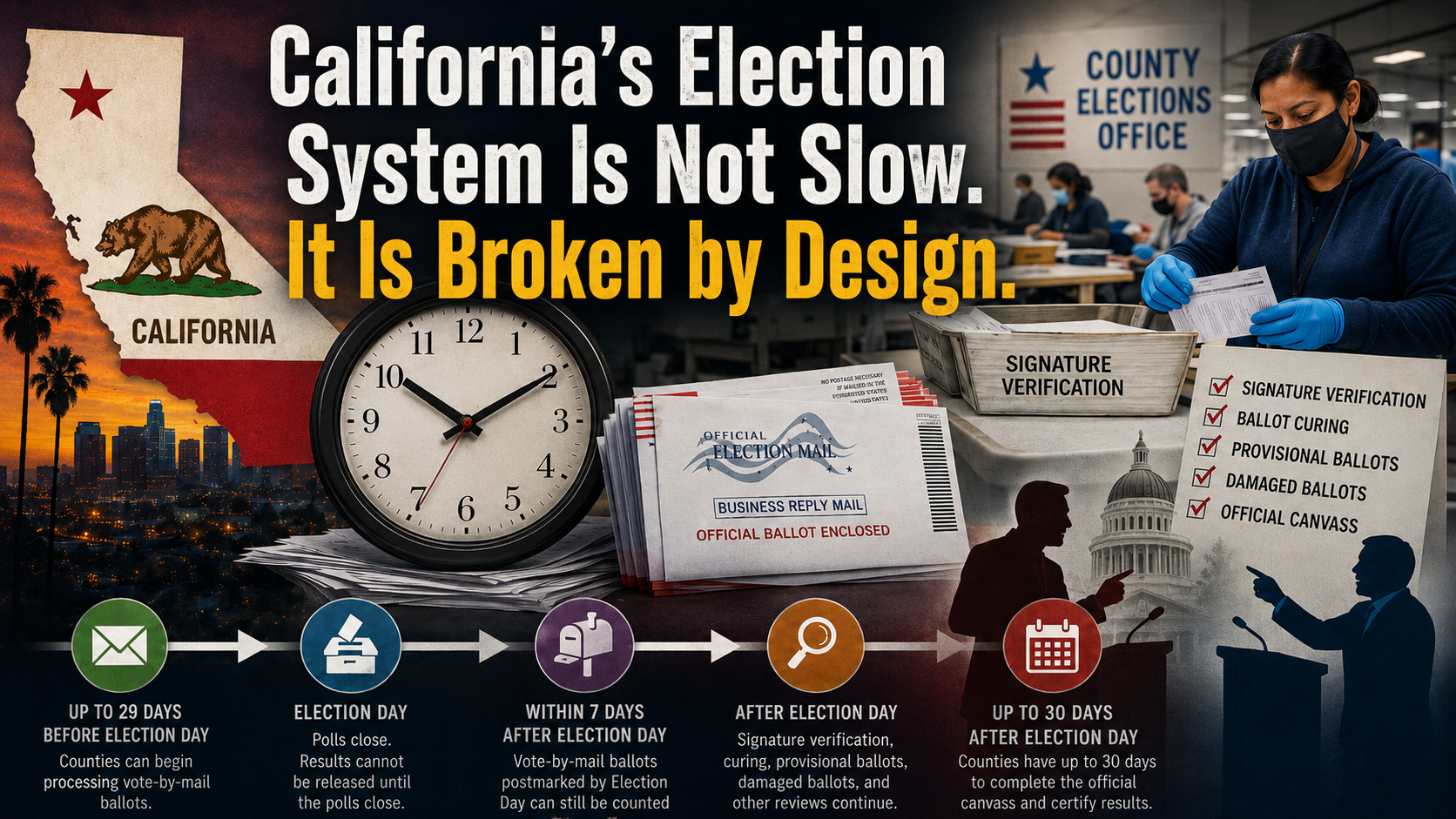
On election night in the June 2 primary, Spencer Pratt led Nithya Raman by approximately 40,000 votes and ten percentage points with half the expected vote counted. Every subsequent batch of mail ballots broke toward Raman at rates that bore no resemblance to the election night composition. By Sunday June 7, five days after election day, Raman had overtaken him. Steve Hilton was leading the gubernatorial race on election night and Xavier Becerra pulled ahead through the same mechanism in that race.
The official explanation is that mail ballot voters skew differently than election day voters. That explanation accounts for some directional shift. It does not account for the magnitude or the consistency. When every single batch of mail ballots processed after election night breaks the same direction at rates sufficient to overcome a ten-point deficit, you are not seeing a demographic skew. You are seeing a count that is pulling from a population fundamentally different from the one that voted in person. The question is what is in that population and who put it there. California will not allow the federal government to look.
Americans are not stupid. When a candidate loses by ten points on election night and wins by three points a week later through mail ballots nobody can audit from rolls nobody is allowed to inspect, calling that normal ballot counting requires more faith than evidence.
The Ballot Replacement Problem
California allows a voter who has already returned a mail ballot to request a replacement ballot if they claim they made a mistake. In practice this creates a mechanism where a voter can cast a mail ballot early, watch the political environment change over the following weeks as election day approaches, and then request a new ballot claiming an error on the first one. The first ballot is supposed to be spoiled when the replacement is issued. The verification that this process was properly followed depends on the same county registrar offices that are already processing hundreds of thousands of ballots on a thirty-day timeline with no federal oversight allowed. Whether this provision is being exploited systematically is unknown. What is known is that California has blocked every attempt to find out.
What California's Defenders Get Wrong
California's defenders make a specific and narrow argument: the count is legal, the procedures are followed and no fraud has been proven. All three statements may be true. None of them addresses the structural problem. Legal is not the same as secure. Procedurally followed is not the same as verified. And the absence of proven fraud when you have spent over a year blocking the federal audit that would determine whether fraud occurred is not exculpatory. It is suspicious.
The state's Secretary of State called the DOJ lawsuit a "fishing expedition" and a "blatant overreach." That framing inverts the actual situation. The federal government is trying to verify that only eligible citizens are voting in federal elections. That is not a fishing expedition. It is the basic function of election oversight. A state that registers voters with gym cards, mails ballots to everyone on rolls that have not been federally audited, allows mail ballot replacement and then fights for over a year in federal court to prevent anyone from looking at its voter data is not defending voter privacy. It is defending opacity. Those are different things.
Fraud Claims Require Evidence. So Does Clearing the Allegations.
The DOJ has announced multiple election fraud investigations in California without providing specifics. The investigations are active. The evidence, if there is any, has not been made public. It is important to be honest about what we know and do not know. What we know is that California's registration rules are among the loosest in the country. What we know is that the voter rolls have documented history of containing ineligible registrations. What we know is that California has refused a federal audit for over a year. What we know is that mail ballot counting in the June 2026 primary produced directional shifts in multiple races that are statistically remarkable. What we do not know, because the audit has been blocked, is whether those shifts reflect legitimate voter preferences or something else.
Demanding that evidence before calling it fraud is the right standard. Demanding the same level of proof before calling it suspicious is an unreasonable standard that California is counting on the public accepting. The absence of completed fraud investigations does not mean the concerns are baseless. It means the investigations are ongoing and the state is making them harder to conduct. That matters.
My Bottom Line
California has built an election system with no meaningful citizenship verification at registration, a voter roll that the federal government cannot audit, universal mail balloting to addresses that include dead voters and people who have moved, a ballot replacement provision that allows multiple submissions, a thirty-day counting window that makes election night results meaningless and a pattern of post-election mail ballot counting that consistently reverses election night results in Democratic-favorable directions. Every individual element of this system has a legal justification. The combination of all of them in one state, run by one party that benefits from the outcomes they produce, is not a coincidence. It is a design.
Other states considering California-style election law should look at this primary very carefully. Not at the slow count in isolation, not at the gym card in isolation, not at the voter roll audit fight in isolation. At all of it together. Because together it describes a system where the integrity of the result depends entirely on trusting the people running it, with no independent verification allowed and no federal oversight permitted. That is not a democracy. That is a machine.
If California's elections are clean, open the records and prove it. A year of litigation to block a federal audit is not the behavior of a state with nothing to hide. It is the behavior of a state that knows what the audit would find.
Why This Matters
Election integrity in California is not a California problem. It is a national problem. California sends members to Congress. California's electoral votes go to presidential candidates. California's election rules influence what other states consider normal. When the largest state in the union runs elections on gym card registration, unaudited voter rolls, universal mail balloting and thirty-day counting windows, and then fights the federal government's attempt to verify any of it, the legitimacy problem does not stop at the state line. The rest of the country has a stake in California cleaning up its election system. It has had one for years. The evidence that California intends to do so is, at this point, nonexistent.
References
- KTLA / ABC7 Los Angeles. (2026, June 8). U.S. attorney accuses California of blocking voter roll audit amid legal battle. ktla.com.
- Just The News. (2026, June 8). US attorney accuses California of blocking voter roll audit. justthenews.com.
- Western Journal. (2026, June 8). DOJ vows action after California blocks federal audit of voter rolls.
- PJ Media. (2026, June 7). Wait till you see what IDs California accepts for voter registration. pjmedia.com.
- Nevada News and Views. (2026, June 8). Your gym card is valid voter ID in California.
- DOJ Civil Rights Division. (2025, August). Letter to California Secretary of State Shirley Weber demanding voter registration records.
- ACLU. (2026, January). Federal court dismisses DOJ lawsuit seeking California voter data. aclu.org.
- Judicial Watch v. Los Angeles County. (2019). Settlement agreement requiring removal of inactive voter registrations.
- California Secretary of State. (2026). Voter registration accepted identification documents. sos.ca.gov.
Disclaimer: The views expressed in this post are the personal opinions of the author and are offered for educational, commentary and public discourse purposes only. They do not represent the positions of any institution, employer, organization or affiliated entity. Nothing in this post constitutes legal, financial, medical or professional advice of any kind. References to ongoing investigations reflect publicly available information only. No finding of fraud is stated or implied beyond what cited sources document. Commentary on political and electoral subjects reflects the author's independent analysis and is protected expression of opinion. Readers are encouraged to consult primary sources and form their own conclusions.