
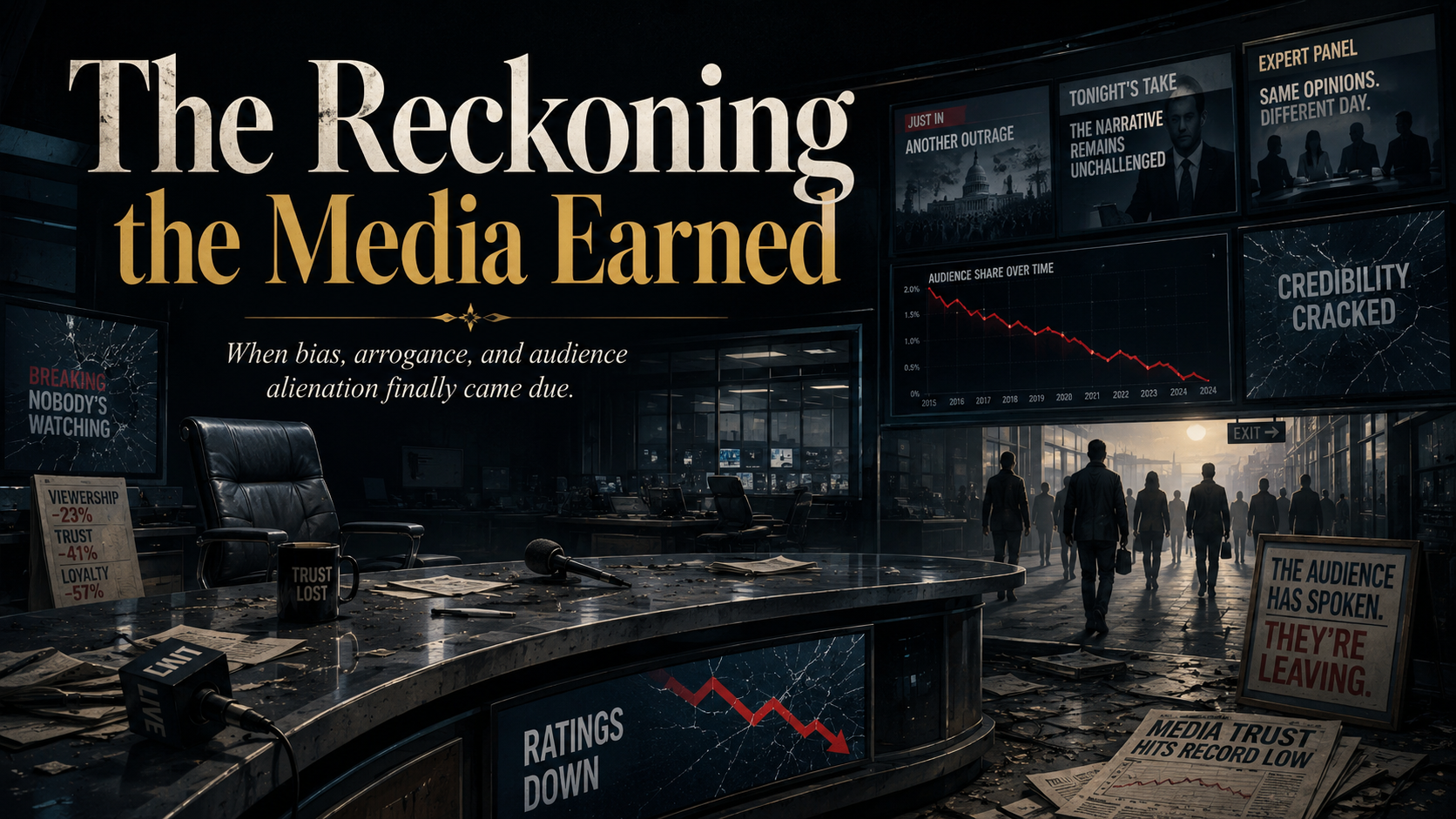
Scott Pelley's firing today at CBS is the latest and most visible data point in a trend that has been building for years. But Pelley is a serious journalist with serious credentials and a legitimate career interrupted by institutional collapse. The more revealing story is not Pelley. It is the roster of anchors, hosts, correspondents and talking heads who were never primarily journalists to begin with — who built careers as partisan performers operating under the cover of journalism's credibility and then discovered, one by one, that management had finally done the math. Don Lemon. Jim Acosta. Joy Reid. Joe Scarborough and Mika Brzezinski. The cast of The View. These are the faces of what went wrong with the American press, and their exits, firings and diminished platforms are not attacks on journalism. They are journalism defending itself from the people who spent a decade calling themselves journalists while doing something else entirely.
Don Lemon: The Mask Came Off
Don Lemon was fired by CNN in April 2023 after 17 years. The official explanation was vague. The real explanation was not. Lemon had made sexist and ageist remarks about Nikki Haley on air — telling his audience that women were in their prime in their twenties, thirties and maybe forties, and that Haley at 51 was past hers. His co-host asked "prime for what?" The answer, of course, was irrelevant, because the remark was not analysis. It was the kind of reflexive condescension that Lemon had been allowed to perform for years because it was directed at the right targets. When it landed on the wrong one — a Republican woman running for president — management ran out of patience.
Lemon spent his CNN tenure building a reputation as an advocate rather than a reporter. His on-air commentary routinely crossed from coverage into activism. He was not pretending to be neutral and getting caught. He had stopped pretending. His show became a nightly exercise in telling his audience what to feel about the people he wanted them to dislike, and his audience rewarded him for it — until the audience shrank and the advertiser math changed. His response to being fired was to claim he was never given adequate warning, then to start a YouTube show, then to sell coffee. The market had spoken about the news product. He found a different one.
Lemon was not an outlier at CNN. He was the fully developed version of what CNN's primetime had been becoming for years — a lineup of hosts whose job was not to report news but to process it through a political frame and deliver the audience a verdict. When that model stopped generating viewers it became a liability. Management at CNN understood that the brand had become synonymous with anti-Trump programming, which meant half the country had no reason to turn it on. Lemon was the visible tip of a structural problem the whole network shared.
Jim Acosta: The Activist Who Called Himself a Reporter
Jim Acosta's departure from CNN in January 2025 was framed, by Acosta and his supporters, as a principled stand against a management capitulating to Trump. The facts are somewhat different. CNN offered Acosta a new time slot — midnight to 2 a.m. Eastern. He declined and left. His farewell broadcast included the admonition "don't give in to the lies, don't give in to the fear." His first Substack post told Trump and his allies: "You may think you have silenced me. Guess again." He launched a show called The Jim Acosta Show.
This is instructive. Acosta's entire post-CNN identity is built on the premise that he is a warrior against Trumpism who was pushed out for telling the truth. In reality he was offered a less desirable time slot during a network restructuring and chose not to take it. That is a career decision, not a martyrdom. His years at CNN were defined by combative exchanges with Trump and Trump officials that generated enormous media coverage and made him a hero to one half of the political spectrum. They also made him unviewable to the other half, which was precisely the business problem CNN was trying to solve when it reshuffled his role. Acosta departed saying management was bowing to a tyrant. Management was actually trying to recover an audience that Acosta's brand of coverage had helped drive away.
When your departure from a news network is indistinguishable from a campaign announcement, you were never really a journalist. You were a political operative with a press credential. The audience figured that out before management did.
Joy Reid: The Ratings Said Everything
Joy Reid's show The ReidOut was cancelled by MSNBC in February 2025 as part of a broader restructuring of the network's lineup. Reid had hosted the 7 p.m. slot since 2020. Her ratings had been declining for years. Trump, characteristically direct, noted on Truth Social that her viewership was "virtually non-existent." That was an exaggeration, but not by as much as her defenders suggested. Reid had built her program around a specific and relentless frame: America is a systemically racist country, the Republican Party is a vehicle for white supremacy and anyone who disagrees is either ignorant or complicit. That frame attracted an audience that agreed with it and repelled an audience that did not. Over time the first group shrank and the second group stopped having reasons to engage.
Reid was a talented performer who understood her audience and served it loyally. The problem is that serving a narrow ideological audience is not journalism. It is programming. And when the programming stops generating sufficient viewership to justify its costs, the business cancels it. Reid's response was gracious on social media and defiant in subtext. She thanked her audience. She did not ask why the audience had become too small to sustain the show. That question would have required an honest conversation she was not prepared to have — about whether a program built entirely around the premise that half the country is morally irredeemable can survive as a commercial product indefinitely.
Morning Joe: The Performative Resistance That Ran Out of Steam
Morning Joe with Joe Scarborough and Mika Brzezinski became, during the Trump years, the flagship of the professional class resistance. Scarborough, a former Republican congressman who had reinvented himself as a centrist, pivoted again to become one of Trump's most vocal daily critics. The show's format was essentially an extended therapy session for educated liberals who needed two hours of affirmation before their workday began. It worked commercially for a time. Then it did not.
The most revealing moment came after the 2024 election, when Scarborough and Brzezinski traveled to Mar-a-Lago to meet with Trump. The progressive audience that had been their core constituency reacted with fury. Brzezinski explained that they had decided it was time to talk with Trump rather than just about him. This was treated as a betrayal by a viewership that had specifically tuned in for the anti-Trump content. The episode revealed the show's problem in concentrated form: it had built its audience by serving a political emotion rather than by doing journalism, and when the hosts showed any sign of stepping back from that emotion, the audience felt deceived. A show that cannot change its editorial direction without losing its viewers is not a news program. It is a political service.
Scarborough spent years positioning himself as the reasonable conservative voice warning about Trump's danger to democracy. That positioning required Trump to remain the central villain of every broadcast. When the show's hosts visited Mar-a-Lago, the audience correctly perceived that the positioning had been performance rather than principle. Both things cannot be true simultaneously: Trump cannot be an existential threat to democracy and also a person you visit at his Florida estate for a cordial meeting. The audience did not forgive the contradiction. It stopped watching.
The View: Entertainment Masquerading as Analysis
The View occupies a different category from the cable news anchors, but its cultural influence on political discourse has been significant enough to warrant examination. The daytime talk show has for years featured co-hosts whose political commentary generates national headlines and whose reach with a specific demographic — college-educated women over 40 — made it a mandatory stop for Democratic politicians and a target-rich environment for Republican critics. Whoopi Goldberg, Joy Behar, Sunny Hostin and their rotating cast of co-hosts have made careers of delivering political opinion with the confidence of people who have been told they are important for so long that they have started to believe it without checking.
The View is not journalism and does not claim to be. But it functions as a political opinion factory for an audience that treats its pronouncements with the weight of news. When Goldberg declared that the Holocaust was not about race, she was wrong and the subsequent backlash was appropriate. When the panel dismisses conservative guests with contempt that would never be extended to liberal ones, the double standard is visible to anyone outside the target demographic. The show survives because it serves its audience loyally and its audience is not going away. But it has contributed meaningfully to the cultural environment in which political opinion dressed as informed analysis flourishes, accountability is optional and the assumption that one political coalition's values represent the obvious correct position goes unchallenged by anyone in the room.
The Common Thread
What connects Lemon, Acosta, Reid, Scarborough, Brzezinski and The View's ensemble is not talent or even ideology. It is the confusion of advocacy with journalism and the business model that confusion produced for about a decade. Each of them found an audience by telling it what it wanted to hear about the people it wanted to dislike. Each of them was rewarded handsomely for doing so. Each of them convinced themselves that the reward was for journalism rather than for performance. And each of them has been confronted, to varying degrees, with the reality that the audience for performance is not loyal to the performer. It is loyal to the emotion. When the emotion loses intensity or the performer fails to sustain it at the required pitch, the audience leaves for someone who will.
Management tolerated all of this while the numbers held up. When the numbers stopped holding up, management acted. The anchors and hosts experiencing that action are calling it political persecution. It is actually something more mundane and more humbling: a market correction. The product stopped working. The business changed the product. The people who were the product are not happy about it.
My Bottom Line
None of this means these individuals are bad people or that they have no legitimate grievances about how the media landscape is changing. Some of those grievances are real. Bari Weiss at CBS is making editorial decisions that reflect her own political sensibilities just as surely as the people she replaced made decisions reflecting theirs. The question of who controls editorial direction at major news organizations is a legitimate one. But the people currently complaining loudest about that question spent years when the editorial direction ran their way saying nothing about it. The concern for independence and neutrality arrived precisely when the direction changed. That is not principle. That is self-interest arriving late and calling itself principle.
Americans are not obligated to watch, subscribe to or trust media organizations that spent a decade treating them as the problem rather than the audience. They exercised their option to stop. The ratings are the record of that decision. Management is finally reading the record. The hosts who built careers on the old model are calling the reckoning an attack on journalism. Most of the country calls it overdue.
You cannot spend a decade telling half the country it is deplorable, irredeemable or complicit — and then be surprised when that half stops watching. They heard you the first time. They just disagreed. And then they left.
Why This Matters
It matters because the media institutions going through this reckoning are not peripheral. They shaped public discourse, influenced elections and established the conversational terms on which American political life was conducted for a generation. When those institutions fail — not because of government suppression but because of their own choices about what product to deliver to what audience — the republic loses something it needs, even if the specific product being lost was not serving the republic well. The question now is whether what replaces it will be better: more honest about its biases, more willing to cover stories the old model suppressed and more focused on earning trust from an audience it does not condescend to. That is possible. Whether the people currently running the replacements are capable of it is a different and still open question.
References
- NPR. (2023, April 24). News anchor Don Lemon is out at CNN. npr.org.
- Adweek / TVNewser. (2025, January 29). Jim Acosta exits CNN, launches new show on Substack.
- The Hill. (2025, January 28). Jim Acosta to exit CNN, rejects new time slot. thehill.com.
- Hollywood Reporter. (2025, February 25). Famously fired TV news figures Don Lemon and Megyn Kelly spar over Joy Reid's MSNBC dismissal.
- Newsweek. (2025, February 24). Don Lemon blasts Megyn Kelly for rejoicing in Joy Reid's cancellation.
- OutKick. (2025, January 16). CNN hopes to save ratings with new lineup shakeup. outkick.com.
- Fox News. (2024, November 26). From Trump Bump to Trump Slump: Ratings suffer as liberals avoid news after election.
- TV Insider. (2025, January 28). Morning Joe critics want Jim Acosta to take over after rumored CNN exit.
Disclaimer: The views expressed in this post are the personal opinions of the author and are offered for educational, commentary and public discourse purposes only. They do not represent the positions of any institution, employer, organization or affiliated entity. Nothing in this post constitutes legal, financial, medical or professional advice of any kind. References to public figures, institutions and current events are based on publicly available sources cited above and are intended to support analysis and commentary. Commentary on media, political and cultural subjects reflects the author's independent analysis and is protected expression of opinion. Readers are encouraged to consult primary sources and form their own conclusions.