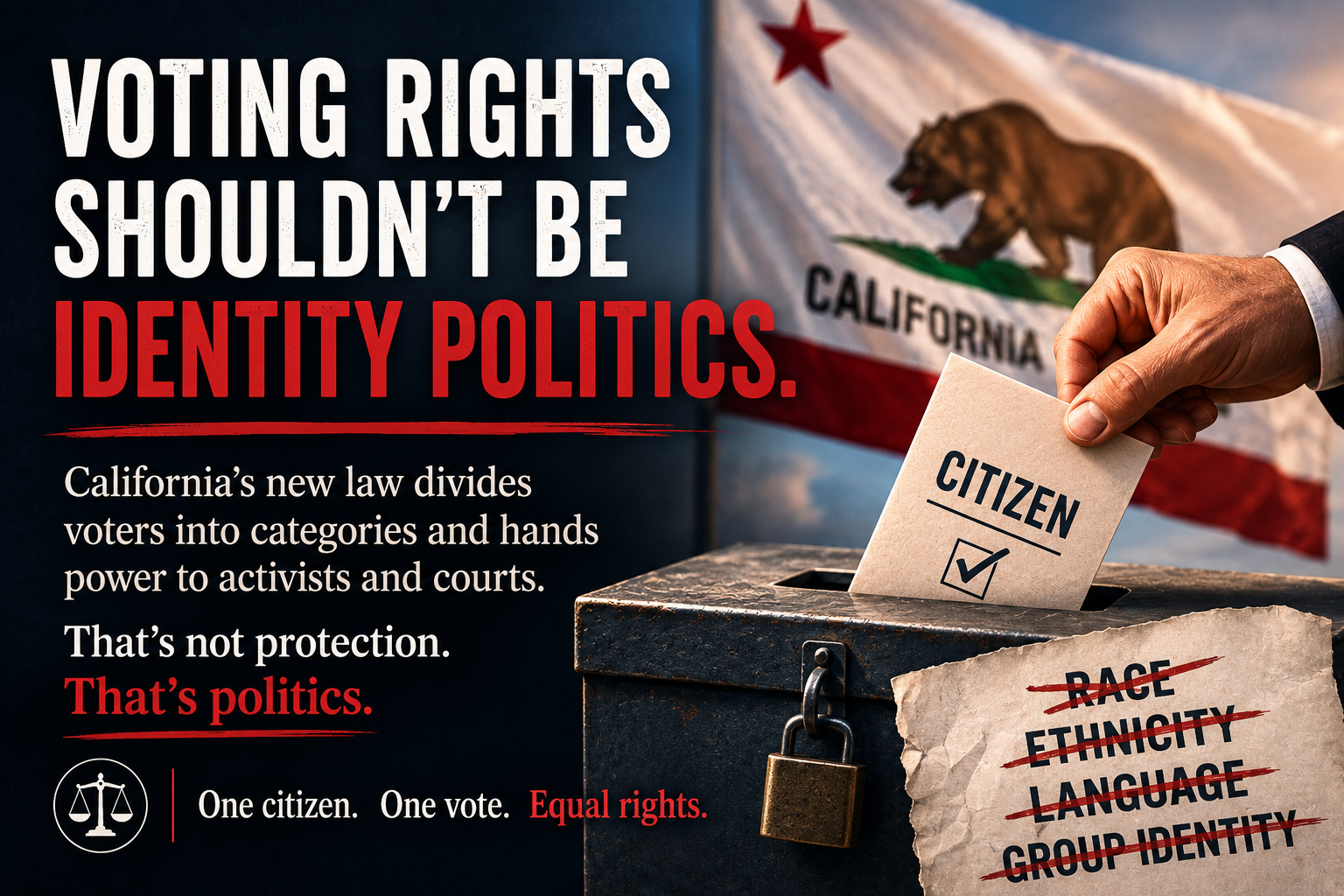
California's latest voting-rights push is being sold in the usual moral language: access, equity, participation, protection and democracy. That language is always useful because it makes the legislation sound nearly impossible to oppose. Who wants to be against voting rights? Who wants to be against access? But that framing hides the real issue. The problem is not ballot access. The problem is the identity-politics machinery being built around ballot access. The California Voting Rights Act of 2026, advanced through SB 1164 and SB 1360, moves deeper into a framework that treats voters primarily as members of protected groups rather than individual citizens. Supporters describe it as a state-level response to federal voting-rights uncertainty and a way to fight vote dilution and voter suppression. Beneath that description is a familiar progressive habit: take a universal civic right, divide the population into identity categories, then give courts and activists more power to manage the political system in the name of equity. That is not democracy strengthened. That is democracy repackaged through identity politics.
Voting Rights Should Belong to Citizens, Not Categories
The right to vote is one of the central rights of citizenship. That is exactly why it should be protected with extreme seriousness. But seriousness does not require turning every election rule into a group-based grievance claim. A free republic rests on the idea that citizens stand equal before the law. That does not mean everyone has the same background, same language, same neighborhood or same political influence. It means the law should not sort citizens into favored and disfavored categories and then adjust political rules to produce preferred group outcomes.
The identity-politics view of voting rights starts somewhere else. It looks at elections and sees blocs: racial blocs, ethnic blocs, language blocs and communities of color. The individual voter disappears into the group. The question shifts from "can every citizen vote?" to "does this group have enough influence?" Once the law starts treating voting power as something that must be measured, balanced and corrected by identity category, elections stop being a neutral contest of citizens and ideas. They become a managed competition among groups. That is poisonous. It teaches people to see themselves not as citizens sharing a common political system, but as members of competing demographic teams. It tells courts to become referees of demographic power rather than guardians of neutral rules.
A republic cannot survive forever if it teaches people to vote first as members of identity groups and only second as citizens. California's political class believes it is strengthening democracy. It is running a civic principle through the progressive identity machine until the original principle is almost unrecognizable.
The Language-Access Question
Language access is the least objectionable part of this proposal, but even here some honesty is needed. Federal law already requires language assistance in certain jurisdictions under Section 203 of the Voting Rights Act when specific population and limited-English-proficiency thresholds are met. California also already tracks language requirements through federal and state law. No serious person should want eligible citizens confused about how to vote. Clear instructions matter and practical accommodation can be reasonable.
But there is a difference between reasonable assistance and the soft abandonment of civic assimilation. Voting is not ordering from a menu. It is an act of citizenship. A country has every right to expect that citizens participating in its political system make some effort to understand the civic language of that system. America has always absorbed immigrants best when it combined opportunity with assimilation. Learn the language. Understand the system. Join the country fully. California's political class increasingly treats that expectation as offensive. It acts as if asking citizens to move toward English proficiency is some form of exclusion. That is nonsense. A shared language is one of the basic tools that allows a diverse republic to function. Language help can be reasonable. Permanent multilingual dependency as a governing model is not.
The Vote-Dilution Litigation Machine
The more dangerous piece is the vote-dilution and voter-suppression framework. SB 1164 expands the ability to challenge election systems and rules by claiming they impair the ability of a protected class to elect candidates of choice or influence outcomes, with standing given to the Attorney General or an aggrieved individual or entity and expedited court procedures for these actions. That is where the machinery starts humming. Once the standard becomes protected class influence, litigation becomes the political weapon. Every district line, local election rule, voting procedure and municipal structure becomes a lawsuit waiting to happen. Every lost election can be recast as dilution. Every neutral rule can be challenged for its effect on a preferred group.
California's 2001 state Voting Rights Act produced exactly this outcome. Cities, school districts and special districts across the state were sued for using at-large elections that plaintiffs argued diluted minority voting power. Hundreds of jurisdictions switched from at-large to by-district elections, often under litigation threat rather than through democratic deliberation. The 2026 act extends and strengthens the same mechanism. More lawsuits, more court-supervised remedies and more judicial control over decisions that local voters and officials used to make for themselves.
This is how identity politics expands. It does not announce itself as power. It announces itself as protection. But protection for whom? From what? And who decides when a group has enough influence? Those questions matter because vote dilution can easily become a demand for political outcomes by demographic category. Real abuses exist. At-large systems have sometimes been used to weaken minority representation. But the existence of real abuses does not justify turning the entire election system into a permanent racial and ethnic accounting exercise. At some point the cure starts damaging the patient.
Courts Should Not Be Told to Favor Outcomes
One of the most troubling provisions is the instruction that courts should interpret voting laws in favor of access and equitable participation. Courts are supposed to interpret laws fairly, neutrally and according to text, precedent and constitutional limits. When lawmakers tell courts to interpret a statute in favor of equitable participation, they are not clarifying law. They are nudging courts toward a political mission. Equity is not the same thing as equality. Equality means every eligible citizen gets the same legal right to vote. Equity means institutions are pushed to correct disparities in outcome or influence. That is a much more aggressive idea.
The Equal Protection Clause does not promise proportional group representation in electoral outcomes. It prohibits state action that intentionally discriminates against individuals. Building group-equity outcomes into the interpretive standard of election law moves in the opposite direction — from individual equal protection toward group-based remedies courts are instructed to favor regardless of whether intentional discrimination has been shown. The Supreme Court's recent jurisprudence, including Students for Fair Admissions v. Harvard in 2023, has been clearly skeptical of race-conscious frameworks that substitute group equity for individual equal treatment. This legislation will face that scrutiny in court.
Once courts are encouraged to favor equitable participation, the legal system becomes another arm of the progressive project. Judges are not demographic engineers. They are not supposed to decide whether one group has enough influence in a city council race or school board election unless there is a clear legal violation. That is not neutral voting rights enforcement. That is politics by lawsuit.
The Moral Blackmail of "Access"
The word access does a lot of heavy lifting in these debates. If someone questions the bill, supporters imply that person opposes access. If someone worries about identity-based litigation, they are accused of enabling suppression. If someone asks whether the law goes too far, the response is predictable: why are you afraid of people voting? That is cheap politics. The issue is not whether eligible citizens should vote. Of course they should. The issue is whether every disagreement over election administration should be framed as suppression and whether every disparity in political influence should become evidence of discrimination.
Progressives use access the same way they use equity — it sounds humane but functions as a shield against scrutiny. A law can expand access and still create bad incentives. A law can protect some voters while empowering activist litigation. A law can address legitimate concerns while smuggling in identity-based assumptions that damage civic equality. Serious citizens have to look past the label.
California's Favorite Trick
California has perfected a political maneuver: take a real concern, attach it to an ideological project, then accuse critics of opposing the concern rather than the ideology attached to it. Worried about crime? You must hate justice reform. Worried about illegal immigration? You must hate immigrants. Worried about school ideology? You must hate teachers. Worried about identity-based election law? You must hate voting rights. This is how the debate gets rigged.
The better question is not whether voting rights matter. They do. The better question is whether California's political class can protect voting rights without turning elections into another battlefield of racial, ethnic and language-group politics. Apparently it cannot. The state's instinct is always the same: categorize, subsidize, litigate and manage. It cannot leave citizens alone as citizens. It must sort them, label them, protect them, represent them, translate for them, sue on their behalf and then claim democracy has been strengthened because the machinery has grown larger. That is not trust in voters. That is distrust of voters.
The Real Threat to Democracy
The real threat to democracy is not a neutral election rule that applies to everyone equally. The real threat is a political culture that no longer believes equal treatment is enough. Modern progressivism increasingly rejects equality because equality does not guarantee preferred outcomes. It prefers equity because equity gives institutions permission to intervene until the numbers look right. In election law that means access is no longer just about whether citizens can vote. It becomes about whether demographic groups achieve political influence deemed acceptable by activists, courts and state officials.
That is a fundamental shift. It changes the voter from an individual citizen into a data point inside a protected class. It changes election law from a neutral framework into a tool for correcting group power. It changes courts from referees into managers. And it changes democracy from a contest of persuasion into a contest of demographic entitlement. That should alarm anyone who still believes citizenship means something more than identity category.
Protect the Vote Without Dividing the Voters
There is a better way. Protect registration. Keep voter rolls accurate. Make election rules clear. Ensure reasonable access for disabled voters, elderly voters, military voters and citizens with genuine language needs. Punish actual intimidation. Prosecute fraud. Keep ballot counting transparent. Require identification. Maintain chain of custody. Make election administration boring, clean and trusted. Protect individuals, not demographic blocs. Guard access and integrity together instead of pretending those two values are enemies. Treat every eligible voter as equally important and every illegal ballot as an injury to lawful voters.
California's approach moves in the opposite direction. It leans into identity, litigation and court-managed equity. That may please advocacy groups and make for glowing press releases about democracy being defended. But it does not heal the country. It divides voters into categories, tells them their political power should be measured as a group and hands lawyers the tools to keep that fight alive indefinitely.
My Bottom Line
The California Voting Rights Act of 2026 is being marketed as a shield against voter suppression. Parts of it may address real access questions. But the identity-politics framework behind it deserves serious criticism. Voting rights should protect citizens as citizens. They should not turn every election into a lawsuit over group influence. They should not instruct courts to favor equity over neutral interpretation. They should not treat language, race or ethnicity as the organizing principles of political power.
The right to vote matters too much to be reduced to another equity project. Categorize, subsidize, litigate and manage — that is California's instinct. It is not democracy. It is distrust of voters dressed up as protection of them.
Why This Matters
Voting is the foundation of citizenship. If election law becomes another identity-based battleground, public trust will continue to collapse. Americans need confidence that election rules are neutral, clear and applied equally. They need to believe courts are protecting rights, not managing political outcomes. They need to know their vote counts the same whether they belong to a favored protected class or not. That is the whole point of equal citizenship. California should protect every lawful voter. It should not build another legal machine that divides those voters by race, ethnicity and language and then calls the division democracy.
References
- ACLU California Action. (2026). California Voting Rights Act of 2026: SB 1164 and SB 1360.
- California Secretary of State. (2026). Language requirements for election materials. sos.ca.gov.
- California Senate District 31. (2026). Cervantes' landmark California Voting Rights Act approved by State Senate.
- LegiScan. (2026). California SB 1164: Elections. legiscan.com.
- LegiScan. (2026). California SB 1360: Elections: Translation of election materials. legiscan.com.
- NAACP Legal Defense Fund. (2026). California Voting Rights Act of 2026. naacpldf.org.
- California Voting Rights Act (2001). California Elections Code §§ 14025–14032.
- Supreme Court of the United States. (2023). Students for Fair Admissions v. President and Fellows of Harvard College, 600 U.S. 181.
Disclaimer: The views expressed in this post are the personal opinions of the author and are offered for educational, commentary and public discourse purposes only. They do not represent the positions of any institution, employer, organization or affiliated entity. Nothing in this post constitutes legal, financial or professional advice. References to public figures, institutions, legislation and current affairs are based on publicly available sources and are intended to support analysis and commentary. Readers are encouraged to consult primary sources and form their own conclusions.