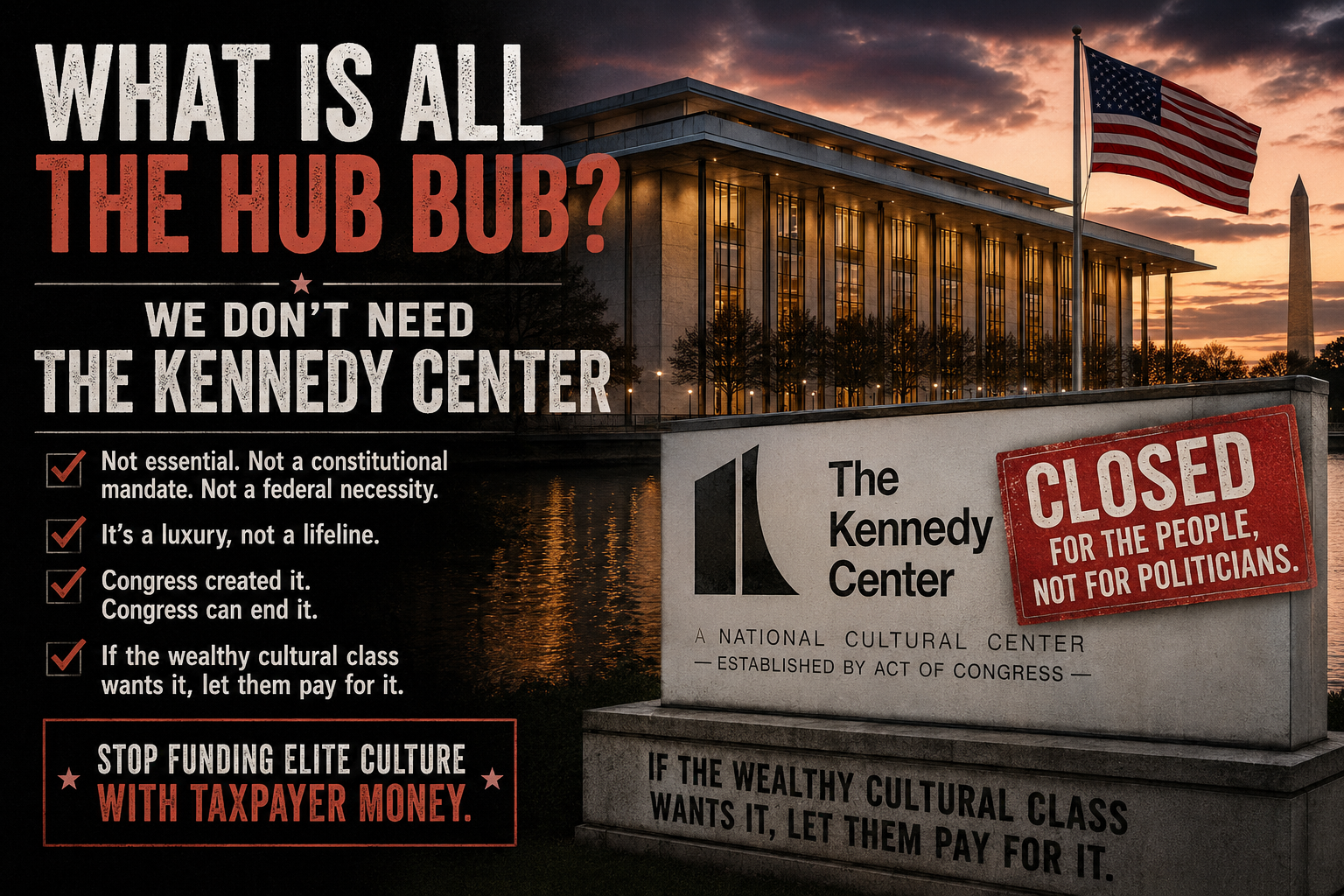
The Kennedy Center for the Performing Arts receives tens of millions of dollars in federal funding every year. It sits on the Potomac waterfront in Washington, D.C., inside a building that cost over $70 million to construct in 1971 and has received hundreds of millions more in federal capital investment since. Tickets to its performances range from expensive to well beyond the reach of ordinary Americans. Its gala events are attended by Washington's political and donor class. Its board reads like a roster of the connected and the wealthy. And every year, the plumber in Ohio, the teacher in Georgia, the truck driver in Nevada and the small business owner in Arizona are required by law to help pay for it. The argument for why this is appropriate has never been made convincingly. The argument against it is simple enough to fit on a bumper sticker: if you want it, pay for it yourself.
What Federal Arts Funding Actually Is
The Kennedy Center received approximately $40 million in federal appropriations in fiscal year 2024, separate from the capital funding it receives as a federal institution for maintenance and operations of the building itself. The National Endowment for the Arts distributes roughly $200 million annually across the country to arts organizations, performances, programs and institutions. The National Endowment for the Humanities adds another $200 million on top of that. These are not trivial numbers in isolation. They represent deliberate policy choices about whose cultural preferences deserve public subsidy and whose do not.
The answer that federal arts funding provides, consistently, is that the preferences of the educated, coastal and upper-income segment of the population deserve subsidy. Symphony orchestras, opera companies, ballet troupes, contemporary art installations, experimental theater and literary journals are the recurring beneficiaries. The preferences of working-class Americans — country music, stock car racing, hunting and fishing culture, minor league baseball, local rodeos, church choirs — receive no federal subsidy and are expected to survive or fail on their own merits in the marketplace. That disparity is not incidental. It is a built-in feature of how federal arts funding has always operated.
The National Endowment for the Arts' own survey data consistently shows that attendance at classical music performances, opera and ballet skews heavily toward households with higher incomes and higher educational attainment. A 2022 NEA survey found that attendance at classical music performances was most common among adults with graduate degrees and household incomes above $75,000. The federal taxpayer subsidizing institutions that primarily serve this demographic is, in effect, a wealth transfer from ordinary Americans to a leisure preference of the professional class. Calling that a public good requires considerable creativity.
The "Cultural Preservation" Argument Does Not Hold
The standard defense of federal arts funding is that certain art forms would not survive without public support, that markets alone cannot sustain high culture and that the government has a responsibility to preserve artistic traditions that enrich civilization. This argument is made with great seriousness by people who attend the Kennedy Center and almost never by people who do not. Let us examine it honestly.
Symphony orchestras in Europe receive generous state subsidies and have for generations. Many of them are also financially troubled despite those subsidies, which suggests the subsidy is sustaining an institution that has failed to build a self-sustaining audience rather than preserving something the public genuinely values. In the United States, the major orchestras and opera companies that are genuinely excellent — the Metropolitan Opera, the New York Philharmonic, the Chicago Symphony — have endowments, donor bases and ticket revenue that dwarf the federal contribution. They would survive without it. The institutions that would not survive without it are, by definition, the ones that have failed to make the case for their own existence to the people they ask to support them.
If an art form cannot survive without federal subsidy, that is not proof of a market failure that government must correct. It is proof that the audience for that art form is too small or too unwilling to pay what the art form actually costs.
Markets are not perfect. But they do communicate something real about value. When millions of Americans choose to spend their entertainment dollars on country concerts, sporting events, streaming services and local theater, and choose not to spend them on opera, that preference is information. The federal government deciding to override that information by taxing everyone to subsidize the preference of a narrow demographic is not cultural stewardship. It is condescension with a budget line.
The Political Tilt Nobody Wants to Discuss
Federal arts funding also has a consistent political valence that its defenders prefer not to acknowledge. The institutions it supports — major metropolitan arts organizations, university-affiliated cultural programs, experimental and avant-garde projects — tend to reflect the cultural and political values of the professional class that runs them. Grant applications that align with progressive cultural priorities have historically fared well in NEA review processes. Content that challenges progressive orthodoxy has historically fared less well. This is not a conspiracy. It is the predictable result of any government agency staffed by people drawn from a particular cultural milieu.
The result is that federal arts funding functions, in practice, as a subsidy for the cultural production of one end of the political and social spectrum, paid for by taxpayers who span the entire range. A conservative working-class voter in rural Pennsylvania is required to subsidize a Washington gala, a Manhattan art installation and a university-affiliated theater program staging productions he would find alien, hostile or simply irrelevant to his life. The argument that this is a reasonable use of his tax dollars has never been made to his satisfaction, and it never will be, because it is not a reasonable use of his tax dollars.
The Kennedy Center Specifically
The Kennedy Center is the most visible symbol of this problem because it is the most prominent and because the political drama around it in 2025 made the underlying questions impossible to ignore. When the Trump administration moved to change the Center's leadership and redirect its programming priorities, the cultural establishment reacted as if a sacred institution had been violated. Prominent performers cancelled engagements. Donors threatened to withdraw. Cultural commentators declared the republic's artistic soul under attack.
What was actually happening was simpler and more defensible. A new administration was exercising authority over a federally funded institution that it was legally empowered to oversee. The outrage revealed something important: the people who benefit from federal arts funding have come to regard that funding as their permanent entitlement, insulated from political accountability and shielded from the normal expectations that apply to every other use of public money. They regard federal arts funding not as a government program subject to democratic oversight but as a cultural right that transcends ordinary politics.
Federal arts funding is discussed in Washington as if it occupies a different moral category from other forms of government spending. Defense spending can be cut. Social programs can be reformed. Infrastructure can be delayed. But suggest reducing the NEA budget or changing the Kennedy Center's programming and you are accused of attacking civilization itself. That rhetorical immunity is telling. It means the people who benefit from the subsidy have successfully framed their preference as a public necessity. They have not made that case. They have simply asserted it loudly enough and long enough that the assertion has acquired the force of conventional wisdom.
What Should Happen Instead
The Kennedy Center should be privatized or converted to a self-sustaining institution that raises its own operating funds from the people who value it. The donor base is there. The ticket buyers are there. The corporations that plaster their names on arts programs in exchange for social capital are there. A building that hosts galas attended by Washington's wealthiest and most connected residents does not need a federal subsidy. It needs a development office that does its job.
The NEA and NEH should be dramatically reduced or eliminated. The legitimate functions they serve — preserving historical archives, funding access programs that bring arts education to genuinely underserved communities, supporting public broadcasting in areas without commercial alternatives — can be reconstituted in a much smaller and more targeted form, or transferred to state governments that are closer to their own citizens' preferences. The bulk of the money currently going to support the cultural preferences of the professional class should stop going there and should either stay in taxpayers' pockets or be redirected to things that serve a broader public.
My Bottom Line
This is not an argument against art or culture. It is an argument against the assumption that the government owes every demographic a subsidy for its preferred leisure activity, and against the particular hypocrisy of a cultural class that demands free markets for everything except the things it enjoys. The people who attend the Kennedy Center, the Metropolitan Opera, the symphony and the experimental theater program are not without resources. They are among the most economically comfortable people in the country. They do not need the truck driver's tax dollars to fund their evening out. They simply prefer to have them.
Art that cannot find an audience willing to pay for it is not being suppressed by the market. It is being evaluated by the market. Government stepping in to override that evaluation does not save culture. It just makes certain people's preferences mandatory for everyone else.
Why This Matters
This matters because the federal arts funding debate is a clean test of a principle that applies far more broadly: should government tax everyone to subsidize the preferences of a particular demographic that is already doing well? The answer the political class has given for fifty years is yes, because that demographic is also the one writing the op-eds, staffing the think tanks and populating the congressional donor lists. The answer a working-class taxpayer would give, if asked directly and honestly, is almost certainly different. At some point those two answers need to be reconciled, and the reconciliation will not favor the Kennedy Center.
References
- Kennedy Center for the Performing Arts. (2024). Annual report and federal appropriations. kennedy-center.org.
- National Endowment for the Arts. (2024). NEA fiscal year 2024 appropriations summary. arts.gov.
- National Endowment for the Arts. (2022). U.S. patterns of arts participation: A full report from the 2022 Survey of Public Participation in the Arts. arts.gov.
- Congressional Budget Office. (2024). Federal spending on arts and cultural programs. cbo.gov.
- Cowen, T. (2006). Good and plenty: The creative successes of American arts funding. Princeton University Press.
Disclaimer: The views expressed in this post are the personal opinions of the author and are offered for educational, commentary and public discourse purposes only. They do not represent the positions of any institution, employer, organization or affiliated entity. Nothing in this post constitutes legal, financial, medical or professional advice of any kind. References to public figures, institutions, historical events and current affairs are based on publicly available sources and are intended to support analysis and argument. Commentary on political and cultural subjects reflects the author's independent analysis and is protected expression of opinion. Readers are encouraged to consult primary sources and form their own conclusions.