
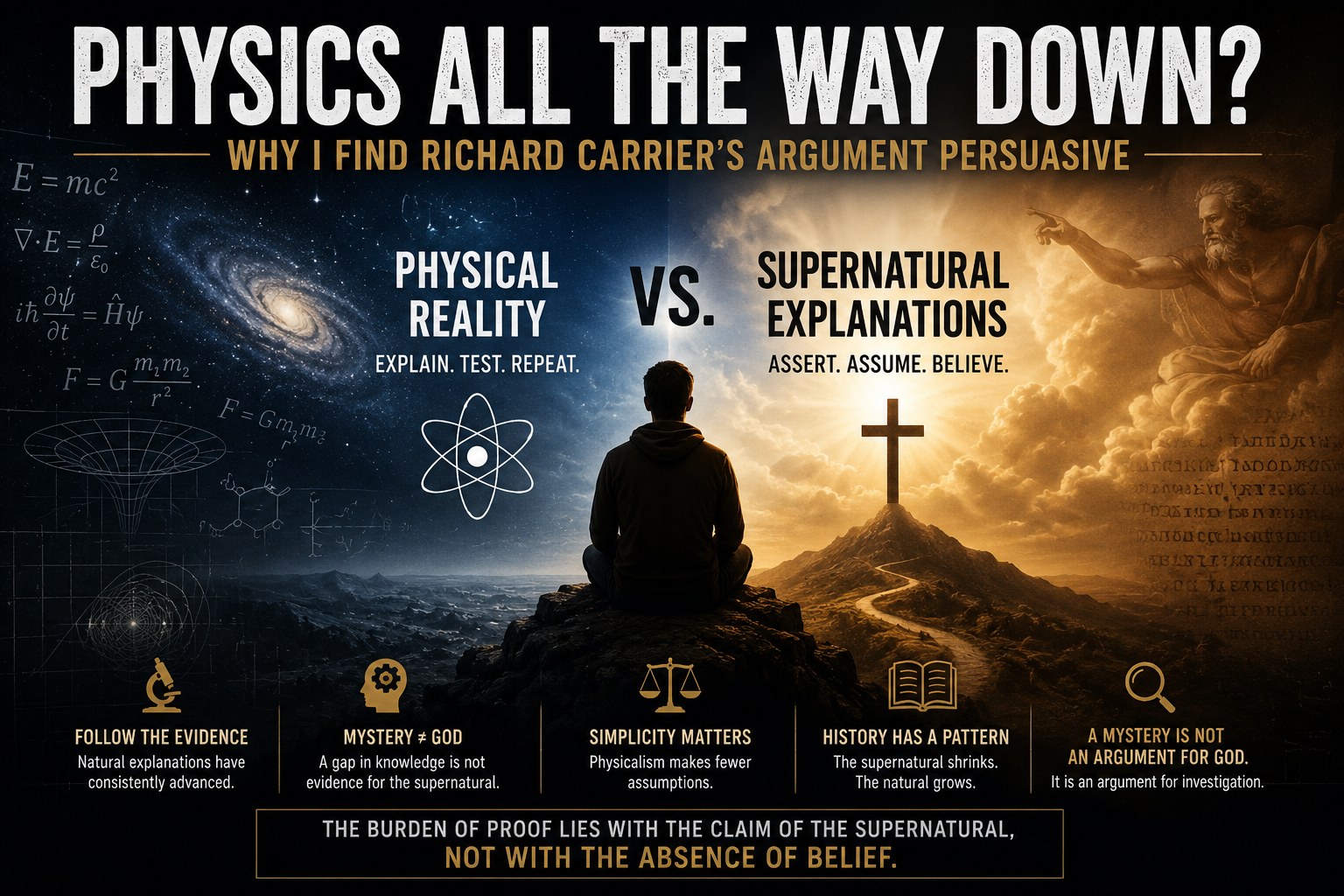
One of the most frustrating aspects of debates about God is that participants spend most of their energy arguing past one another. The atheist accuses the believer of relying on faith over evidence. The believer accuses the atheist of thinking everything came from nothing. Both sides attack caricatures and the real disagreement never gets addressed. Richard Carrier's recent article cuts through much of that. Whether you agree with him or not, he deserves credit for identifying the question that actually matters. The debate is not whether something exists. It is not whether the universe is astonishing or whether human beings seek meaning. It is whether reality is fundamentally physical or fundamentally mental — whether the foundation of everything is physics all the way down, or whether it is ultimately a conscious mind with intentions and purposes. That framing matters because it forces the discussion back to evidence rather than tradition.
The Misconception That Will Not Die
One of the most persistent claims in religious apologetics is that atheists believe everything came from nothing. This is a misunderstanding, and Carrier names it directly. Most atheists who engage these questions seriously hold some version of physicalism or naturalism — the view that reality is ultimately composed of physical processes and entities. That does not mean every mystery has been solved. It does not mean physicists know where the universe came from. It does not mean consciousness is fully understood. It means that the best explanations discovered so far have consistently been natural rather than supernatural, and that pattern has been consistent enough to constitute evidence.
There is a profound difference between "we do not yet know" and "therefore God." The first is intellectual honesty about the limits of current knowledge. The second is an unsupported conclusion dressed up as humility. Carrier is right to distinguish them and right to push back against apologetics that treats any unresolved question as automatic evidence for a specific supernatural answer.
The Real Question Carrier Is Asking
Carrier frames the debate as a competition between explanations. Which account of reality best fits the available evidence: a universe built on physical processes, or a universe built on the intentions of a conscious supernatural being? This is a reasonable and honest way to structure the discussion because both positions are making claims about the ultimate nature of reality. The burden of proof does not rest only with the atheist to explain everything. It rests equally with the believer to demonstrate that adding a supernatural mind actually improves the explanation. Pointing out a difficult question does not prove a particular answer. A mystery is not evidence for God. A mystery is a mystery — the starting point for investigation, not the conclusion of it.
Once you accept Carrier's framing — that the debate is between competing explanations rather than between faith and nihilism — the terms of the argument shift entirely. It is no longer "do you believe in God or do you believe in nothing." It is "which explanation better accounts for what we observe." That is an empirical question, not a spiritual one. And empirical questions have methods for answering them.
The Track Record Problem
Carrier's strongest argument is historical. Throughout human history, countless phenomena were once attributed to gods, spirits, demons and other supernatural causes. Lightning was divine. Disease was demonic. Mental illness was possession. Drought was punishment. Earthquakes were the anger of deities. As knowledge advanced, every one of these explanations was replaced. Natural explanations have consistently displaced supernatural ones, not occasionally, but repeatedly and without exception moving in the opposite direction. We have thousands of examples of supernatural explanations being replaced by natural ones. We have essentially none moving the other way.
Past performance is not absolute proof. But if one explanatory framework repeatedly succeeds while another repeatedly fails, rational people should take that into account. At some point the pattern becomes the evidence.
This matters because it is the strongest argument in the naturalist arsenal and the one religious apologetics most consistently fails to address. The usual response is to claim that science only addresses natural questions and therefore tells us nothing about the supernatural. But that response concedes too much. If supernatural explanations are in principle immune to evaluation by evidence, they are not explanations at all. They are assertions. And assertions that cannot be evaluated by evidence do not deserve the same weight as explanations that can.
The Remaining Big Questions
Critics respond that science still cannot explain everything, and they are right. Carrier acknowledges this directly, which is one reason his argument is more credible than the dismissive variety of atheism. The interesting question is whether unresolved mysteries point toward God. They do not automatically do so, and the history of previously mysterious phenomena suggests caution before drawing that conclusion. Consider the major questions that remain.
Why does anything exist at all? Religious thinkers answer with God, but Carrier notes that invoking God simply moves the question back one step. If everything requires an explanation, why does God exist? If God requires no explanation because He is self-existent and eternal, why cannot physical reality itself be fundamental? The mystery does not disappear. It is merely relocated to a different starting point.
Fine-tuning arguments hold that the universe appears calibrated for life in ways that seem unlikely by chance. Even granting the premise, Carrier argues it does not establish Christianity or any specific religion. The observation that certain constants appear tuned is interesting. The inference that a specific personal God with specific theological attributes is responsible requires many additional steps, none of which the observation supports directly. There are alternative explanations and the question is whether God is demonstrably the best among them, not merely whether He is possible.
Consciousness remains genuinely difficult for science to account for, and Carrier does not dismiss this. His argument is only that an unsolved problem does not justify inserting supernatural explanations as filler. History suggests consistent caution when someone claims that current scientific ignorance proves divine action. That claim has been made about every phenomenon science subsequently explained. The record of such claims is uniformly poor.
Simplicity and Why It Matters
One principle running throughout Carrier's analysis is explanatory simplicity. When two explanations account for the same observations, the simpler one generally deserves preference. Adding an all-powerful, timeless, spaceless, conscious supernatural being with intentions and purposes introduces an enormous number of assumptions. Each of those attributes requires justification. Together they constitute a very complex entity that physicalism does not require. A physical explanation may not answer every question, but it demands fewer entities and fewer assumptions to get where it goes.
Occam's Razor is not infallible. The simplest explanation is not always correct. But unnecessary complexity is not a virtue either. If a simpler explanation covers the same evidence, the burden is on the more complex explanation to demonstrate what it adds. "God did it" is a very complex explanation that adds an entity whose existence requires its own justification. Physicalism does not require that additional entity. That is not a proof. It is a point in favor of the simpler account.
Why This Argument Is Persuasive
What makes Carrier's position compelling is its narrowness. He is not claiming science has solved every mystery. He is not arguing that atheism has every answer. He is arguing something much more limited: physical explanations have consistently outperformed supernatural explanations across the entire history of human inquiry. That observation is difficult to dismiss. Every century has reduced the territory occupied by supernatural explanations and expanded the territory occupied by natural ones. The direction of movement has never reversed. That does not prove God does not exist. But it does raise a question that any honest person should take seriously: if every solved mystery turns out to have a natural explanation, what does that tell us about the unsolved ones?
The argument does not require certainty. It requires only that one weigh the evidence honestly. When forced to choose between "physics all the way down" and "a supernatural mind at the foundation of reality," the historical record, the principle of simplicity and the consistent pattern of naturalistic explanation all point in the same direction. Until compelling evidence points elsewhere, that is the most rational path to follow.
My Bottom Line
Carrier's article succeeds because it focuses the debate where it belongs. The question is not whether life has meaning. The question is not whether human beings experience wonder or whether mysteries remain. The question is whether the evidence points toward a supernatural mind or toward physical reality as the ultimate foundation of existence. Physicalism is the better explanation because it is simpler, better supported by historical precedent and more consistent with the success of science over several centuries of sustained investigation. Agreeing with that conclusion does not mean every question has been answered. It means that when forced to choose between explanations, the evidence favors physics over theology.
A mystery is not an argument for God. It is an argument for investigation. History has consistently rewarded the second response and consistently failed to reward the first. That pattern is itself worth something.
Why This Matters
Questions about God are not merely academic. They influence education, public policy, law, science and culture. When beliefs shape governance, those beliefs should be evaluated by the same standards of evidence applied everywhere else. Whether you ultimately agree with Richard Carrier or not, his article is a useful reminder that difficult questions are not automatically evidence for supernatural answers. The responsible response to mystery is investigation, not assumption. That principle applies whether the mystery is the origin of the universe, the nature of consciousness or the question of why anything exists at all.
References
- Carrier, R. (2026). Physics all the way down? richardcarrier.info/archives/41899.
- Carrier, R. (2014). On the historicity of Jesus: Why we might have reason for doubt. Sheffield Phoenix Press.
- Sagan, C. (1996). The demon-haunted world: Science as a candle in the dark. Random House.
- Dawkins, R. (2006). The God delusion. Houghton Mifflin.
- Dennett, D. C. (2006). Breaking the spell: Religion as a natural phenomenon. Viking.
Disclaimer: The views expressed in this post are opinions of the author for educational and commentary purposes only. They are not statements of fact about any individual or organization, and should not be construed as legal, medical or financial advice. References to public figures and institutions are based on publicly available sources cited in the article. Any resemblance beyond these references is coincidental.