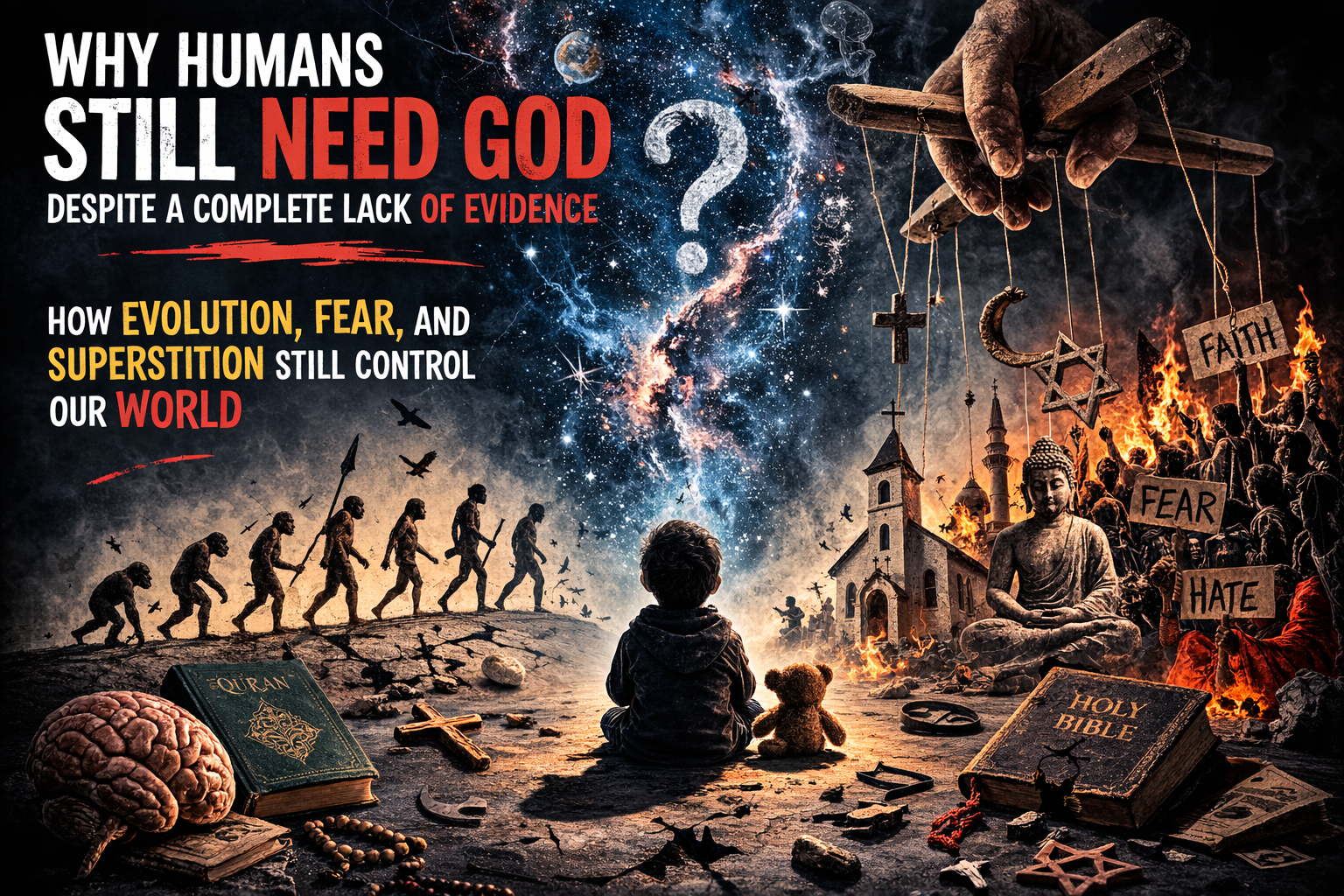
One of the most fascinating questions in human history is not whether gods exist. It is why humans seem to need them. Over the past four centuries, science has steadily explained phenomena once attributed to supernatural forces - lightning, illness, the motion of planets. Today we can map the human genome, land probes on Mars and peer back billions of years into the origins of the universe. And yet belief in supernatural gods remains widespread. Billions of people still accept claims for which there is no empirical evidence: invisible creators, eternal heavens and hells, angels, demons, divine intervention in human affairs. If human thinking were guided primarily by evidence, religious belief should have gradually faded as scientific knowledge expanded. It has not. The reason may lie not in theology but in evolutionary psychology.
The human brain did not evolve to discover objective truth. It evolved to survive. The mental shortcuts that helped our ancestors survive in dangerous environments also produced a deep tendency toward superstition, pattern recognition and agency detection. Those tendencies created fertile ground for religion. Understanding them helps explain why belief persists, why superstition remains powerful and why religious extremism can still take hold in modern societies.
The Brain Evolution Built Was Not Designed for Truth
For most of human history, survival required rapid decisions with limited information. Early humans faced constant threats: predators, hostile groups, food scarcity, disease. In that environment, a specific cognitive bias proved advantageous. If you assume the rustling in the grass is harmless and you are wrong, a predator kills you. If you assume something is out there and you are wrong, you waste energy fleeing from nothing - but you live to try again. Evolution favored the brain that over-detected agency. The brain that required proof often did not survive long enough to pass its caution along.
This cognitive mechanism is called hyperactive agency detection. It allowed early humans to survive real threats. It also made us prone to perceiving invisible agents everywhere - spirits in forests, ancestors watching from beyond, gods controlling storms. The brain that saw intentional forces behind every rustling leaf was the brain that kept breathing. The side effect of that survival advantage is a species permanently inclined to see purpose and intention where none may exist.
The evolutionary preference for assuming a threat is real when it might not be is called false positive bias. Fleeing from wind costs you energy. Ignoring a predator costs you your life. The math is clear. Thousands of generations of that math produced a brain that sees agents - people, spirits, gods - behind events even when none exist. It was a survival shortcut. It became a religious instinct.
Pattern Recognition Is Why Superstition Feels Like Truth
Humans are exceptional pattern detectors. Our brains constantly search for connections between events - an ability that underlies science, mathematics and technological innovation. It also creates illusory patterns. People see faces in clouds, hear hidden messages in random noise and connect unrelated events into narratives that feel meaningful precisely because the brain built them that way.
Early humans interpreted natural phenomena through this pattern-seeking lens. Lightning might follow a ritual. Rain might come after prayer. A successful hunt might follow an offering. Over time those coincidences hardened into belief systems. If a ritual appeared to produce a favorable outcome even once, it could be repeated and transmitted culturally. The result was superstition - not irrationality exactly, but the brain's drive to impose order on an unpredictable world expressing itself through available cultural materials. That drive has not diminished. The materials have changed. The underlying mechanism is identical.
The Comfort of Explanation Is Not Trivial
Another evolutionary factor behind religion is psychological comfort. Uncertainty is genuinely stressful and humans prefer explanations - even incorrect ones - to having none at all. Early humans faced profound mysteries without any scientific framework to answer them. Why do people die? Why do storms strike? Why does disease take children? Why does the sun rise and set with such reliability?
Religion answered all of those questions. Ancestors pass to another realm. Gods are angry. Demonic forces cause illness. A deity maintains cosmic order. Those explanations reduced anxiety by providing narrative structure. Events were no longer random - they were purposeful. Even if the purpose involved punishment or divine anger, the universe felt more understandable. That psychological comfort remains powerful today. For many people the idea that the universe operates without inherent purpose is genuinely unsettling. Religion offers the alternative: a cosmos guided by intentional design, a death that is not simply an ending and a suffering that means something rather than nothing.
Superstition is automatic. Pattern-seeking requires no effort. Comforting explanations feel true before they are examined. Science requires deliberate skepticism, demands evidence over intuition and forces the abandonment of comfort. That asymmetry explains a great deal about why belief persists in educated, technologically advanced societies.
Religion as Social Technology
Beyond psychological comfort, religion served a crucial social function. Large human groups require shared norms to function - cooperation must be maintained, cheating discouraged and trust reinforced across people who do not personally know one another. Religion historically provided the infrastructure for all three. Moral rules became divine commands, which meant breaking them risked supernatural punishment that operated even when no human authority was watching. The surveillance effect of an all-seeing deity is a powerful deterrent with essentially zero enforcement cost.
Anthropologist Ara Norenzayan developed what he calls the Big Gods hypothesis: belief in morally concerned, all-seeing supernatural beings helped stabilize large-scale human cooperation and civilization. Small tribes can enforce norms through personal relationships. Cities and nations cannot. A god who watches everything and punishes cheating in the afterlife solves a coordination problem that secular institutions struggle with even today. That is not an argument for the truth of religious claims. It is an argument for understanding why those claims were adaptive and why they spread.
A system that helped coordinate small agricultural societies can produce serious problems at modern scale - especially when combined with claims of absolute, infallible authority. The same architecture that enforces cooperation within a group can justify violence against those outside it. The Big Gods hypothesis explains the origin and spread of organized religion. It does not justify its worst historical expressions.
Why Religion Turns Extremist
While religion can provide genuine community and meaning, it can also produce extreme ideological systems. When supernatural beliefs get combined with claims of absolute moral authority the result can be dangerous. The mechanism is not mysterious. If a doctrine is believed to originate from a perfect deity, questioning it becomes not merely difficult - it becomes morally forbidden. That rigidity allows extreme interpretations to persist and spread even when they conflict sharply with modern ethical standards, because the standard being applied is not modern ethics but ancient text read by someone certain of their own interpretation.
Most religious believers reject violence. The problem is that extremist factions operate within a framework that treats their sacred texts as infallible - which means moderate voices within the same tradition have no principled ground from which to challenge the extremists' logic. You cannot argue someone out of a position that was never argued into in the first place. You can only assert competing authority, which is exactly what religious reformers throughout history have done, with mixed results.
Meaning Without Gods Is Not the Problem People Think It Is
One of the most common objections to atheism is that it supposedly removes meaning from life. That objection rests on a confusion. Meaning does not require supernatural foundations. Human meaning emerges from relationships, creativity, knowledge and shared experience - none of which depend on divine authority. People find purpose in raising families, building communities, pursuing knowledge, creating art and improving the lives of others. Those sources of meaning arise naturally from the human condition and predate organized religion by whatever measure you choose.
Grounding ethics in human flourishing rather than supernatural obedience also means moral progress is possible. We can improve our frameworks as our understanding grows rather than defending ancient doctrine against all evidence. That flexibility is secular ethics' genuine advantage over revealed religion - not that it is always right, but that it can correct itself when it is wrong.
Recognizing that morality is grounded in human well-being rather than divine command allows ethical systems to evolve as our understanding of the world grows. That flexibility is secular ethics' greatest strength. Ancient doctrine cannot update itself. Human reasoning can.
My Bottom Line
Religion persists not because gods are real but because the cognitive architecture that generates belief was baked into the human brain by evolution long before organized religion existed. Hyperactive agency detection, pattern-seeking and comfort-seeking were survival advantages. Their side effect is a species that sees purpose everywhere, finds meaning in coincidence and builds elaborate systems to explain a universe that may not be explicable in the terms we prefer.
That is not an insult to believers. It is an accurate description of how the human mind works. Understanding it should make us more thoughtful about the difference between what feels true and what is demonstrably true - and more honest about how much of what we believe with certainty is the product of evolved instinct rather than examined evidence.
The long-term trajectory of religious belief may involve a gradual shift from supernatural certainty toward more symbolic interpretations - cultural heritage rather than literal truth, ethical framework rather than cosmological claim. Whether that shift is progress depends on what you think religion was for in the first place. If it was for survival, coordination and comfort, secular institutions can provide substitutes. If it was for truth about the nature of existence, the evidence points elsewhere and always has.
The brain that religion exploits is the same brain that built the telescope. Understanding one is the first step toward mastering the other.
References
- Boyer, P. (2001). Religion Explained: The Evolutionary Origins of Religious Thought. Basic Books.
- Dawkins, R. (2006). The God Delusion. Houghton Mifflin.
- Haidt, J. (2012). The Righteous Mind. Pantheon.
- Norenzayan, A. (2013). Big Gods: How Religion Transformed Cooperation and Conflict. Princeton University Press.
- Pinker, S. (2011). The Better Angels of Our Nature. Viking.
Disclaimer: The views expressed in this post are the personal opinions of the author and are offered for educational, commentary and public discourse purposes only. They do not represent the positions of any institution, employer, organization or affiliated entity. Nothing in this post constitutes legal, financial, medical or professional advice of any kind. References to public figures, institutions, historical events and current affairs are based on publicly available sources and are intended to support analysis and argument, not to state facts about any individual's character, intent or conduct beyond what the cited sources support. Commentary on religious, political and cultural subjects reflects the author's independent analysis and is protected expression of opinion. Readers are encouraged to consult primary sources and form their own conclusions. Any resemblance to specific individuals or situations beyond those explicitly referenced is coincidental.