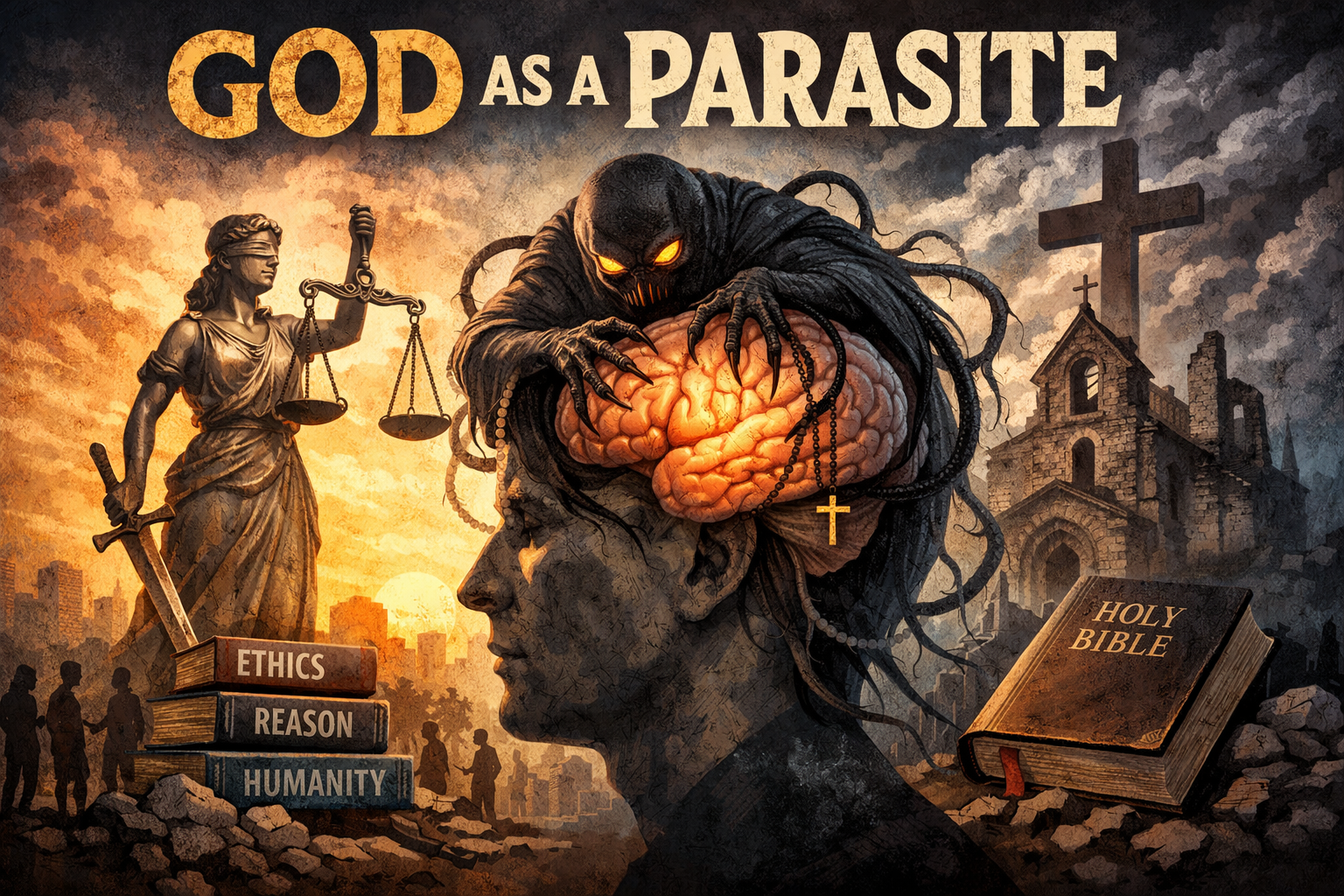
A commenter left an interesting quote under one of my posts about early Christianity and it opened a question I keep returning to: where does morality actually come from? The quote was from the Colombian philosopher Nicolás Gómez Dávila: "God has just become a parasite in souls where ethics predominates." At first glance that sounds like a philosophical jab rather than an argument. But it points directly at the oldest problem in the debate between religion and secular philosophy. For centuries, religious thinkers have insisted that ethics requires God - that without divine authority moral systems collapse into relativism. The opposite argument has grown steadily stronger: human morality appears to arise from social evolution, empathy and reason, not from divine command. If that is true, then Dávila's quote takes on a meaning he likely did not intend. Morality does the work. God gets the credit. That is the parasite relationship.
The Claim That Morality Comes from God Has a 2,400-Year-Old Problem
Most major religions assert some version of the same principle: without God there is no morality. The reasoning goes that moral rules require authority, only God provides ultimate authority, therefore morality depends on God. This argument has enormous emotional power. It suggests that abandoning religion means abandoning the foundation of ethics entirely. But there is a philosophical problem with it that Plato identified before Christianity existed.
In the dialogue Euthyphro, Socrates posed a deceptively simple question: is something good because God commands it, or does God command it because it is good? Each answer creates a serious problem. If something is good simply because God commands it, then morality is arbitrary. Anything could be moral if God commanded it - genocide, slavery, the killing of children. This is not hypothetical. Religious texts contain passages where God commands actions that modern societies consider deeply immoral. Divine command theory reduces morality to obedience to power, nothing more. But the second horn is equally uncomfortable. If God commands things because they are already good, then goodness exists independently of God. Which means we can recognize morality without appealing to religion at all. God becomes a messenger for a standard that was already there - not the source of it.
Either way, the claim that morality depends on God collapses. The dilemma has been sitting there for two and a half millennia. No divine-command theorist has produced a satisfying answer to it. That is worth noting plainly rather than tiptoeing around.
If something is good because God commands it, morality is arbitrary - anything goes with the right command. If God commands it because it is already good, then goodness exists without God. There is no third option. The dilemma has been there for 2,400 years and nobody has solved it.
Where Moral Instincts Actually Come From
Modern science has dramatically expanded our understanding of moral origins. Human morality appears to be rooted in evolutionary social behavior. For social species, cooperation improves survival. Groups that develop norms around fairness, reciprocity, empathy and punishment for cheaters consistently outperform groups that do not. Over time those behaviors become embedded in social structures and human psychology - not because God commanded them but because groups that practiced them outlasted groups that did not.
The evidence is not limited to human societies and that is the part religious apologists prefer to ignore. Proto-moral behavior appears across the animal kingdom. Chimpanzees demonstrate fairness expectations and react strongly to unequal treatment within their groups. Bonobos display empathy and active conflict resolution, consoling distressed individuals without being prompted. Capuchin monkeys protest unequal rewards visibly and vocally, refusing food when they observe others receiving more for the same work. Frans de Waal spent decades documenting this in his research on primate behavior and the implications are straightforward: the building blocks of morality existed long before organized religion. Religion did not create ethics. Ethics emerged from social evolution and religion arrived considerably later to take credit for it.
Even small tribal societies without organized religion develop ethical systems - norms around fairness, harm, reciprocity and care for group members. This is documented across cultures that had no contact with one another and no shared theological tradition. The universality of basic moral intuitions across human societies is evidence of a common evolutionary origin, not a common divine source. Anthropology and evolutionary biology point in the same direction. Religion inherited a moral framework that was already running.
Religion as Moral Branding
If morality already existed, what role did religion actually play? Historically it functioned as a moral amplifier and authority structure - taking existing moral instincts and reframing them as divine commands. Cooperation benefits society becomes God commands you to treat others well. Stealing harms social trust becomes thou shalt not steal. The behavior is identical. The justification changes. This allowed religious institutions to claim ownership over morality. But claiming ownership is not the same thing as creating something. A company that buys an existing technology and puts its name on it did not invent the technology. It branded it.
That rebranding served a real social function. Divine authority is a more powerful enforcement mechanism than social consensus, especially in large societies where personal relationships cannot carry the weight of coordination. If people believe an all-seeing God punishes cheating in the afterlife, the enforcement problem gets solved cheaply. The Big Gods hypothesis in anthropology - developed by Ara Norenzayan - argues that belief in morally concerned supernatural beings helped stabilize large-scale human cooperation precisely because of that enforcement architecture. Religion borrowed moral content from human evolution and gave it supernatural backing. That is a useful social technology. It is not evidence that God authored the morality in the first place.
When Religion and Morality Conflict, We Know Which One Wins
One of the strongest pieces of evidence that morality is independent of religion is what happens when religious teachings conflict with modern ethical standards. The record here is not ambiguous. Religious traditions across history have endorsed slavery and the suppression of women's rights, sanctioned religious persecution and executions for apostasy, prescribed stoning for adultery and condemned homosexuality as an abomination. In most of these cases it was secular moral reasoning that pushed society forward - not religious doctrine. When societies abolished slavery, expanded civil rights and protected individual liberty, they often did so in direct opposition to entrenched religious authority.
That pattern tells you something important about the actual relationship between religion and ethics. Morality evolves. Religious texts do not. When the two collide, societies increasingly choose human ethics over ancient doctrine - and they are right to do so. The moral progress of the last three centuries has come almost entirely from secular sources: the Enlightenment, the abolitionist movement, the suffragist movement, the civil rights movement. All of them faced religious opposition. All of them won. If morality truly flowed from religion, that trajectory would run in the opposite direction.
Morality evolves. Religious texts do not. When the two collide, societies increasingly choose human ethics over ancient doctrine. That is not a coincidence. It is the record.
Secular Ethics Does Not Need God to Function
If morality does not depend on God, what does it depend on? Several philosophical traditions offer well-developed answers grounded entirely in human reasoning about human life. Humanism grounds morality in human well-being - actions are good if they promote flourishing and reduce suffering, with no divine authority required. Utilitarianism evaluates actions by their consequences, maximizing happiness and minimizing harm through an empirical rather than theological standard. Virtue ethics focuses on developing character traits that allow humans to live well in communities - a tradition that dates to Aristotle and predates Christianity by several centuries.
One of the most persistent myths in religious apologetics is that atheism leads to moral collapse. The empirical data does not support this. Some of the least religious societies in the world also rank among the most stable, safe and socially cooperative. Sweden, Denmark, Norway, the Netherlands and Japan consistently appear at or near the top of global rankings for low crime, high social trust and quality of life - and consistently near the bottom for religious observance. This does not prove that religion causes moral failure. It does demonstrate clearly that belief in God is not required for ethical societies to function. The argument from necessity - that we need God for morality - fails on the evidence.
My Bottom Line
Dávila's quote - "God has just become a parasite in souls where ethics predominates" - was almost certainly not intended as a defense of secular ethics. He was a conservative Catholic aphorist with his own complex religious commitments. But from a secular perspective the quote accidentally describes something accurate. If morality already arises from human empathy and social cooperation, then attaching God to it adds no explanatory value. It simply relabels human ethics as divine command. The divine explanation feeds off a system that was running long before religion arrived. Morality does the work. God gets the credit. That is the parasite relationship - and it runs in the opposite direction from what divine-command theory claims.
The debate about religion and morality is not merely academic. It shapes how societies think about law, civil rights, education and scientific progress. If morality truly depended on religion, secular societies should be in moral freefall. They are not. Modern ethical frameworks - built on human rights, individual autonomy and empirical reasoning - have produced the most sustained moral progress in human history. That foundation is more than sufficient. And it has the advantage of being able to correct itself when it is wrong, which ancient doctrine by definition cannot do.
Morality came first. Religion came later. The question is not whether we can be good without God. The question is whether we have been honest about the order of events.
References
- Aristotle. (2009). Nicomachean Ethics. Oxford University Press.
- Dawkins, R. (2006). The God Delusion. Houghton Mifflin.
- de Waal, F. (2013). The Bonobo and the Atheist: In Search of Humanism Among the Primates. W. W. Norton.
- Haidt, J. (2012). The Righteous Mind: Why Good People Are Divided by Politics and Religion. Pantheon.
- Norenzayan, A. (2013). Big Gods: How Religion Transformed Cooperation and Conflict. Princeton University Press.
- Plato. (1997). Euthyphro. In Complete Works. Hackett Publishing.
- Pinker, S. (2011). The Better Angels of Our Nature. Viking.
Disclaimer: The views expressed in this post are the personal opinions of the author and are offered for educational, commentary and public discourse purposes only. They do not represent the positions of any institution, employer, organization or affiliated entity. Nothing in this post constitutes legal, financial, medical or professional advice of any kind. References to public figures, institutions, historical events and current affairs are based on publicly available sources and are intended to support analysis and argument, not to state facts about any individual's character, intent or conduct beyond what the cited sources support. Commentary on religious, political and cultural subjects reflects the author's independent analysis and is protected expression of opinion. Readers are encouraged to consult primary sources and form their own conclusions. Any resemblance to specific individuals or situations beyond those explicitly referenced is coincidental.