- Part 1 — Why Church and State Must Stay Separate
- Part 2 — Suppression of Rivals After 380: When Imperial Backing Ended the Debate
- Part 3 — Holy War and Mob Slaughter: The Crusades in Full
- Part 4 — The Inquisitions: Torture, Fear and the Architecture of Heresy Control
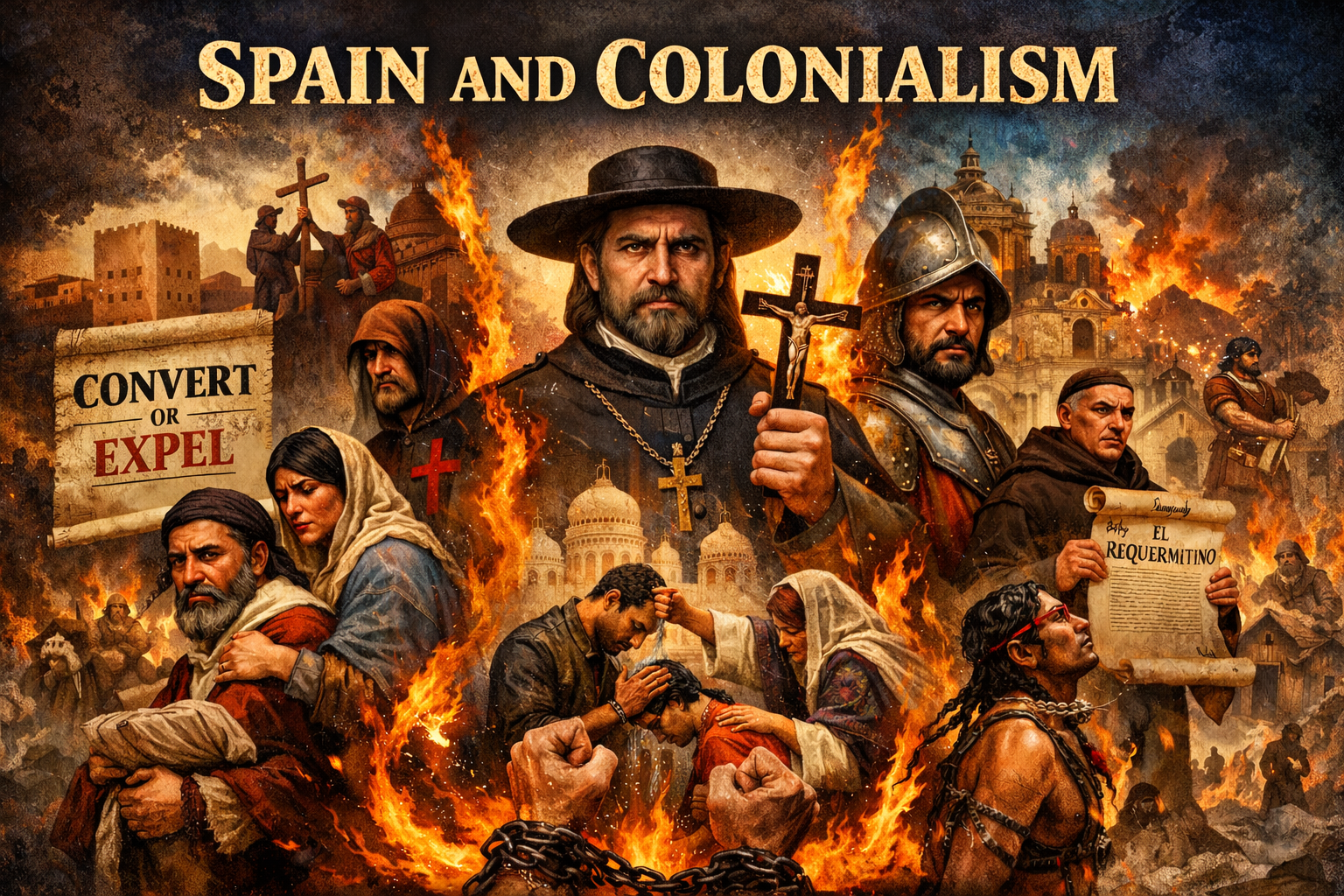
- Part 5 — Forced Conversion and Expulsion: Spain, Goa and the Colonial World (this post)
- Part 6 — The Witch Hunts: Christian Europe's Ugliest Moral Panic
- Part 7 — Colonial Brutality Under a Christian Banner
- Part 8 — Christian-on-Christian Violence: The Confessional Wars
- Part 9 — Moral Cover for Slavery
- Part 10 — Resistance to Modern Liberties: Institutional Christianity vs. the Enlightenment
The missionary impulse at the center of Christian theology has always carried within it the seeds of coercion. A religion that believes it possesses the only path to salvation, that all other paths lead to damnation, and that it is commanded to bring the message to every person on earth is a religion that faces a permanent temptation: when persuasion is too slow or too uncertain, power is available. The history of Christian missions is not uniformly coercive. There were missionaries who learned local languages, respected local cultures and worked through genuine relationship. There were also missionaries who arrived with soldiers, who baptized at swordpoint, who destroyed sacred objects and replaced them with crosses, who reported to colonial administrators who would burn villages that refused the faith. Both traditions exist in the historical record. This post is about the second one - about what happened in Spain in 1492, in Goa in the sixteenth century, in the Americas across three centuries of colonial evangelization - because that tradition has been apologized for, contextualized and minimized in ways that do not survive contact with the documents left behind by the people who carried it out.
Spain 1492: The Alhambra Decree and the End of Medieval Pluralism
The year 1492 is remembered in Western history primarily for Columbus. It is also the year that Ferdinand and Isabella signed the Alhambra Decree, expelling the entire Jewish population of Spain - somewhere between 100,000 and 200,000 people, with scholarly estimates varying - unless they converted to Christianity. Jews had lived in the Iberian Peninsula for more than a thousand years. They had built communities, institutions and intellectual traditions that were interwoven with Spanish civic and cultural life across generations of coexistence that, while never uncomplicated, had produced a degree of interfaith contact unusual in medieval Europe. The Decree gave them approximately four months to convert or leave, forfeiting property and assets that could not be liquidated in time. Many left. Many converted, becoming the conversos who would then face the Spanish Inquisition's suspicion that their Christianity was insincere - that they were secretly continuing Jewish practice behind the facade of baptism. The Inquisition's particular focus on conversos reveals the logic of the entire enterprise: forced conversion was not primarily about saving souls. It was about eliminating a distinct religious community that was perceived as incompatible with the project of a unified Catholic Spain.
The expulsion of the Muslims of Spain - the Moriscos - followed in stages across the sixteenth and early seventeenth centuries. Muslim communities had existed in Iberia since the eighth century and had been gradually incorporated into Christian kingdoms as the Reconquista advanced. They were offered the same choice as the Jews: convert or leave. Many converted. Many conversions were judged insincere, and Morisco communities were subjected to restrictions on language, clothing, naming practices and religious observance designed to extinguish cultural identity as well as religious practice. The final expulsion of the Moriscos was completed between 1609 and 1614, removing an estimated 300,000 people from the peninsula. The human cost of these expulsions was not a byproduct of some other policy. It was the policy. Spain was constructing a religiously unified state, and the method was to make it impossible for non-Christians to remain.
The doctrine of limpieza de sangre - purity of blood - emerged in fifteenth-century Spain as a response to mass conversion and represents one of the uglier logical extensions of religiously motivated ethnic cleansing. Since forced or pressured conversion could not guarantee genuine faith, the argument went, the only reliable guarantee of Christian orthodoxy was ancestry. Conversos and their descendants, regardless of how devout their Christianity was in practice, were suspected of crypto-Judaism because they had Jewish blood. This proto-racial logic - the idea that religious identity was heritable through biology rather than freely chosen through faith - infected Spanish institutional life for generations. Statutes of limpieza de sangre were adopted by the military orders, the cathedral chapters, the universities and eventually the Inquisition itself, barring people with Jewish or Moorish ancestry from various positions and offices. The doctrine contradicted the official theology of baptismal rebirth at every point and was never formally endorsed by Rome. It persisted anyway, because it served the interests of those with old Christian ancestry in excluding the newly converted from competition for power and status. Forced conversion produced a permanently suspect underclass, which the doctrine of blood purity then used to justify their permanent exclusion.
Goa and the Portuguese Inquisition in Asia
The Inquisition of Goa, established in 1561 under Portuguese colonial authority in India, is among the least discussed episodes of Christian institutional coercion in any popular account of the period. It operated for over two and a half centuries, was not abolished until 1812, and was conducted by the same institutional framework - the Dominican inquisitors, the autos-da-fé, the secret denunciations, the torture, the burning of the condemned - that operated in Spain and Portugal, transplanted to a colonial context where it applied not primarily to Christian heretics but to Hindu and Muslim populations who had been compelled or pressured into baptism and were then subject to prosecution if they continued their prior religious practices.
The Portuguese had established Goa as a colonial base in 1510 and the Christianization of the territory proceeded through a combination of incentives and coercion that is documented in the records of the colonial administration itself. Temples were destroyed and replaced with churches on the same sites. Hindu religious practice was prohibited by law in Portuguese-controlled territory. Property and civic rights were conditional in ways that rewarded conversion. Francis Xavier, who spent time in Goa in the 1540s and is now a canonized saint, wrote letters to the Portuguese king requesting that the Inquisition be brought to Goa specifically to deal with the problem of lapsed converts - people who had nominally accepted baptism and then returned to Hindu or Muslim practice. The Inquisition he requested arrived fifteen years after his death and operated for over two hundred years. The victims were not exclusively from non-Christian backgrounds. Portuguese settlers, traders and soldiers also fell under its jurisdiction. But the specific context of a colonial Inquisition applying European heresy-control machinery to populations that had been pressured into baptism in the first place represents a qualitatively distinct form of institutional violence - one that combined religious coercion with colonial domination in ways that neither could have achieved alone.
The Inquisition of Goa applied European heresy-control machinery to populations that had been pressured into baptism in the first place. That is not the suppression of heresy. That is the punishment of people for not believing what they were forced to claim to believe.
The Americas: Evangelization and Extinction
The evangelization of the Americas began with Columbus's second voyage in 1493, which included a company of priests whose mission was to convert the indigenous populations encountered. What followed across three centuries of Spanish, Portuguese, French and English colonial expansion was a process of Christianization inseparable from conquest, dispossession and demographic catastrophe. The indigenous populations of the Americas declined by an estimated 50 to 90 percent in the century following European contact, a catastrophe driven primarily by epidemic disease but also by the violence of conquest, the brutality of forced labor systems and the social disruption of cultural and religious destruction. The missionaries operated within this context and in many cases facilitated it, providing the theological and administrative framework that justified the conquest as a civilizing and saving mission.
The encomienda system, which assigned indigenous populations to Spanish colonizers as a labor force, was defended and organized partly through the Catholic Church's administrative presence in the colonies. The requirement of the Requerimiento - a legal document read aloud to indigenous people before military action, informing them of Christianity and the authority of the pope and demanding their submission, typically in a language they could not understand - was a Church-approved instrument of conquest. Its purpose was not genuine evangelization. It was the production of a legal record that the indigenous population had been offered the opportunity to convert and submit before being conquered by force. The document was recognized as a farce by many of the Spanish soldiers who were required to use it and by some of the priests who observed it. It was used anyway, for decades, because it served the administrative and legal needs of an imperial project that required a religious justification.
The Mission System and Its Costs
The Franciscan, Dominican and Jesuit missions that operated across the Americas, from California to Paraguay to Brazil, represent a more complex chapter than the straightforward violence of the initial conquest. Some missionaries were genuine advocates for indigenous populations against the worst excesses of colonial exploitation. Bartolomé de las Casas, a Dominican friar who had been an encomendero before his conversion to advocacy, produced the most detailed contemporary account of Spanish atrocities against indigenous peoples and spent decades lobbying the Spanish crown for legal protections. His Short Account of the Destruction of the Indies is a document of extraordinary moral courage written from within the system he was criticizing.
But the mission system as an institution, even in its more benevolent expressions, operated on premises that amounted to cultural destruction by design. The California missions run by Junipero Serra - now canonized as a saint - housed indigenous populations in conditions that modern scholars have characterized as coercive at minimum and lethal at worst. Indigenous people were not free to leave. Traditional religious practices were forbidden. Traditional social structures were dismantled and replaced with mission hierarchy. Mortality rates within the missions were dramatically higher than in unconverted indigenous communities nearby. Serra's canonization in 2015 produced sustained protest from indigenous communities who experienced his legacy not as salvation but as the institutional destruction of their ancestors' cultures. Pope Francis canonized him anyway, noting his defense of indigenous people against colonial violence, which was real, while the critics noted that the system he built was itself a form of colonial violence, which was also real.
The Requerimiento, drafted by jurist Juan López de Palacios Rubios in 1513 and used by Spanish conquistadors for decades, is worth examining in detail because it reveals the precise function of religious justification in colonial violence. The document explained the Christian theological history of the world, the authority of the pope as Christ's representative on earth, the pope's donation of the Americas to the Spanish crown, and the requirement that indigenous people submit to Spanish authority and accept Christian missionaries. If they refused or failed to respond in time, the Spanish were authorized to wage war against them, enslave them and take their property. The document was often read in Spanish from a distance, or read to an empty beach before troops advanced, or read in the middle of the night so it could technically be said to have been delivered. Gonzalo Fernández de Oviedo, a Spanish historian who witnessed its use, reported that when he asked Palacios Rubios whether the conscience was satisfied by this reading, the jurist laughed. The laughter did not stop the practice. It continued for forty years because the empire needed the legal record more than it needed the indigenous response to actually happen.
The Pattern Across Cases
Spain in 1492, Goa in 1561, the Americas across three centuries - these are not isolated episodes with different explanations. They are expressions of the same structural logic: a religion with exclusive truth claims, backed by state power, encountering populations it defined as lost and using that definition to justify coercion. The specific form of coercion varied. In Spain it was expulsion and the Inquisition. In Goa it was colonial prohibition and the imported machinery of heresy control. In the Americas it was the full spectrum from legal theater to outright genocide, with mission enclosure and cultural destruction occupying the middle range. What all three cases share is the theological framework that made the coercion seem not just permissible but obligatory: souls were at stake, time was short, and the alternative - allowing people to remain in what the church defined as error and damnation - was morally unacceptable to the people making the decisions.
That framework is worth naming explicitly because it is the same framework that drives contemporary Christian nationalist arguments about the obligation to shape civil law according to Christian moral teaching. The specific content is different. Nobody is proposing the Requerimiento or the expulsion of Jews in twenty-first century America. But the underlying premise - that a religiously defined truth obligates its holders to use available power to bring others into conformity with it - is continuous from 1492 to the present. The history of what that premise has produced when it had state power behind it is the argument this series exists to make visible.
My Bottom Line
The forced conversion and expulsion episodes documented here are not cherry-picked anomalies from an otherwise gentle missionary tradition. They are the predictable outcomes of combining exclusive truth claims with state authority and a theological mandate to convert. They are what happened when the logic of the mission was allowed to operate without constraint. The apologists for this history make two arguments that deserve acknowledgment before being rejected. The first is context: these were different times, different standards, different understanding of what cruelty meant. That is partly true and entirely insufficient. The people being expelled, tortured and destroyed knew it was happening to them. Their suffering was not diminished by the fact that their persecutors believed they were doing God's work. The second is that individual missionaries often acted with genuine compassion and in genuine opposition to the worst excesses. That is also true and also insufficient. Individual decency operating within a coercive institutional structure does not redeem the institution. It describes what ordinary human goodness looks like under conditions of institutional evil - present, insufficient, and used after the fact to argue that the institution was not really what the record shows it was.
The choice was convert, leave or die. Christianity offered it in Spain, in Goa, in the Americas and in a dozen other contexts where it had the power to enforce the demand. That is not the power of a message. That is the power of a state. The distinction matters, and the record makes it impossible to pretend it does not exist.
References
- Kamen, H. (2014). The Spanish Inquisition: A Historical Revision (4th ed.). Yale University Press.
- Netanyahu, B. (1995). The Origins of the Inquisition in Fifteenth Century Spain. Random House. (On conversos and the limpieza de sangre doctrine.)
- Boyajian, J. C. (1983). Portuguese Bankers at the Court of Spain, 1626-1650. Rutgers University Press.
- Pearson, M. N. (1987). The Portuguese in India. Cambridge University Press. (On the Goa Inquisition in colonial context.)
- de las Casas, B. (1542/1992). A Short Account of the Destruction of the Indies. Penguin Classics.
- Restall, M. (2003). Seven Myths of the Spanish Conquest. Oxford University Press. (On the Requerimiento and conquest ideology.)
- Cook, N. D. (1998). Born to Die: Disease and New World Conquest, 1492-1650. Cambridge University Press. (On demographic catastrophe.)
- Hackel, S. W. (2005). Children of Coyote, Missionaries of Saint Francis: Indian-Spanish Relations in Colonial California, 1769-1850. University of North Carolina Press. (On the California mission system.)
- Seed, P. (1995). Ceremonies of Possession in Europe's Conquest of the New World, 1492-1640. Cambridge University Press. (On the Requerimiento as legal ceremony.)
- Hanke, L. (1949). The Spanish Struggle for Justice in the Conquest of America. University of Pennsylvania Press. (On Las Casas and the debate over indigenous rights.)
Disclaimer: The views expressed in this post are the personal opinions of the author and are offered for educational, commentary and public discourse purposes only. They do not represent the positions of any institution, employer, organization or affiliated entity. Nothing in this post constitutes legal, financial, medical or professional advice of any kind. References to historical events, primary sources and academic scholarship are based on publicly available sources cited above. This post examines historical episodes of religiously authorized coercion and does not make claims about contemporary Christianity or individual believers. Commentary on religious and historical subjects reflects the author's independent analysis and is protected expression of opinion. Readers are encouraged to consult primary sources and form their own conclusions.