
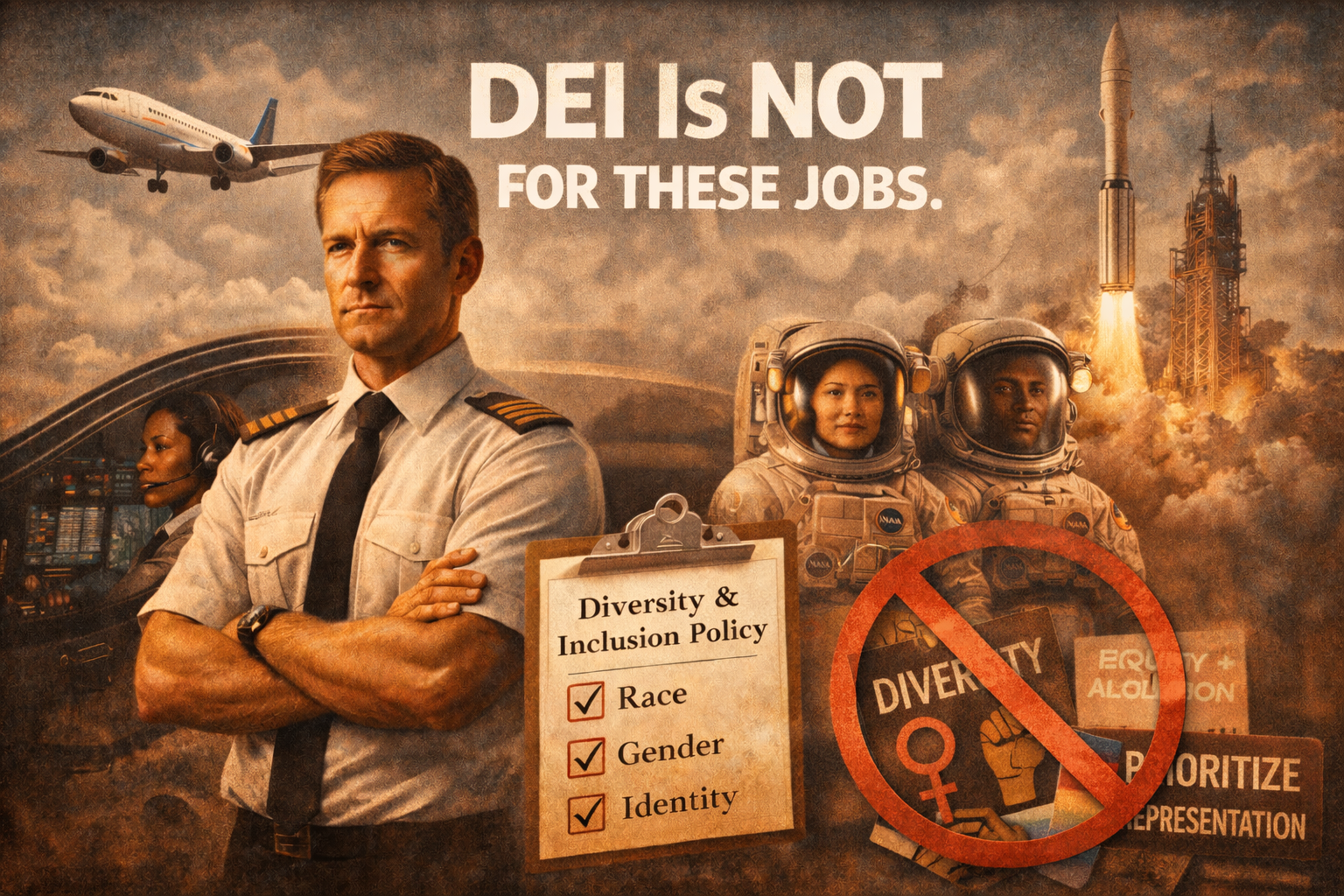
There are areas of life where symbolism is cheap and consequences are expensive. Flying airplanes is one of them. Launching astronauts is another. Running nuclear plants, performing surgery, designing bridges and managing air traffic all belong in the same category. These are not arenas for ideological theater. They are arenas for precision, training, judgment and performance under pressure. That should not require a defense. Yet for years public institutions and large corporations have wrapped hiring, promotion and training in the language of Diversity, Equity and Inclusion, as if the moral prestige of the slogan changes the basic reality of high-risk work. It does not. A cockpit does not care about your politics. Orbit does not care about your narratives. An engine failure at 30,000 feet is not impressed by a diversity statement. The question is not whether people from different backgrounds can excel in aviation, aerospace or any other demanding field. Of course they can. The question is whether standards remain standards, or whether institutions begin treating demographic balancing as a competing objective alongside competence. That is where things get dangerous, and the record of the last several years provides enough specific evidence to make the argument without any abstractions at all.
Meritocracy Exists for a Reason
Meritocracy is not a perfect social system. Institutions make mistakes, biases exist and talent is not always discovered cleanly or fairly. Fine. None of that changes the central point. In fields where lives are on the line, meritocracy is still the least dangerous governing principle available. You want the best pilot, not the most politically useful pilot. You want the best engineer signing off on a component, not the one who helps a company hit a quota, flatter a board or survive a social media campaign. You want astronauts selected because they are the most capable human beings for the mission, not because somebody in an office thinks the crew photo needs a more fashionable moral message. That is not cruelty. That is adulthood.
The entire point of rigorous qualification systems is to separate who wants the job from who can do the job under real conditions. Training hours, test scores, simulations, physical standards, technical mastery and stress performance exist because reality is indifferent to feelings. The laws of physics do not become inclusive because HR changed the wording in a policy manual. When institutions start muddying this principle, trust starts to rot - not just public trust but internal trust. The minute people suspect that race, sex or identity categories are being weighed in ways that compete with competence, every achievement becomes vulnerable to suspicion. That is unfair to the genuinely excellent people who earned their place. It also poisons teamwork because colleagues begin wondering whether the person next to them is there because they were the best or because the institution wanted a press release.
A cockpit does not care about your politics. Orbit does not care about your narratives. An engine failure at 30,000 feet is not impressed by a diversity statement. The laws of physics do not become inclusive because HR rewrote the policy manual.
The Problem Is Not Diversity. The Problem Is Priority.
This is where the usual dishonest framing begins. Critics of DEI in safety-critical fields are routinely accused of opposing diversity itself. That is lazy and evasive. A diverse workforce can happen naturally when institutions widen pipelines, improve access to preparation, recruit broadly and then hold everyone to the same hard standard. No serious person should object to any of that. The problem begins when diversity stops being an outcome and becomes an operational priority that competes with merit. Once that happens, the mission gets bent around ideology.
NASA incorporated equity and DEIA language explicitly into strategic planning and budget documents in recent years. The FAA advanced DEI planning under prior leadership, including a strategic framework that tied diversity, equity, inclusion and accessibility to agency culture and performance metrics. Both agencies built administrative infrastructure around demographic goals that sat alongside - and in some cases ahead of - the performance objectives that justified their existence. Then in February 2026 the FAA announced a mandatory merit-based pilot hiring specification for Part 121 air carriers. The administrator's statement was direct: race, sex and creed have nothing to do with the ability to fly and land aircraft safely. That contrast tells the story. Institutions flirt with fashionable abstractions until reality walks back into the room. Eventually somebody has to say the obvious out loud. That somebody should not have needed to say it at all.
There is a distinction that too many people pretend not to see. Equality of opportunity means removing illegitimate barriers. You recruit widely, judge fairly, train seriously and hold everyone to the same standard. That is worth doing and nobody serious objects to it. Equity, as the term is used in modern bureaucratic language, usually means something different: managed outcomes. It means looking at demographic disparities and altering process, emphasis or selection until the numbers look morally acceptable to the people in charge. That is not neutral administration. That is social engineering. Once you move from opportunity to outcome management, merit starts taking hits. Not always all at once. More often the corruption is softer: standards get re-examined, tests get reframed as barriers, selection processes become holistic, definitions of excellence become more elastic. Political language starts crowding out performance language. The Supreme Court's 2023 decision in Students for Fair Admissions did not deal with pilots or surgeons but it restated a principle that travels: institutions do not get moral permission to sort human beings by race simply because they prefer a socially engineered outcome. That logic applies wherever the outcome being engineered is measured in bodies when it goes wrong.
Symbolism Kills Trust in High-Stakes Work
Aviation and spaceflight depend on trust more than almost anything else. Passengers trust unseen mechanics, controllers, software designers, maintenance supervisors and pilots they will never meet. Astronauts trust entire chains of technical judgment built by people across multiple institutions and generations. That trust only works when those institutions are believed to be ruthless about competence and indifferent to everything else. The minute they are seen as softening that ruthlessness around political demands, the trust degrades.
This is one of the most destructive side effects of DEI ideology in high-consequence work, and it compounds an injustice that goes unremarked. Even when a selected person is excellent - and many are, because excellent people come from everywhere - the institution damages that person by advertising identity as a point of institutional pride. It takes someone who may have fully earned the role and wraps that person in a cloud of uncertainty they did not create and cannot dispel. That is not progress. It is reputational vandalism visited on the very people the institution claims to be elevating. The strongest respect you can show a high-performing person is to say: you met the standard, period. No asterisk. No ideology. No patronizing applause. If a pilot, engineer or astronaut is first-rate, treat that person like a first-rate professional and let the work speak without the moral marketing campaign attached.
The Sane Alternative
The answer is not exclusion and it is not nostalgia. The answer is not the fantasy that only one kind of person is capable of excellence. The answer is simpler and less dramatic than either side of the political argument usually allows. Recruit widely. Train hard. Measure honestly. Select the best. Promote by performance. Correct actual bias where you find it with specific evidence. Keep standards clear, public and consistently applied. Stop moralizing demographics. Stop treating every statistical disparity as automatic evidence of institutional sin requiring demographic intervention at the selection stage.
If the goal is more excellent candidates from underrepresented backgrounds in aviation and aerospace, build stronger early pipelines. Improve STEM education in underserved communities. Expand access to serious flight training programs. Mentor talent before the selection stage, not at it. Fund the preparation that makes the standard achievable for more people. Those are legitimate ways to broaden opportunity without corrupting the standard that protects the public. But once the selection moment arrives the ideology has to leave the room. No passenger boarding a commercial flight wants to hear that the airline balanced several institutional values when choosing the person in the cockpit. They want the best qualified pilot available. Every sane person knows it. The rule is not complicated. It has never been complicated. The resistance to stating it plainly has been entirely political.
My Bottom Line
DEI has no business displacing meritocracy in any field where mistakes can kill people. Not aviation. Not aerospace. Not medicine. Not engineering. Not any field where competence is the thin line between routine success and irreversible disaster. That is not an argument against people. It is an argument against a bad governing philosophy applied to the wrong domain. Identity politics is a luxury belief when applied to high-risk work. It is the kind of indulgence comfortable institutions afford themselves until reality reasserts itself with a crash report, a system failure or a catastrophic loss of public trust that takes years to rebuild.
The FAA's February 2026 announcement was the right call and should not have required a change in administration to produce. The principle it restated was available to the people who built the DEI framework into agency operations. They chose not to apply it. That choice had costs that were predictable in advance and are now being corrected in public. The lesson is simple enough: open the door to everyone, hold the bar where it belongs, pick the best and then fly the plane. A society that cannot say that out loud without political recrimination has a problem that goes well beyond aviation.
Once institutions teach themselves to subordinate excellence to ideology, they do not stop neatly at one department. The habit spreads. Standards become negotiable. Language becomes evasive. Common sense has to sneak in through the back door disguised as courage. A serious society cannot function that way for long.
References
- Federal Aviation Administration. (2022). Annual EEO Program Status Report for Fiscal Year 2021. faa.gov.
- Federal Aviation Administration. (2026, February 13). New mandatory OpSpec A134, merit-based pilot hiring, for certificate holders conducting operations under 14 CFR Part 121. faa.gov.
- Federal Aviation Administration. (2026, February 13). Transportation Secretary Sean P. Duffy statement on merit-based pilot hiring. faa.gov.
- NASA. (2022). NASA's Equity Action Plan. nasa.gov.
- NASA. (2024). FY 2025 Budget Agency Fact Sheet. nasa.gov.
- NASA. (2024). FY 2025 Volume of Integrated Performance. nasa.gov.
- Students for Fair Admissions, Inc. v. President and Fellows of Harvard College, 600 U.S. 181 (2023).
Disclaimer: The views expressed in this post are the personal opinions of the author and are offered for educational, commentary and public discourse purposes only. They do not represent the positions of any institution, employer, organization or affiliated entity. Nothing in this post constitutes legal, financial, medical or professional advice of any kind. References to federal agency documents, court decisions and published materials are based on publicly available sources cited above. Commentary on workplace policy and institutional practices reflects the author's independent analysis and is protected expression of opinion. Readers are encouraged to consult primary sources and form their own conclusions.