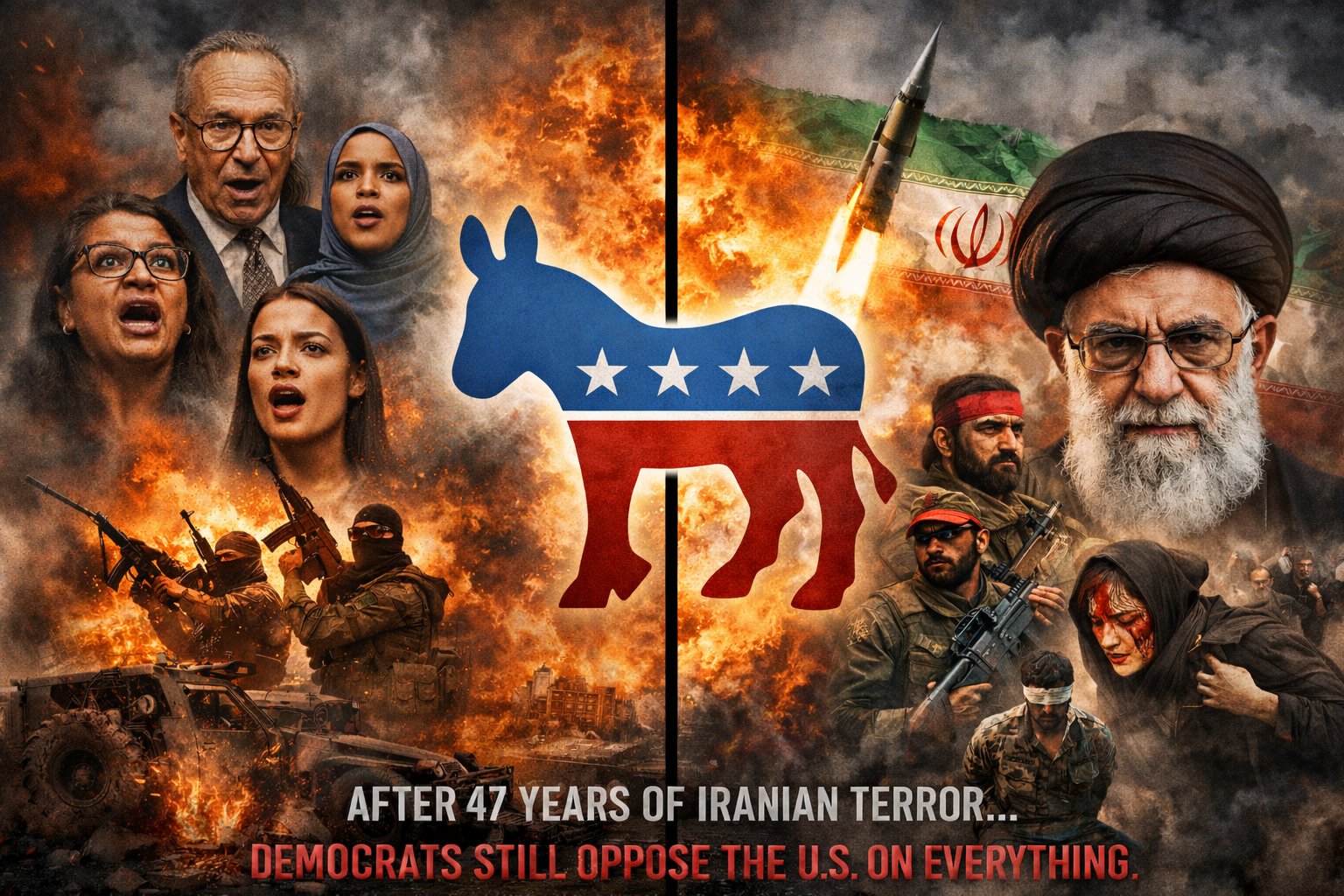
At some point a political party has to decide what it actually stands for, as opposed to what it is against. The modern Democratic Party has not made that decision. What it has decided, with remarkable consistency since the 2016 election, is that opposition to Donald Trump is a complete political program - that the visceral rejection of everything he says, does, appoints and signs is sufficient substitute for having a governing vision of their own. The results of this strategy are visible in election returns, in polling and in the daily spectacle of Democratic lawmakers performing outrage for cameras in ways that would embarrass a high school debate team. They have turned resistance into a brand, obstruction into an identity and the theater of protest into a substitute for the work of actual opposition. None of it has worked. None of it will work. And the country, which has real problems requiring serious engagement from both parties, is paying the price for a Democratic Party that has confused emotional expression with political strategy.
What the Antics Actually Look Like
The catalogue of Democratic performance politics since 2017 is extensive enough to fill a book and depressing enough that nobody should have to read it. Members of Congress walking out of joint sessions. Committee hearings turned into theater where the goal is the clip rather than the answer. Cabinet confirmation hearings used to audition for cable news rather than evaluate nominees. Press conferences held on the Capitol steps to announce opposition to things that have not happened yet. Votes against legislation that Democrats themselves proposed in previous sessions because Trump was now proposing something similar. The reflex is so complete and so automatic that it has become self-parody. The party that once produced Lyndon Johnson's legislative machine and John Kennedy's foreign policy vision now produces walking-out-of-rooms as its signature contribution to American governance.
The cabinet confirmation process is the purest expression of this. Every nominee, regardless of qualifications, background or the actual merits of their appointment, is greeted with the same performance: the ritual denunciation, the portentous questions designed to produce a soundbite rather than information, the coordinated vote against confirmation regardless of what the hearing revealed. A party that opposes everything has told the electorate that its judgment cannot be trusted on anything, because judgment requires discrimination and discrimination requires actually evaluating cases on their merits. When everything is disqualifying, nothing is.
A party that opposes everything has told the electorate that its judgment cannot be trusted on anything. When everything is disqualifying, nothing is. The voters noticed before the strategists did.
The Iran Strike and Forty-Six Years of Excuses
The Democratic response to American military action against Iranian nuclear facilities is a useful case study in how performance politics produces the opposite of its intended effect. The reaction from the left followed the familiar script: reckless, dangerous, no congressional authorization, risks wider war, international law, allies not consulted. Some of those concerns are legitimate procedural arguments about executive war powers that deserve serious engagement in the appropriate venue. What they are not is a serious engagement with the underlying question, which requires starting at the beginning. Iranian revolutionaries seized the United States Embassy in Tehran in November 1979 and held American diplomats hostage for 444 days, with Iran's revolutionary leadership backing the takeover. That was not a diplomatic misunderstanding. It was a declaration of the terms of the relationship, and the terms have not changed in the nearly half century since.
The Council on Foreign Relations documents that Iran, through the IRGC and especially the Quds Force, has spent decades training, funding and arming proxy groups hostile to the United States across Lebanon, Iraq, Syria, the Palestinian territories and Yemen - providing weapons, money, training and military advice specifically to project Iranian power and push Western influence out of the region. The GAO's terrorism-victims report addresses compensation for victims of the 1983 Beirut barracks bombing, which killed 241 American servicemembers, and the 1996 Khobar Towers bombing, which killed 19 Americans - both long associated with Iran-backed networks. Iran armed and supported the Iraqi militias through the IRGC and Quds Force that used EFP roadside bombs to kill hundreds of American soldiers between 2003 and 2011. The Houthis, armed and directed by Tehran, have fired hundreds of missiles at American bases and attacked commercial shipping in the Red Sea. Iran helped keep Assad in power in Syria by deploying Hezbollah and other proxy militias into the civil war. And according to Human Rights Watch, Iranian authorities in 2025 carried out executions on a scale not seen since the late 1980s and killed thousands of their own protesters and bystanders in the 2026 crackdown.
That is the record. Not a selective reading of it. Not a neoconservative threat inflation. The record, sourced from the Council on Foreign Relations, the GAO, and Human Rights Watch - organizations that are not known for their warmongering tendencies. Iran has taken American hostages, backed anti-American terrorism, built proxy armies across an entire region, destabilized neighboring states, attacked dissent at home and murdered its own citizens to preserve the regime. Every administration from Carter through Biden managed this accumulating record with sanctions, diplomacy, proxy engagement and strategic patience. The result is a Iran closer to a nuclear weapon than at any point in history, with a regional proxy network more capable than it has ever been, having absorbed zero military consequences serious enough to alter its strategic behavior. The argument that striking Iranian nuclear facilities is reckless requires you to believe this trajectory leads somewhere better. The Democratic position, stripped of its procedural packaging, is that consequences should not be applied because consequences are dangerous. That is not a foreign policy. It is a preference for a problem that never gets resolved over a risk that might produce resolution. Eight presidents chose the preference. The problem got worse every decade.
The JCPOA - the Iran nuclear deal negotiated under Obama - was the most ambitious diplomatic attempt to address the nuclear dimension of the Iran problem. Iran negotiated it, accepted its terms and received substantial sanctions relief in return. The United States withdrew from the agreement under Trump. Iran then accelerated its enrichment program beyond the levels permitted under the deal it had agreed to. The lesson the Iranians drew from this sequence was not that diplomacy works. It was that enrichment should continue because the leverage it provides is the only thing that produces concessions. The Democratic argument that the deal should have been maintained is a defensible one. The Democratic argument that diplomacy is the right approach and military action is categorically wrong requires ignoring what forty-six years of diplomacy and no military consequences actually produced. A theory of change is not foreign policy. A track record is.
The Cost of Permanent Opposition
The Democratic Party's performance politics strategy has a cost that its practitioners seem genuinely unable to perceive, possibly because they are insulated from it by the media environment they live in. The cost is credibility. When a party opposes everything with equal intensity, it has no credible signal left for the things that actually deserve opposition. When every Trump action is described as uniquely catastrophic, uniquely dangerous and uniquely unprecedented, the warnings lose their force even among people who are inclined to take them seriously. Crying wolf is not a metaphor. It is a description of what happens to political messaging when the messenger has trained the audience to discount it by applying maximum alarm to minimum cause, repeatedly and without apparent awareness of the effect.
There are legitimate things to oppose in the current administration. There are legitimate concerns about executive power, about specific policy choices, about the pace and scope of institutional changes. Those concerns deserve serious articulation from a serious opposition party that has earned the audience's trust by demonstrating that it can tell the difference between a serious problem and a performance opportunity. The Democratic Party has not earned that trust in the current cycle because it has not demonstrated that discrimination. It has treated everything as equally outrageous, which means it has told the electorate that its outrage is a mood rather than a judgment. Moods do not win elections. Judgments do.
What a Real Opposition Party Does
A serious opposition party does several things the current Democratic Party is conspicuously failing to do. It develops specific policy alternatives rather than generic opposition to the other side's proposals. It identifies genuine overreach and distinguishes it carefully from policy disagreement, so that when it says something is a constitutional crisis, the word means something. It engages with the concerns of the voters it has lost rather than treating those voters as the problem to be educated. It wins arguments by being more persuasive than the other side rather than by being louder, more indignant or more creative in its methods of disruption.
The walking-out-of-chambers maneuver is a good symbol for where the party is. It accomplishes nothing procedurally. The session continues without the Democrats present. Their absence does not stop the vote, delay the legislation or produce a different outcome. What it does is generate a clip for the members' social media feeds, which their base applauds and which everyone else either ignores or files under further evidence that these people are not serious. The audience that matters - the persuadable middle of the electorate that decides elections in competitive states - does not watch the clip with admiration. They watch it and conclude, not unreasonably, that the people walking out would rather perform than govern. They are correct. And until the Democratic Party develops a reason to be voted for rather than a list of reasons to be appalled by the other side, the performance will keep producing the same results.
My Bottom Line
The country needs a functioning opposition party. That is not a partisan statement. Single-party dominance, however temporary, produces bad governance because competition and accountability are what make democratic institutions self-correcting over time. A Democratic Party that has replaced policy with performance, argument with outrage and governing vision with the perpetual rejection of everything the other side does is not fulfilling that function. It is a support group for people who are upset about the election results, and support groups, whatever their therapeutic value, do not produce legislation, shape foreign policy or provide the country with an alternative set of ideas about how to be governed. The Iran strike deserved serious engagement, not reflexive denunciation. The cabinet deserves evaluation on the merits, not ritual opposition. The administration deserves a real opponent, not a drama club. The Democratic Party should decide which of those things it wants to be. The clock on that decision is running.
Opposing everything is not a strategy. It is a posture. Postures do not win elections, do not produce legislation and do not provide the country with the serious opposition it needs. The tantrum has been running for nearly a decade. It is time to grow up or get out of the way.
References
- Council on Foreign Relations. (2024). Iran's Foreign and Defense Policies. cfr.org. (On IRGC/Quds Force proxy network, training, funding and regional strategy.)
- U.S. Government Accountability Office. (2023). Terrorism-Related Compensation for Victims of State-Sponsored Terrorism. gao.gov. (Addresses Beirut barracks bombing 1983 and Khobar Towers 1996.)
- Human Rights Watch. (2025). Iran: World Report 2025. hrw.org. (On mass arrests, executions and protest crackdowns.)
- Human Rights Watch. (2026). Iran: Security Forces Kill Thousands in 2026 Crackdown. hrw.org.
- U.S. Department of Defense. (2024). Casualty Reports: Iran-Backed Militia Attacks on U.S. Forces. defense.gov.
- Arms Control Association. (2024). Iran Nuclear Agreement at a Glance. armscontrol.org. (On JCPOA history and enrichment acceleration post-withdrawal.)
Disclaimer: The views expressed in this post are the personal opinions of the author and are offered for educational, commentary and public discourse purposes only. They do not represent the positions of any institution, employer, organization or affiliated entity. Nothing in this post constitutes legal, financial, military or professional advice of any kind. Commentary on political parties, elected officials and foreign policy reflects the author's independent analysis and is protected expression of opinion. References to historical events are based on publicly available sources. Readers are encouraged to consult primary sources and form their own conclusions.