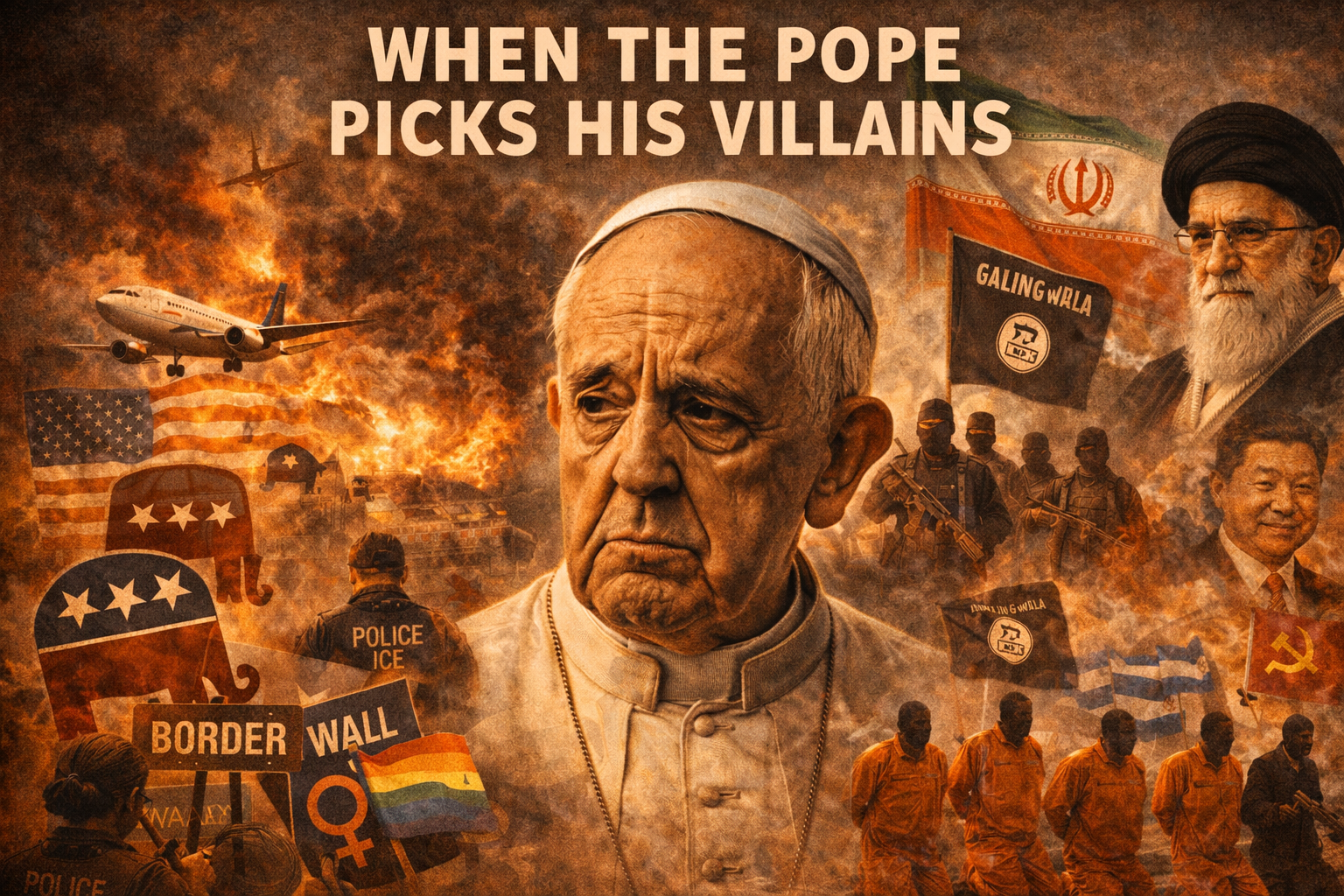
The Bishop of Rome is supposed to be the universal pastor of the Catholic Church and a moral voice that transcends the political alignments of any particular nation or ideology. That is the job description. Pope Francis, who died April 21, 2025, spent his papacy testing how far that description could be stretched before it broke. His successor, Pope Leo XIV - Robert Francis Prevost, a Chicago-born Augustinian friar elected May 8, 2025 - has continued in the same vein. Leo has called for dialogue over the Iran strikes, pressed the migration cause with urgency and positioned himself as a peacemaker willing to confront the Trump administration in terms his predecessor would have recognized. What the Vatican under both Francis and Leo has not delivered, with anything like equivalent urgency or frequency, is moral condemnation of the Iranian regime that has sponsored terrorism against American forces and allies for forty-six years, executed protesters at historic rates and driven Christians from their ancestral communities across the Middle East. Nor has it delivered serious named attention to the wholesale slaughter of Christians in northern Nigeria, which has been ongoing for years and which the international community has largely declined to call what it is. The asymmetry is not subtle. It is consistent. And consistency is what separates a pattern from a coincidence.
What the Vatican Has Said About America
The record of papal commentary targeting American policy runs across two papacies and shows no sign of changing with the transition. Francis called Trump's border wall plans not Christian in a 2016 interview - a remarkable intervention in the democratic politics of a sovereign nation by a foreign head of state who had just returned from Mexico. He repeatedly framed American immigration enforcement as a humanitarian crisis requiring moral condemnation, using language that mapped cleanly onto the Democratic Party's messaging. His successor Leo XIV has taken up the same posture. Leo has spoken forcefully on migration and peace, Britannica notes that within the first year of his papacy he showed himself "unafraid of speaking out on such issues as war and the rights of migrants." When American forces struck Iranian nuclear facilities in 2026, the Vatican's response was to call for dialogue and express concern about escalation - a position that aligns precisely with the progressive foreign policy critique while ignoring the forty-six-year documented record of Iranian state violence that made the strikes defensible.
Leo XIV's background makes the pattern worth examining carefully. He is the first American pope, born in Chicago, formed as an Augustinian missionary in Peru for decades. That formation - deeply immersed in Latin American Catholicism and its tradition of alignment with the poor against powerful northern interests - is not a neutral orientation when it comes to evaluating American immigration enforcement and military action. Leo chose his papal name in honor of Leo XIII, who developed Catholic social teaching, specifically describing it as a response to the challenges of a new industrial revolution and artificial intelligence. That is a man with a social justice framework built into his papacy by design. None of that is disqualifying. It explains the positions. The question is whether it also explains the silences.
The Vatican condemns American border enforcement with specific named urgency and calls the Iran strikes reckless. Iran's execution of Christians, the slaughter of Nigerian congregations and the expulsion of bishops in Nicaragua get diplomatic restraint. That is not a pastoral balance. It is a political one.
What the Vatican Has Not Said About Iran
Iran's revolutionary government has been killing people for its theology since 1979. It executed thousands of political prisoners in 1988 in summary killings that Amnesty International has characterized as crimes against humanity. It has executed gay men for the act of homosexuality. It has arrested, tortured and imprisoned religious minorities including Christians, Baha'is and Zoroastrians. It has sponsored terrorism against Jewish communities on multiple continents, most infamously the 1994 AMIA bombing in Buenos Aires that killed 85 people. It supplies the Houthis with the missiles landing near Red Sea shipping lanes. Human Rights Watch documented that Iranian authorities carried out executions in 2025 at a scale not seen since the late 1980s and that security forces killed thousands of protesters in 2026.
Neither Francis nor Leo has condemned any of this with the directness and repetition the Vatican brings to American immigration policy. When American forces struck Iranian nuclear facilities in 2026, the response was dialogue. The theological question neither pope appeared to ask is whether forty-six years of documented state terrorism, proxy warfare and the active pursuit of nuclear weapons constitute a situation in which the just war tradition - which the Catholic Church developed and has maintained for centuries - might apply. The just war framework exists precisely for situations like this. The Vatican chose not to use it. It chose dialogue instead, which costs the Vatican nothing and obligates Iran to nothing.
The killing of Christians in Nigeria's Middle Belt and northern states by Fulani militant herdsmen and Boko Haram affiliates has produced casualties that by any reasonable measure constitute a humanitarian crisis. Open Doors has consistently ranked Nigeria among the most dangerous countries in the world for Christians, with thousands killed annually and hundreds of thousands displaced. Villages have been burned, churches destroyed and communities that existed for generations eliminated. The Vatican's response has been minimal - general references to persecuted Christians without the specific named urgency applied to American immigration enforcement. The asymmetry is not explained by the relative severity of the situations. It is explained by the relative political utility of the condemnations. Criticizing American policy generates global progressive applause. Condemning the killing of Nigerian Christians by Muslim militants generates silence from the same audience and complicates the interfaith dialogue agenda that has been a priority of both recent papacies. Leo XIV, for all his emphasis on building bridges and dialogue, has not yet named Nigeria the way he has named the Trump administration's policies. That choice has consequences for the people whose deaths are not being named.
The Pattern of Selective Moral Urgency
The consistency of the pattern across two papacies makes it impossible to dismiss as the quirk of a single pope's formation or personality. The Vatican has been vocal about climate change, the arms industry, economic inequality and the treatment of migrants - all positions that align with the political program of the Western European and American left. It has been notably quieter about the persecution of Catholics and Christians under Communist regimes in China, Cuba and Nicaragua, where the Church's institutional interests in maintaining access and avoiding confrontation provide a more plausible explanation for the restraint than pastoral neutrality. It has been quieter about the theological content of Islam's treatment of apostates, women and religious minorities in countries where Islam is the governing ideology - a restraint never explained by theological principle but easily explained by the politics of interfaith relations.
Leo XIV is, by most accounts, a genuine moderate - neither the ideological progressive that some cardinals feared nor the traditionalist that others hoped for. His selection of the name Leo, his restoration of some liturgical traditions altered by Francis, his reputation as a calm and balanced administrator all suggest a man trying to hold the center of a fractured institution. None of that changes the observable pattern. When a moral voice consistently targets one side of a political argument and consistently restrains itself from targeting comparable conduct on the other side, the voice has become a political actor wearing the clothes of a pastor. The problem is not the content of any individual statement. The problem is the systematic asymmetry that reveals the selection criteria. A church leader who condemns American border enforcement as inhumane while maintaining studied silence about Iran's execution of Christians and the mass killing of Nigerian congregations is not applying a consistent moral standard. He is applying a political filter and calling it theology.
What the Vatican's Silence Costs
There are Catholics in Iran who practice their faith in hiding because public Christianity brings state attention that ends in imprisonment or worse. There are Catholics in Nigeria who have buried their priests, neighbors and children because of religiously motivated violence their government has not suppressed and the international community has not demanded be suppressed. There are Catholics in Nicaragua whose bishops have been expelled by a government treating the Church as a political enemy. For all of these people, the Vatican's moral authority is potentially the most powerful external support available - an institution with global reach, diplomatic relationships and the spiritual standing to make its silence a political statement when it chooses silence.
When the Vatican uses that authority to lecture the Trump administration about deportation policy and then maintains diplomatic restraint about governments actively persecuting its own flock, it is making a choice about whose suffering gets the moral megaphone. That choice has consequences for the people whose suffering does not get it. It tells them that the universal pastor has found their situation less useful for his purposes than the situations he chooses to address. Leo XIV is early in his papacy and the record is still being written. But the pattern established under Francis and continued through the first year of Leo's tenure deserves honest examination rather than the deference the mainstream press consistently extends to Vatican statements about American policy.
My Bottom Line
Popes have always been political actors as well as religious leaders. The papacy is a sovereign state with diplomatic relationships and institutional interests that shape its public positions in ways that cannot be fully separated from its theological ones. That is not new and it is not unique to either Francis or Leo. What is notable is the degree to which the political alignment has become visible and consistent across papacies, and the degree to which the press has accepted the Vatican's framing of its positions as purely pastoral rather than examining the pattern of selection that reveals them as something more specific. Leo XIV is a man of apparent genuine faith and genuine concern for the poor. He is also a man whose public moral interventions in his first year have continued the pattern of targeting American conservatism while maintaining diplomatic restraint about the actors and governments that the American left prefers not to confront. A serious Catholic - or a serious observer of any faith tradition - should be able to hold both of those things at once and name what the pattern means without pretending the selectivity is not there.
If the standard for moral condemnation is atrocity, then Iran, Nigeria and Nicaragua are on the list. If the standard is political utility, they are not. The Vatican has been applying the second standard while claiming the first. Americans are not stupid. They can see which rule is actually being enforced.
Disclaimer: The views expressed in this post are the personal opinions of the author and are offered for educational, commentary and public discourse purposes only. They do not represent the positions of any institution, employer, organization or affiliated entity. Nothing in this post constitutes legal, financial, medical or professional advice of any kind. References to papal statements, human rights reports and historical events are based on publicly available sources. This post critiques specific public statements and documented patterns of institutional behavior and does not make claims about the personal sincerity or spiritual character of Pope Leo XIV, Pope Francis or any individual. Commentary on religious and political subjects reflects the author's independent analysis and is protected expression of opinion. Readers are encouraged to consult primary sources and form their own conclusions.