Judge J. Michael Luttig is a serious person. He served on the Fourth Circuit Court of Appeals for fifteen years, was on the short list for the Supreme Court under George W. Bush and has a reputation as a serious constitutional scholar. He also advised Mike Pence that the vice president had no authority to unilaterally reject certified electoral votes on January 6 - advice that was correct, that Pence followed and that the system validated when Biden was inaugurated on January 20, 2021. The constitutional crisis Luttig warned about in that context did not materialize, because the mechanisms he trusted held. That should have been a data point worth carrying forward. Instead Luttig has spent the four years since producing a sustained series of increasingly alarming predictions about Trump's intentions toward democratic governance, predictions that are now being amplified by the Trump Resistance Movement under the banner of a third term seizure and a willing vice president primed to steal the 2028 election. The argument deserves the same serious examination that Luttig's reputation invites. It does not survive that examination.
The 2020 Argument and What It Actually Proved
Luttig's argument starts with January 6: Trump tried to overturn the 2020 election, therefore he may try to overturn future elections. The first part of that sentence is disputable in its framing and important to examine carefully. Trump contested the 2020 election results through a combination of legal challenges, public pressure on state officials, pressure on Pence to delay certification and the rally that preceded the Capitol breach. Every legal challenge failed in court, including before judges Trump himself had appointed. State officials in Georgia, Arizona, Pennsylvania and Michigan - several of them Republicans - certified the results. Pence followed Luttig's own advice and certified the election. Congress completed certification after the Capitol was cleared. Biden was inaugurated. The system, in other words, worked. Every institution that was supposed to hold held. Every check that was supposed to operate operated.
If the evidence that democracy is fragile is that a sitting president challenged an election result through legal and political channels and was defeated at every stage by constitutional processes functioning as designed, then democracy is considerably more robust than Luttig's framing suggests. The appropriate lesson from January 6 is not that the system is on the edge of collapse - it is that the system absorbed a serious stress test and held. That is actually an argument for the durability of the institutions, not for their imminent demise. Luttig draws the opposite lesson and has been drawing it for four years while the institutions keep not collapsing.
Every court rejected the 2020 challenges. Every state official certified the results. Pence certified the election. Biden was inaugurated. If that record proves democracy is fragile, then fragile is doing a lot of heavy lifting in this argument.
The Vance Gambit and What the Law Actually Says
The specific new alarm in Luttig's October 2025 Atlantic piece - the claim being amplified in the graphic circulating now - is that JD Vance, as a "willing" vice president, could preside over the certification of the 2028 election and decline to certify a result that went against Trump. This is presented as the mechanism by which a third term seizure becomes possible. There is a significant problem with this scenario: Congress already addressed it. The Electoral Count Reform Act of 2022, passed with bipartisan support specifically in response to the January 6 controversy, clarified beyond reasonable legal ambiguity that the vice president's role in certifying the electoral count is purely ministerial. The vice president cannot reject, delay or substitute alternate slates of electors. The act requires that governors certify results, that Congress count those certified results and that the vice president announce the outcome. Luttig himself was one of the expert voices who supported this legislative clarification. He knows what it says. He wrote and spoke about it extensively. The scenario he is now warning about would require not just a willing vice president but the wholesale abandonment of a federal statute that was designed precisely to prevent that scenario.
Beyond the statutory question, there is the constitutional one. The 22nd Amendment prohibits any person from being elected to the presidency more than twice. It does not contain an exception for vain men who want a third term. It does not have a carve-out for vice presidents who are willing to facilitate constitutional violations. It is one of the shorter and clearer provisions in the Constitution and it has been in force since 1951. The suggestion that Trump would simply ignore it, that Vance would cooperate in ignoring it and that the entire federal judiciary, the Congress, the Secret Service, the military chain of command and the rest of the constitutional architecture would stand aside while this happened is not a serious constitutional analysis. It is an anxiety scenario presented in the language of constitutional scholarship.
The Electoral Count Reform and Presidential Transition Improvement Act was signed into law in December 2022 with votes from both parties in both chambers. Its key provisions are directly relevant to the Luttig scenario. The act specifies that the vice president's role in the joint session of Congress is solely ministerial - to open the certificates and announce the result. It raises the threshold for objecting to a state's electoral votes to one-fifth of both chambers rather than a single member of each. It clarifies that governors have the exclusive authority to certify their states' electors and that Congress cannot substitute alternate slates. It establishes that the president cannot delay or interfere with the electoral certification process. These provisions were designed specifically to eliminate the ambiguities that January 6 exposed. Luttig advised on this legislation. The scenario he is now warning about - a willing vice president refusing to certify - is precisely what the act makes legally impossible through the ministerial-role clarification. His warning requires either that he has forgotten what the act says or that he believes it will be ignored. Neither premise supports a guarantee of imminent democratic collapse.
The Prediction Record and Why It Matters
Luttig's credibility rests on his reputation as a serious constitutional jurist. That reputation deserves respect. It also creates an obligation of intellectual honesty about the prediction record that accompanies his alarming claims. In 2022 Luttig testified before the House January 6 Committee that American democracy was in the most peril it had been since the Civil War. In 2023 he predicted that the 2024 election would be the last democratic election in American history if Trump won. Trump won in 2024. The 2024 election - despite being contested in some states, despite the ongoing litigation and political controversy that has characterized every recent election - was certified, the results were accepted by the losing candidate and a new administration took office. The last democratic election in American history, by Luttig's prediction, turned out to be a normal election followed by a normal transition.
This matters not because Luttig is stupid or acting in bad faith - he is neither - but because a pattern of predictions that do not come true should inform how we weight the next prediction. The wolf has been called in the constitutional law commentary since at least 2021. Each time the wolf arrives it turns out to be a difficult political situation that the constitutional architecture absorbs and processes as designed. The architecture is not perfect. The institutions are not beyond criticism. But "not perfect" and "in the most peril since the Civil War" are different claims, and the person making the second claim repeatedly while the first claim keeps being the accurate one has a credibility problem that his credentials do not resolve.
What the Graphic Is Actually Doing
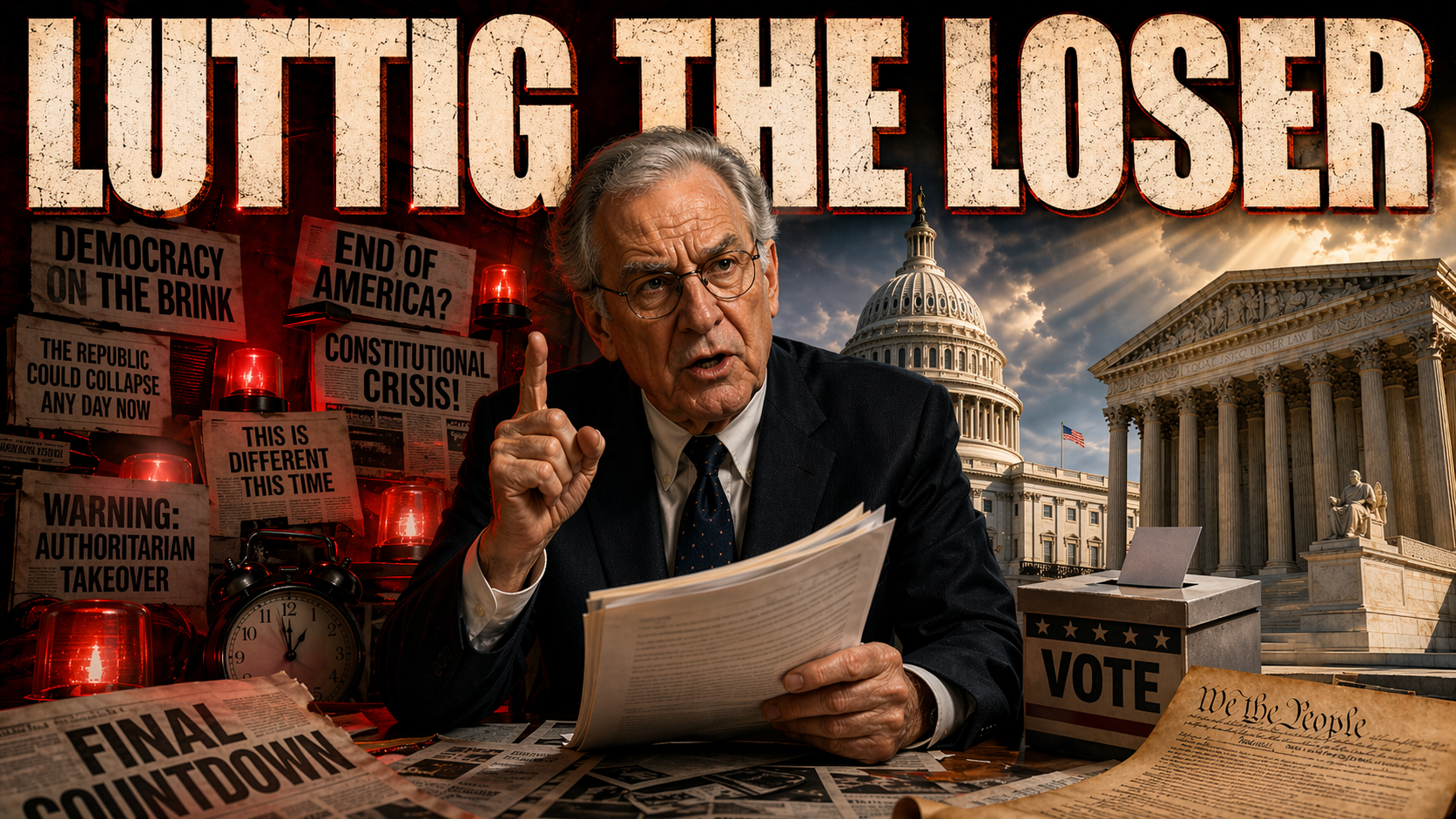
The Trump Resistance Movement graphic carrying Luttig's name and argument is not primarily a constitutional analysis. It is pre-loading the 2028 election cycle with a framework that treats any Trump-adjacent outcome as presumptively illegitimate. The logic is circular and self-sealing: Trump tried to overturn 2020, therefore anything that happens in 2028 that benefits Trump is evidence of the overturning he was always planning. In that framework, a Trump victory in 2028 - achieved through normal campaigning, normal voting and normal certification - becomes evidence of the seizure rather than evidence against it. A defeat of Trump becomes evidence that democracy survived. The hypothesis is structured to be unfalsifiable. Evidence for it is evidence of the threat. Evidence against it is evidence that the threat was temporarily defeated but remains.
This is the same structure the Democrats have been applying to every election since 2016. When they lose, the election was stolen, suppressed, manipulated or corrupted. When they win, democracy was saved by a narrow margin. The asymmetry is not an analytical framework. It is a political one, and dressing it in the language of constitutional scholarship does not change what it is. Americans are not stupid. They can see a political argument wearing a legal costume. The resistance movement and the credentialed jurists it amplifies have been warning that the next election will be the last for four consecutive elections now. At some point the warning starts to look less like prescience and more like the permanent opposition's permanent emergency.
My Bottom Line
The specific claims in Luttig's Atlantic piece do not hold up to legal scrutiny. The 22nd Amendment prohibits a third term and contains no mechanism for vanity or willingness to override it. The Electoral Count Reform Act eliminated the vice-presidential certification ambiguity that January 6 exposed. The constitutional system absorbed the 2020 stress test and functioned as designed. The 2024 election was held, certified and resulted in a transition. The predictions of democratic collapse have not materialized across the four years they have been made by serious and credentialed people who should be held to their track record. None of that means the concerns are fabricated or that democratic vigilance is unnecessary. Vigilance is always appropriate. What is not appropriate is manufacturing constitutional emergencies from scenarios that require ignoring existing federal law, the Constitution's plain text and the demonstrated resilience of the institutions that have held every time they were tested. The democracy keeps not dying. At some point that is also evidence.
The system held in 2020. The 2024 election proceeded and was certified. The constitutional architecture absorbed every stress test it was given. A prediction record of four straight misses does not become more credible by adding judicial credentials to the fifth prediction. It becomes the track record that the fifth prediction has to answer for.
Disclaimer: The views expressed in this post are the personal opinions of the author and are offered for educational, commentary and public discourse purposes only. They do not represent the positions of any institution, employer, organization or affiliated entity. Nothing in this post constitutes legal advice of any kind. References to public figures, legal texts and historical events are based on publicly available sources. Commentary on constitutional law and political analysis reflects the author's independent analysis and is protected expression of opinion. Readers are encouraged to consult primary sources and form their own conclusions.