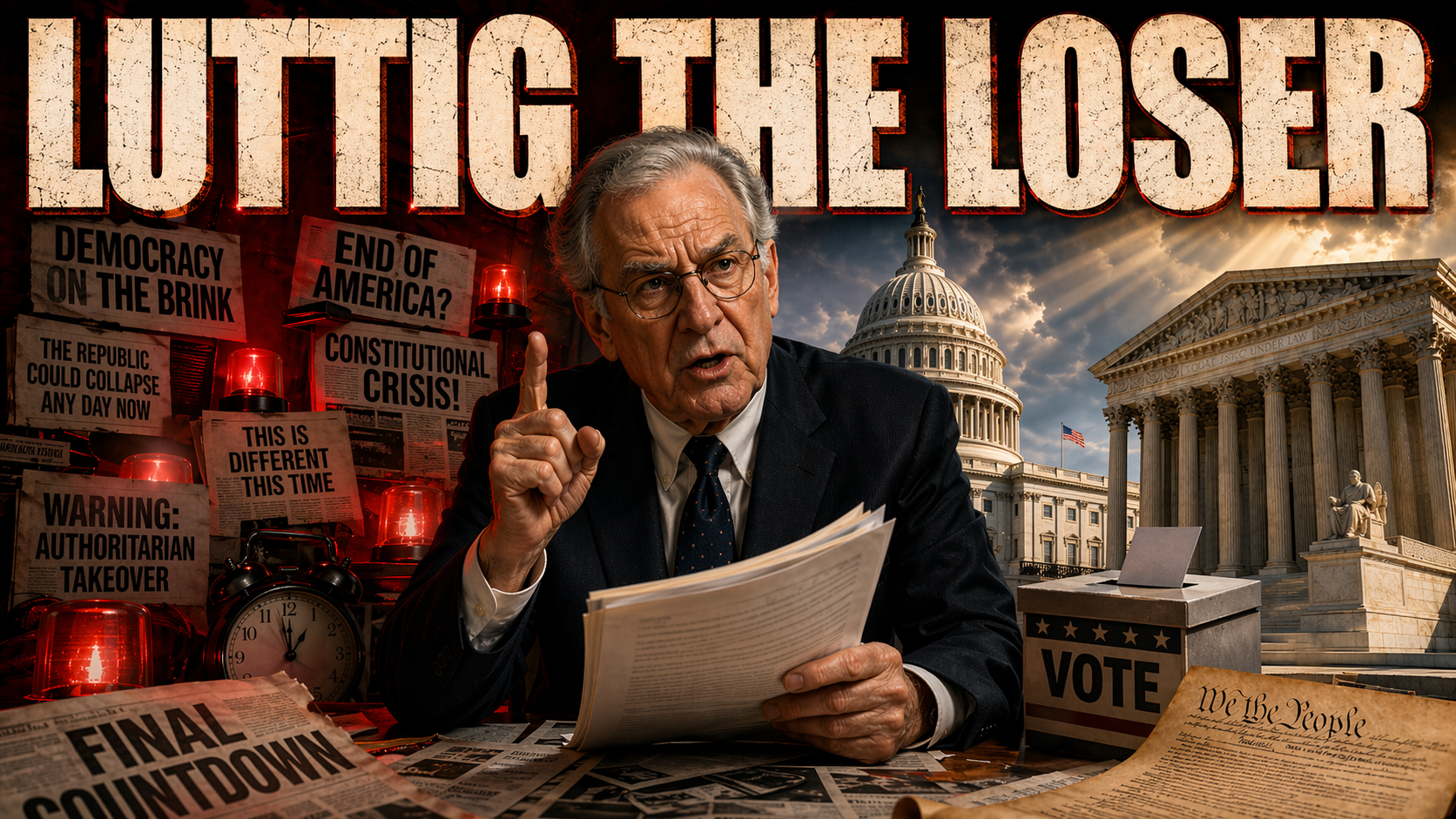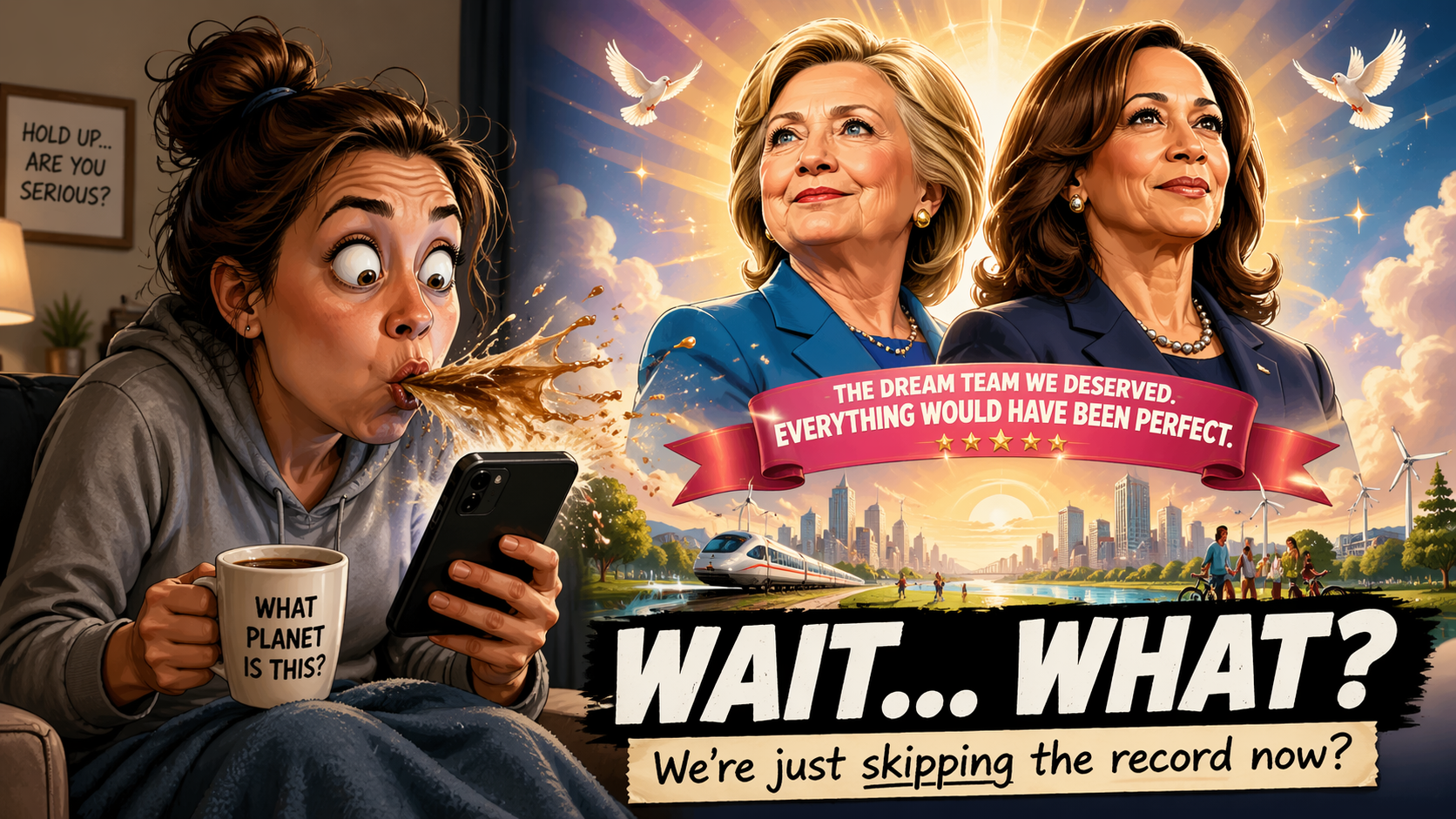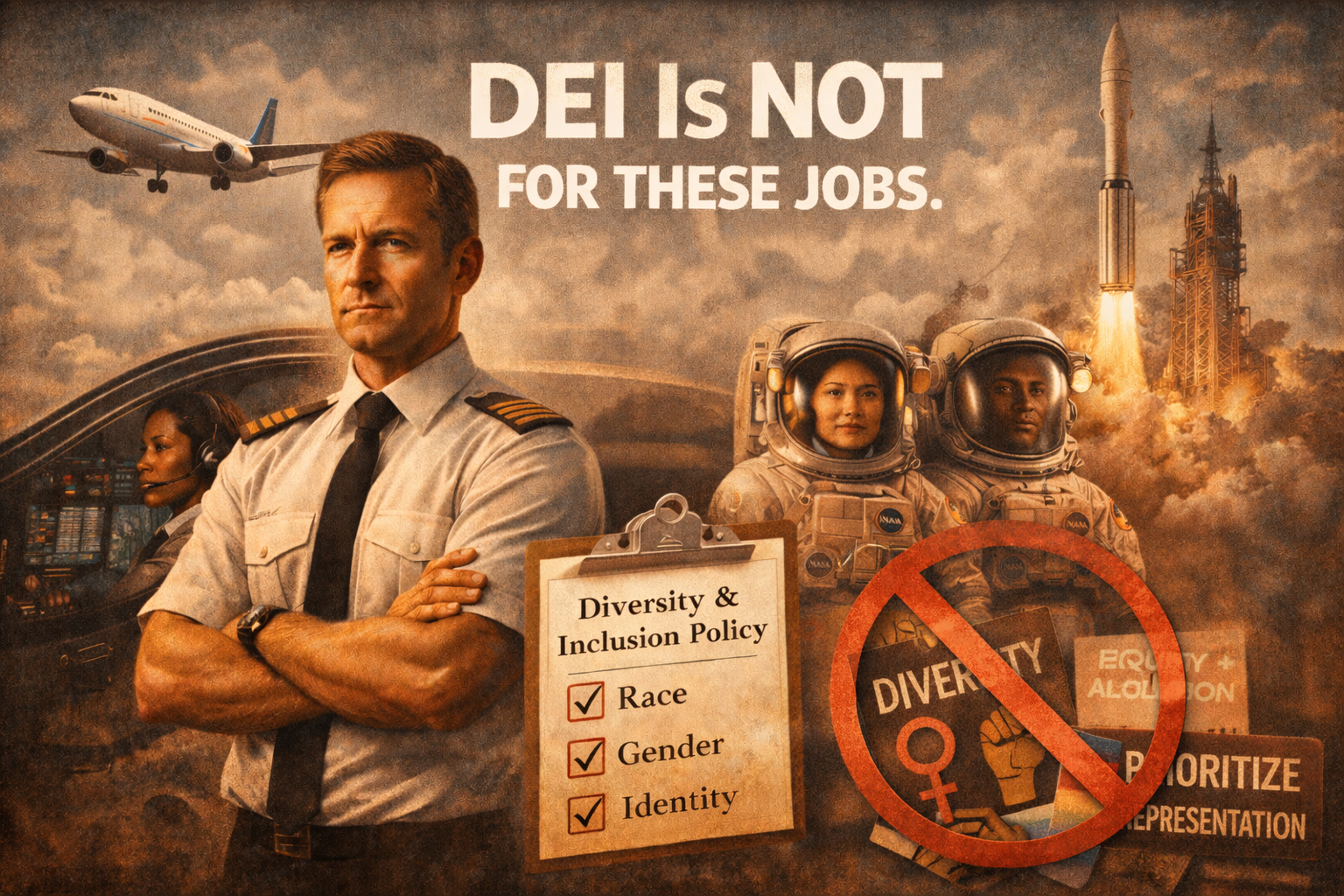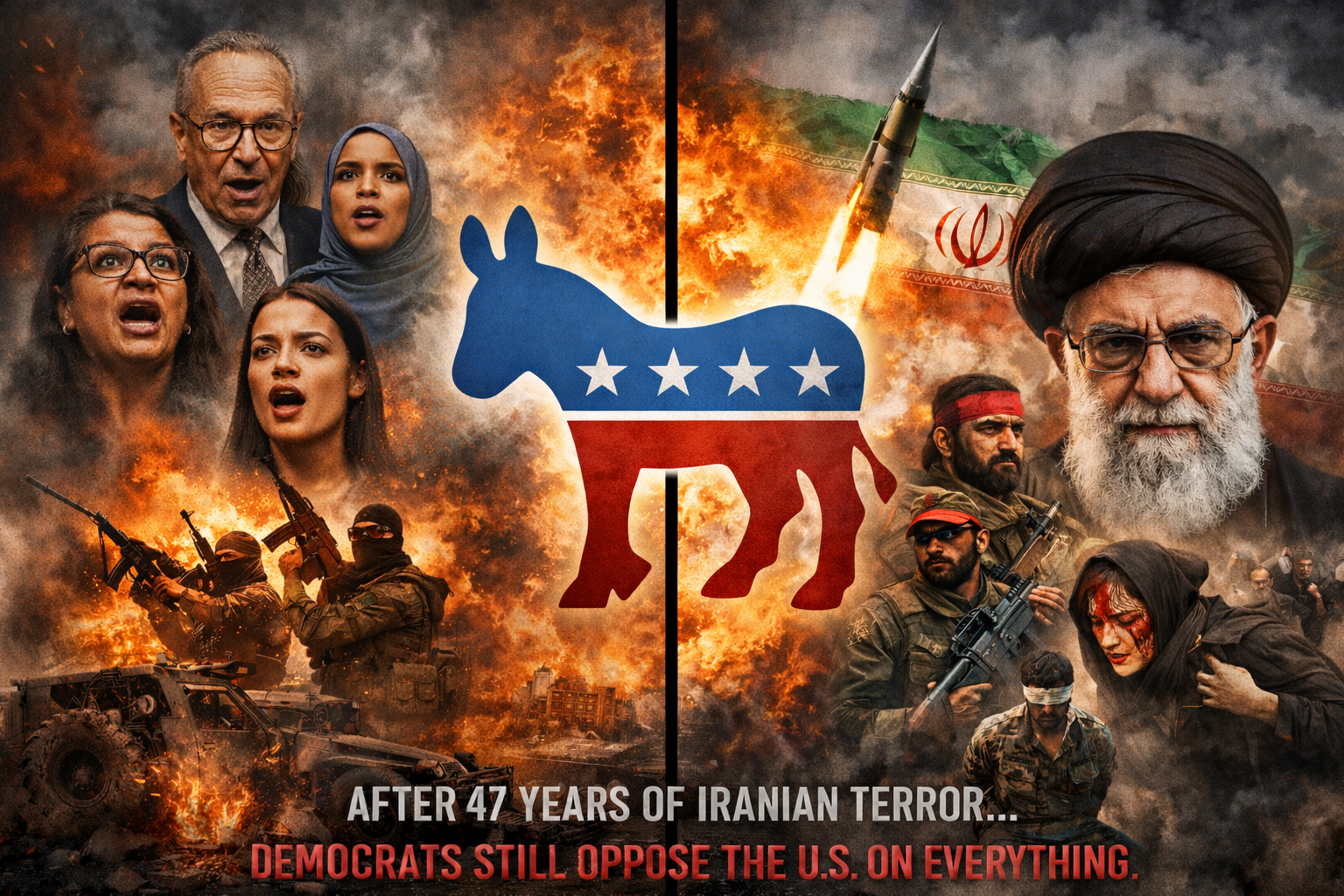
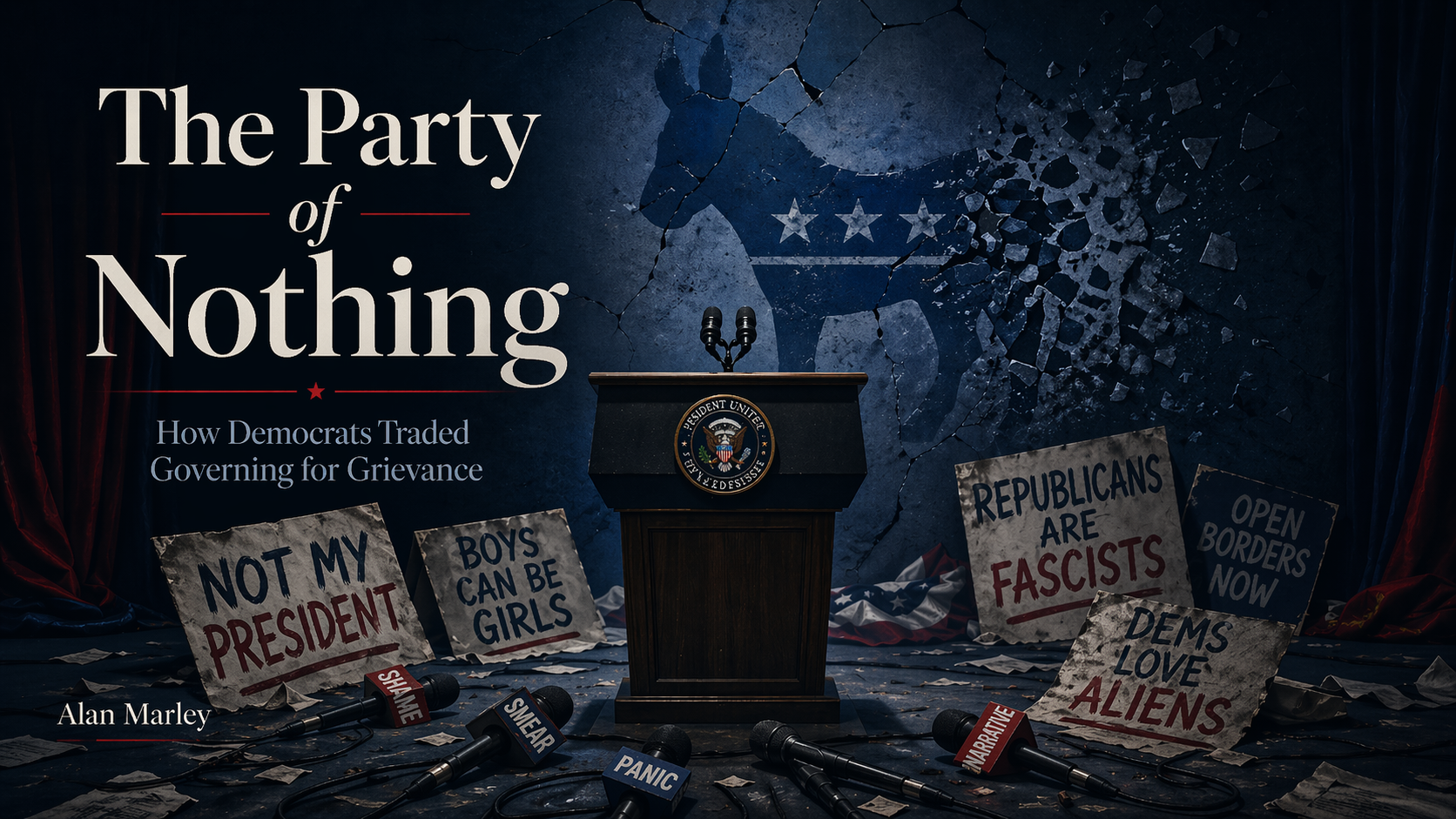
Ask a Democrat in 2026 what the party stands for and you will get one of two answers. The first is a list of things the party opposes - Trump, deportation, the Iran strikes, tax cuts, the rollback of gender ideology in schools, the Supreme Court's conservative majority and approximately forty-seven other things that produce the required quantity of moral alarm. The second is a collection of slogans so vague they could mean anything: democracy, dignity, inclusion, equity, science. These are not policies. They are not a governing vision. They are the vocabulary of a party that has confused being righteously opposed to things with having something to offer in their place. The Democratic Party of 2026 has no coherent economic program, no credible foreign policy alternative, no identifiable leader who commands the respect of a majority of the party's own voters, no theory of government that connects its stated values to specific outcomes and no apparent willingness to examine why a party that spent a decade telling Americans that their common sense was bigotry keeps discovering that Americans have voted accordingly. The temper tantrum is not a strategy. It is a symptom. And the disease is a party that stopped trying to persuade the country and started trying to shame it instead.
The Leadership Vacuum Nobody Will Name
Name the leader of the Democratic Party. Take your time. The answer in 2026 is that there isn't one in any meaningful sense - not a figure who commands national respect across the party's factions, not a voice that sets the agenda, not a person whose judgment the base trusts enough to follow when that judgment requires accepting an uncomfortable truth. What the party has instead is a collection of performance politicians who generate the maximum social media engagement by delivering the maximum outrage, a former president who is no longer an asset and a roster of potential 2028 candidates who are either too old, too regional, too associated with the failures of the Biden years or too captured by the activist wing that has been systematically driving away the working-class voters the party needs to win national elections.
This is not an accident and it is not primarily a talent problem. It is a structural consequence of what the party chose to prioritize over the last decade. When the dominant culture of a political party is activist-driven, social-media-optimized and oriented toward demonstrating ideological purity rather than building governing coalitions, it selects for people who are very good at performing outrage and very bad at the boring, compromising, unglamorous work of building majority support for achievable policy goals. The Democratic Party rewarded the performers. The performers won primaries. The performers lost general elections and then blamed the general election voters for failing to appreciate the performance. The cycle has been running for ten years and the party has not drawn the obvious lesson from it because drawing the obvious lesson would require admitting that the activist base that drives primary turnout has been pulling the party in a direction that general election majorities have consistently rejected.
When your political strategy is to tell the working class that their concerns about crime, the border and their children's education are symptoms of moral failure, do not be surprised when the working class votes for someone who takes those concerns seriously. The lesson was available. The party chose not to learn it.
A Decade of Telling Americans They Are Wrong
Let us be specific about what the Democratic Party and its allied institutions spent the last decade telling ordinary Americans. They were told that a man can be a woman if he says so, that this is settled science rather than contested ideology and that any parent, teacher or citizen who questioned it was a bigot whose views disqualified them from participation in polite society. They were told that the biological differences between male and female athletes are irrelevant and that girls who object to competing against biological males are expressing transphobia rather than a reasonable preference for fair competition. They were told that the concerns of communities experiencing the direct consequences of illegal immigration - the fentanyl deaths, the overwhelmed schools and emergency services, the workers whose wages were suppressed by an unlimited supply of undocumented labor willing to work for less - were racist rather than legitimate. They were told that releasing violent criminals without bail was equity and that the neighbors of those released criminals who then reoffended were simply the acceptable casualties of a more just system.
They were told that the police were the problem rather than the solution when crime was rising in their neighborhoods, that defunding was the answer and that the decade-high murder rates in cities that implemented that answer were not evidence against the policy. They were told that the academic failures documented in American public schools after sixty years of federal education intervention - the reading scores, the math scores, the persistent achievement gaps that increased federal spending and increased regulatory complexity have never closed - were the fault of underfunding rather than of the policy architecture that the party has defended against reform for two generations. They were told that parents who wanted to know what their children were being taught at school were threats to those children's safety rather than the primary stakeholders in their children's education. Every one of these positions polled badly with the broad electorate. Every one of them was held with religious fervor by the activist class. The party followed the activist class and lost the voters.
The Elementary and Secondary Education Act was passed in 1965 as part of the Great Society - the foundational federal commitment to improving American public education through federal funding and oversight. Sixty years later the United States ranks middling among developed nations in reading and mathematics despite spending more per pupil than almost any country in the world. The National Assessment of Educational Progress - the Nation's Report Card - shows that approximately two-thirds of American fourth and eighth graders read below proficiency. The achievement gap between affluent and low-income students, and between white and minority students, that the Great Society was specifically designed to close has narrowed modestly over sixty years and in some measures has not narrowed at all. The Democratic response to this record has been consistent: more funding, more federal programs, more curriculum mandates and fierce opposition to any reform - charter schools, vouchers, parental choice mechanisms - that threatens the institutional interests of the teachers' unions that are among the party's largest donors. The people paying the price for this policy are the low-income and minority children in the failing schools. The people profiting from the status quo are the institutional actors whose funding depends on it. The party that claims to speak for the former has consistently chosen the latter.
The Government That Helps Itself
The Democratic Party's theory of government rests on the proposition that social problems are best addressed by federal programs, that federal programs produce better outcomes than market mechanisms or local solutions and that opposition to federal programs is evidence of indifference to the suffering those programs are meant to address. That theory has been tested at scale across sixty years of the modern administrative state, and the results do not support it as strongly as the theory requires. The War on Poverty has spent more than twenty-two trillion dollars since 1964 in constant dollars. Poverty rates declined sharply in the late 1960s and then largely stagnated. Family formation among lower-income populations declined dramatically over the same period, a development that the academic literature consistently identifies as the single strongest predictor of poverty persistence across generations. Whether federal welfare policy contributed to that decline in family formation is a contested empirical question. That the decline happened during and after the massive expansion of federal programs is not contested.
Housing policy in American cities is a monument to the gap between government intentions and government outcomes. The federal public housing program demolished functional low-income neighborhoods and replaced them with concentrated poverty towers that became among the most dangerous environments in American cities. Urban renewal cleared communities that could not defend themselves politically and replaced them with highways, parking structures and institutional buildings that served the priorities of planners rather than the people displaced. The Affordable Care Act extended insurance coverage to millions who lacked it while producing premium increases that made coverage unaffordable for millions more who had it. Student loan programs designed to increase access to higher education inflated tuition costs to the point where the debt burden they created exceeds the economic benefit of the credentials they financed for a significant share of borrowers. These are not conservative talking points. They are documented outcomes that a party serious about governance would engage with honestly rather than defending every program by attacking anyone who questions it.
No Alternative, No Vision, No Honest Reckoning
The most damning thing about the current Democratic Party is not that it holds bad positions on specific issues. Parties hold bad positions all the time and correct them when the electorate provides sufficient feedback. The most damning thing is that the party has received substantial electoral feedback across multiple consecutive cycles and has responded to that feedback not with self-examination but with an increasingly elaborate theory of why the voters are the problem. Rural voters are the problem because they are uneducated. Working-class voters are the problem because they are economically anxious and susceptible to populist manipulation. Hispanic voters who shifted toward Trump are the problem because they have internalized the oppressor's values. Black voters who shifted toward Trump are the problem because they have been deceived. The one group that is never the problem, in this analysis, is the Democratic Party itself and the activist coalition that has driven its policy and messaging agenda for the past decade.
A party with a serious alternative to offer would be doing the hard work of rebuilding its relationship with the working-class voters who left, developing specific policy frameworks that address inflation, crime, the border and education in ways that reflect what those voters actually want rather than what the party's donor and activist base prefers. It would be identifying and developing leaders who can speak to that coalition rather than performing for the college-educated professional class that generates fundraising emails but does not determine national elections. It would be having honest internal conversations about which positions cost it votes and whether those positions are worth the cost. None of that is happening with any visible urgency. What is happening is more resistance, more walking out of chambers, more press conferences denouncing things that have not happened yet, more fundraising emails with the word democracy in the subject line and more bewildered post-election analysis that asks why the voters keep choosing wrong.
What a Real Opposition Party Looks Like
The country genuinely needs a functioning opposition party. Not because the Republican Party has all the answers - it does not - but because single-party dominance, even temporary, produces complacency, corruption and bad policy that accountability would have prevented. The Democratic Party used to provide that accountability. It had periods of genuine governing seriousness - the New Deal coalition that built the postwar middle class, the Kennedy-Johnson legislative program that produced the Civil Rights Act and the Voting Rights Act, the Clinton administration's welfare reform and fiscal discipline that generated the only federal budget surpluses in living memory. Those Democrats understood that governing required making specific promises, keeping them, accepting the political costs of hard choices and earning majority support by delivering things people could see and touch in their daily lives rather than by performing virtue.
The current party's relationship to that tradition is almost entirely nominal. It invokes Roosevelt and Kennedy and Johnson as talismans while pursuing a policy agenda that none of them would recognize and rejecting the coalition-building discipline that made their achievements possible. Roosevelt did not build the New Deal by telling working Americans their concerns were symptoms of moral failure. Kennedy did not build his coalition by demanding ideological conformity from voters who disagreed with him on cultural questions. Johnson did not pass the Civil Rights Act by walking out of the legislative chamber when the opposition frustrated him. They governed. They negotiated. They compromised. They counted votes and built majorities out of people who disagreed with each other on many things but could agree on enough to get things done. The current party has abandoned that tradition in favor of the temper tantrum and is mystified that the temper tantrum does not produce majority coalitions.
My Bottom Line
The Democratic Party in 2026 is a party defined almost entirely by what it opposes and almost not at all by what it would do with power if it had it. It has no leader the party can rally around, no economic program with specific achievable goals, no foreign policy vision beyond generic multilateralism, no honest engagement with the educational failures of the programs it has defended for sixty years and no apparent capacity to hear what the voters who have left the party have been saying about why they left. It spent a decade telling ordinary Americans that their instincts about crime, the border, their children's schools and basic biological reality were symptoms of bigotry and then expressed genuine surprise when those Americans stopped identifying with the party doing the telling. That is not an unfair electorate. That is cause and effect. A party that treats voters as the problem rather than the judge will keep losing to politicians who treat them as the customer. The temper tantrum is not a substitute for a governing philosophy. It never has been. The sooner the party figures that out the sooner the country gets the opposition it actually needs.
The Democratic Party does not have a Trump problem. It has a mirror problem. The reflection shows a party that stopped listening to the people it claims to represent somewhere around 2015 and has been explaining ever since why that is the people's fault. Until the mirror gets honest, the losses will continue.
Disclaimer: The views expressed in this post are the personal opinions of the author and are offered for educational, commentary and public discourse purposes only. They do not represent the positions of any institution, employer, organization or affiliated entity. Nothing in this post constitutes legal, financial, medical or professional advice of any kind. Commentary on political parties, policy history and electoral trends reflects the author's independent analysis and is protected expression of opinion. References to polling data, policy outcomes and historical programs are based on publicly available sources. Readers are encouraged to consult primary sources and form their own conclusions.