
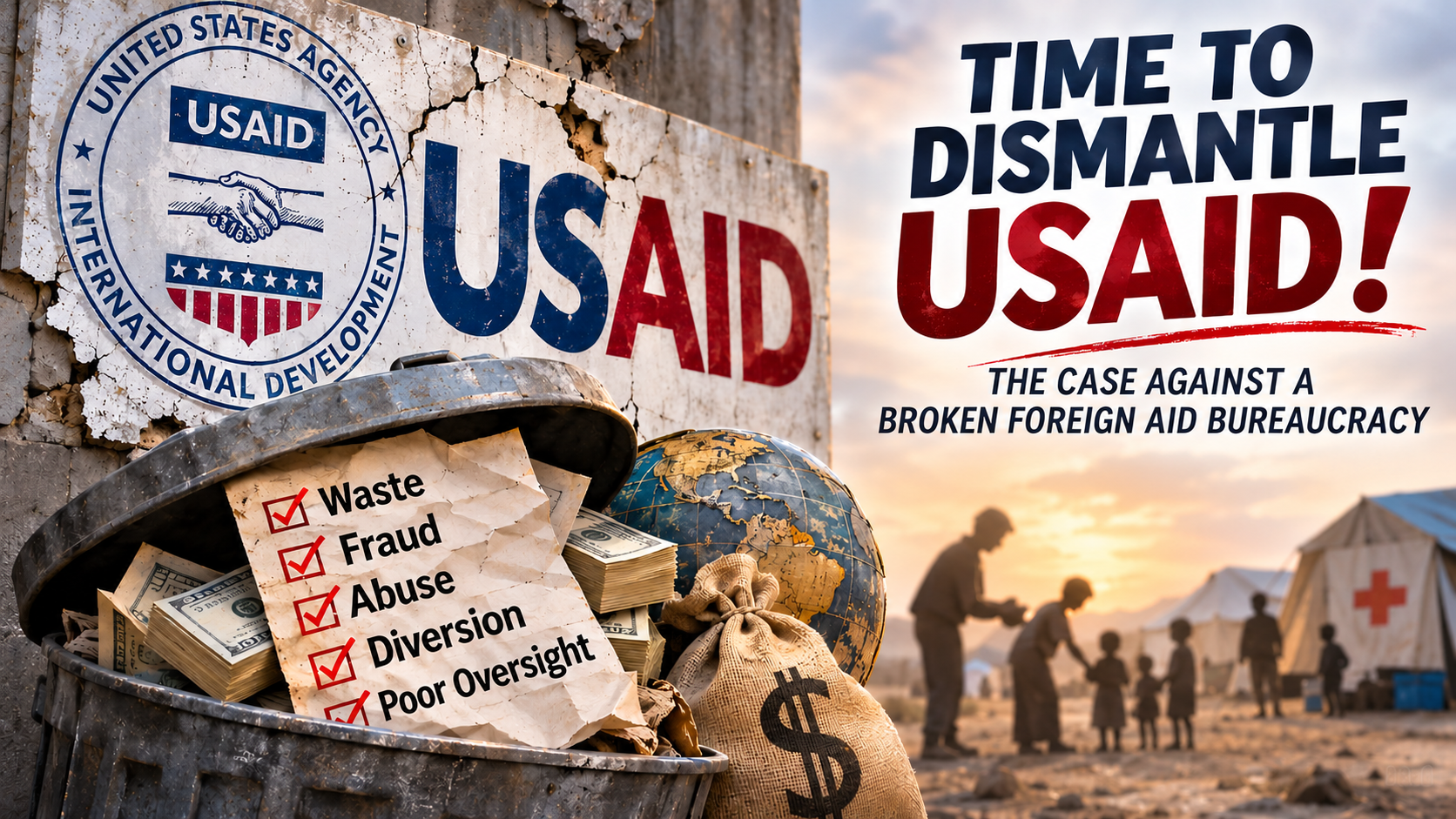
There comes a point when the failure to adequately reform an institution raises a legitimate question about whether that institution should continue to exist.
For decades, American taxpayers have financed international assistance through USAID, United Nations agencies, nongovernmental organizations, international development institutions and an extensive network of contractors and subcontractors.
We have been told that these expenditures alleviate poverty, promote democracy, improve public health, stabilize governments and advance American interests.
Some undoubtedly have. But decades of documented waste, fraud, abuse, corruption and inadequate financial oversight raise a fundamental question: Are these institutions the most effective means of accomplishing those objectives?
The debate should not be about whether Americans are compassionate. It should be about whether the institutional machinery established to administer that compassion remains effective, accountable and necessary.
1. USAID: The case against restoring a failed institutional model
As of July 1, 2025, USAID ceased implementing foreign assistance programs, with selected responsibilities transferred to the Department of State.
That distinction matters. The question today is not simply whether USAID should be dismantled, but whether its former institutional structure should ever be restored and whether other organizations operating under similarly inadequate oversight should continue receiving American taxpayer dollars.
Consider what the federal government’s own investigators have uncovered.
On June 12, 2025, the Department of Justice announced that a USAID contracting officer and three corporate executives pleaded guilty to participating in a decade-long bribery scheme involving at least 14 government contracts valued at more than $550 million.
Although the entire $550 million was not necessarily stolen, the procurement process governing those contracts was compromised by criminal activity.
Ten years.
How does a government contracting officer participate in a bribery operation for approximately a decade before the operation is stopped?
Where were the administrative safeguards? Where was management? Where was the independent oversight?
In the private sector, shareholders would be demanding answers from senior management. Financial institutions might reconsider lending arrangements. Customers might take their business elsewhere.
Government institutions, however, do not operate under the same competitive pressures. Their revenues are not dependent upon satisfying customers in an open marketplace. They depend primarily on congressional appropriations.
That difference is precisely why government institutions require strong external accountability.
2. When humanitarian assistance never reaches the people it was intended to help
In May 2023, USAID suspended food assistance in Ethiopia’s northern Tigray region after discovering that food intended for people experiencing famine-like conditions was being diverted and sold commercially.
A February 2025 inspector general evaluation subsequently identified inadequate monitoring, reporting and award administration as factors that hindered the agency’s detection of the diversion.
In 2026, investigators also documented American-funded nutritional products appearing on an Ethiopian online marketplace. These included specialized foods intended to address malnutrition.
Consider the absurdity of that situation.
An American family purchases groceries, pays its mortgage, struggles with healthcare costs and pays federal taxes. A portion of those taxes finances humanitarian food supplies overseas.
Those supplies are subsequently diverted and offered for sale.
The American taxpayer loses. The hungry child loses. The corrupt intermediary profits.
When the institutions responsible for distributing assistance cannot reliably establish that the intended recipients are receiving it, continued funding becomes difficult to justify.
The central issue is not whether Ethiopians deserve assistance. It is whether the mechanism established to provide that assistance can accomplish its stated purpose without enriching opportunists along the way.
3. American taxpayers should not be financing questionable entities
Perhaps the most troubling aspect of international assistance is the possibility that American resources ultimately benefit organizations or individuals whose activities conflict with American interests.
In March 2026, the Government Accountability Office reported that weaknesses in the oversight of foreign assistance partners and their subcontractors increased exposure to fraud and the possibility of resources reaching individuals or entities associated with terrorism.
Between July 2016 and September 2025, the GAO made at least 51 recommendations concerning the management of fraud and other risks associated with foreign assistance.
Fifty-one recommendations over approximately nine years.
These are not isolated complaints from disgruntled taxpayers. They are findings from the federal government’s own accountability organization.
When assistance passes through multiple intermediaries, determining who ultimately benefits becomes increasingly difficult.
The traditional distribution model can resemble the following:
Appropriations and award administration
Management and operational expenses
Additional administration and distribution
Local procurement and delivery
Illustrative distribution model. Actual assistance arrangements vary by program.
Every additional layer creates potential administrative expenses, oversight challenges and opportunities for misconduct.
If the federal government cannot adequately monitor an organization’s subcontractors, verify the identities of ultimate recipients or independently establish that assistance reaches its intended destination, what exactly is the justification for continuing that particular funding arrangement?
4. UNRWA and the limits of international accountability
The United Nations Relief and Works Agency for Palestine Refugees in the Near East, commonly known as UNRWA, provides another example of the difficulties associated with financing international institutions.
In August 2024, the United Nations’ own Office of Internal Oversight Services completed an investigation into allegations involving 19 UNRWA employees.
Investigators concluded that evidence indicated nine employees might have participated in the October 7, 2023, attacks against Israel. Those employees were dismissed.
The investigation found no supporting evidence in one case and insufficient evidence in nine others.
These findings do not establish that UNRWA as an institution financed terrorism or that its entire workforce was complicit. They do, however, illustrate the serious consequences of inadequate personnel screening and institutional oversight.
International organizations operate under legal and administrative arrangements that can complicate American investigative authority.
That presents a fundamental dilemma.
The United States provides financial resources, but its ability to directly investigate and supervise the institutions receiving those resources may be restricted.
International status should not become a substitute for accountability. Nor should an organization’s humanitarian mission automatically entitle it to continued American funding.
If an institution cannot provide satisfactory assurances concerning its employees, financial activities and distribution partners, suspending contributions becomes a legitimate policy option.
Humanitarian assistance for civilians can be evaluated separately from financial support for a particular organization.
5. The World Bank and the broader international bureaucracy
USAID and United Nations agencies are not the only international institutions confronting corruption.
In fiscal year 2025, the World Bank reported sanctioning 32 firms and individuals following investigations into prohibited practices.
The existence of these sanctions is evidence that misconduct occurs, but it also demonstrates that the World Bank maintains mechanisms for identifying and penalizing it.
The larger question concerns whether those mechanisms are sufficient and whether institutions receiving American financial support consistently demonstrate that their operations justify continued contributions.
There is nothing inherently virtuous about an organization merely because it operates internationally, identifies itself as a nonprofit or describes its activities as humanitarian.
Organizations should be evaluated according to their conduct, financial integrity and measurable accomplishments.
An institution’s mission statement is not an audit.
Its publicity materials are not evidence of effectiveness.
Its nonprofit designation is not a guarantee against corruption.
6. The documented financial problems
The following examples illustrate why the institutional structure of foreign assistance deserves examination.
| Institution or program | Documented concern |
|---|---|
| USAID contracting | More than $550 million in contracts implicated in a decade-long bribery scheme. |
| USAID-funded international assistance | More than $50 million in questioned expenditures identified by independent auditors reviewing nearly $3 billion in expenditures between October 2023 and March 2026. |
| Government-to-government assistance | Disproportionate financial control and compliance deficiencies identified in audits. |
| USAID Ethiopia assistance | Widespread food diversion and inadequate monitoring. |
| UNRWA | Nine employees dismissed following findings of possible involvement in terrorist attacks. |
| World Bank | Thirty-two firms and individuals sanctioned during fiscal year 2025. |
| Federal foreign assistance oversight | At least 51 GAO recommendations concerning fraud and other risks between 2016 and 2025. |
These figures represent different categories of misconduct, risk and administrative deficiency. They cannot simply be combined into a single total of stolen taxpayer money.
Questioned costs also require careful interpretation. In an earlier review covering fiscal years 2021 through 2023, approximately $75 million in expenditures were questioned. USAID subsequently determined that approximately $72 million was allowable and recovered roughly $3 million in disallowed costs.
Nevertheless, the recurring findings establish that the concerns surrounding foreign assistance accountability are substantial and extend beyond any individual institution.
7. When does reform become an exercise in futility?
Government institutions frequently respond to documented failures with additional regulations, committees, oversight positions, reporting requirements and administrative procedures.
Sometimes these reforms work. Sometimes they merely add another layer of bureaucracy to an already complicated organization.
At some point, policymakers must consider whether the costs associated with repairing an institution exceed the benefits of preserving it.
In business, this is a relatively straightforward concept.
A company experiencing persistent losses might restructure an operating division. If restructuring fails, management might sell the division, eliminate it or replace its operating model.
The existence of a division for 60 years would not, by itself, justify maintaining it for another 60.
Government institutions deserve similar scrutiny.
USAID was established in 1961. The international environment in which it was created was fundamentally different from the environment in which the United States operates today.
Its historical accomplishments do not establish that its former structure remains necessary indefinitely.
The fundamental questions are whether its functions remain necessary, whether alternative delivery mechanisms exist and whether those alternatives can operate with greater accountability.
8. The problem with institutional self-preservation
Economists have long recognized the importance of incentives.
Businesses have incentives to increase revenue. Employees have incentives to protect their livelihoods. Government agencies have incentives to protect their budgets. Nonprofit organizations have incentives to maintain their funding sources.
These incentives are not inherently improper.
However, they can create conflicts between the interests of an institution and the interests of the people it was established to serve.
Consider an organization that receives millions of dollars annually to address poverty in a particular country.
If poverty is substantially eliminated, what happens to the organization’s funding?
Its employees, consultants, contractors and administrative infrastructure may no longer be necessary.
An organization genuinely dedicated to solving the underlying problem should consider that outcome a success. Yet financially, the disappearance of the problem could threaten its continued existence.
This does not establish that humanitarian organizations deliberately perpetuate poverty. It does establish why independent performance measurement is essential.
The organizations receiving funding should not have exclusive authority to determine whether their funding remains necessary.
Success should be measured by improvements in people’s lives, not the number of employees hired, conferences conducted, reports published or grants renewed.
9. Why should American taxpayers finance foreign political and social initiatives?
Foreign assistance extends well beyond emergency food, medicine and disaster relief.
It also includes governance programs, civil society initiatives, democracy promotion, institutional development and other activities intended to influence political and social conditions abroad.
Some of these programs have identifiable strategic purposes. Others invite disagreement over whether they represent an appropriate use of public money.
In November 2026, the GAO reported that Congress appropriated $205 million annually in both fiscal years 2025 and 2026 for the Human Rights and Democracy Fund. Its report examined deficiencies in congressional notification concerning the use of certain authorities.
The existence of congressional authorization does not eliminate the legitimate public debate surrounding these expenditures.
Should American taxpayers finance political development programs in foreign countries?
Should they subsidize foreign organizations promoting social or cultural initiatives that lack a demonstrable connection to American national interests?
Should the United States attempt to transform foreign institutions while struggling to address institutional problems within its own borders?
These questions should be answered through transparent legislative debate, supported by evidence of costs, results and strategic value.
Disagreement with an organization’s political or social objectives is not proof of fraud. It is, however, a legitimate basis for debating whether taxpayers should finance those objectives in the first place.
Not every worthwhile cause constitutes an obligation of the United States Treasury.
10. Foreign aid should not become international welfare without an exit strategy
There is a significant difference between providing emergency assistance and permanently subsidizing another country’s economic shortcomings.
If a country experiences a devastating earthquake, emergency food, medical assistance and rescue operations can serve an immediate humanitarian purpose.
If a country receives economic development assistance for decades without meaningful progress toward self-sufficiency, the effectiveness of that assistance deserves reassessment.
Long-term assistance can encounter several economic problems:
- Reduced incentives for domestic institutional reform.
- Dependence on foreign financing.
- Distortion of local markets and competition.
- Opportunities for politically connected individuals to capture resources.
- Weak incentives to develop sustainable domestic revenue sources.
- Continued dependence on foreign contractors and consultants.
These consequences are not inevitable, and well-designed assistance can help countries overcome them.
The key distinction is whether a program helps establish sustainable economic capacity or simply maintains an ongoing financial relationship.
Development should have an objective beyond continued development spending.
If an assistance program has no measurable goals, no meaningful performance requirements and no credible exit strategy, its continued existence warrants serious examination.
11. What about America’s domestic responsibilities?
The American government has obligations to its own citizens.
We have veterans requiring healthcare, deteriorating infrastructure, Americans experiencing homelessness, families struggling with medical expenses and retirement programs facing long-term financial challenges.
We also carry an enormous national debt.
Foreign aid represents only a relatively small portion of overall federal expenditures. Eliminating it would not resolve America’s national debt or eliminate the federal deficit.
That does not make its opportunity cost irrelevant.
| Annual amount | Domestic spending units |
|---|---|
| $100 million | 1,000 units |
| $500 million | 5,000 units |
| $1 billion | 10,000 units |
| $5 billion | 50,000 units |
Hypothetical annual reallocations, assuming $100,000 per unit of domestic spending. Illustrative calculation, not an estimate of recoverable foreign aid spending or actual domestic program costs.
The government’s obligation is to evaluate competing expenditures and determine where public resources produce the greatest value consistent with its legal responsibilities and strategic objectives.
The fact that a program represents a small percentage of the federal budget does not automatically justify its existence.
A billion dollars does not become insignificant because the government spends trillions.
12. Abolishing an institution does not require abandoning its legitimate functions
One of the principal arguments against dismantling foreign assistance organizations is that doing so could leave vulnerable populations without essential services.
That concern deserves serious consideration.
The President’s Emergency Plan for AIDS Relief, or PEPFAR, reported an estimated 26 million lives saved by December 2024. These estimates reflect epidemiological modeling and program results, but they illustrate the potential benefits of targeted foreign assistance.
The existence of successful programs, however, does not necessarily establish the need to preserve every institution administering them.
There is a difference between preserving a beneficial function and preserving an administrative structure.
An organization may be eliminated, consolidated or replaced while selected services continue through alternative mechanisms.
The same principle applies to emergency disaster relief, disease surveillance and other activities with demonstrable humanitarian or national security value.
The argument for institutional restructuring is strongest when it includes a credible plan for maintaining necessary functions rather than assuming that every program can disappear without consequences.
13. Moving USAID into the State Department is not enough
Transferring responsibilities from USAID to the Department of State does not automatically resolve the underlying problems.
An October 2026 GAO report found weaknesses in guidance and information management associated with the restructuring of American foreign assistance.
The State Department’s own inspector general also reported in 2026 that recommendations concerning workforce planning, administrative capacity and implementation arrangements had not been fully addressed.
This illustrates the distinction between eliminating an agency and eliminating the practices that created problems within that agency.
If the same questionable contractors continue receiving money, if the same subcontracting arrangements remain opaque and if the same financial reporting weaknesses persist, the underlying risks have simply acquired a different administrative address.
Institutional restructuring should therefore be accompanied by an examination of the entire funding ecosystem.
Changing the name on the office door is not a substitute for changing the operating model.
14. What could replace the traditional foreign aid bureaucracy?
A more limited foreign assistance framework could separate international spending into clearly defined categories.
| Category | Potential delivery mechanism |
|---|---|
| Emergency disaster relief | Time-limited appropriations and competitively selected relief providers |
| Infectious disease control | Targeted health programs with independent medical and financial evaluation |
| National security assistance | State or Defense Department administration with congressional oversight |
| Economic development | Performance-based agreements, private investment and appropriately structured development financing |
| Voluntary charitable activities | Privately funded nonprofit and humanitarian organizations |
| Foreign political and social initiatives | Separate congressional authorization and explicit justification of strategic value |
This approach would distinguish essential government functions from activities that could potentially be financed through private philanthropy or other arrangements.
It would also permit policymakers to examine individual programs without automatically preserving the bureaucracies historically responsible for administering them.
There are trade-offs. Consolidating authority could reduce duplication, but it could also concentrate administrative risk. Private charities may operate efficiently, but they cannot necessarily replace the scale and coordination of government-funded emergency responses.
Any replacement model would need to demonstrate that it can deliver necessary services more effectively than the structure it replaces.
15. Establishing conditions for continued American funding
Whether an organization is a federal agency, international institution, foreign government or nonprofit contractor, continued eligibility for taxpayer funding could be based on several fundamental requirements.
Independent financial verification
Recipients should provide sufficient financial documentation to establish how public resources were spent.
Complete disclosure of funding relationships
Organizations should identify major contractors, subcontractors, implementing partners and relevant beneficial ownership interests.
Verifiable performance
Programs should demonstrate measurable accomplishments rather than simply reporting activities and expenditures.
Effective recipient screening
Personnel and organizational vetting should address criminal misconduct, terrorism-related risks, conflicts of interest and applicable sanctions requirements.
Enforceable consequences
Funding agreements should establish circumstances under which expenditures can be recovered, payments withheld or contracts terminated.
No automatic renewals
Continuation should require affirmative evidence that a program remains necessary and effective.
Independent investigative access
Organizations receiving taxpayer resources should provide appropriate access to records and personnel for authorized investigators, subject to clearly defined legal and security protections.
A defined exit strategy
Long-term development programs should identify conditions under which external financing can end or substantially decline.
Under such a framework, organizations unable or unwilling to satisfy accountability requirements would face the possibility of losing their funding.
Their humanitarian designation would not exempt them from scrutiny.
16. Private charity is not the same as government spending
Americans are free to support international humanitarian organizations with their personal resources.
They can donate to religious charities, disaster relief organizations, international medical programs and institutions supporting causes consistent with their individual values.
That is voluntary charity.
Government-funded assistance is fundamentally different.
Taxpayers do not individually determine which organizations receive their contributions. Those decisions are made through appropriations, legislation and administrative processes.
Consequently, the government carries a responsibility to justify those decisions to the public.
A private donor may choose to contribute to an organization based primarily on its mission or personal convictions.
Public officials must also consider financial stewardship, statutory authority, national priorities and measurable results.
The distinction is not between generosity and selfishness.
It is between voluntary generosity and the administration of compulsory public revenues.
Conclusion: No institution is entitled to immortality
Government agencies and international organizations should not be considered permanent fixtures merely because they have existed for decades or were originally established for admirable purposes.
The evidence concerning USAID and other foreign assistance institutions includes criminal convictions, compromised procurement arrangements, diversion of humanitarian supplies, questioned expenditures and persistent oversight deficiencies.
It also includes examples of successful humanitarian intervention and functioning enforcement mechanisms.
The policy debate is therefore about more than whether foreign assistance should exist. It concerns which functions justify public financing, which institutions can be trusted to administer them and what alternatives are available when existing arrangements prove inadequate.
There is a legitimate case for permanently retiring USAID’s former institutional model, consolidating selected necessary functions and withdrawing support from international organizations that cannot satisfy meaningful accountability standards.
There is also a responsibility to examine the humanitarian, economic and national security consequences of those decisions.
No organization should be entitled to an unlimited stream of American taxpayer money simply because it claims to serve a noble purpose.
The people receiving humanitarian assistance deserve effective programs. American taxpayers deserve financial accountability. Neither is well served by institutions that cannot demonstrate where the money goes or what it accomplishes.
- U.S. Department of Justice. (2025, June 12). USAID official and three corporate executives plead guilty to decade-long bribery scheme involving over $550 million in contracts.
- U.S. Government Accountability Office. (2026). Foreign assistance: Opportunities exist for agencies to improve their management of fraud, waste, and abuse risks. GAO-26-108945.
- USAID Office of Inspector General. (2025). Emergency food assistance in Ethiopia: Gaps in USAID's award administration, monitoring, and incident reporting hindered its ability to detect widespread food diversion.
- USAID Office of Inspector General. (2026). U.S.-funded food commodities diverted to online marketplace in Ethiopia.
- USAID Office of Inspector General. (2026). Non-federal audits helped identify millions in questioned costs to U.S. foreign assistance.
- USAID Office of Inspector General. (2026). Non-federal audits helped provide oversight of government-to-government awards.
- USAID Office of Inspector General. (2025). Non-federal audits: Actions needed to standardize processes for reviewing reports and assessing questioned costs.
- United Nations. (2024, August 5). Investigation completed: Allegations concerning UNRWA staff participation in the October 7 attacks.
- World Bank Group. (2025). Annual report: Institutional oversight and integrity.
- U.S. Government Accountability Office. (2024). Foreign assistance: USAID should strengthen risk management in conflict zones. GAO-24-106192.
- U.S. Government Accountability Office. (2026). Foreign assistance: Agencies made broad changes, but State lacked guidance for decisions. GAO-26-108607.
- U.S. Department of State, Office of Inspector General. (2026). Evaluation of Department of State administration of foreign assistance programs transferred from USAID.
- U.S. Government Accountability Office. (2026). Democracy assistance: State Department should improve congressional notification of its use of certain legal authorities. GAO-27-107900.
- U.S. Department of State. (2024). PEPFAR program results fact sheet.
- USAID Office of Inspector General. (2026). Foreign assistance: Key lessons for managing awards.