- Is Blue Ocean Strategy Really All That? (this post)
- Who It Helps and Who It Mostly Won't
- Blue Ocean Without the Fantasy
- Beyond Efficiency: Value Not Speed
- Blue Ocean Meets the Real World
Blue Ocean Strategy is one of those business frameworks that gets into your head and stays there. The pitch is simple and emotionally satisfying: stop fighting for scraps in a bloody, overcrowded market and go build something so different that the old comparisons no longer apply. If you have ever run a business where margins get chewed up by copycats, price shoppers and "my cousin does it cheaper" conversations, the idea is not just appealing. It is irresistible.
But irresistible ideas deserve skeptical scrutiny. So the question worth sitting with is this: is Blue Ocean Strategy a genuine strategic breakthrough, or is it a well-marketed repackaging of advice that has always existed under less evocative names?
The honest answer is both. And the place where it is actually useful sits squarely in the middle of that tension.
What the Framework Actually Claims
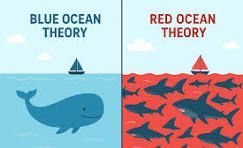
At its core, Blue Ocean Strategy argues that companies win big by creating uncontested market space rather than battling rivals in existing categories. The framing divides the business world into red oceans, which are known industries with accepted rules and competitors fighting over existing demand, and blue oceans, which are market spaces that are new or newly reconstructed, where demand gets created rather than stolen. The hook is the promise that you can make competition irrelevant.
But Kim and Mauborgne are not simply saying differentiate. They are saying you can pursue differentiation and low cost simultaneously by breaking the usual tradeoff between them. That is what they call value innovation: raising buyer value while lowering your cost structure, typically by eliminating or reducing factors your industry competes on and raising or creating factors it ignores. Strip away the ocean metaphors and the core claim is this. Stop over-serving the wrong things. Start over-delivering the right things. Do it in a way that scales.
That is not a crazy idea. That is good strategy when it is real.
Why It Gets Traction
Blue Ocean earns its popularity because it gives people something most strategy frameworks fail to deliver. It gives them permission to stop worshipping competitors. Most businesses are competitor-obsessed. They benchmark, copy and match features until they have commoditized themselves. The framework says stop playing that game, and that instruction alone is worth something to a leadership team that has been running in circles.
It also provides a visual toolkit that makes tradeoffs visible. The strategy canvas forces you to map where your industry over-serves and under-serves relative to what buyers actually value. The four-action framework, eliminate, reduce, raise and create, pushes you to make explicit choices rather than vague aspirations. Whether you use every tool in the kit or not, the discipline of working through them tends to surface assumptions the business has been operating on without examination.
"Blue Ocean became popular because it is one of the rare strategy frameworks that is easy to teach, easy to remember and easy to run with a real team on a real afternoon."
And the narrative matches real breakthroughs people have actually seen. Some successful businesses really did win by combining elements across categories rather than by incremental improvement on existing ones. The framework gives language to something that otherwise gets described vaguely as innovation or disruption.
The Problem With Oceans as a Metaphor
Here is where the hype quietly sneaks in. A lot of people subconsciously treat Blue Ocean like a destination rather than a process. Once we find it, we are safe. But the authors themselves acknowledge that blue oceans attract imitation. Successful moves draw attention. Competitors notice. The ocean turns red again, sometimes faster than the business that opened it had anticipated.
The more serious problem is that uncontested market space is sometimes uncontested for reasons that have nothing to do with a lack of imagination among your competitors. Sometimes it is uncontested because the market is thin, the customer acquisition cost is brutal, the buyer education required is expensive and the economics never work at scale. Blue Ocean can be a gold mine. It can also be a swamp. The framework does not automatically protect you from mistaking no competition for no demand.
A fair critique of Blue Ocean is that its early popularity leaned heavily on story-driven examples. You can always find patterns in winners after the fact. What you actually want to know is whether the framework predicts success or only explains it once you already know who won. Academic reviewers have flagged limited scientific validation and weak implementation guidance as persistent concerns. That does not make the framework fake. It makes it a lens rather than a guarantee.
Where Porter Still Has the Better Argument
Michael Porter's foundational point is that strategy is about choices, tradeoffs and building a coherent system of activities that fit together and reinforce each other. Operational effectiveness is not strategy. Doing the same things as your competitors but doing them better is not a strategic position. It is a temporary advantage that competitors can replicate.
That matters here because a lot of Blue Ocean attempts are really just adding features, launching a new service line or making a repositioning claim in the marketing materials. That is not a blue ocean. That is trying something new. A real strategic move, blue or otherwise, requires coherence. It requires that what you do, how you do it and what you refuse to do all reinforce each other and point in the same direction.
Blue Ocean works best when it forces those choices into the open. It works worst when people use it as a motivational poster to avoid the hard math of whether the idea is actually viable.
The Most Common Ways It Goes Wrong
If you have watched a team try to run a Blue Ocean exercise, you have probably seen at least one of these patterns. The team decides to create a new category, which in practice means inventing a market from scratch. Creating demand is expensive. Customer education takes time and money. Most businesses run out of runway before the market develops the way the whiteboard suggested it would.
Or the team confuses novelty with value innovation. New is not the same as valuable. Value innovation specifically requires aligning utility, price and cost so the offer makes sense for both the buyer and the company simultaneously. A new thing that costs more to deliver than customers will pay is not a blue ocean. It is a hobby.
Or the team does a brainstorming exercise that produces a wish list of things to add rather than a set of hard choices about what to eliminate and what to stop doing. That is not strategy. That is expansion with optimism attached to it.
"The dirty secret is that most blue oceans are just reframed red oceans. A niche within an existing market. A new bundle. A different business model around the same core service. That does not make them bad. That is often exactly how real growth happens."
How to Use It Without Drinking the Kool-Aid
The practical sequence that works is simpler than the full framework suggests. Start by writing the uncomfortable sentence about your current competitive reality. We compete on price. Customers choose between us and others based on availability. Our category norms are these. That stops the fantasizing before it starts.
Then run the four-action questions as an audit rather than a dream. What do you do that customers barely notice but you keep doing because that is how it has always been done? What are you over-delivering relative to what buyers actually value? What do buyers care about that you consistently under-deliver? What could change the buying experience rather than just the product list?
Then force the economics. If you raise and create these things, what must be eliminated and reduced to fund them? What scales and what is artisanal? If a competitor copies eighty percent of this at lower cost, do you still win?
Then validate demand rather than enthusiasm. Before committing resources, prove that customers will pay more, switch faster or refer at a higher rate. If none of those are true, you do not have a blue ocean. You have a well-reasoned hypothesis that still needs to meet a real buyer.
My Bottom Line
Blue Ocean Strategy is worth taking seriously as a forcing function and not worth worshipping as a doctrine. Its best value is making you ask better questions than your competitors are asking, especially questions about what customers actually value versus what your industry has normalized. Its biggest risk is convincing you that you have escaped economics when you have only chosen a different set of constraints.
The framework does not replace competitive strategy. It is one method of creating advantage, often by changing what is being competed on. And research on the overlap between blue ocean and competitive approaches confirms what common sense already suggests: it is not a binary switch between two clean alternatives. It is a mix of strategic logics depending on context, resources and the realities of the market you are actually in.
Use it like a compass. The moment you treat it like a treasure map is the moment it turns into strategy cosplay.
References
- Kim, W. C. & Mauborgne, R. (2004). Blue Ocean Strategy. Harvard Business Review.
- Kim, W. C. & Mauborgne, R. (2005). Blue Ocean Strategy: How to Create Uncontested Market Space and Make the Competition Irrelevant. Harvard Business School Press.
- Porter, M. E. (1996). What Is Strategy? Harvard Business Review.
- Burke, A., van Stel, A. & Thurik, R. (2009). Blue Ocean versus Competitive Strategy: Theory and Evidence. ERIM Report Series.
- Mutua, J. (n.d.). A Critique of Blue Ocean Strategies: Exploring the Limits of Creating Uncontested Markets. ResearchGate.
Disclaimer: The views expressed in this post are opinions of the author for educational and commentary purposes only. They are not statements of fact about any individual or organization and should not be construed as legal, medical or financial advice. References to public figures and institutions are based on publicly available sources cited in the article. Any resemblance beyond these references is coincidental.