
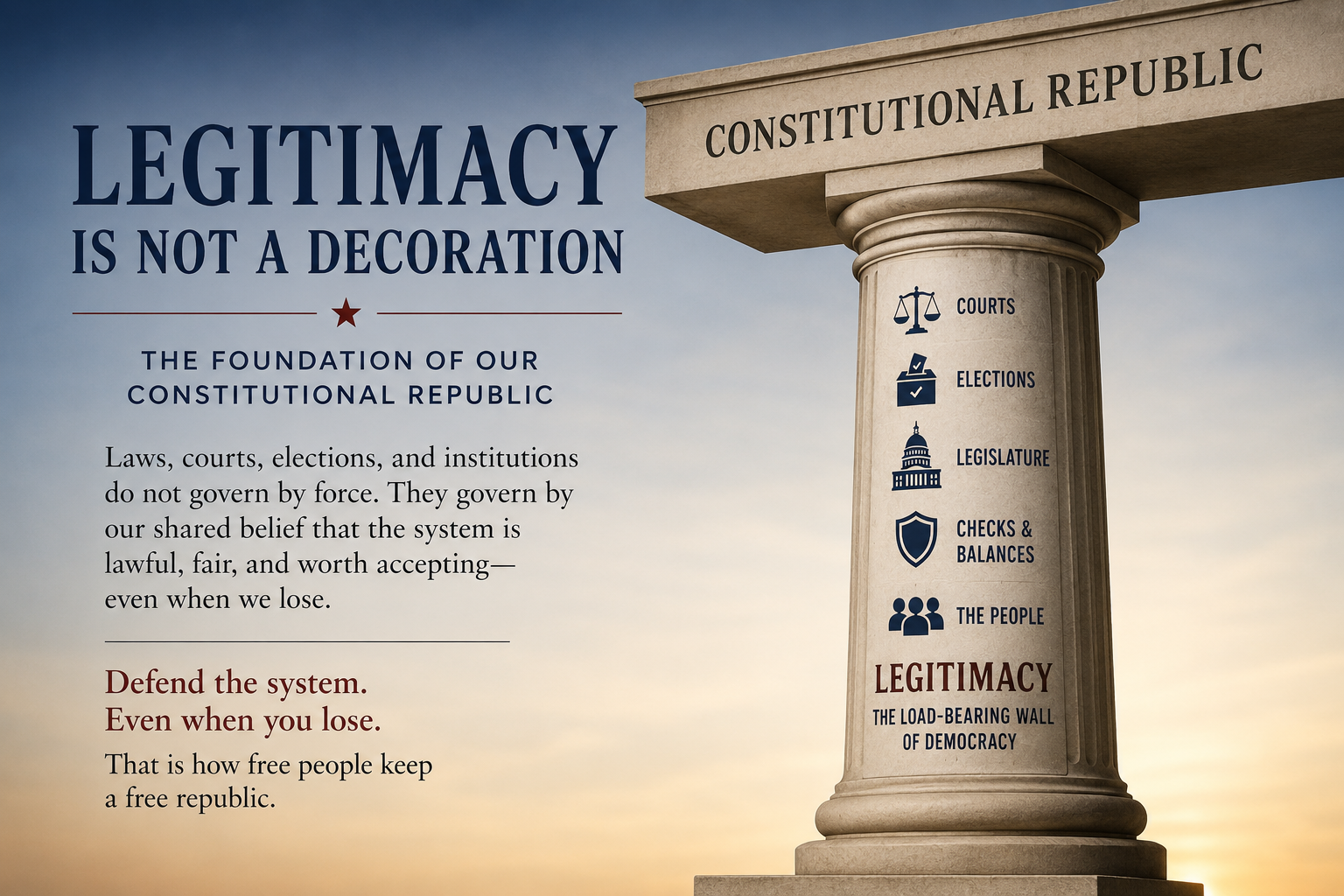
One of the most overlooked political truths in modern America is that constitutional systems do not run primarily on laws, buildings, judges, elections or even the text of the Constitution itself. They run on legitimacy. They run on a shared public belief that, despite imperfections and political disagreements, the system itself deserves acceptance and continued participation. That belief is not sentimental. It is structural. Legitimacy is not some ceremonial ornament hanging from the side of democratic government. It is the load-bearing wall. Remove enough of it and the entire structure begins to crack.
This has become increasingly difficult to discuss because Americans increasingly view institutions through the lens of immediate political outcomes. If a court rules in our favor, the court is wise. If it rules against us, it is corrupt. If an election produces our preferred candidate, democracy worked. If it does not, democracy failed. If federal agencies pursue our enemies, they are protectors of justice. If they target our side, they become tools of tyranny. That instinct may be emotionally satisfying. It is also deeply dangerous. A constitutional republic cannot survive if legitimacy becomes conditional.
Legitimacy Is Not the Same as Approval
Legitimacy is often misunderstood as approval. They are not the same thing. Citizens do not need to like institutions. They do not need to trust every politician or believe every court decision is wise. Legitimacy simply means accepting that the system itself possesses lawful authority even when it delivers outcomes we dislike.
A citizen in a functioning constitutional republic says: "I disagree with this ruling, but I accept the authority of the court." "I voted against that candidate, but I accept the election results." "I oppose this law, but I recognize Congress had the constitutional power to enact it." That attitude creates stability. Without it, every loss becomes theft and every disagreement becomes evidence of systemic corruption.
The moment political defeat becomes indistinguishable from institutional illegitimacy, constitutional order begins to weaken. Acceptance becomes surrender. Opponents become enemies. Politics becomes existential warfare. That is a road constitutional republics rarely survive.
The Constitution Was Built Around the Expectation of Losing
The American constitutional system was never designed to ensure constant victory for anyone. The opposite is true. The system was deliberately built around the expectation that people, parties and factions would regularly lose elections, court cases, legislative battles and policy fights. The founders knew this because they understood human nature. The Constitution was not written to eliminate conflict. It was written to channel conflict into peaceful institutional processes. That design only works if people continue accepting the rules after defeat.
If citizens begin believing every unfavorable outcome proves the system itself is fraudulent, peaceful transfer of power becomes increasingly difficult. Acceptance becomes surrender. That is a road constitutional republics rarely survive. Madison discussed this directly in the Federalist Papers, warning that groups driven by passion and self-interest could place immediate political goals above constitutional order. The constitutional structure — courts to settle disputes, Congress to represent competing interests, states to retain powers, checks and balances to slow passions — was the solution. That structure intentionally created friction. Today many criticize these institutions because they are frustrating. That frustration was partly the point.
Governments Survive Through Consent, Not Force
Courts do not possess armies. Judges do not physically compel obedience. Congress cannot force hundreds of millions of citizens into compliance daily. Police powers alone cannot sustain a nation at that scale. Instead, functioning republics rely heavily on voluntary acceptance. People obey court rulings because they recognize judicial authority. People pay taxes because they recognize governmental legitimacy. People follow election outcomes because they trust procedural fairness. Trust reduces the need for coercion.
As legitimacy weakens, governments increasingly rely on power rather than consent. History repeatedly shows where that road leads. Constitutions become less important. Power becomes more important. That transition rarely ends well.
When institutions lose public confidence, states often become increasingly dependent on force, censorship, emergency powers or centralized authority. That is not a theoretical concern. It is the documented pattern of republics under strain.
Legitimacy Is Easy to Spend and Hard to Replace
Institutional trust accumulates slowly. It can disappear rapidly. Political leaders often discover that attacking institutions creates immediate rewards. Outrage motivates voters. Anger energizes fundraising. Suspicion drives engagement. Delegitimizing institutions can provide short-term political gains. But legitimacy behaves like savings. You can spend it much faster than you can replenish it.
Repeatedly telling citizens that courts are corrupt, elections are fraudulent, agencies are tyrannical or constitutional structures are illegitimate gradually trains people to distrust the system. And distrust spreads. It rarely remains confined to the original target. Citizens taught that one institution cannot be trusted frequently begin questioning all institutions. Eventually confidence erodes across the board.
The Particular Danger of Elected Officials
The problem becomes especially serious when elected officials themselves participate in institutional erosion. Ordinary citizens possess opinions. Elected leaders possess authority. When a governor, senator or president repeatedly tells supporters that institutions cannot be trusted, those claims carry weight ordinary rhetoric does not. Citizens naturally assume they must know something. That assumption can be profoundly damaging.
The same officials who undermine institutional trust frequently depend upon those institutions for their own authority. Presidents depend on elections. Congress depends on constitutional structures. Courts depend on legitimacy. Undermine enough confidence and leaders eventually weaken the very system empowering them. They may gain short-term advantages from feeding distrust, but over time they create a public increasingly unwilling to accept institutional outcomes altogether. The damage becomes self-defeating.
Delegitimization Works Until It Doesn't
Political actors frequently assume they can selectively attack institutions. They imagine legitimacy can be withdrawn temporarily and restored later. History suggests otherwise. Citizens do not compartmentalize distrust neatly. People repeatedly told institutions are corrupt may eventually stop believing them entirely. You spend years persuading supporters that the courts are rigged, the election system cannot be trusted and federal agencies are corrupt. Then circumstances change. Those institutions now issue favorable rulings, deliver victories and pursue preferred policies. But by then legitimacy may already be damaged. The public has internalized years of distrust, and trust is not easily rebuilt.
Political leaders sometimes discover they successfully convinced supporters that the system itself deserves rejection. That realization often comes too late.
Criticism Is Necessary. Destruction Is Different.
None of this means institutions are beyond criticism. Courts make mistakes. Government agencies abuse authority. Congress becomes dysfunctional. Presidents exceed proper boundaries. Reform remains necessary and criticism is not the enemy. There is a crucial distinction between "this institution requires reform" and "this institution is fundamentally illegitimate." One preserves constitutional order. The other destabilizes it. Healthy republics criticize institutions because they expect them to improve. Failing republics abandon institutions because they no longer believe improvement is possible.
Modern politics increasingly operates under a dangerous assumption: institutions are legitimate only when they produce preferred outcomes. This mindset appears across ideological lines. Courts are guardians of democracy when they rule correctly and compromised when they do not. Elections reflect the will of the people when they produce favored candidates and become suspect when they do not. Agencies defend justice when they pursue favored causes and become authoritarian when they investigate the wrong side. Conditional legitimacy eventually becomes no legitimacy. A constitutional republic cannot survive if rules only apply when convenient.
Constitutional Government Requires Civic Restraint
One of the hidden requirements of constitutional government is self-restraint — not legal restraint, but moral and civic restraint. The Constitution cannot enforce this itself. No amendment can compel public maturity. No statute can require institutional respect. Citizens and leaders alike must choose restraint voluntarily. People must resist treating every disagreement as tyranny. Politicians must resist monetizing outrage. Leaders must resist the temptation to inflame distrust for temporary gain. This restraint often appears invisible because successful constitutional systems normalize it. But once restraint disappears, damage accelerates quickly.
History Rarely Announces Democratic Decline
Constitutional systems usually do not collapse dramatically. History does not often provide movie scenes. No music plays. No final speech arrives. Instead decline usually occurs slowly. Trust erodes. Confidence weakens. Institutions become viewed with increasing suspicion. Political opponents become enemies. Every election becomes existential. Every ruling becomes evidence of conspiracy. Eventually citizens cease believing constitutional processes deserve loyalty. The visible crisis arrives last. The cultural decay begins much earlier, quietly, over many years, in ways easy to dismiss in the moment and impossible to reverse once they compound.
My Bottom Line
Legitimacy is not decoration. It is not ceremonial. It is not optional. It is the invisible agreement allowing constitutional government to function without descending into coercion and factional warfare. Citizens do not need blind faith in institutions. Institutions are imperfect because human beings are imperfect. Criticism is healthy. Reform is necessary. Skepticism is valuable. But there is a line between demanding improvement and convincing citizens the entire constitutional structure deserves abandonment. Cross that line often enough and eventually trust disappears.
Constitutions ultimately live not on paper. They live in the public willingness to believe the system deserves preservation. Lose that willingness and no document saves you.
Why This Matters
Most Americans focus on policy battles, elections and personalities. Those matter. But beneath all of those fights lies something more fundamental: trust in the constitutional framework itself. Lose an election and the country survives. Lose a court case and the country survives. Lose a legislative battle and the country survives. Lose legitimacy and eventually the entire system becomes unstable. The danger is not disagreement. The danger is convincing millions of citizens that constitutional structures only deserve loyalty when their side wins. That is not how republics endure. That is how they slowly come apart.
References
- Madison, J. (1787–1788). The Federalist Papers, Nos. 10 and 51. Particularly on faction and the structure of republican government.
- de Tocqueville, A. (1835–1840). Democracy in America. On civic participation, voluntary associations and the conditions sustaining democratic governance.
- U.S. Constitution (1787). Article I, Article II, Article III; Amendments I–X (Bill of Rights).
Disclaimer: The views expressed in this post are opinions of the author for educational and commentary purposes only. They are not statements of fact about any individual or organization, and should not be construed as legal, medical, or financial advice. References to public figures and institutions are based on publicly available sources cited in the article. Any resemblance beyond these references is coincidental.