
For thousands of years humanity has asked the same question: are we alone? It predates science, predates philosophy and predates written history. Ancient people looked at the stars and wondered if something else was looking back. Modern astronomy has given that question a dizzying new context. There are hundreds of billions of stars in our galaxy and hundreds of billions of galaxies in the observable universe. The numbers strain human comprehension. And yet despite all that cosmic real estate, all those planets, all those billions of years of chemistry running in parallel across the universe, we have found exactly one example of life. Us. That sample size of one is both the most astonishing fact in science and the most frustrating limitation in it. We cannot know whether life is common or extraordinarily rare because we have nothing to compare ourselves to. But imagine that changes tomorrow.
Imagine a probe exploring the ocean beneath the ice of Europa returns data showing microbial movement. Or a rover examining ancient Martian sediment identifies fossilized cellular structures. Or a space telescope detects an unmistakable biological signature in the atmosphere of an exoplanet four hundred light-years away. Any of those discoveries would be the most important moment in the history of science. But imagine scientists examine that life more closely and find something that elevates the discovery to an entirely different category. The alien life uses the opposite molecular handedness from life on Earth. It turns right where we turn left. That detail would transform not just biology, but philosophy, religion and humanity's understanding of its own place in the cosmos.
The Strange Fact About Life on Earth
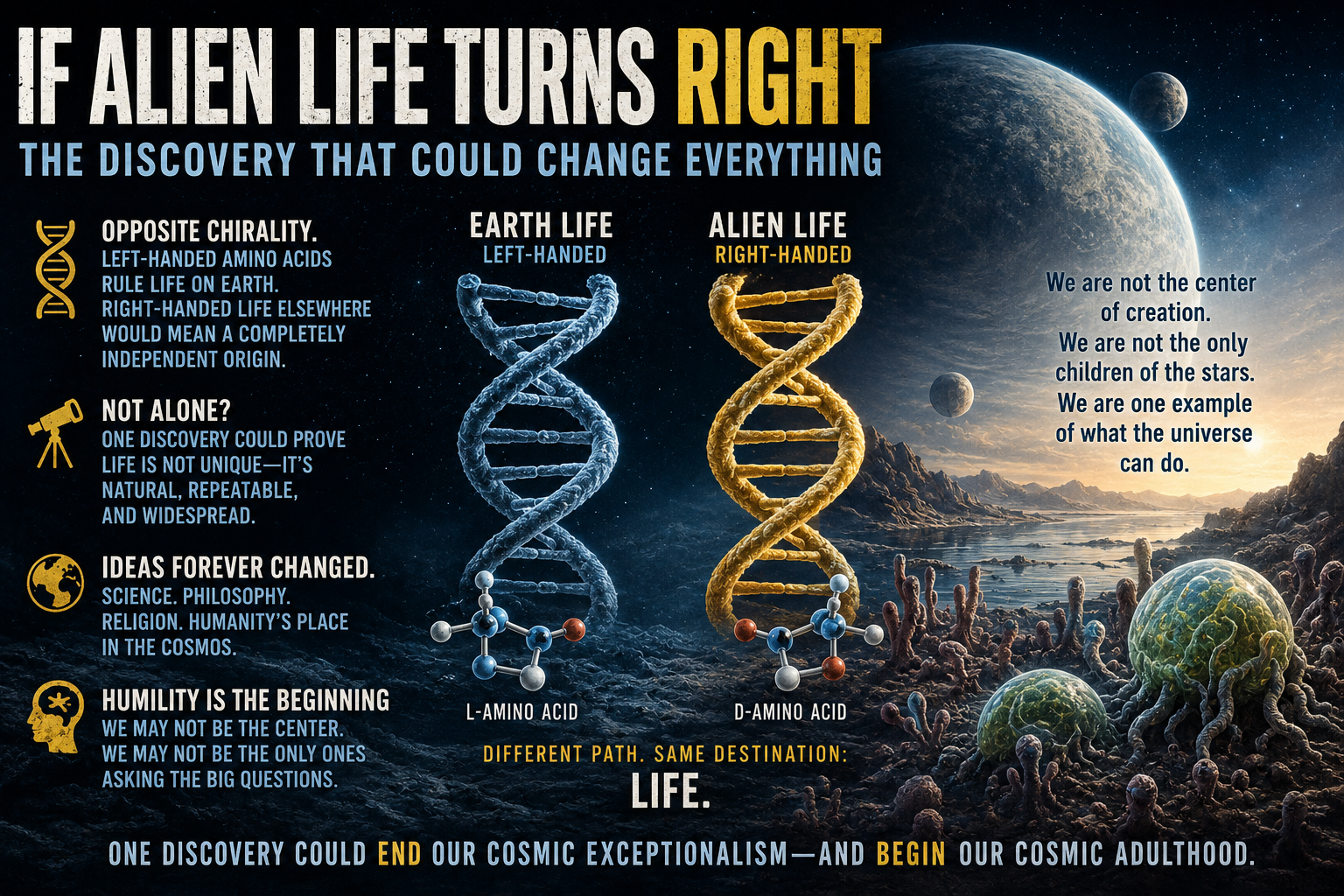
Most people have never encountered the concept of chirality. Yet it may be one of the defining characteristics of life as we know it. Many biological molecules come in two mirror-image forms, much like your left and right hands. They look similar. They contain the same atoms. They have the same chemical formula. But they cannot be perfectly superimposed. Your left hand cannot fit into a right-handed glove, and the same geometric asymmetry applies at the molecular level. Life on Earth overwhelmingly uses left-handed amino acids and right-handed sugars — a property called homochirality. Chemistry itself does not strongly prefer one orientation over the other. In laboratory conditions, chemical reactions typically produce equal amounts of both forms. In theory, life could have evolved using the opposite arrangement. Yet it did not. Somewhere near life's origin, a choice was locked in, and every known organism on Earth inherited it.
Opposite chirality in alien life would be the biological equivalent of finding two independently written books that tell similar stories, contain equally complex characters and describe entire civilizations — but share no common author and borrowed nothing from each other. Nature would have written the story of life twice, using different molecular choices, arriving at the same result through entirely independent experimentation. That would be one of the most consequential discoveries in the history of science.
Shared Ancestry or Second Genesis?
Suppose scientists discover life on another world. The immediate revolutionary question would be followed almost instantly by a second one: is it related to us? Life may have spread through the solar system via meteorites — panspermia. If life originated on Mars and later reached Earth, both biospheres might share common molecular architecture, perhaps even identical chirality. They would be distant relatives, not independent inventions. But if alien life uses opposite molecular handedness, that rules out shared ancestry entirely. It would be powerful evidence for a completely independent origin. Not a distant cousin. A second genesis. Two biospheres representing parallel experiments by nature, conducted in isolation, arriving at life through different molecular paths.
What It Would Tell Us About the Origin of Life
One of science's most important unresolved questions concerns abiogenesis — how nonliving chemistry becomes living biology. With a sample of one, it is impossible to distinguish between a process and a fluke. A second independent origin of life would change that calculation dramatically. Consider flipping a coin. Getting heads once is interesting. Getting heads twice begins to suggest something. The more times it happens under different conditions, the harder it becomes to argue the result is an accident. A second independent origin would suggest that chemistry under suitable conditions produces life not as a miraculous exception but as something closer to an expected outcome.
If life emerged independently twice, the argument that life requires a miracle becomes much harder to maintain. The simpler explanation becomes: life is what chemistry does when the conditions are right.
The End of Cosmic Uniqueness
Humanity has a long history of placing itself at the center of things and a longer history of discovering it was wrong. Ancient civilizations placed Earth at the center of creation. The stars existed for us. Everything revolved around us. Science has been steadily correcting that picture ever since. Earth is not the center of the solar system. The Sun is not the center of the galaxy. Our galaxy is one among two trillion in the observable universe. Each discovery pushed humanity further from the center of its own cosmology. Independent alien life would deliver perhaps the largest displacement since the Copernican revolution — the suggestion that life itself is not the exclusive property of one fortunate planet but a natural feature the universe generates under the right conditions.
What Religion Would Actually Face
Let me say directly what the usual version of this conversation tiptoes around. The discovery of independently originated alien life would not be merely "challenging" or "uncomfortable" for certain religious traditions. For specific, named, institutionally powerful religious frameworks — biblical inerrancy, Young Earth Creationism and the theological system that insists an omniscient God produced an immutable, complete and error-free revelation — it would be a structural catastrophe. Not a nuisance. Not a talking point for a Sunday sermon. A direct falsification of specific empirical claims those traditions have staked their authority on.
Here is the architecture of the problem. Biblical inerrancy, as codified in the Chicago Statement signed by more than three hundred evangelical leaders in 1978, declares Scripture "without error or fault in all its teaching" — not just salvation doctrine but everything it affirms about history, nature and creation. The Southern Baptist Convention states the Bible contains "truth, without any mixture of error, for its matter." Answers in Genesis insists the Earth is approximately six thousand years old and that all life was specially created in its current forms. These are not metaphors. They are specific empirical claims. An omniscient God, by these traditions' own definition, knows everything — every galaxy, every planet, every biosphere He is simultaneously running. An inerrant text produced by that omniscient God and addressed to humanity would, if complete and error-free, reflect that knowledge.
Inerrancy, omniscience and human exceptionalism are an interlocking system, not three independent beliefs. An omniscient God cannot be wrong. An inerrant Bible produced by that God cannot be wrong. A Bible that cannot be wrong places humanity at the center of creation as the primary purpose of divine revelation. These three claims stand together or fall together. A second independent origin of life strikes all three simultaneously: the omniscient God knew about other life and said nothing in the inerrant text, the inerrant text is therefore incomplete in its description of creation and human exceptionalism loses its cosmological foundation entirely.
An omniscient God who was generating independent life on other worlds while dictating Genesis to ancient scribes who believed the sky was a dome over a flat Earth either did not know about that life, did not care enough to mention it or did not dictate the text. Every one of those options destroys a pillar of the inerrancy framework. The usual theological escape — that God revealed only what humanity needed to know for salvation — cannot do the work it is asked to do here, because inerrancy claims the text is without error in all it affirms, not merely sufficient for its salvific purpose. The moment you invoke selective revelation to explain the silence, you have conceded that the text is not complete, which means it is not inerrant. The escape hatch surrenders the position.
Human exceptionalism — the claim that humanity occupies a unique and central position in the concern of the divine creator of the universe — would face a reckoning it cannot survive in its current form. Genesis places human beings as the culmination of creation, made in God's image, given dominion over the Earth and established as the primary audience and beneficiary of divine revelation. If the universe independently generated life at least twice, and if the scale of the cosmos suggests two is almost certainly a lower bound on a much larger number, then the universe is not a stage built for humanity. It is a vast chemical engine that produces life as a natural function of its operation. That does not make human beings insignificant. It makes the theological claim that the creator of two trillion galaxies organized the entire enterprise specifically around one species on one planet impossible to defend.
An omniscient God who knew about alien life and said nothing about it in an inerrant text either did not know, did not care or did not write it. None of those options is compatible with inerrancy.
This will not destroy religion broadly. It needs to be said clearly that liberal Protestantism, Catholicism, mainline Judaism and most of the world's religious traditions outside American fundamentalism have theological frameworks flexible enough to absorb a second biosphere. The Vatican's own astronomers have said so publicly. These traditions do not depend on inerrancy, Young Earth timelines or the claim that life required direct supernatural special creation on a six-thousand-year schedule. They will adapt, as they have adapted to Copernicus, Darwin and the Hubble Deep Field before. The discovery will unsettle them and generate serious theological work. It will not break them.
What it will break — or more precisely, what it will expose as already broken — are the specific empirical claims of biblical inerrancy, Young Earth Creationism and the theological framework that uses an immutable divine text as the governing authority over public education, public health and the governance of a pluralistic secular republic. Those claims are brittle because they are specific and testable. They make predictions about the nature of creation that can be evaluated against evidence. The evidence of independently originated alien life would evaluate those predictions and deliver a verdict. At that point, inerrancy does not disappear as a confessional commitment that individuals choose to hold by faith. It disappears as a serious intellectual position that can claim the authority of fact. It belongs in the philosophy department alongside every other unfalsifiable commitment — not as a condemnation but as a clarification about what kind of claim it actually is.
The Deeper Philosophical Stakes
Beyond the religious implications, the most profound impact might be philosophical. If two independently evolved civilizations both arrived at logic, mathematics and self-reflective inquiry, that convergence would suggest something important about the structure of intelligence — that it is not an accident of our specific biology but a natural attractor that sufficiently complex information-processing systems tend toward. That would be one of the most significant results in the history of philosophy, arriving not from argument or thought experiment but from empirical discovery.
The New Scientific Era It Would Open
An independent second origin of life would transform biology from a one-example descriptive science into a genuinely comparative one. Researchers would compare genetics, biochemistry, evolutionary pathways, cellular structures and information storage systems across two separate biospheres. The central question would shift from "how did life begin?" to "what aspects of life are universal and what aspects are contingent?" Every biology textbook on Earth would require revision — not because existing science was wrong, but because it would suddenly be understood as the science of one example rather than the science of life in general.
My Bottom Line
If scientists discover life elsewhere and that life uses opposite chirality, it would be among the most important events in the history of human thought. A second independent origin would shift the baseline assumption about life from "extremely improbable exception" to "natural consequence of chemistry operating over time." That shift would ripple across science, philosophy and religion in ways that would take generations to fully absorb. For religious traditions grounded in adaptable interpretation, the absorption will be difficult but possible. For the traditions grounded in inerrancy, omniscience and special creation as specific empirical facts, the absorption will require abandoning the positions that made those traditions powerful. That is not a small ask. But it is the honest one.
Nature may have written the story of life twice. If it did, it almost certainly wrote it more times than we can count. That changes everything about what we thought we were — and everything about who had the authority to tell us.
Why This Matters
Every generation experiences discoveries that reshape humanity's understanding of itself. Heliocentrism did it. Evolution did it. Modern cosmology did it. The discovery of independent alien life could do it again, perhaps more dramatically than any previous scientific revolution. The question is not merely whether we are alone. The deeper question is whether life is a rare cosmic accident or a natural consequence of the universe operating over billions of years. If we find life that turns right while we turn left, we may finally have evidence enough to answer it. And the answer, whatever it is, will be the most consequential thing science has ever told us about our place in the cosmos.
References
- Blackmond, D. G. (2010). The origin of biological homochirality. Cold Spring Harbor Perspectives in Biology, 2(5).
- Pizzarello, S., & Cronin, J. R. (2000). Non-racemic amino acids in the Murray and Murchison meteorites. Geochimica et Cosmochimica Acta, 64(2), 329–338.
- McKay, C. P. (2004). What is life — and how do we search for it in other worlds? PLOS Biology, 2(9).
- NASA Astrobiology. (2023). Astrobiology strategy. astrobiology.nasa.gov.
- Sagan, C. (1994). Pale blue dot: A vision of the human future in space. Random House.
- Davies, P. (2010). The eerie silence: Renewing our search for alien intelligence. Houghton Mifflin Harcourt.
- The Chicago Statement on Biblical Inerrancy. (1978). International Council on Biblical Inerrancy.
- Southern Baptist Convention. (2000). Baptist Faith and Message, Article I. sbc.net.
- Vatican Observatory. (2009). Public statements on extraterrestrial life. vatican.va.
Disclaimer: The views expressed in this post are opinions of the author for educational and commentary purposes only. They are not statements of fact about any individual or organization, and should not be construed as legal, medical, or financial advice. References to scientific concepts are based on current scientific understanding, which may evolve with future discoveries. Readers are encouraged to consult primary scientific sources and form their own conclusions.