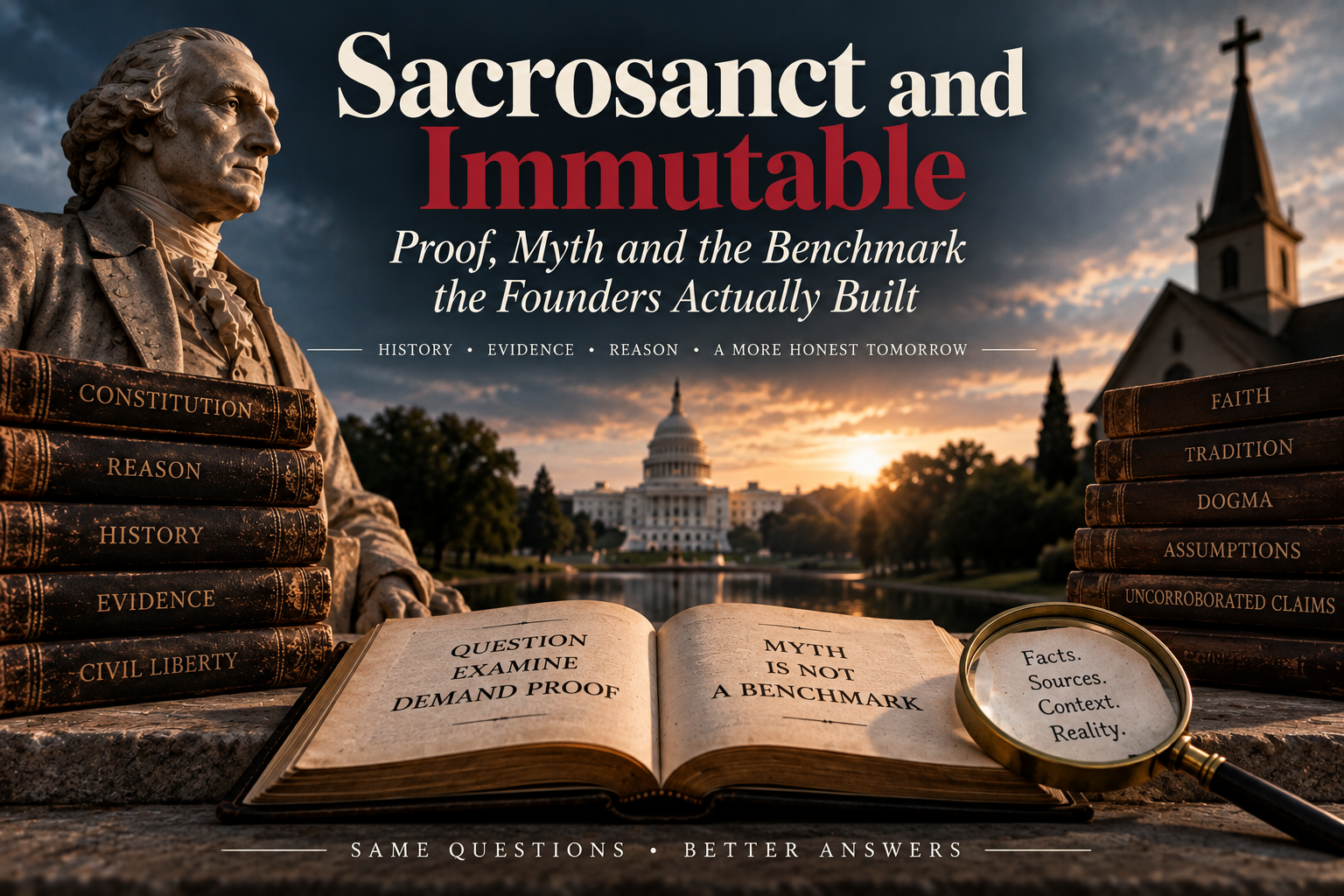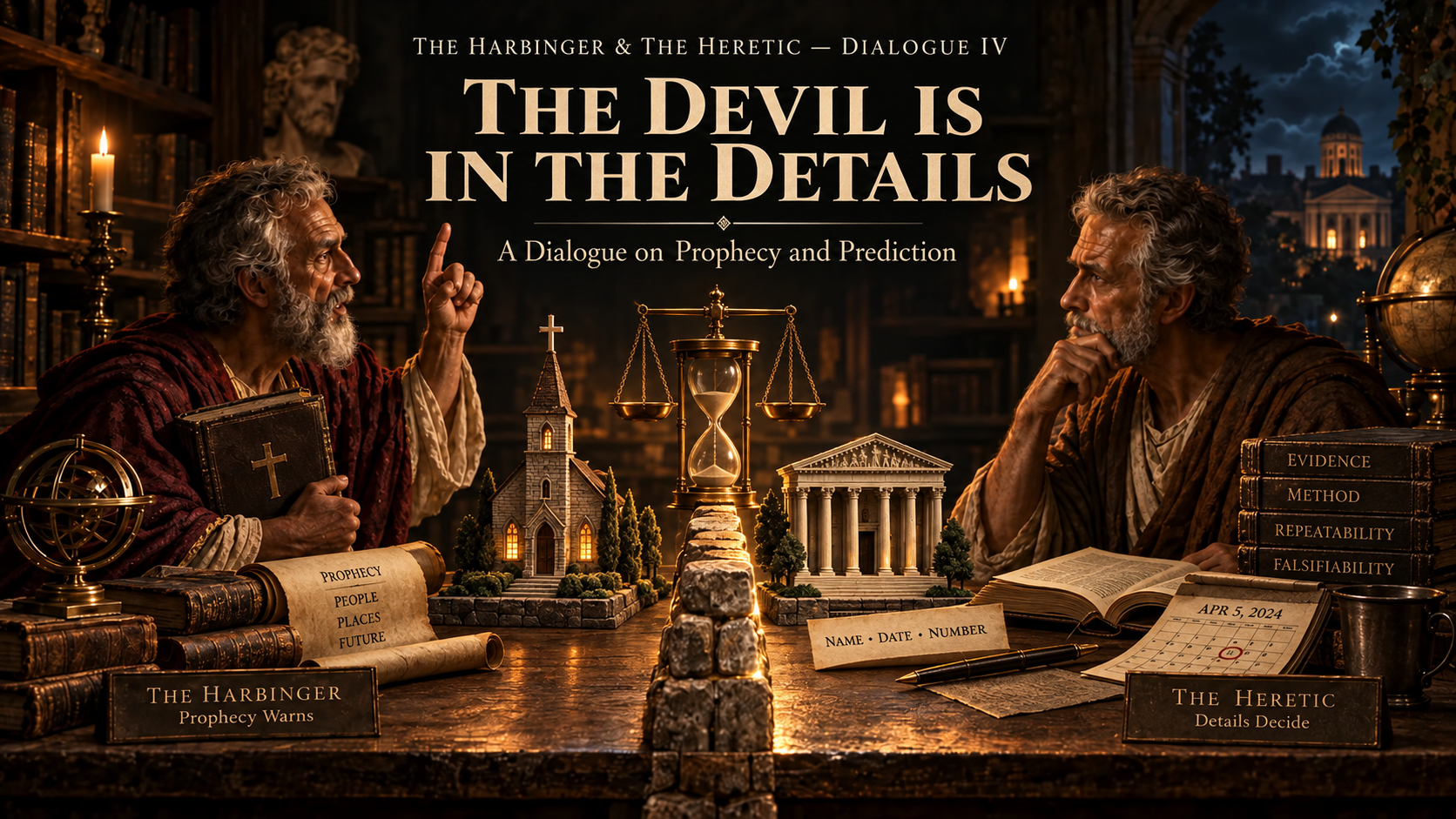
I have a Christian fundamentalist friend who keeps repeating a line that sounds smart until you actually listen to it: "The proof doesn't exist, but the evidence is overwhelming." Translation: I do not have what you asked for, but I am going to act like I do anyway. That is not an argument. That is a sales pitch. It is the rhetorical equivalent of telling someone you cannot show them the receipt but the purchase was absolutely real. And then comes the follow-up move, the guilt-laden spiritual flex: "I told you how you can discover undeniable proof, but you refuse." That is not proof either. That is a rigged test - one where belief counts as success and skepticism counts as doing it wrong. If the method only works for people who already agree with the conclusion, it is not an honest test. It is confirmation bias with incense.
The best part - and by best I mean most absurd - is when this routine tries to borrow credibility from science while rejecting what science actually is. "I watched real scientists all day, people with multiple PhDs, heads of departments." Good. We have now moved from "I have overwhelming evidence" to "I know a guy." That is not how truth works. That is how fan clubs work.
Proof, Evidence and the Bait-and-Switch
Let us clean up the vocabulary, because this is where the confusion becomes convenient. Empirical proof is not "I feel strongly about it." It is not "a lot of people agree." It is not "a credentialed person said it on YouTube." Empirical claims require empirical standards: testability, independent verification and results that do not depend on whether the audience already believes. When someone says the proof does not exist but the evidence is overwhelming, they are trying to smuggle certainty into a category where certainty is not available.
If you are talking about a bodily resurrection, you are not talking about a repeatable natural event. You are talking about a one-time supernatural claim. That is fine as a faith claim. The moment you attach the words "undeniable proof" and "true science" to it, you are pretending the claim belongs to a different rulebook than the one it actually lives under. A simple test: if your claim cannot be examined in a way that could show it false, you do not get to call it empirical proof. Call it belief, testimony, tradition, revelation, personal experience - whatever fits. Just do not call it science.
If your method for finding God has built-in excuses for failure - "God doesn't answer to you," "you want it your way" - then the method is unfalsifiable. It cannot fail. Which means it cannot prove anything.
"Theory" Is Not an Insult - It Is a Scientific Achievement
Here is where the most common amateur mistake shows up. My friend said: "You keep coming up with theories, hypotheses, and conjectures." That sentence was intended as an indictment. In reality it is a confession of scientific illiteracy. In everyday conversation, "theory" can mean hunch. In science, a theory is a powerful and well-supported explanation that integrates a broad range of evidence and makes testable predictions. That is why "it's just a theory" is considered a cheap shot in science education - it misuses the word deliberately or ignorantly, and neither is a good look.
Theories do not "graduate" into laws either. That is another popular myth. Theories explain mechanisms. Laws describe patterns, often mathematically. They are different tools, not different ranks on the same ladder. So when my friend says "you only have theories," he is essentially saying "you only have the most successful explanatory frameworks in the history of human knowledge." That is not the devastating critique he thinks it is. Take evolution by natural selection - it integrates genetics, the fossil record, observed adaptation, comparative anatomy and biogeography into a single coherent explanation. Take relativity - confirmed across more than a century of experimental and observational tests. These frameworks carry authority not because their authors were geniuses, though they were, but because reality keeps behaving the way the frameworks predict. That is what earns scientific confidence. That is precisely what faith claims do not do.
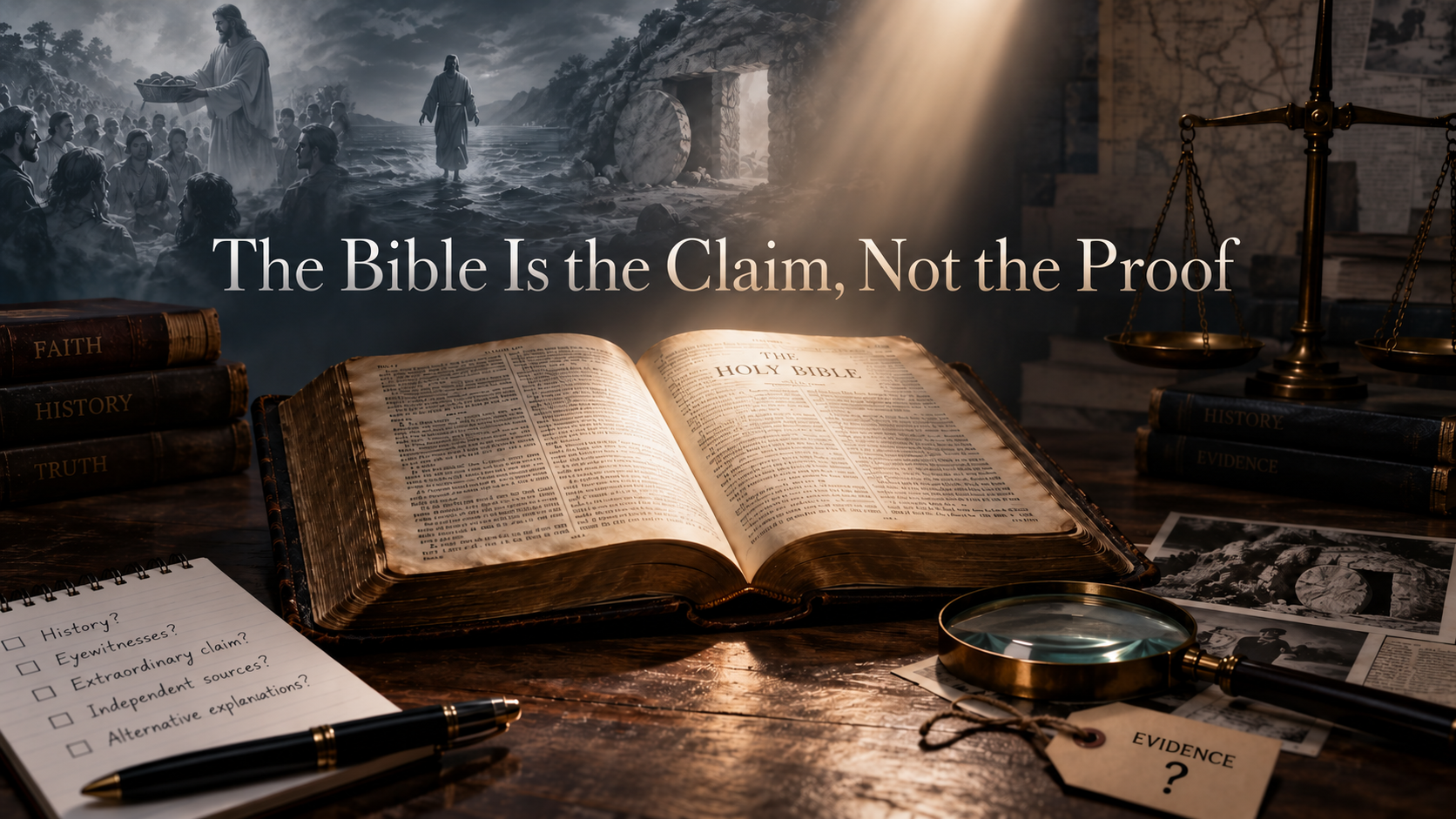
A certain style of Christian apologetics tries to be both scientific and immune to scientific standards simultaneously. The loop runs roughly like this: you cannot prove it, but it is undeniable proof; science backs it, but science is wrong unless it agrees with the conclusion; you refuse the test, and that refusal proves you are the problem. That is not reasoning. It is a closed circuit built to protect a conclusion rather than discover a truth. If your proof depends on already accepting the Bible as the baseline authority, you are not doing empirical reasoning. You are doing circular reasoning: this is true because the book says so, and the book is true because it says it is true. Pointing that out is not arrogance. It is the minimum requirement for an honest conversation.
The Authority Card: "I Watched Scientists All Day"
Credentials matter in the right context. I am not anti-expertise. If my car needs a transmission I want a mechanic, not a poet. If I need brain surgery I want a neurosurgeon, not a motivational speaker. But name-dropping authorities is not evidence. It is often an attempt to bypass evidence. Appeal to authority becomes fallacious when the authority is irrelevant, is speaking outside their specialty, is being misquoted or when credentials are being used as a substitute for the actual argument rather than a supplement to it.
On the internet this gets abused constantly - a scientist speaking outside their field, a credentialed person selling a religious conclusion dressed as science, a cherry-picked clip that ignores the broader consensus, a "Dr." on a channel that survives on clicks rather than peer review. If your argument is essentially "trust this guy," your argument is not true science. Science is not a personality cult. Science is a method, and the method does not care who is invoking it.
The Double Standard: Impossible Standards for Science, Certainty for Miracles
Here is the most glaring inconsistency in the whole mindset. Science is held to an impossible standard - absolute proof, right now, with certainty - while miracles are granted certainty without any comparable standard because someone says they are undeniable. In actual scientific practice we talk about evidence, confidence levels, models and prediction. We revise when new information arrives. That is not weakness. That is intellectual honesty in operation. But the apologetics routine I am describing treats doubt as moral failure, skepticism as pride and "I don't know" as rebellion against God rather than as the honest starting point of every serious inquiry.
When my friend observed that I had placed my faith in books other than the Bible, he was inadvertently describing the actual difference between these two approaches: trusting a process that is transparent, testable and self-correcting on one hand, and trusting a claim because it is sacred and protected from testing on the other. Those are not equivalent ways of knowing. Calling them equivalent is not humility. It is the erasure of a distinction that matters enormously.
Another classic move in this style of argument: "You refuse because you want it your way." That is not an argument about evidence. That is an attack on motive - a way of avoiding the actual problem, which is the absence of empirical proof, by impugning the character of the person asking for it. If the response to "show me independently verifiable empirical evidence" is "you're proud," that is not a rebuttal. It is an escape hatch. It is also an implicit admission: I cannot meet your standard, so I am going to accuse you of bad character for having one. That move ends conversations without winning them. It also reveals that the person making it knows the standard has not been met.
This Is Not About All Christians
I want to be precise here because I am not interested in cheap shots. This is not about all Christians. Plenty of Christians understand the difference between faith and empirical science clearly and will say plainly: my belief is not empirically provable, and that is why it is called faith. That position is at least coherent. We can disagree without pretending one side has undeniable proof when even the person making the claim admits the proof does not exist in the conventional sense.
What I am calling out is a specific and recognizable mindset: one that wants the moral comfort of faith and the rhetorical authority of science simultaneously, that wants certainty without accountability, that wants to win arguments without doing the argumentative work, that treats the word "evidence" as a magic charm and treats credentialed names as holy relics. It is the mindset that calls skepticism ignorance while misusing basic scientific terms in the same breath. And tacking on an election prophecy at the end - "if Republicans lose you ain't seen nothing yet" - is not evidence of anything except that fear and political anxiety have been welded onto the theological argument in ways that neither discipline would endorse. Even if the political prediction proves accurate, it validates a guess about elections, not a claim about the supernatural. Different categories, different standards, different claims entirely.
My Bottom Line
The "faith cosplaying as science" routine does not just confuse people. It poisons honest conversation. When we redefine words like proof, theory and evidence to mean whatever helps our side, we do not get closer to truth. We just get louder. It also turns every conversation into a loyalty test: agree or you are proud, comply or you refuse, convert or you are choosing darkness. That is not friendship and it is not evangelism. It is manipulation dressed as concern, and most people can sense it even when they cannot name it.
Science is a method for investigating the natural world. Faith is a commitment that goes beyond what can be empirically demonstrated. Both can be meaningful. Neither is well served by pretending to be the other. Keeping those categories straight is not arrogance. It is the minimum requirement for thinking clearly - and for having a conversation that is actually worth having.
If your friend says the proof does not exist but the evidence is overwhelming, ask him which one he means. Then watch what happens to the conversation. That is where the honesty starts.
References
- National Center for Science Education. (2016). Definitions of fact, theory, and law in scientific work. ncse.ngo.
- National Science Teaching Association. (n.d.). Science 101: How does a scientific theory become a scientific law? nsta.org.
- University of California, Berkeley. (n.d.). Understanding Science 101: Science at multiple levels. undsci.berkeley.edu.
- Hansen, H. (2015). Fallacies. In E. N. Zalta (Ed.), Stanford Encyclopedia of Philosophy. Stanford University.
- Internet Encyclopedia of Philosophy. (n.d.). Fallacies. iep.utm.edu.
Disclaimer: The views expressed in this post are the personal opinions of the author and are offered for educational, commentary and public discourse purposes only. They do not represent the positions of any institution, employer, organization or affiliated entity. Nothing in this post constitutes legal, financial, medical or professional advice of any kind. This post critiques a specific rhetorical style found in some forms of Christian apologetics and does not make claims about Christian belief or Christians as a whole. Commentary on religious and philosophical subjects reflects the author's independent analysis and is protected expression of opinion. Readers are encouraged to consult primary sources and form their own conclusions.