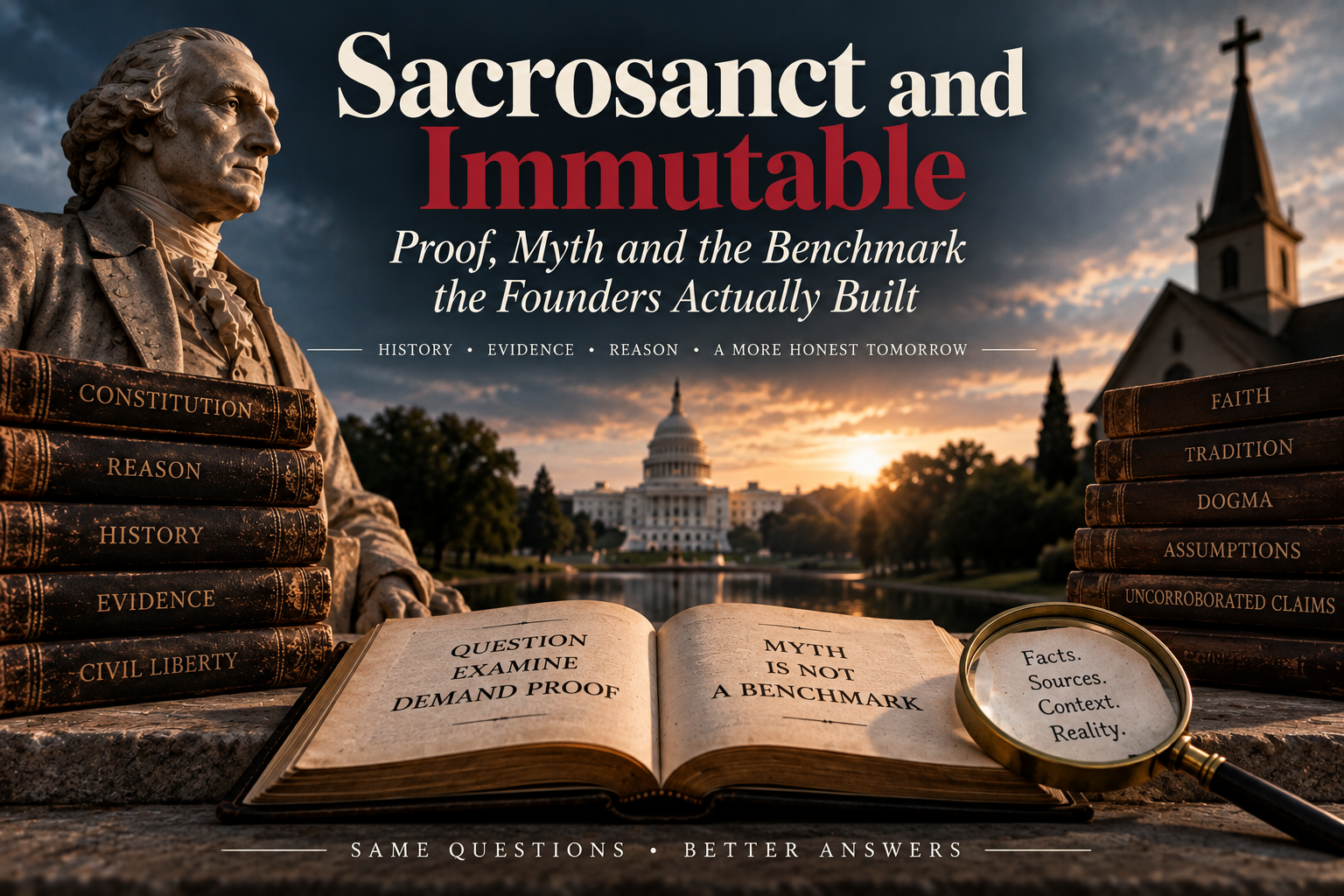
Empirical Proof, Political Claims, and Religious Guarantees: A Survival Guide for Thinking Adults
New Title

Introduction
If you want to start an argument in America, pick one of these three topics: politics, religion, or “science.” Then watch what happens next: people stop talking about evidence and start talking about identity. They don’t defend a claim; they defend a tribe. And the moment a claim becomes tribal, “proof” turns into a prop—something you say you have, not something you can demonstrate.
That’s why “empirical proof” matters!
Not because it makes you smarter than everyone else, but because it keeps you honest. Empiricism is basically the idea that, for a lot of real-world claims, experience and observation are the best tools we have for knowing what’s true. Not vibes. Not credentials. Not tradition. Not “my pastor said.” Not “my favorite expert said.” Experience, evidence, testing, and a willingness to be wrong. That’s the only adult way to operate in a world where people lie for money, votes, status, and comfort.
Now, before anyone gets dramatic: empiricism doesn’t solve everything.
There are moral questions, metaphysical questions, and personal questions that don’t fit neatly into a lab. Fine. But once you step into the world of guarantees—“this policy will work,” “this ideology always leads to justice,” “this religion promises definitives,” “this miracle is a historical slam dunk”—you are back in the world of claims. And claims have to earn belief.
“Proof” has a definition, even when people don’t like it
One of the sneakiest games people play is swapping meanings mid-sentence.
They’ll say: “The proof doesn’t exist… but the evidence is overwhelming.”
That’s not a profound mystery. That’s a category problem. If you admit the proof doesn’t exist, you don’t get to pivot and act like it does. You can argue plausibility, meaning, tradition, testimony, inference—sure. But don’t call it “undeniable proof” while also admitting it isn’t available.
And this is where religion—especially modern, politicized religion—gets tempted to cheat. It wants the comfort of faith and the authority of empiricism. It wants to say, “Believe without seeing,” while also saying, “God already proved it.” Those are two different claims.
If you want to speak the language of empirical proof, you inherit empirical standards: independent verification, transparent methods, and conclusions that don’t depend on already believing the conclusion.
That’s the deal.
Politics is where “guarantees” go to die
Politics is full of promises. Some are sincere. Some are marketing. Most are a mixture of both.
“This bill will lower costs.”
“This program will reduce crime.”
“This regulation will save the planet.”
“This reform will create fairness.”
“This crackdown will restore order.”
“This movement is on the right side of history.”
Notice the common feature: certainty. Definitives. Guarantees.
The problem is that politics isn’t theology. It’s messy human behavior, incentives, tradeoffs, and unintended consequences. So when someone talks like their political vision is a guaranteed path to paradise, your skepticism should kick in. Not because you’re cynical, but because humans are unreliable and complex systems are unforgiving.
Empiricism in politics means asking boring, grown-up questions:
- Compared to what?
- Over what timeframe?
- At what cost?
- With what tradeoffs?
- Measured how?
- Who benefits, who pays, who gets ignored?
- What happened the last time someone tried something like this?
This approach isn’t “anti-compassion.” It’s anti-delusion. And we need more of it—especially when political movements start borrowing religious language: salvation, damnation, heresy, purity, and “the chosen.”
Once politics becomes religion, dissent becomes sin. And once dissent becomes sin, you don’t debate—you excommunicate. That’s how you end up with mobs, censorship, and moral panic pretending to be virtue.
Religious guarantees: when faith pretends it’s a warranty
Religion often makes claims in two modes.
Mode one is humble: “This is faith. This is meaning. This is how I interpret existence. I can’t prove it like a math problem, but it guides my life.”
That’s coherent.
Mode two is aggressive: “This is definitive truth. This is undeniable proof. God already proved it. True science supports it. If you don’t accept it, it’s because you refuse.”
That’s not humility. That’s a power move.
Because “proof” here isn’t a method. It’s a weapon. It’s not used to discover truth; it’s used to shame the skeptic into compliance.
And here’s the tell: the so-called “undeniable proof” is usually personal experience dressed up as universal evidence.
- “Try this spiritual practice and you’ll know.”
- “Open your heart and you’ll see.”
- “God doesn’t answer to your demands.”
- “If you don’t get the result, it’s your fault.”
That is not a test. It’s an unfalsifiable loop. A system where success validates the claim and failure condemns the person. You can’t lose. Which means you can’t prove anything.
If your “proof” only works after submission, it’s not proof—it’s conversion.
The science vocabulary trap: “theory” isn’t a weakness
A lot of people reveal their ignorance of science with one line:
“You only have theories.”
In normal conversation, theory can mean “hunch.” In science, a theory is a broad explanatory framework supported by multiple lines of evidence. It’s not the bottom rung. It’s the high rung.
And another popular myth needs to die: theories do not “graduate” into laws. They’re not competing for promotion. Laws generally describe patterns (often mathematically). Theories explain why those patterns occur. Different jobs. No hierarchy.
So when someone mocks “theory” as if it means “made up,” what they’re really doing is broadcasting that they don’t understand how scientific knowledge is built: observation, hypothesis, testing, peer review, revision, and constant exposure to being proven wrong.
That brings us to the key difference between science and religious certainty.
Science earns confidence by surviving criticism.
Religious certainty often survives by dodging criticism.
“Authorities said so” is not evidence
Now let’s talk about the fallacy that shows up everywhere—especially online:
“I watched REAL scientists all day. Heads of departments. Multiple PhDs. So I don’t have to prove anything.”
No. That’s not how this works.
Expertise is valuable, but it is not a substitute for evidence. Citing an authority can be reasonable when they’re relevant, when their claims reflect the broader body of research, and when the evidence is accessible and checkable. It becomes fallacious when the authority is used as a shortcut to avoid evidence—or when the “authority” is irrelevant, outside their field, cherry-picked, or being used like a human shield.
The internet is a factory for credential theater:
- A degree becomes a brand.
- A lab coat becomes a costume.
- A confident tone becomes “proof.”
- A clip becomes “the science.”
But science isn’t a person. It’s a method. If you can’t explain what the evidence is and why it supports the claim, then you don’t have a scientific argument—you have a vibe backed by a resume.
And religious apologists love this move because it sounds impressive to non-specialists:
“Look! A scientist believes in the resurrection.”
“Look! A scholar says miracles are real.”
“Look! This PhD says the Bible is historically airtight.”
Okay—show the argument. Show the methodology. Show what would count as disconfirming evidence. Show independent verification. Otherwise, it’s not proof; it’s marketing.
“But you believe things you read in books” — yes, that’s called learning
Another rhetorical trick goes like this:
“You don’t have empirical proof, but you read it in a book other than the Bible, so you put all your faith in it.”
This sounds clever until you realize it’s an accidental self-own.
Most of what you “know” comes from mediated information: books, instructors, experts, measurements, recorded data, and shared methods. The difference is not that one side reads and the other doesn’t. The difference is the standard used to sort reliable information from nonsense.
Empirical thinking isn’t “I saw it with my own eyes, therefore true.” That would be naive. Empirical thinking is: “What’s the best available evidence, how was it produced, can it be checked, and does it hold up when people try to break it?”
In other words, you can rationally trust information you didn’t personally observe if the process behind it is transparent, replicable, and self-correcting. That’s exactly why science advances.
Religious claims about miracles and the spiritual world generally do not work that way. They’re not replicable. They’re not independently testable. They may be meaningful, but they are not empirical in the scientific sense.
So when someone tries to drag scientific knowledge down to “you just have faith too,” they’re trying to blur categories. It’s a confidence game: “Your trust in tested methods is the same as my trust in revelation.” It isn’t.
Critical thinking isn’t cynicism—it’s self-defense
Critical thinking gets caricatured as mocking everything, believing nothing, and being smug. That’s not it.
Critical thinking is simply disciplined judgment: interpretation, analysis, evaluation, inference, and explanation—based on evidence and context.
It’s the ability to say:
- I might be wrong.
- I’m not going to pretend certainty where certainty isn’t available.
- I won’t outsource my brain to a tribe.
- I don’t confuse confidence with competence.
- I don’t confuse “I want it to be true” with “it is true.”
And yes—politically, this matters more than ever. Because politics constantly tempts people to stop thinking and start chanting.
A practical “empiricism filter” for everyday life
Here’s the part that actually helps: how do you apply empiricism and logic without becoming a robotic buzzkill?
Use a simple filter.
- What type of claim is this?
- Empirical claim (about the physical or measurable world)
- Historical claim (about past events)
- Moral claim (about values)
- Metaphysical claim (about ultimate reality)
- Identity/tribal claim (about belonging)
Don’t treat them the same. A moral claim won’t be proven by a lab test. An empirical claim can’t be settled by testimony alone.
- What would change your mind?
If the honest answer is “nothing,” you’re not reasoning—you’re defending. - Is this falsifiable?
If there’s no conceivable observation that could count against it, it might still be meaningful, but it isn’t empirically provable. - Is there independent verification?
Not “my group agrees.” Not “a charismatic guy said so.” Independent verification means other people can check the claim without joining your worldview. - Are you being sold certainty?
Whenever a person, party, preacher, or pundit offers definitive guarantees about complex systems, assume you’re being marketed to.
This filter works for politics (policy outcomes), religion (miracle claims), and everyday decisions (money, health, relationships). It doesn’t make you cold. It makes you harder to manipulate.
The political angle nobody wants to admit
Here’s the uncomfortable truth: political movements often behave like religions because it works.
Religion offers:
- a story
- a villain
- a meaning system
- a community
- a moral ladder
- a promise of victory
Politics offers the same thing when it goes off the rails.
And the more people lose trust in institutions—media, universities, government—the more they cling to narratives that make them feel grounded. Some cling to religion. Some cling to ideology. Some cling to conspiracies. Same psychological need, different packaging.
Empirical thinking is the antidote because it forces the question everyone hates:
“Okay, but what’s true?”
Not what’s comforting.
Not what’s trending.
Not what gets applause.
Not what the tribe demands.
What’s true.
And if you build the habit of demanding clarity—definitions, standards, evidence—you become extremely difficult to recruit into mass delusion. That’s why people who run on emotion hate empiricism. It ruins the spell.
Why This Matters
Because life punishes sloppy thinking.
Bad reasoning doesn’t just lead to wrong opinions. It leads to bad votes, bad policies, bad financial choices, bad medical decisions, broken friendships, and unnecessary fear.
Religious guarantees can comfort people—but when they’re treated like empirical warranties, they produce arrogance: “I don’t have to prove anything; God already proved it.” Politics can motivate people—but when it becomes a faith substitute, it produces cruelty: “Disagree and you’re evil.”
Empiricism and critical thinking don’t make you omniscient. They make you less gullible. They force honesty about what you know, what you don’t, and what you’re merely hoping.
And in a world where everyone is trying to sell you something—votes, salvation, outrage, identity—that’s not academic.
That’s survival.
References
References
National Academies of Sciences, Engineering, and Medicine. (n.d.). Scientific methods and knowledge. https://www.nationalacademies.org/read/25303/chapter/5
National Center for Science Education. (n.d.). Definitions of fact, theory, and law in scientific work; Theory and fact. https://ncse.ngo/definitions-fact-theory-and-law-scientific-work
National Science Teaching Association. (n.d.). Science 101: How does a scientific theory become a scientific law? https://www.nsta.org/science-101-how-does-scientific-theory-become-scientific-law
Stanford Encyclopedia of Philosophy. (n.d.). Rationalism vs. empiricism. https://plato.stanford.edu/entries/rationalism-empiricism/
Stanford Encyclopedia of Philosophy. (n.d.). Fallacies. https://plato.stanford.edu/entries/fallacies/
University of California, Berkeley. (n.d.). Understanding science: Science at multiple levels; Even theories change. https://undsci.berkeley.edu/understanding-science-101/how-science-works/science-at-multiple-levels/
Disclaimer:
The views expressed in this post are opinions of the author for educational and commentary purposes only. They are not statements of fact about any individual or organization, and should not be construed as legal, medical, or financial advice. References to public figures and institutions are based on publicly available sources cited in the article. Any resemblance beyond these references is coincidental.