Something feels off. You hear it from contractors, small business owners, tradesmen, realtors, independent truckers, franchise owners and young families. People with decent jobs. People with two incomes. People who hustle. The complaint is not always ideological and it is not always coherent. Many people struggle to explain exactly what feels wrong. They simply say things like: "I work harder than I used to and seem to get less." "Everything costs more." "Owning anything feels impossible." "The game feels rigged." These are not socialists. They are not demanding government ownership of industries. They still believe in risk, ownership and hard work. But increasingly they suspect that something changed. Maybe the issue is not capitalism. Maybe the issue is what happens when enough capital accumulates that it stops competing in markets and starts quietly buying the market itself.
Capitalism Is Not the Problem
Let's start with an important distinction. Capitalism is not synonymous with concentrated financial power. Capitalism rewards work, risk, innovation, service, ownership and competition. You build a better product. You serve customers better. You create value. You assume risk. You get rewarded. A contractor starts a roofing company. A family opens a restaurant. Someone creates software or a better tool or a service no one thought to offer. That is capitalism. And most Americans still believe in that model.
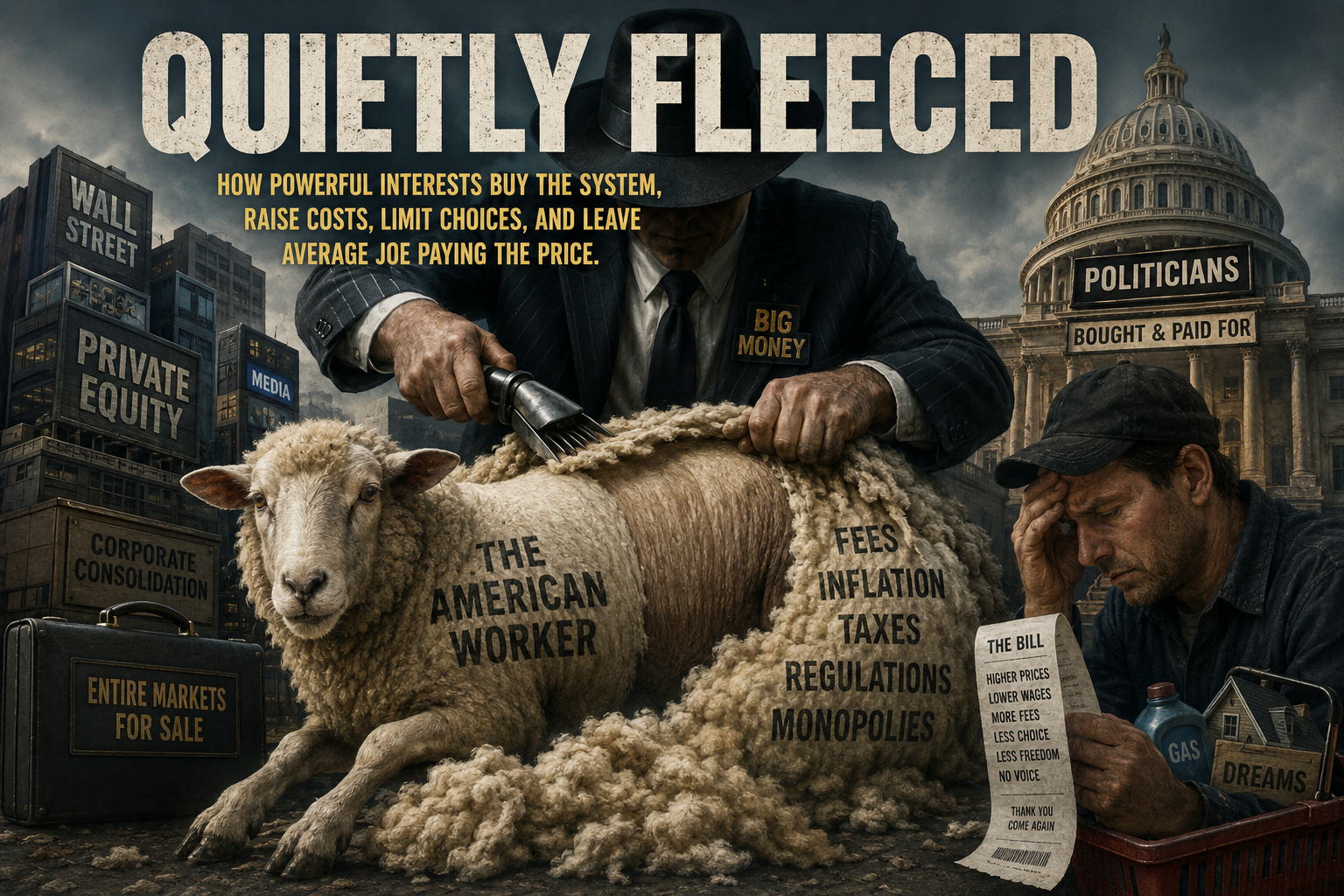
But there is a meaningful difference between participating in a market and quietly controlling the infrastructure surrounding the market. The average citizen buys products. The ultra-wealthy often buy systems. They buy competitors, portfolios, housing inventory, technology platforms, supply chains, data, influence and media. Sometimes they buy the structures determining who receives access in the first place. That distinction matters because markets behave differently when capital reaches enormous scale.
There is a difference between winning the game and owning the board. The self-employed business owner competes customer by customer. Large capital pools ask a different question: what can we acquire?
The Roll-Up Economy Nobody Talks About
One of the least discussed changes in America involves acquisition roll-ups. Instead of one giant corporation openly monopolizing an industry, modern concentration frequently occurs quietly. One acquisition, then another, then another. Different names. Different brands. Different logos. Different websites. Same ownership structure behind the curtain. Regulators have increasingly examined serial acquisitions and roll-up strategies because of concerns about competition and market concentration.
Old monopolies were visible. Modern concentration often is not. Consumers think they have choices. Sometimes they do. Sometimes what appears like competition is merely branding. The companies look different. Ownership may not be. Prices rise together. Service deteriorates together. Fees appear together. Local relationships disappear. You call what appears to be a local company and the phone routes somewhere else. Ownership exists somewhere else. Decisions happen somewhere else. The neighborhood name remains. The neighborhood itself vanished years ago.
The Fee Economy
Many Americans increasingly feel they are not being hit by one giant expense. Instead they are being tapped repeatedly. Service fees, convenience fees, processing fees, platform fees, subscription fees, administrative fees, card fees, delivery fees, activation fees, cancellation fees. Fees are beautiful business tools because they often avoid the emotional resistance attached to direct price increases. A ten-dollar increase creates anger. Three smaller fees spread across a transaction often do not. But over time the accumulation becomes substantial. The average person feels squeezed — not crushed instantly, but squeezed slowly, quietly, relentlessly.
Businesses competing in genuine markets keep prices honest through price, service, speed, quality, innovation and reputation. Concentrated ownership quietly weakens those pressures. When a small number of owners control most of an industry, choices narrow, fees move together and local accountability disappears. The question is not whether any single transaction is unfair. The question is whether the system as a whole still resembles competition at all.
Housing Is Becoming an Asset Class
Perhaps nowhere do ordinary Americans feel this more strongly than housing. Homes once represented stability, ownership, community, equity and family life. Today housing increasingly functions as an investment vehicle. Large investors do not need to purchase every house. They simply need enough influence to affect inventory and pricing. A family buying a home thinks about schools, neighborhoods, children and roots. An institutional buyer thinks about yield, growth, portfolio returns and occupancy rates. Neither motive is inherently evil. But they are not the same motive. And ordinary Americans increasingly feel the difference.
The Self-Employed Person Feels It First
Employees often experience market concentration indirectly. Small business owners experience it directly. The contractor sees lead costs increase, platform fees rise, suppliers consolidate, national chains emerge and customer acquisition change. He works harder while owning less of the process. Many entrepreneurs increasingly sound politically contradictory. They support capitalism. They oppose socialism. They believe in ownership. Yet they distrust concentrated corporate power. That is not contradiction. That is experience.
The Tax Debate Is Too Small
Politicians love simple debates. Tax the rich. Do not tax the rich. Those arguments contain pieces of truth but they often ignore deeper questions. Taxation alone does not necessarily solve structural concentration. Suppose billionaires pay higher taxes. What if enormous capital structures still control housing, platforms, healthcare, information, suppliers, lead generation and market access? The larger question is whether ordinary citizens can still build independent lives. That issue cuts deeper than tax rates. It goes to whether the market structure itself still permits the kind of independent participation that capitalism promises.
Antitrust Exists for a Reason
America confronted similar questions before. John D. Rockefeller did not merely become wealthy. Standard Oil became so dominant that competition itself weakened. The response was the Sherman Antitrust Act. The purpose was not punishing success. The purpose was preserving competition. Because capitalism without competition eventually begins mutating into something else. Modern concentration looks different — private equity, venture funds, institutional ownership, platform control, data ecosystems and serial acquisitions. The challenge for antitrust law is adapting to modern realities where the dominant position is often built through accumulation rather than a single visible monopoly.
The original antitrust impulse was not socialist. It was pro-competition. It recognized that unrestrained accumulation eventually undermines the market dynamics that make capitalism work in the first place. Small business owners, contractors and independent operators who object to concentrated corporate power are not asking for government control. They are asking for the conditions that allow genuine competition to exist. That is a capitalist argument, not a socialist one.
When Economic Distrust Becomes Constitutional Distrust
This is where the issue becomes bigger than money. Economic legitimacy and political legitimacy are connected. If enough Americans conclude that the market is rigged, that ownership is inaccessible, that competition is performative and that institutions serve insiders, distrust spreads past the economy. People stop trusting leaders, agencies, elections and institutions. Eventually economic frustration becomes constitutional frustration.
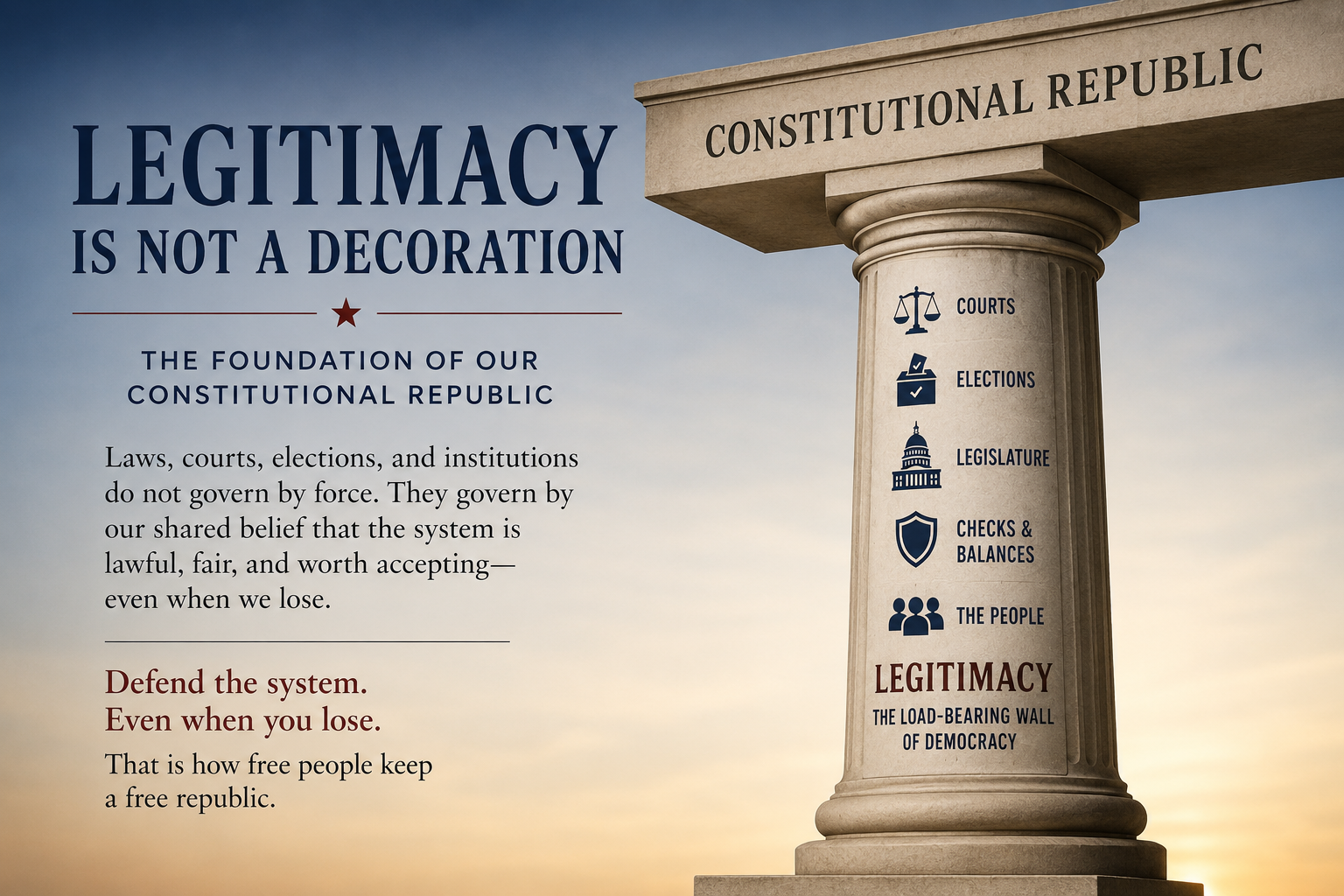
Constitutional republics depend heavily on legitimacy — not approval, but the shared public belief that the system itself deserves acceptance even when it produces outcomes we dislike. When political losses become proof that institutions are illegitimate, and when economic losses become proof that the market is captured, both forms of distrust compound. The founders understood this. The Constitution was written to channel conflict rather than eliminate it, but that system only functions if citizens continue accepting institutional outcomes after defeat. Once people conclude the rules themselves are for sale, that acceptance becomes increasingly difficult to sustain.
My Bottom Line
I am still a capitalist. I believe in work, risk, ownership and building something. But capitalism requires competition. Without competition, capitalism slowly becomes extraction. Average Americans are not demanding guaranteed outcomes. They are demanding a fair shot. A fair market. A fair system. A reason to believe effort still matters. They are not always able to name exactly what changed. But enough of them feel it that the feeling deserves honest examination rather than dismissal.
The dangerous moment is not when people complain about prices. The dangerous moment is when enough of them conclude that the board itself can be purchased by those wealthy enough to acquire it. Economic distrust does not stay economic. It moves outward. It becomes institutional distrust. It becomes constitutional distrust. And legitimacy, once lost, is very difficult to restore.
A constitutional republic survives disagreement. It struggles when citizens conclude the rules themselves are for sale.
Why This Matters
Lose a court case and the country survives. Lose an election and the country survives. Lose a policy battle and the country survives. Lose legitimacy and eventually the system itself weakens. The danger is not rich people. The danger is concentrated power becoming so expansive that citizens stop believing ordinary participation still matters. Markets and constitutional republics share the same dependency: they both require the public belief that the game is worth playing. Once that belief collapses in either arena, rebuilding it takes far longer than destroying it did.
References
- Madison, J. (1787–1788). The Federalist Papers, Nos. 10 and 51. On faction, self-interest and constitutional structure.
- de Tocqueville, A. (1835–1840). Democracy in America. On civic participation and the conditions sustaining democratic governance.
- U.S. Constitution (1787). Preamble; Article I; Amendment XIV.
- Federal Trade Commission and Department of Justice. (2023). Merger guidelines and serial acquisition concerns. ftc.gov; justice.gov.
- Sherman Antitrust Act (1890). 15 U.S.C. §§ 1–7.
Disclaimer: The views expressed in this post are opinions of the author for educational and commentary purposes only. They are not statements of fact about any individual or organization, and should not be construed as legal, medical, or financial advice. References to public figures and institutions are based on publicly available sources cited in the article. Any resemblance beyond these references is coincidental.