Let me be precise about my target in this post, because imprecision on this subject is how honest arguments get dismissed. This is not an argument against religious belief in general. It is not an argument against Christianity as a tradition of ethical thought, community practice or personal spiritual life. It is an argument about a specific, named, institutionally organized set of claims made by specific religious movements — Young Earth Creationism, biblical inerrancy as codified in documents like the Chicago Statement, and the theological framework of Christian nationalism that insists the Bible is immutable divine truth applicable to all of human life and governance. Those claims are testable. And if scientists ever confirm that alien life uses the opposite molecular handedness from Earth life, those claims will not merely face pressure. They will face a reckoning they are structurally incapable of surviving.
What Inerrancy Actually Claims
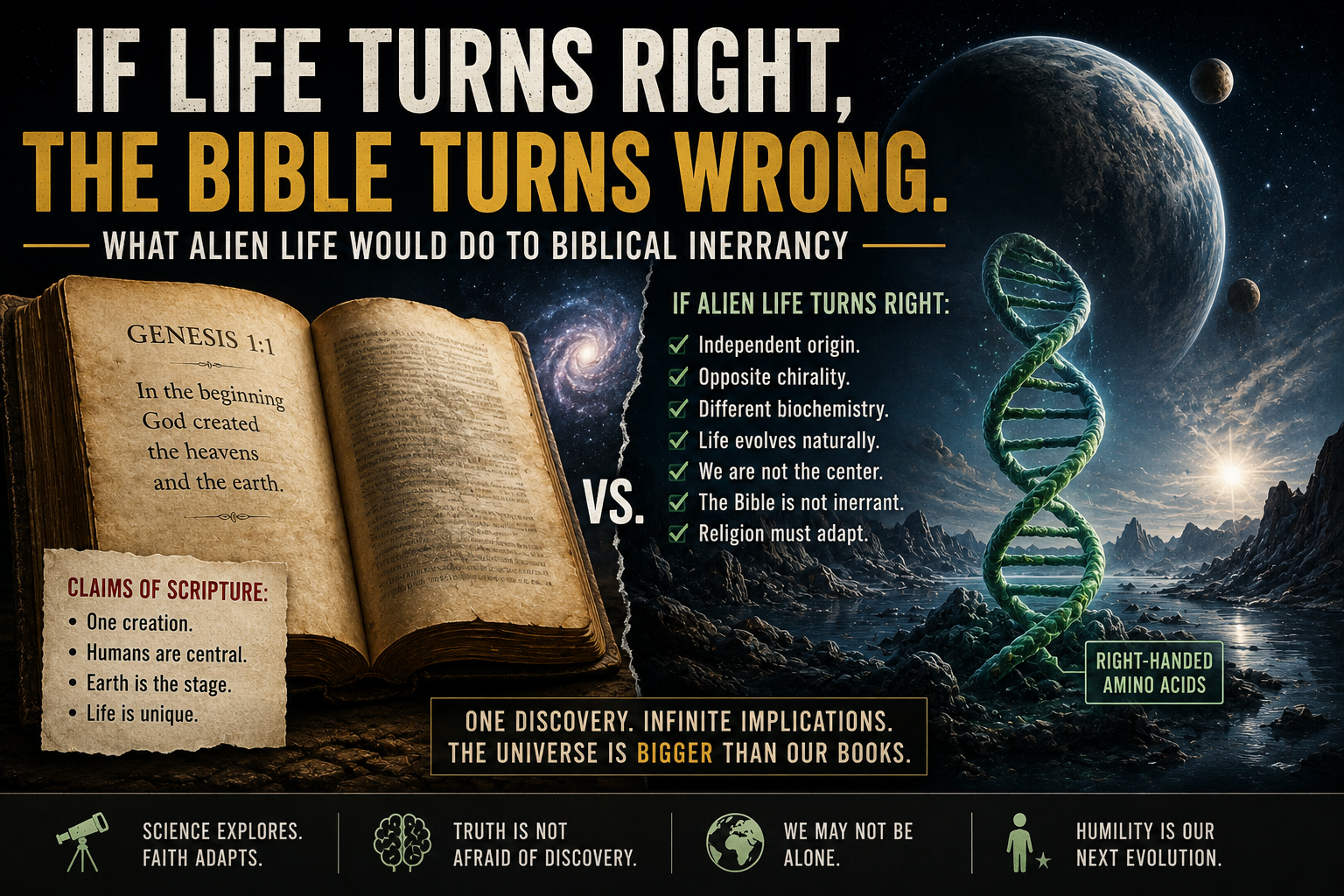
Biblical inerrancy is not a soft or metaphorical position. It is a precise theological claim with a documented institutional history. The Chicago Statement on Biblical Inerrancy, drafted and signed in 1978 by more than three hundred evangelical scholars and leaders, declares that Scripture is "without error or fault in all its teaching" — not merely on matters of salvation but on everything it affirms, including history, science and cosmology. The Southern Baptist Convention's statement of faith affirms that the Bible has "truth, without any mixture of error, for its matter." Answers in Genesis, one of the most visible Young Earth organizations in the country, states flatly that the Earth is approximately six thousand years old, that all species were created in their current forms and that the global flood of Genesis is literal history.
These are not fringe positions within American religious life. Young Earth Creationism has majority or near-majority support within American evangelical Christianity, one of the most politically influential religious demographics in the country. These organizations operate museums, fund legislative efforts, influence school curriculum debates and claim to speak for biblical truth on scientific questions. When they say the Bible is inerrant and immutable, they mean it in the most operational possible sense. The Earth is young. Genesis is history. Life was specially created. Human beings are the primary object of divine concern. God is omniscient, meaning he knows all things and has revealed what needs to be known. None of that is negotiable, because an immutable God produced an inerrant text and the text says what it says.
Inerrancy, omniscience and human exceptionalism are not three separate claims that happen to coexist. They are a single interlocking system. An omniscient God knows everything and cannot be wrong. An inerrant Bible is the product of that omniscient God and therefore cannot be wrong. A Bible that cannot be wrong places humanity at the center of creation as the primary purpose and audience of divine revelation. Remove any one piece and the others become structurally unstable. This is why inerrantist traditions resist even partial concessions to science so fiercely. It is not stubbornness. It is architectural awareness. The whole building depends on every load-bearing wall staying exactly where it is.
What an Omniscient God Would Have Known
Start with the omniscience claim, because it is the foundation everything else rests on. An omniscient God, by definition, knows everything. Not most things. Not everything relevant to salvation. Everything. Every subatomic event. Every star in every galaxy. Every planet capable of hosting chemistry. Every moment in the 13.8-billion-year history of a universe containing two trillion galaxies. An omniscient God who inspired or dictated a text for the guidance of his creation would have known, at the moment Genesis was written, that the universe was not a dome over a flat Earth with the stars as decorative fixtures. He would have known about the other two trillion galaxies. He would have known about the other planets. He would have known, critically, whether life existed elsewhere.
If an omniscient God knew about extraterrestrial life and chose not to mention it in the text claimed to be His inerrant revelation, that is a theological problem of significant magnitude. Why would a God who knows everything and whose text contains no errors of omission in matters relevant to human understanding choose to leave out the existence of life elsewhere in a universe He created? The inerrantist answer would presumably be that God revealed what was relevant to humanity's salvation and left the rest as discovery. That answer might work as a general theological principle. It does not work as a defense of inerrancy, because inerrancy claims the text is without error in all it affirms, and a text that presents humanity as the sole focus of creation without mentioning that creation contains billions of other potential biospheres is making an implicit claim about the nature of creation that the discovery of alien life would directly falsify.
The Specific Problem of Opposite Chirality
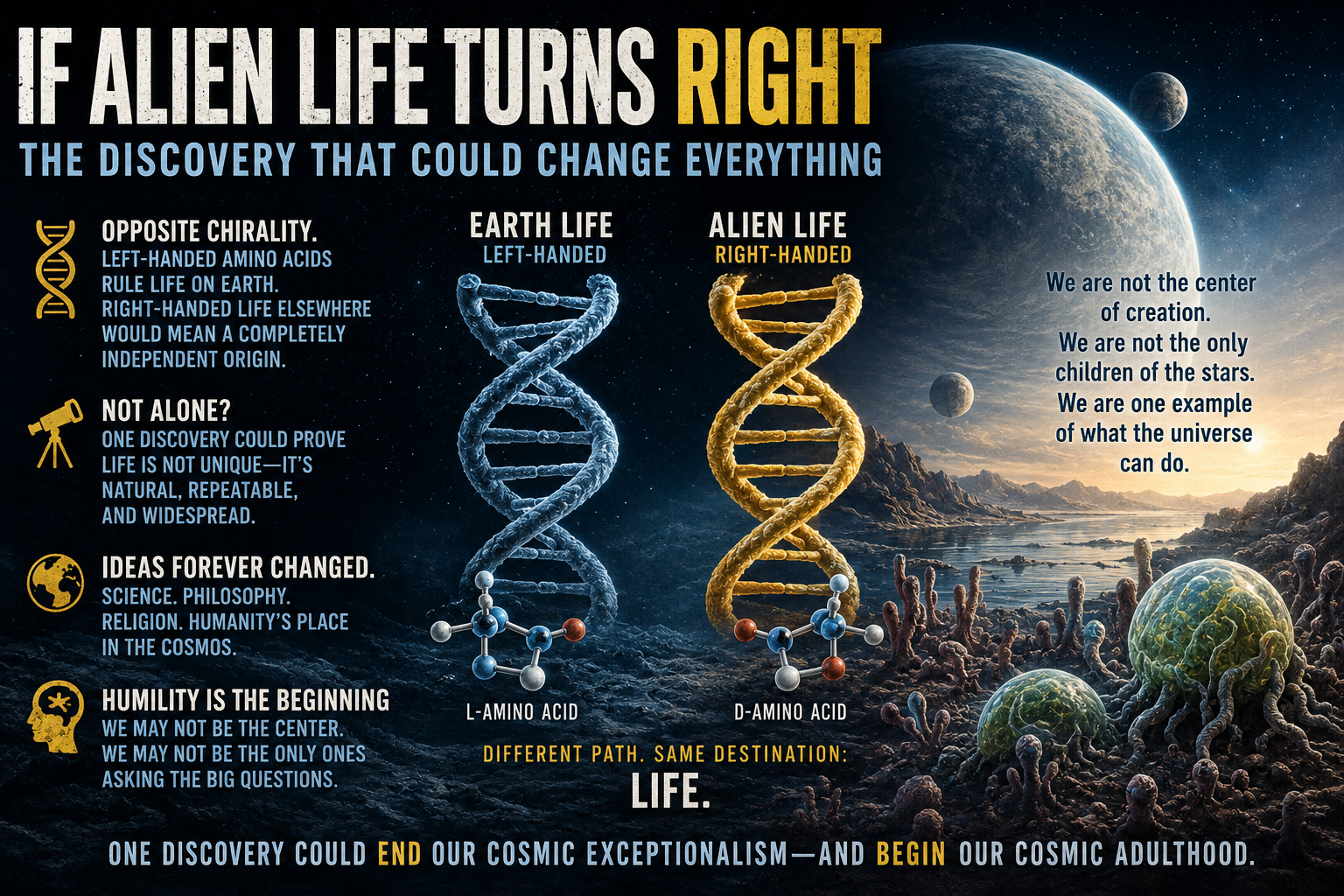
Now sharpen the argument to the specific scenario this series has been examining. Scientists discover microbial life on Europa or in Martian sediment or through biosignatures on an exoplanet. That discovery alone would be the most important scientific event in human history. But the theological earthquake arrives when those scientists examine the molecular structure of the discovered life and find that it uses opposite chirality from Earth life — right-handed amino acids and left-handed sugars where Earth life universally uses the reverse. That detail is the confirmation of independent origin. It rules out panspermia as an explanation. It rules out the possibility that the two biospheres are related. It establishes that life emerged separately, in a different place, through a different molecular pathway, at a different time.
For the inerrancy framework, this discovery produces a chain of failures that cannot be theologically patched without abandoning the framework itself. An omniscient God who created both biospheres knew they existed when Genesis was written. The inerrant text He produced describes a creation story centered entirely on Earth, humanity and human salvation without a syllable about the other independent experiment in life He was simultaneously running. That is not a minor omission. It is a direct contradiction of the claim that the text reflects the knowledge of an all-knowing author and reveals what humanity needs to understand about the nature of creation.
An omniscient God who knew about alien life and did not mention it in an inerrant text either did not know, did not care or did not write it. None of those options is compatible with inerrancy.
Human Exceptionalism: The Centerpiece That Shatters
Of all the theological claims threatened by independent alien life, human exceptionalism faces the most direct challenge. The claim is not merely that humans are special among Earth species. The claim, foundational to most inerrantist theology, is that humanity occupies a unique and central position in the concern of the divine creator of the universe. Genesis places human beings as the culmination of creation, made in God's image, given dominion over the Earth and established as the primary audience and beneficiary of divine revelation. The entire biblical narrative is a human story in a universe that appears to exist for the benefit of human beings.
A second independent origin of life does not merely challenge that claim. It eliminates the cosmological premise on which the claim rests. If the universe generated life independently in at least two places, and if the scale of the universe suggests that two is almost certainly a lower bound on a much larger number, then the universe is not a stage built for humanity. It is a vast chemical engine that produces life as a natural function of its operation, of which humanity is one local example among potentially billions. That does not mean human beings are not significant. But it does mean that a theology built on the premise that the creator of two trillion galaxies organized the entire enterprise specifically around one species on one planet needs to account for why that same creator was running an entirely separate biological experiment on the next moon over without mentioning it to the audience He was supposedly addressing.
The Special Creation Problem
The inerrantist position on the origin of life is not merely that life began with divine assistance. It is that life was specially and directly created by God in the forms described in Genesis, on the timeline described in Genesis, on the planet described in Genesis. Answers in Genesis explicitly states that all life was created by God during the six-day creation week approximately six thousand years ago. The Discovery Institute's intelligent design framework, while avoiding the young Earth timeline, similarly insists that life cannot arise through natural processes alone and requires the intervention of an intelligent designer at key points in its development.
Independent alien life with opposite chirality would directly falsify the special creation claim as applied to Earth life as well. Here is the logic: if life emerged independently on another world through natural chemistry without divine intervention — and that is what an independent second origin implies — then the argument that life requires supernatural intervention loses its grounding. A natural process that produced life once could have produced it twice. A natural process that produced it twice almost certainly produced it more times. The argument from design relies heavily on the premise that life is so improbable that it requires explanation beyond natural chemistry. Remove that premise by demonstrating that nature generates life independently under the right conditions and the design argument loses its strongest pillar.
The inerrantist escape from these arguments usually takes one of two forms. The first is to say the Genesis cosmology is not meant to be read literally — it is poetry, metaphor, theological narrative rather than scientific description. That is a reasonable theological position held by many serious Christians. But it is completely incompatible with inerrancy. You cannot simultaneously claim the text is without error in all it affirms and then retreat to metaphor every time the affirmations collide with reality. The second escape is to say God could have created life elsewhere without mentioning it. That may be true, but it undermines the claim of a complete and sufficient revelation. Each escape hatch surrenders a piece of the inerrancy claim while pretending the overall position survives intact.
Where Religion Lands After the Discovery
Here is what the history of science and religion actually suggests will happen, and it is worth being honest about it. Most religious traditions will survive the discovery of alien life. They have survived Copernicus, Darwin, Einstein and the Hubble Deep Field. They will survive this too, because most religious traditions are not as rigidly committed to specific empirical claims as inerrancy requires. Liberal Protestantism, Catholicism, mainline Judaism, most of Islam's major theological schools and the broad range of religious thought outside American evangelical fundamentalism all have interpretive frameworks flexible enough to absorb a second biosphere without institutional collapse. The Vatican's own astronomers have publicly stated that the discovery of alien life would not threaten Catholic faith. That intellectual flexibility is a genuine theological resource.
What will not survive, or at minimum will not survive intact, is the specific package of claims associated with biblical inerrancy, Young Earth Creationism and the theological framework that places an immutable text as the governing authority over both private conscience and public governance. Those claims are brittle precisely because they are specific and empirical. They make testable predictions about the nature of the universe. The universe containing independently originated life with opposite chirality would fail those predictions in multiple simultaneous ways. That does not end religion. But it does end those specific religious claims as serious intellectual positions rather than pure confessional commitments held by faith alone.
The Philosophy Department Receives the Referral
The discovery of independent alien life would not consign all religion to the philosophy department. It would consign specific theological claims to it — the ones that positioned themselves as empirically grounded truth rather than as faith commitments. There is an important distinction here that the inerrancy tradition has always refused to honor. Faith is not knowledge. Faith is a commitment to belief in the absence of, or sometimes in the face of, conclusive evidence. That is not a contemptible thing. It is a description of what faith actually is. Many serious theologians have been perfectly honest about this. Kierkegaard's "leap of faith" acknowledges that belief requires a step beyond what evidence compels. Paul Tillich's treatment of religious symbols acknowledges that theological language points toward transcendent reality rather than describing it with empirical precision.
The inerrancy tradition has refused that intellectual honesty. It has insisted its claims are not merely confessional but factual — that the Earth is young, that life was specially created, that humans are uniquely positioned in creation, that an omniscient God produced a text without error. Those are empirical claims and they will be evaluated by empirical evidence. When independent alien life arrives, the evidence will do what evidence does. It will measure the claims against reality and deliver a verdict. The tradition that has staked its identity on those specific empirical claims will have to either abandon inerrancy to survive as a spiritual community or maintain inerrancy and accept that it has become a philosophical position rather than a scientific one. Either way, the referral to the philosophy department is the appropriate outcome. Philosophy is the proper home for commitments that cannot be empirically falsified. That is not a demotion. It is a clarification about what kind of claim is being made.
My Bottom Line
Religious belief broadly construed will survive the discovery of alien life. It has survived every prior scientific revolution and it will survive this one. What will not survive in its current institutional form is the claim that the Bible is inerrant and immutable, that God is omniscient in the specific sense of having revealed complete and error-free knowledge in a text that makes no mention of the independent life He was generating elsewhere in His own creation, and that human beings occupy a uniquely central position in a universe that turns out to be full of life it generated on its own. Those claims are in a different category from generic theism. They are specific, empirical and falsifiable. When alien life with opposite chirality turns up, they will be falsified.
That is not a tragedy for religion. It is a long-overdue clarification about what religion is. Faith that remains honest about what it is — a commitment, a community, a way of navigating existence and meaning — has nothing to fear from science. Faith that has disguised itself as empirical certainty, that has demanded the authority of fact while resisting the accountability of evidence, has been borrowing against a debt that is eventually going to come due. Independent alien life would be the bill arriving in the mail.
An omniscient God who knew about alien life and said nothing about it in an inerrant text has some explaining to do. So does every institution that spent centuries insisting the text was complete.
Why This Matters
This matters because the inerrancy tradition is not merely a private spiritual commitment. It is a political force that has sought, and in many cases obtained, authority over public education, public health policy, public law and the governance of a pluralistic republic. When organizations built on inerrancy push creationism into science classrooms, oppose reproductive healthcare on the basis of biblical interpretation, advocate for the governance of a secular republic by biblical law or insist that their reading of an ancient text should override the findings of every relevant scientific field, they are making empirical and political claims that deserve empirical and political scrutiny. The discovery of independent alien life would not just be a scientific event. It would be a reckoning for every institutional claim that has been built on the foundation that the inerrant Bible is the final word on the nature of creation. That foundation would crack. What stands on it would need to find another one.
References
- The Chicago Statement on Biblical Inerrancy. (1978). International Council on Biblical Inerrancy.
- Southern Baptist Convention. (2000). Baptist Faith and Message, Article I: The Scriptures. sbc.net.
- Answers in Genesis. (2023). About AiG: Our beliefs. answersingenesis.org.
- Discovery Institute. (2023). About intelligent design. intelligentdesign.org.
- Blackmond, D. G. (2010). The origin of biological homochirality. Cold Spring Harbor Perspectives in Biology, 2(5).
- Vatican Observatory. (2009). Would you baptize an extraterrestrial? Public statements by Vatican astronomers. vatican.va.
- Tillich, P. (1951). Systematic theology, Vol. 1. University of Chicago Press.
- Kierkegaard, S. (1846). Concluding unscientific postscript to Philosophical Fragments. (H. Hong, Trans., 1992). Princeton University Press.
Disclaimer: The views expressed in this post are the personal opinions of the author and are offered for educational, commentary and public discourse purposes only. They do not represent the positions of any institution, employer, organization or affiliated entity. Nothing in this post constitutes legal, financial, medical or professional advice of any kind. Commentary on religious, political and cultural subjects reflects the author's independent analysis and is protected expression of opinion. Readers are encouraged to consult primary sources and form their own conclusions. Any resemblance to specific individuals or situations beyond those explicitly referenced is coincidental.