A recent headline from The Intellectualist reads: "President Trump Privately Floats Blanket Pardons for Aides as Legal Risks Mount." It is exactly the kind of headline designed to make you stop scrolling. Trump, blanket pardons, aides, legal risks, put those words together and the implication practically writes itself. Trump knows members of his administration have committed crimes and is preparing to protect them before prosecutors arrive. There is only one problem. That is not what the available evidence establishes.
The underlying story is real. President Donald Trump has reportedly discussed issuing sweeping pardons to members of his administration before he leaves office. According to an April 2026 Wall Street Journal report, Trump has repeatedly joked about pardoning large numbers of officials, at one point reportedly saying he would pardon everyone who had come within 200 feet of the Oval Office. People familiar with the discussions told the Journal that no specific pardons for specific acts were known to have been offered. That is newsworthy. But it is not the same thing as discovering that Trump's aides are facing imminent criminal prosecution, and that distinction matters.
The Headline Is Technically True and Still Misleading
This is one of the more sophisticated forms of media framing. The first half of the headline is supported by reporting: Trump has floated broad pardons. The second half, "as legal risks mount," does considerably more work. What legal risks, exactly? Criminal indictments, grand juries, target letters, federal prosecutors preparing charges? Not necessarily.
Some Trump officials have faced litigation, congressional scrutiny, judicial criticism and demands from Democrats for investigations. Those are legitimate matters to report. But an investigation is not an indictment. A congressional hearing is not a prosecution. A judge criticizing an administration lawyer is not a criminal conviction, and a political opponent demanding an investigation is certainly not evidence that a crime occurred. Those distinctions seem elementary until politics enters the picture. Then they become surprisingly easy to forget.
There Are Real Controversies
None of this means there is nothing to investigate. Consider the administration's 2025 deportation fight. U.S. District Judge James Boasberg investigated whether Trump administration officials deliberately ignored his order halting deportation flights involving Venezuelan migrants. At one point, the dispute became serious enough to involve the possibility of criminal contempt, which sounds considerably more like genuine legal exposure than an ordinary congressional investigation.
But there is an important update. In April 2026, a divided panel of the D.C. Circuit Court of Appeals blocked Boasberg's contempt investigation. The majority concluded that the judge had exceeded his authority by attempting to probe high-level executive deliberations involving national security and diplomacy. Whatever one thinks of that ruling, the trajectory hardly supports the simplistic suggestion that criminal liability in that particular matter is currently mounting. If anything, the strongest potential criminal exposure in that specific case actually receded.
Then there is Defense Secretary Pete Hegseth and the Signal conversation involving military operations in Yemen. A Pentagon inspector general review faulted Hegseth for using Signal on a personal device to share sensitive operational information, finding that doing so created unnecessary risks. Democrats demanded investigations and heavily criticized his judgment. Again serious, again worthy of scrutiny, but there remains an enormous difference between improper conduct, a violation of departmental policy, and proof beyond a reasonable doubt that somebody committed a federal crime.
What Happens If Democrats Win the House?
This may be the most important piece of context behind Trump's pardon talk. Reuters reported on August 8 that House Democrats are already preparing an extensive investigative strategy in the event they regain control of the House in the November midterms. Potential areas of inquiry include Department of Homeland Security contracts, corporations dealing with the administration, Trump-linked financial interests, foreign investments and allegations involving donors and presidential influence. Democratic committee leaders are discussing hearings, subpoenas and demands for records, which is precisely what congressional oversight is supposed to allow the majority party to do.
No final target list has been established. Formal investigations into many of these targets have not begun, and Reuters could not determine whether some of the companies being discussed face any accusations of wrongdoing. That is a long way from federal prosecutors preparing handcuffs. The more accurate description might be that Trump expects aggressive investigations if Democrats retake the House and has discussed using pardons to protect administration officials from that possibility, not that he is racing to shield aides from crimes already discovered.
Less exciting headline. More accurate story.
Then There Is Joe Biden
Here is where the partisan narrative becomes inconvenient. Trump did not invent the modern concept of protecting government officials from a succeeding administration through preemptive pardons. Joe Biden made extraordinary use of exactly that concept during his final hours in office. On January 20, 2025, Biden issued preemptive pardons covering Dr. Anthony Fauci, retired Gen. Mark Milley, members and staff of the House January 6 committee and police officers who had testified before it. Those individuals had not been convicted of crimes. Many had not even been charged.
Biden's justification was essentially preventative. He argued that public servants should not be subjected to politically motivated investigations or prosecutions merely for performing their duties, and specifically said the pardons should not be interpreted as acknowledgment that the recipients had done anything wrong. That rationale sounds remarkably similar to the rationale Trump's defenders could now make: the other side is threatening investigations, these people served the government, I am protecting them from political retaliation. Change the president's name and watch how quickly many people's constitutional philosophy changes.
If preemptive pardons were dangerous when Biden issued them, they do not suddenly become harmless because Trump is considering them. The principle has to survive a change in party.
But Presidents Really Can Do This
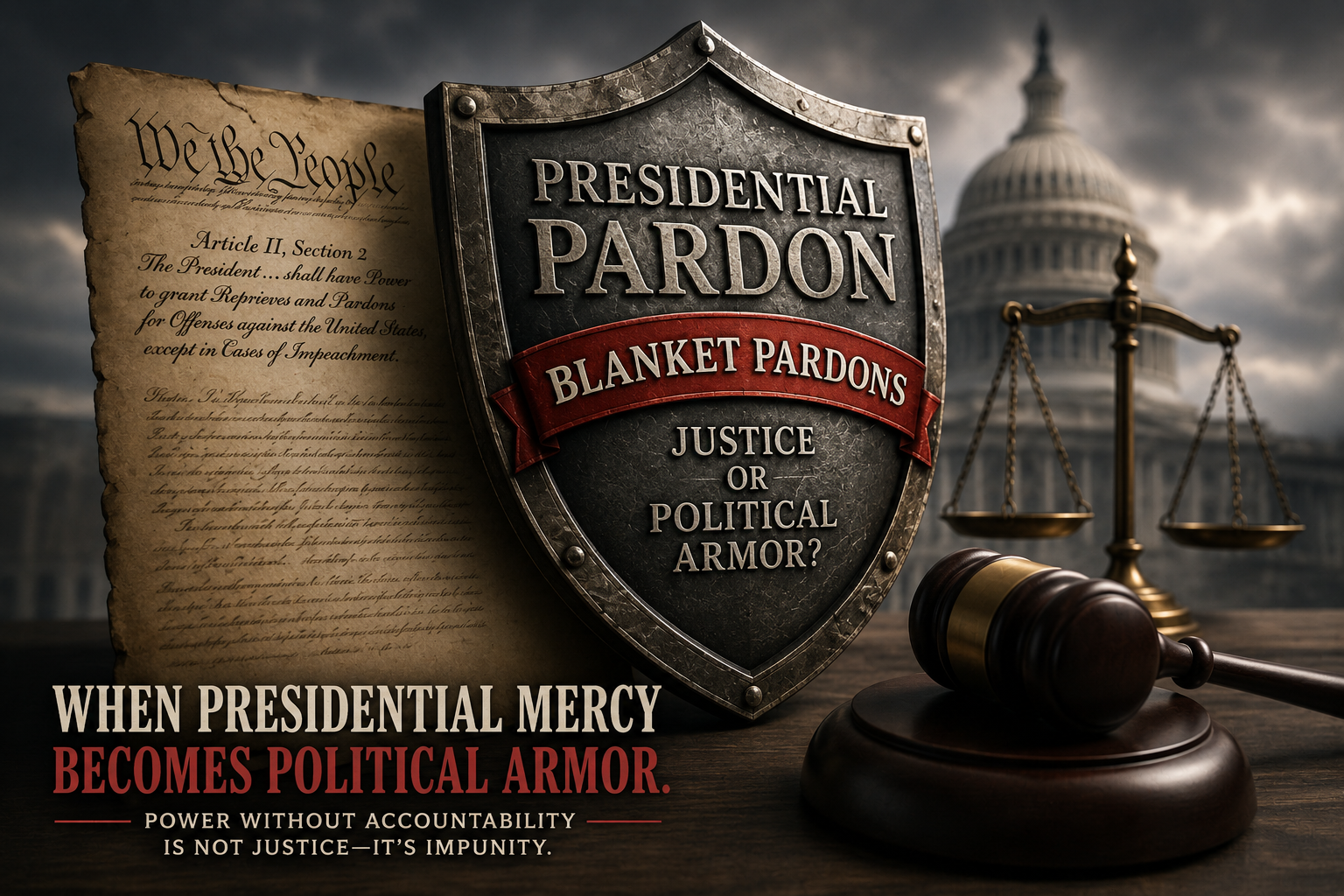
The Constitution gives presidents an extraordinarily broad pardon power. Article II authorizes the president to grant reprieves and pardons for offenses against the United States, except in cases of impeachment, and the Supreme Court has interpreted that authority broadly for more than a century. In Ex parte Garland , the Court held that a president may issue a pardon even before legal proceedings have begun. Congress's Constitution Annotated specifically notes Gerald Ford's pardon of Richard Nixon as the obvious historical example. Nixon had not been criminally charged when Ford pardoned him for federal offenses he might have committed in connection with Watergate.
So a pardon does not require an indictment, a trial, a conviction, or even a prosecutor's announced investigation. But there is an important limitation. A president cannot pardon crimes that have not yet occurred. The offense must already have been committed, and a president cannot erase state criminal liability, civil liability or impeachment through the federal pardon power. That distinction matters when people hear the phrase "blanket pardon." Trump cannot legally tell his staff to do whatever they want for the next three years and consider themselves pardoned in advance. He could, however, theoretically issue an extremely broad pardon near the end of his presidency covering federal offenses already committed during a defined period. That power is constitutionally formidable, which is exactly why its normalization should concern us.
The Real Danger Is Not Trump or Biden
The deeper problem is not whether Donald Trump is allowed to pardon his aides. He probably has enormously broad constitutional authority to do exactly that for federal offenses already committed. The bigger question is what happens to the American political system when this becomes standard operating procedure.
Imagine the pattern. A Republican administration takes office and investigates officials from the previous Democratic administration. Before leaving office four years later, the Republican president pardons his entire senior staff because Democrats have promised retaliation. A Democratic president takes office and investigates the Republicans anyway, concentrating on conduct outside the pardon or looking for state violations. Before leaving office, that Democratic president issues another round of preemptive pardons. Repeat.
At some point, the pardon power ceases to look primarily like an instrument of mercy. It becomes political armor.
And that creates a dangerous incentive. Suppose you are a senior government official facing a legally questionable directive. Under normal circumstances, one thing restraining you is personal accountability. You might ask whether this is legal, whether you could be prosecuted for it later, whether you are willing to risk your career or freedom over it. Now change the calculation. The president tells you not to worry, that if anybody comes after you, he will pardon you before he leaves. That alters the incentive structure dramatically, and it does not matter whether the president saying it is Donald Trump, Joe Biden or some future progressive president whose policies Republicans despise. The danger is identical.
Pardons Should Not Become Get-Out-of-Jail Cards for Administrations
The pardon power exists for good reasons. Justice can be imperfect. Sentences can be excessive. People can rehabilitate themselves. Political passions can produce unjust prosecutions, and there are circumstances in which presidential clemency is not only appropriate but necessary. But there is a considerable difference between pardoning someone after examining an individual injustice and issuing sweeping protection to political allies because the opposing party might investigate them later. The latter transforms clemency from mercy into insulation from accountability, and that should trouble conservatives just as much as liberals. Perhaps more.
One of the central conservative arguments for limited government is that concentrated governmental power eventually falls into the hands of someone you do not trust. Never judge government power solely by whether you trust the person currently wielding it. Ask instead whether you would willingly hand the identical power to your worst political opponent. That remains one of the best tests of government authority ever devised.
There Is Another Problem: Political Investigations Themselves
None of this excuses politically motivated prosecution. Weaponizing the criminal justice system against political opponents is every bit as dangerous as abusing the pardon power to protect political allies. Both things can be true simultaneously. Trump's advisers should not receive immunity merely because they worked for Trump. They also should not be investigated merely because they worked for Trump. There must be evidence, specific conduct, applicable law and due process. That should not be controversial.
Unfortunately, Washington increasingly operates according to an entirely different standard: investigate first, find the crime later.
When political parties openly discuss investigations before they even possess subpoena power, presidents have predictable incentives to protect their administrations. That does not necessarily justify blanket pardons, but it helps explain them. The cycle becomes obvious once you see it: political investigations encourage political pardons, political pardons generate suspicions of wrongdoing, and those suspicions justify more investigations, which in turn justify more pardons. Eventually every administration enters office preparing to investigate the last one while planning pardons for itself when it leaves. That is not healthy republican government.
And Trump Has His Own Pardon Questions to Answer
Criticism of the media's framing should not become an excuse to ignore legitimate concerns about Trump's own use of clemency. Democratic lawmakers are currently seeking records related to some Trump pardons amid allegations that access, lobbying, political relationships or financial influence may have affected the clemency process. Reuters reported in June that lawmakers were pressing the administration to preserve records as they examined possible "pay-to-play" concerns. The White House rejected the accusations as politically motivated.
An allegation is not proof. But a genuine quid pro quo involving official action would be an entirely different matter from a president simply exercising his constitutional pardon power controversially. That is exactly why investigations must begin with evidence and end with conclusions, not the other way around. Trump deserves that standard. So did Biden. So does the next president.
So What Should We Make of the Headline?
"Trump privately floats blanket pardons for aides" is fair. He reportedly has. "As legal risks mount" is much more loaded. There are legal disputes, congressional inquiries and potential future investigations involving Trump administration officials, but the publicly available record does not currently demonstrate a wave of imminent criminal prosecutions of Trump's senior aides. That distinction should have been obvious in the headline. Instead, readers are encouraged to connect the dots themselves: Trump is discussing pardons, therefore his aides committed crimes, therefore Trump knows they committed crimes, therefore he is preparing to obstruct justice. That chain of reasoning contains several enormous unsupported leaps.
Criticize Trump for contemplating mass pardons if you believe they undermine accountability. I think there is a strong argument that they do. But criticize what actually happened. Do not manufacture guilt through headline construction.
Why This Matters
Ironically, the real story may be more consequential than the sensational one. America appears to be creeping toward a system in which outgoing presidents protect officials from incoming presidents and incoming presidents investigate outgoing administrations. Biden's final pardons moved us further down that road. Trump appears willing to continue down it. Democrats are preparing investigations should they regain the House. Republicans will undoubtedly remember those investigations the next time political power changes hands. Everybody can explain why their investigation is legitimate. Everybody can explain why their pardon is necessary. And everybody will insist the other side is destroying the rule of law. That is how institutional norms die, not usually in one spectacular moment, but eroded one precedent at a time.
The Constitution gives presidents vast pardon authority. The fact that a president can exercise a power does not mean every possible use of that power is wise. Likewise, Congress possesses enormous investigative authority, and the fact that Congress can investigate an administration does not mean every politically attractive investigation is justified. Power needs restraint even when the Constitution permits it. Especially then.
So yes, pay attention when Trump talks about blanket pardons. But do not fall for the implication that considering a pardon proves the recipient committed a crime, and do not pretend this phenomenon began with Donald Trump. The far more important question is whether Americans are comfortable creating a political culture in which every administration eventually needs a pardon from itself.
Because once that becomes normal, we have changed the presidency in a way that will long outlive Trump. That is the story worth worrying about.
References
- The Intellectualist. President Trump Privately Floats Blanket Pardons for Aides as Legal Risks Mount.
- The Wall Street Journal. (2026, April). Report on Trump's discussions of sweeping pardons for administration officials.
- U.S. District Court, D.C. Circuit Court of Appeals. (2026, April). Ruling blocking Judge James Boasberg's contempt investigation into the 2025 Venezuelan deportation flights dispute.
- U.S. Department of Defense, Office of Inspector General. Review of Secretary Pete Hegseth's use of Signal to share operational information.
- Reuters. (2026, August 8). Report on House Democrats' preparations for potential investigations if the party regains the House majority.
- Reuters. (2026, June). Report on lawmakers pressing the Trump administration to preserve pardon-related records amid "pay-to-play" allegations.
- Ex parte Garland, 71 U.S. 333 (1867). [On the president's authority to pardon before legal proceedings begin.]
- Congress.gov, Constitution Annotated. Presidential Pardon Power, Article II. constitution.congress.gov. [Citing Gerald Ford's pardon of Richard Nixon.]
- NPR. (2025, January 20). Biden pardons Fauci, Milley and members of Jan. 6 panel. npr.org.
Disclaimer: This article reflects the author's personal opinions and analysis of publicly reported facts. It does not assert that any named individual has committed a crime, and it does not represent the positions of any institution, employer, organization or affiliated entity with which the author may be associated in any capacity. Allegations described as unproven remain unproven at the time of writing. Political commentary is protected opinion under the First Amendment. Readers are encouraged to consult primary sources and form their own conclusions.