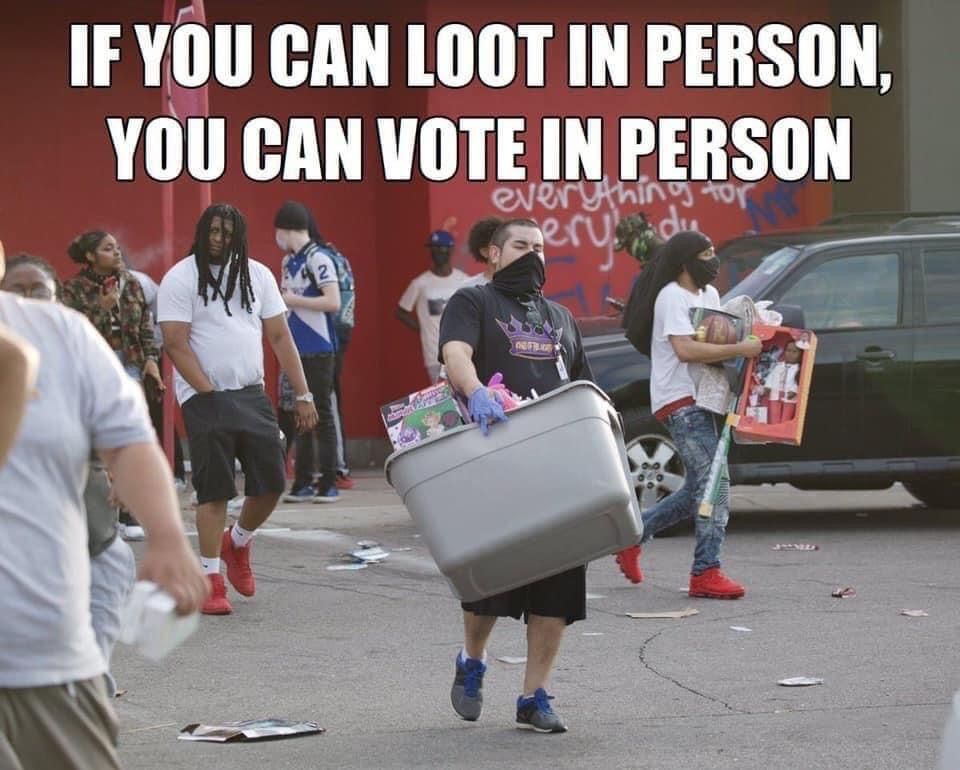
For most of American history voting was a straightforward act of citizenship. You got up on Election Day, went to your polling place, showed your identification and cast your ballot. One person. One ID. One vote. Nobody thought that was complicated. Nobody thought it was oppressive. It was what adults did in a self-governing republic. Then we decided it was too hard. We decided that standing in line once every two years was an unreasonable burden and that the solution was to flood the country with mail-in ballots, unsolicited and unverified. We traded the integrity of the system for the convenience of the system. Those are not the same thing and we should not pretend they are.
The damage is visible. Election Day became Election Month. Results that once came in by midnight are now contested for weeks. Ballots arrive after deadlines. Drop boxes appear on street corners with no chain of custody. "Found" ballots surface days after polls close. The losing side walks away convinced the process was manipulated - not because they are sore losers but because the system they are watching no longer resembles the one that earned trust over two centuries. When half the country doubts the outcome before the count is finished, the system has failed at its primary job, which is not to record votes but to produce a result that both sides accept as legitimate.
Legitimacy is not a sentiment. It is the functional prerequisite of republican government. Without it you do not have elections. You have organized conflict with a scoreboard.
What the SAVE Act Actually Does
The Safeguard American Voter Eligibility Act, passed by the House in April 2025, does something simple. It requires documentary proof of United States citizenship when registering to vote in federal elections. The acceptable documents are a passport, a birth certificate, naturalization paperwork, a military ID paired with a record of service showing U.S. birthplace or a qualifying government-issued photo ID that confirms citizenship. That is it. You prove you are a citizen before you register. Everything else about how and when you vote stays the same.
The problem the SAVE Act addresses is not imaginary. Noncitizen voting is already illegal under federal law, but illegal and impossible are two different things. The existing honor system - where applicants simply attest to citizenship on a registration form - creates an opening that the act closes. More broadly, the act is part of a return to the principle that elections belong to citizens and that the mechanism for verifying that should involve more than a checkbox.
A 2024 Gallup survey found more than four in five Americans support proof-of-citizenship requirements for first-time voters. That number crosses party lines. The objections to the SAVE Act are coming predominantly from advocacy organizations and progressive legal groups, not from the broad electorate. Americans understand intuitively that verifying citizenship before voting is not a radical idea. Every other country that holds elections does something equivalent. The controversy is manufactured at the institutional level. The public has not been confused about this for very long.
The Mail-In Problem It Reinforces
Mail-in voting is where ballot integrity goes to die. When a ballot leaves a polling place the security apparatus that makes in-person voting trustworthy vanishes entirely. In-person voting has witnesses, election judges, signature verification, ID checks and a clear chain of custody from voter to ballot box. Mail-in voting has an envelope, a drop box and a prayer. The person who fills out the ballot and the person who mails it may not be the same person. There is no way to know. The ballot harvesting that became normalized in some states - where political operatives collect and return ballots from entire neighborhoods - is a direct product of removing the voter from the secured environment where the vote is supposed to happen.
The argument for mail-in voting is that it increases turnout. That may be true in raw numbers. It is the wrong metric. Turnout without integrity is not democracy. It is volume. What matters is not how many ballots are cast but how many legitimate citizens cast exactly one ballot apiece in an environment where that can be verified. Mail-in voting makes that verification structurally impossible and then dares you to prove a specific fraud occurred. The burden is backward. You should not have to prove fraud after the fact in a system deliberately designed to prevent pre-verification.
A system that cannot be audited is not a system that can be trusted. That is not a conspiracy theory. That is a design problem.
On the Married Women Objection
This is the objection that gets the most airtime so it deserves a direct answer. The argument, advanced primarily by the Center for American Progress and repeated widely, is that approximately 69 million American women who changed their names at marriage have birth certificates that no longer match their current legal names and would therefore face an undue burden proving citizenship under the SAVE Act.
Let's be precise about what this objection is actually claiming. It is claiming that a married woman who possesses a birth certificate, a marriage certificate and a current ID cannot navigate the process of registering to vote. That is not a voting problem. That is an argument that adult women are incapable of managing the same basic documentation that the federal government already requires for a passport application, a Social Security update, a name change on a driver's license or a background check for employment.
Women do all of those things routinely. They do them after marriages. They do them after divorces. They do them after relocations. The documentation trail that connects a birth certificate name to a current legal name is a marriage certificate. That document already exists. It is already in the possession of the woman who got married. Carrying it to a voter registration office one time is not a constitutional crisis. It is an errand.
The argument that women cannot manage two pieces of identification is not feminism. It is condescension with a press release attached.
The SAVE Act itself specifies that states must develop processes to accept additional documentation when a voter has a discrepancy between documents. The bill does not say women with changed names are locked out. It says the state must have a process to handle exactly that situation. The opponents of the bill know this. They are describing a worst-case administrative failure that the legislation specifically anticipates and addresses, as if it were the legislation's actual design. It is not.
Consider who the "69 million women can't vote" argument is actually protecting. The Center for American Progress - which produced that number - is a progressive policy organization with a direct institutional interest in opposing any measure that tightens voter registration requirements. Their analysis was designed to generate a headline, not to assess whether the administrative process is manageable. It was designed to produce the number 69 million in a sentence about women being disenfranchised. That sentence has been repeated as settled fact in coverage that never pauses to ask whether bringing a marriage certificate to a registration office constitutes disenfranchisement by any reasonable definition of the word.
The data cut that the opponents of the SAVE Act do not advertise: conservative and Republican-leaning women are twice as likely to have changed their surnames after marriage as their liberal counterparts, according to the Center for American Progress's own data. Rural voters - disproportionately Republican - are less likely to have passports. If the SAVE Act's documentation burden were as catastrophic as described, the demographic groups most affected would be the ones the Republican base is drawn from. The bill's Republican sponsors are not designing a system to suppress their own voters. That observation does not answer every concern about implementation but it does put the "suppress the vote" framing in a different light.
We Can Show Up
There is a deeper condescension embedded in the opposition to the SAVE Act and to in-person voting generally that needs to be named. The argument that requiring identification to vote is oppressive rests on the assumption that large categories of Americans are too disadvantaged, too disorganized or too burdened to obtain and present identification. That assumption is both factually wrong and insulting to the people it claims to protect.
You need identification to buy alcohol. To board a plane. To open a bank account. To apply for government benefits. To pick up a prescription. To drive a car. To get a job. The Americans who are allegedly too burdened to obtain ID for voting are navigating those requirements constantly. The argument that they can manage all of those but not this one is not an empirical observation. It is a political choice about which verification requirements to oppose and which to accept, dressed up as concern for the vulnerable.
Americans can show up. We showed up for two centuries before mail-in ballots became a national norm. We showed up when polling places required longer lines, less technology and less accommodation. The notion that Election Day participation is a hardship that modern citizens cannot be expected to meet is an argument for learned helplessness, not expanded democracy.
If you believe in the right to vote, you believe in the obligation to verify it. One follows the other. You do not get to claim the principle while dismantling the mechanism.
What Legitimacy Requires
The function of an election is not to maximize the number of ballots counted. It is to produce a result that both the winning and losing sides accept as a true reflection of the will of eligible citizens. That acceptance requires a process that is transparent, verifiable and secured against manipulation. Mail-in ballots at scale make that process less transparent, less verifiable and more vulnerable at every step from printing to delivery to collection to counting. The SAVE Act does not solve every problem with American elections but it restores a basic principle: that citizenship should be demonstrable before citizenship rights are exercised.
That is not a new idea. It is the original idea. It is what elections looked like when they commanded the confidence of both sides. We did not abandon that because the old system failed. We abandoned it in the name of convenience and participation and ended up with neither legitimacy nor confidence. We got volume and distrust.
One person. One ID. One vote. It was not complicated before. It does not have to be complicated now. The only people who benefit from complexity in the verification process are the people who have an interest in the results being unverifiable. Everyone else benefits from a system clean enough that the loser can look at the outcome and say: I lost, and I know why, and I believe it.
Democracy does not fail when elections are too secure. It fails when elections are too easy to doubt.
Disclaimer: The views expressed in this post are the personal opinions of the author and are offered for educational, commentary and public discourse purposes only. They do not represent the positions of any institution, employer, organization or affiliated entity. Nothing in this post constitutes legal, financial, medical or professional advice of any kind. References to public figures, institutions, historical events and current affairs are based on publicly available sources and are intended to support analysis and argument, not to state facts about any individual's character, intent or conduct beyond what the cited sources support. Commentary on political and policy subjects reflects the author's independent analysis and is protected expression of opinion. Readers are encouraged to consult primary sources and form their own conclusions. Any resemblance to specific individuals or situations beyond those explicitly referenced is coincidental.