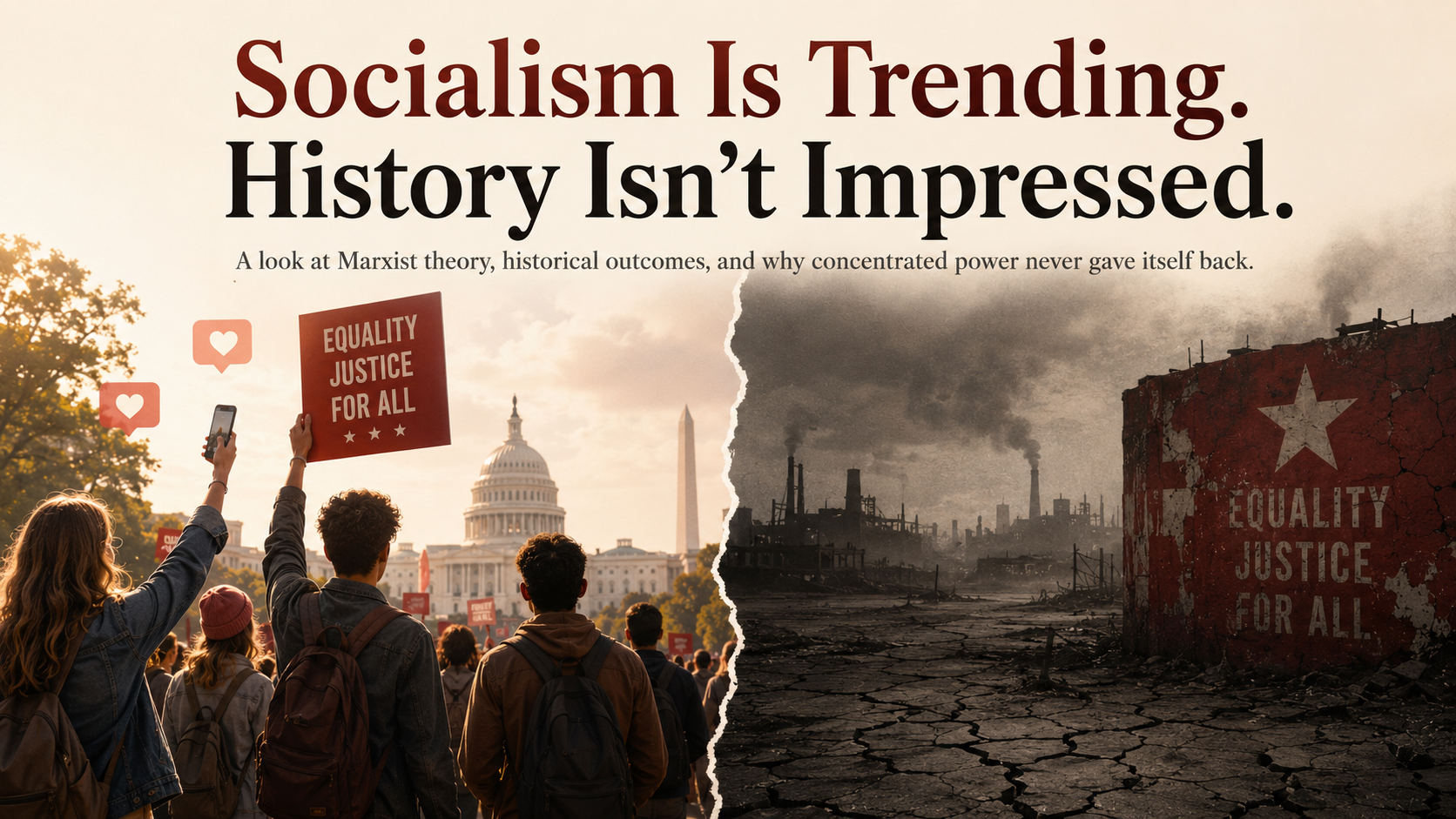
There is an argument that appears every time socialism or communism is criticized. That wasn't real communism. The Soviet Union wasn't real communism. Mao's China wasn't real communism. Cuba wasn't real communism. North Korea wasn't real communism. The Eastern Bloc wasn't real communism. Strangely enough, there is a sense in which this defense is correct. None of those countries ever reached the society Karl Marx envisioned as the final stage of communist development. But that does not rescue Marxism. It exposes its central problem.
The real historical question is not simply whether anyone reached Marx's promised destination. The more important question is what happened every time governments seriously attempted to travel the road Marx and Engels described. That road is worth examining carefully, because Marx and Engels did not envision capitalism being replaced overnight by some peaceful, stateless society where everyone voluntarily shared everything. There was supposed to be a transition. Political power would change hands, private ownership of the major means of production would be displaced, economic power would become increasingly centralized and class distinctions would disappear. Eventually, after those transformations had been completed, government itself would supposedly become unnecessary.
The extraordinary historical fact is that governments repeatedly made it through the centralization part. They never made it through the giving-the-power-back part. That is not an incidental failure of Marxism. It may be the most important thing history has taught us about it.
What Marx Actually Said
Before discussing socialism and communism, there is a terminology problem worth clearing up. Marx himself did not consistently describe socialism as a clearly separated historical stage followed by communism in exactly the way later Marxist-Leninist governments taught it. In his 1875 Critique of the Gotha Programme , Marx instead described a lower phase and a higher phase of communist society. Lenin later systematized the terminology by identifying the lower phase with socialism and the higher phase with full communism.
That distinction matters. It shows that the familiar pathway from capitalism to socialism to communism is essentially a later shorthand for ideas that are unmistakably present in Marx and Engels themselves, and those ideas form a recognizable progression.
Stage One: Capitalism Creates the Conditions for Its Own Destruction
Marx and Engels believed capitalism was historically important, a part of the theory that gets forgotten. They credited capitalism with transforming production, destroying feudal economic relationships, creating enormous productive capacity and creating an industrial working class. But they believed capitalism contained an unavoidable conflict between those who owned capital and those who sold their labor, a conflict that would intensify until the working class became conscious of its common interests and challenged the capitalist class politically.
The Communist Manifesto describes the working class gaining political supremacy and using that power to progressively take capital from the bourgeoisie and centralize major productive resources. Capitalism, in other words, was not supposed to be peacefully improved forever. It was supposed to prepare the material conditions for its own replacement.
Stage Two: The Proletariat Takes Political Power
Marx later described the political period between capitalist and communist society as the revolutionary dictatorship of the proletariat, a phrase that carries more weight than it usually gets credit for. Marx was not proposing that the capitalist state simply add a few social programs and gradually become Sweden. He envisioned political control transferring to the working class, which would then reorganize economic relationships. The Communist Manifesto explicitly contemplated measures that would centralize credit, transportation and significant portions of production while reducing the economic power of private capital.
This was supposed to be transitional power. The state would be extraordinarily powerful for a time because it would have to dismantle the previous economic order. But Marxists insisted this concentrated power was not supposed to remain permanent. That brings us to the next stage.
Stage Three: Social Ownership Replaces Capitalist Ownership
Once political power had been captured, the means of production would increasingly cease being privately owned in the capitalist sense. Factories, major industry, land, finance and other productive resources would become collectively controlled. The justification was straightforward. If private ownership produced classes, and classes produced exploitation, then eliminating private ownership of productive capital would eventually eliminate the economic basis for class society.
This is where the theory begins colliding violently with a practical problem. Who exercises that collective ownership? The people cannot literally walk into every factory every morning and collectively decide how many tractors, shoes, houses, microprocessors, tons of steel, gallons of milk and hospital beds should be produced. Someone has to make those decisions. In actual socialist states, that someone became the government.
Stage Four: The Lower Phase of Communism
Marx recognized that a post-capitalist society would not immediately produce perfect equality or unlimited abundance. In the lower phase described in the Critique of the Gotha Programme , society would still bear what Marx called the marks of the capitalist society from which it emerged, and distribution would remain connected in important ways to an individual's contribution of labor.
This was not yet the famous communist paradise. Scarcity still existed. Work still had to be allocated, production still had to be organized and rules still had to be enforced. Marx expected productive capacity eventually to rise enough that these limitations would disappear, and then humanity could proceed to the final stage.
Stage Five: Full Communism
Marx's higher phase was where the great promise finally arrived. Productive abundance would become so great, class distinctions would disappear so completely and social cooperation would become so natural that distribution could operate according to need rather than traditional market exchange. It was in describing this higher phase that Marx wrote his famous principle: "from each according to his ability, to each according to his needs."
And something remarkable was supposed to happen politically. The state would cease being necessary. Engels argued that once social classes and class domination disappeared, the special coercive institution required to suppress one class on behalf of another would become unnecessary, and state interference would progressively become superfluous. This is where the famous Marxist concept of the state "withering away" comes from.
Consider the entire progression. Capitalism creates class conflict, workers acquire political power, the new state centralizes economic resources and private ownership of major productive assets disappears. Class distinctions disappear. Productivity and abundance increase, the need for coercive government diminishes and the state eventually becomes unnecessary. Humanity reaches communism.
It is an elegant theory. There is just one enormous problem. History repeatedly traveled in the opposite direction.
The State Never Withered Away
The Soviet experiment is perhaps the clearest demonstration. The Bolsheviks seized political power after the Russian Revolution and embarked on the creation of a socialist economy. Rather than government becoming progressively unnecessary, Soviet government became one of the most centralized political and economic systems of the twentieth century. Production targets were established through central planning, agriculture was collectivized, private economic activity was severely restricted and political opposition was suppressed. Instead of eliminating coercive state power, the system concentrated it.
Forced collectivization and grain procurement during Stalin's rule contributed to catastrophic famines across parts of the Soviet Union in the early 1930s, killing millions. The USSR unquestionably achieved some major accomplishments, including rapid industrialization, mass education, scientific achievements and eventual superpower status, and a serious criticism of socialism should acknowledge those accomplishments. But it never became Marx's stateless communist society.
By the later Soviet period, economic stagnation, shortages, weak productivity growth and the difficulties of centralized economic management had become profound problems, and the Soviet Union ultimately dissolved in 1991. The temporary revolutionary state had lasted more than seven decades.
It never withered away. It collapsed.
Mao Tried Another Route
China provides an even more revealing experiment. Mao Zedong attempted to accelerate socialist transformation dramatically through collectivization and central planning. The Great Leap Forward sought rapid agricultural and industrial transformation. It produced catastrophe. Forced collectivization, distorted production incentives, false reporting, misallocation of labor and disastrous agricultural policies contributed to one of the worst famines in modern history. Estimates vary substantially, but the death toll ran into the tens of millions.
Then something extraordinary happened. China eventually changed direction. Beginning in 1978, China introduced reforms that decentralized agricultural decision-making, expanded market incentives, opened the country to international trade and investment and progressively allowed greater space for private economic activity.
The World Bank reports that since the beginning of China's reform and opening period, the country experienced decades of extraordinary growth and lifted nearly 800 million people out of extreme poverty. China became dramatically richer after introducing more markets, not fewer. Research examining China's poverty reduction specifically identifies incentive reforms and the freeing of agricultural markets as central contributors to the early reduction in poverty.
China remains governed by the Communist Party. That does not make its modern economy Marx's communist ideal. It has private businesses, billionaires, wage labor, international investment, competitive markets and substantial private accumulation of capital. Its political system remained communist while its economic system incorporated many of the mechanisms Marx expected history to eliminate.
Vietnam Learned a Similar Lesson
Vietnam offers another revealing example. Its Đổi Mới reforms, beginning in 1986, deliberately moved the country away from rigid central planning and toward a market-oriented economy. What followed was dramatic growth and poverty reduction. The World Bank describes Vietnam's transformation from one of the world's poorest countries into a dynamic middle-income economy as a major development success, and attributes an important part of that transformation to economic reforms and integration with the global economy. A separate World Bank assessment stated directly that market-based reforms promoting sustained growth were critical to Vietnam's poverty reduction.
Again, the pattern is difficult to ignore. The communist government survived. The rigidly planned economy did not.
"Real Communism Has Never Been Tried" Is Not the Defense People Think It Is
This is where the familiar objection comes back. But none of those countries reached real communism. Correct. That is precisely the problem. Marxism asks society to pass through a stage in which enormous political and economic authority becomes concentrated in the state, then predicts that once this concentration of power accomplishes its historical mission, the conditions requiring political coercion will disappear and the state will surrender its importance. Human history gives us very little reason to expect institutions possessing extraordinary power to voluntarily make themselves irrelevant.
The Marxist response is that the state is supposed to represent the workers rather than a separate ruling class. History suggests something else happens. A new political class emerges. Government officials administer production, party officials decide priorities, bureaucracies allocate resources and political leaders determine which economic failures can even be discussed. Those who control the supposedly temporary socialist state acquire every incentive to preserve their authority.
The bridge to communism becomes the permanent destination.
The Economic Calculation Problem Is Even Worse
Capitalism possesses something central planners repeatedly struggle to reproduce: prices. Prices are not merely numbers attached to merchandise. They communicate information. When something becomes scarce, its price tends to rise, which encourages consumers to conserve it and producers to make more of it. High profits attract competitors, and competition places pressure on producers to improve products, lower prices and find more efficient ways of operating. When consumers stop wanting something, companies either adapt or eventually fail.
None of this operates perfectly. Monopolies distort markets, fraud occurs, external costs such as pollution may not be properly priced and consumers make irrational decisions. Businesses sometimes become enormous and politically influential. Regulation is therefore necessary. But decentralized markets continuously process information generated by millions of buyers, workers, investors and businesses. Central planning attempts to replace those countless decisions with administrative decisions, and that is a staggering information problem.
Even when planners possess excellent information, they face another problem: incentives. Why take a financial risk developing something new if there is little personal benefit from success? Why produce beyond a quota? Why improve a product if consumers cannot choose a competitor? Why eliminate an inefficient government enterprise when its employees and managers possess political influence? Market competition does not solve every problem, but the OECD identifies vibrant competition as important for productivity and consumer welfare and finds substantial evidence connecting competitive pressure with efficiency and innovation, although the precise relationship varies by industry.
Capitalism does not work because businesspeople are saints. It works partly because they aren't required to be.
Self-interest, competition and price signals can channel individual ambition toward producing something other people voluntarily choose to buy. That is an enormously powerful mechanism.
Capitalism's Greatest Advantage Is That Failure Is Allowed
There is another fundamental difference. Under capitalism, individual businesses can fail without requiring the entire economic system to admit failure. Kodak can misread technological change. Blockbuster can underestimate streaming. A restaurant can make terrible food. A manufacturer can build something nobody wants. Someone else can replace them.
Capitalism contains thousands of simultaneous experiments. Most fail. Some succeed spectacularly, and those successful ideas spread. Central planning concentrates experimentation instead of dispersing it, so when government makes the wrong economic decision, everybody may be forced to participate in the same mistake.
Capitalism is messy because it allows people to be wrong. The first system disperses mistakes. The second can nationalize them.
Capitalism Is Not Perfect
None of this means capitalism deserves religious devotion. It doesn't. Capitalism can produce enormous inequality. Companies can exploit workers. Corporations can pollute. Financial markets can become irrational. Monopolies can undermine competition. Businesses can capture regulators. People can inherit enormous advantages they did nothing personally to create. Market economies periodically experience recessions and financial crises, and even some of capitalism's strongest theoretical benefits disappear when competition disappears.
A serious defense of capitalism should admit all of this. Markets require rules. Contracts require enforcement. Property rights require courts. Competition requires antitrust enforcement. Pollution and other externalities sometimes require government intervention, and people unable to support themselves require a social safety net in any civilized society. Education, infrastructure, basic research and public health all involve legitimate public responsibilities.
None of those things requires abolishing capitalism. The choice is not between nineteenth-century laissez-faire capitalism and Marxist central planning. Modern successful economies are overwhelmingly mixed market economies in which private enterprise remains the primary engine of production while democratic governments regulate markets and provide public services. That is not a concession to Marxism. It is capitalism correcting its own excesses without abolishing private ownership.
Capitalism's Record Is Better
I would stop just short of saying capitalism is literally superior in every imaginable way, because that wording is unnecessarily easy to attack. The Soviet Union, for example, demonstrated that centralized governments can mobilize enormous resources quickly toward a narrow national objective, and socialist systems have sometimes achieved rapid increases in literacy, industrial capacity or basic service provision. The question is what happens over time and across an entire economy.
On wealth creation, consumer choice, technological adaptation, entrepreneurship, responsiveness to demand, economic freedom and the ability to correct errors without replacing the entire political system, market capitalism has the far stronger historical record.
The World Bank reports that the number of people living in extreme poverty fell dramatically between 1990 and 2025, with much of that progress driven by rapid economic growth in Asia. Two of the most important contributors to that decline, China and Vietnam, achieved their greatest improvements after introducing market mechanisms into previously rigidly planned socialist economies.
That does not prove every free-market policy is good. It demonstrates something much more significant. Markets work, private incentives matter, trade matters, entrepreneurship matters, prices matter, property rights matter and competition matters. Attempts to eliminate those mechanisms have repeatedly discovered how difficult they are to replace.
The Irony Marx Never Solved
There is a tremendous irony at the heart of Marxism. Marx expected capitalism to generate such extraordinary productive capacity that humanity could eventually transcend capitalism itself. He was right about the productive capacity. He appears to have been wrong about the conclusion.
Capitalism kept evolving. Workers gained political rights, trade unions emerged, workweeks shortened, workplace safety improved, mass education expanded and social insurance developed. Technology created industries Marx could never have imagined, and democratic governments regulated businesses, taxed wealth and built social programs without abolishing private enterprise.
Capitalism proved capable of changing. Marxism repeatedly assumed capitalism's contradictions would destroy it. Instead, capitalism repeatedly incorporated reforms and continued. That adaptability may be capitalism's greatest strength.
The Fundamental Mistake
Marx and Engels believed private control of capital was the fundamental problem. History suggests that concentrated power may be the more dangerous problem. Capitalism disperses economic power imperfectly. Government disperses political power imperfectly. Democratic capitalist societies attempt to keep those powers divided among businesses, consumers, workers, voters, courts, legislatures, regulators and competing political institutions.
Marxist socialism moves in the opposite direction. It attempts to solve concentrated private economic power by placing enormous economic authority in the same institution that already possesses coercive political authority, then promises that this concentration of power will eventually eliminate the need for power.
That is the leap of faith. History has not rewarded it.
The Experiment Has Been Run
At some point, political theories have to answer to evidence. Marx died in 1883. Engels died in 1895. Neither man witnessed the twentieth century's great experiments conducted in their names. We did.
We saw the Soviet Union, collectivization and Mao's Great Leap Forward. We saw the Eastern Bloc and governments attempting central planning on enormous scales. We also saw what happened when socialist governments began introducing market mechanisms instead. China opened markets and exploded economically. Vietnam introduced market reforms and transformed itself. Former communist countries throughout Eastern Europe moved toward private enterprise and markets after Soviet domination ended, although their transitions were often painful and uneven, and the World Bank has extensively documented both the economic disruption and transformation associated with the post-communist transition.
No Marxist-Leninist government has completed the promised journey to Marx's higher communist phase in which classes disappear and the coercive state becomes unnecessary. The state never withered away. It became stronger.
When economic performance became intolerable, governments generally did one of two things. They introduced markets, or the system eventually broke.
Why This Matters
The renewed fascination with socialism often begins with legitimate complaints about capitalism. Housing is expensive. Medical care can be expensive. Corporations can wield too much influence. Wealth inequality is real, and people sometimes work extraordinarily hard without getting ahead. Those problems deserve serious solutions.
But dissatisfaction with capitalism does not constitute evidence for socialism. A leaking roof does not mean burning down the house is an improvement. The relevant question is not whether capitalism has flaws. Of course it does. The relevant question is compared with what, and we have more than a century of evidence with which to answer.
Market capitalism has produced enormous wealth, relentless technological innovation, consumer abundance and historically unprecedented improvements in material living standards. Its greatest communist rivals eventually found themselves borrowing capitalist mechanisms simply to make their economies function. China did not rescue Marxism by adopting markets. Markets rescued China's economy from some of Marxism's worst economic instincts. Vietnam's experience tells much the same story. And the Soviet Union never reached the communist destination at all. The socialist state that was supposed to become unnecessary instead accumulated tremendous power until the system itself disappeared.
That is the historical lesson worth remembering whenever someone announces that this time socialism will finally work because the right people will be in charge. Every generation thinks it will be the generation capable of managing concentrated power wisely. Marxism requires us to believe something even more extraordinary, that after accumulating unprecedented political and economic power, those in control will eventually discover they no longer need it and quietly surrender it. History suggests otherwise.
Capitalism doesn't promise utopia. That may be one of its virtues. It assumes human beings are ambitious, competitive, creative, selfish, cooperative, irrational and ingenious all at once, and rather than requiring human nature to change, it builds an economic system around those realities and then uses democratic institutions, regulation and law to restrain its excesses.
Communism promised something far grander: a classless society, economic abundance, an end to exploitation and eventually even the disappearance of the coercive state. It was a magnificent promise.
The problem is that humanity never got past the dictatorship required to reach it. And after more than a century of evidence, that is no longer merely a theoretical objection. It is history.
References
- Marx, K. (1875). Critique of the Gotha Programme.
- Marx, K. & Engels, F. (1848). The Communist Manifesto.
- Engels, F. (1880). Socialism: Utopian and Scientific. [Source of the "withering away of the state" concept.]
- World Bank. The World Bank in China. worldbank.org. [Poverty reduction following China's 1978 reform and opening period.]
- World Bank. The World Bank in Vietnam. worldbank.org. [Đổi Mới reforms and Vietnam's poverty reduction.]
- World Bank. (2025). Poverty and Shared Prosperity. worldbank.org. [Global extreme poverty trends, 1990 to 2025.]
- World Bank. Transition economies of Eastern Europe and Central Asia. worldbank.org. [Post-communist economic transition.]
- OECD. Competition and productivity. oecd.org.
Disclaimer: This article is an argument in favor of market capitalism and against Marxist socialism and communism. It does not contend that every policy enacted by a capitalist country is superior to every policy enacted by a socialist government, nor does it claim that capitalism eliminates poverty, inequality, corruption or political oppression. Economic systems exist on a spectrum, and modern economies typically combine private markets with public regulation and social programs. The argument is that the historical record provides substantially stronger evidence for decentralized market economies than for comprehensive state ownership and central economic planning as a sustainable means of achieving prosperity, innovation and individual economic choice. The views expressed are the personal opinions of the author for educational, commentary and public discourse purposes only and do not represent the positions of any institution, employer, organization or affiliated entity with which the author may be associated in any capacity. All factual claims are drawn from publicly documented cited sources. Readers are encouraged to consult primary sources and form their own conclusions.