One of the most persistent misunderstandings in public discussions about science revolves around a single word: theory.
You hear it constantly in debates about evolution, climate change, cosmology, vaccines and basic physics. Someone inevitably says, "Well, it's just a theory." The implication is clear - if something is "just a theory," scientists must not really be sure about it. Maybe it's speculation. Maybe it's waiting to be proven.
In everyday language, that interpretation makes sense. But in science, the word means something very different. And confusing the two creates a public that routinely dismisses well-established scientific explanations because they misunderstand the vocabulary scientists are using.
If we're going to argue about science, the least we can do is understand the language first.
The Everyday Meaning of "Theory"
In casual conversation, theory basically means a personal explanation or hunch. "My theory is that the Broncos lost because of bad coaching." It might be informed by observation, but it's not necessarily supported by evidence, testing or systematic analysis. It's simply someone's idea about what might be happening.
This is perfectly fine in casual conversation. The problem arises when people carry that meaning into discussions about science. When someone hears Theory of Evolution or Theory of Relativity , they interpret it through the everyday definition. To them, theory means guess. So when they hear "evolution is a theory," they assume scientists are admitting they're not sure whether evolution actually happened.
That interpretation is completely backwards.
What a Scientific Theory Actually Is
In scientific terminology, a theory is not a guess. It is a comprehensive explanation of natural phenomena supported by a large body of evidence. To qualify, it must meet several criteria:
What makes something a scientific theory
- Supported by extensive empirical evidence
- Testable through observation and experiment
- Makes predictions that can be verified
- Consistent with other established scientific knowledge
- Repeatedly tested, refined and expanded over time
Some of the most important scientific theories include the Theory of Evolution, the Theory of Relativity, Atomic Theory, Germ Theory of Disease and Plate Tectonics. These are not speculative ideas floating around the scientific community. They represent decades or centuries of observation, experimentation and validation.
Take germ theory as an example. Before the nineteenth century, many people believed disease was caused by "bad air" - the miasma theory. Once microscopes improved and researchers like Louis Pasteur and Robert Koch demonstrated that microbes could cause disease, germ theory gradually replaced earlier explanations. Today it forms the foundation of modern medicine, sanitation and surgery. Calling germ theory "just a theory" would sound absurd to anyone who has watched a surgeon scrub their hands before an operation. Yet the same dismissal is routinely applied to other scientific theories.
What a Scientific Law Is - and Isn't
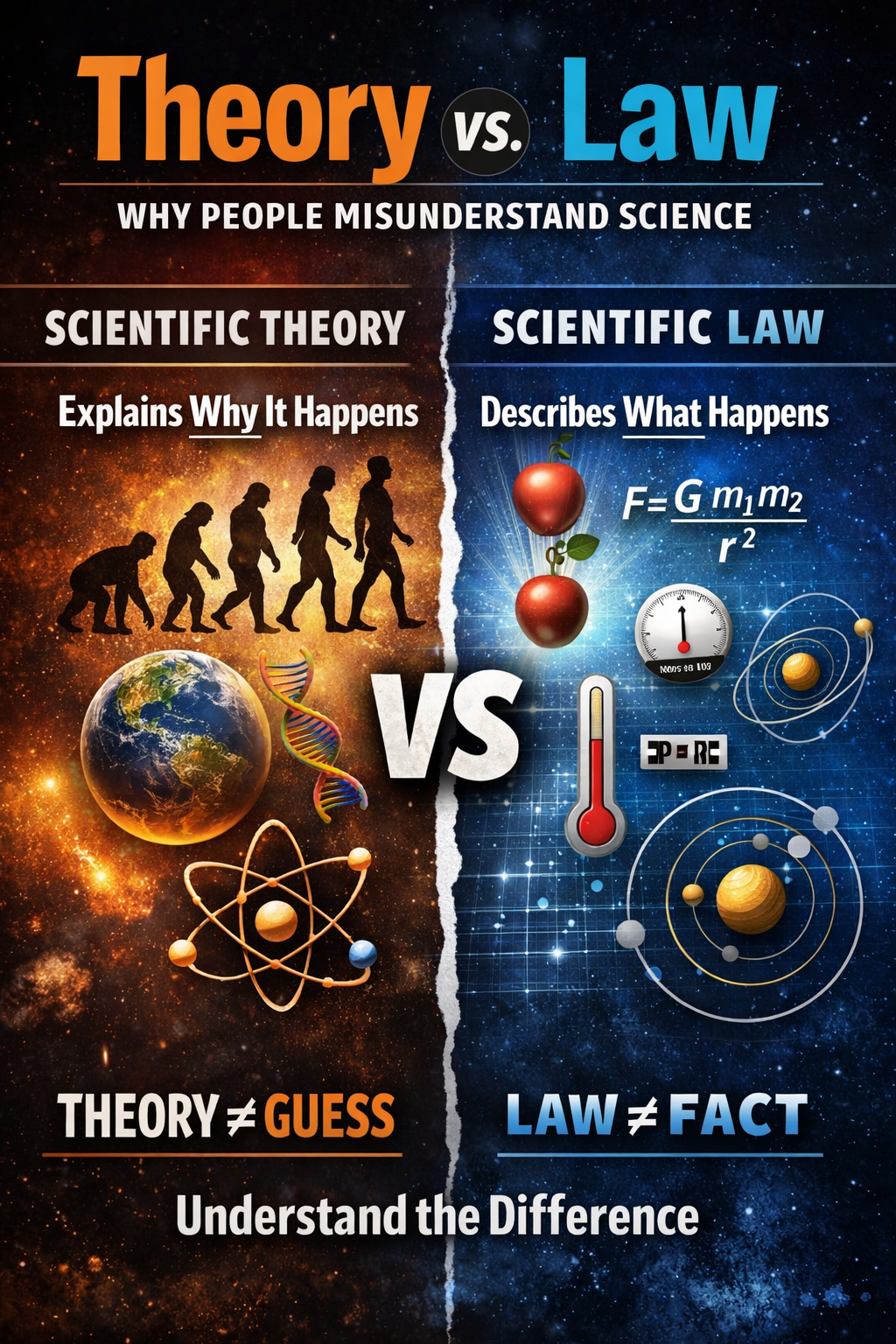
Scientific laws are different from theories - but not in the way most people assume. A scientific law describes a consistent, observable pattern in nature, often expressed mathematically. Newton's Law of Universal Gravitation, Boyle's Law of gases, the Laws of Thermodynamics. These describe what happens. They don't necessarily explain why.
Scientific Law
Describes behavior
Captures a consistent, measurable pattern in nature. Often expressed as a mathematical relationship. Tells you what will happen under given conditions.
Scientific Theory
Explains behavior
Provides the mechanism behind the pattern. Draws on multiple lines of evidence. Tells you why something happens the way it does.
Neither is "more proven" than the other. They simply serve different roles in scientific understanding. A law without a theory is a pattern without an explanation. A theory without supporting laws and data is just an idea.
Why "Just a Theory" Is Misleading
When someone says evolution is "just a theory," they are unintentionally mixing up two very different meanings of the word. They're applying the everyday definition - guess - to a term scientists use to mean the opposite.
Evolutionary theory explains the diversity of life through mechanisms such as natural selection, genetic mutation and inheritance. The evidence supporting it comes from multiple independent fields:
Genetics, paleontology, comparative anatomy, molecular biology and directly observed evolutionary change in living organisms - each discipline independently reinforces the same framework. That convergence is exactly what makes it one of the most strongly supported explanations in all of biology.
Scientists continue refining the details of evolutionary processes. But that's how science progresses - details improve over time while the larger explanation becomes stronger, not weaker.
Why Science Avoids Absolute Certainty
Some people wonder why scientists don't simply call well-supported theories "facts." The answer is that science avoids claiming absolute certainty - by design. Scientific knowledge is always provisional. If new evidence appears that contradicts an existing explanation, scientists are obligated to examine it and revise their understanding.
That flexibility is not a weakness. It's one of science's greatest strengths. Science advances precisely because it allows ideas to be challenged and improved. A theory that can be revised is more trustworthy than a belief that can't.
The Bottom Line
"Just a theory" is one of the most common misunderstandings in discussions about science. In everyday language, a theory is a guess. In science, it's a powerful explanatory framework supported by extensive evidence and repeated testing.
Scientific laws describe patterns in nature. Scientific theories explain those patterns. Confusing the two leads to sloppy thinking and weak arguments - and makes it far too easy for misinformation to fill the gap.
If we want meaningful conversations about science, we should start by using the terminology correctly.
Public decisions increasingly depend on scientific understanding - medicine, technology, environmental policy, public health. When people misunderstand fundamental concepts like theory and law, it becomes easier for misinformation to spread and harder for meaningful discussion to take place. In an age where misinformation travels faster than evidence, that kind of literacy matters more than ever.
References
- American Association for the Advancement of Science. (1993). Benchmarks for science literacy. Oxford University Press.
- McComas, W. F. (1998). The nature of science in science education. Kluwer Academic Publishers.
- National Academy of Sciences. (2008). Science, evolution and creationism. National Academies Press.
- University of California Museum of Paleontology. (2024). Understanding evolution. evolution.berkeley.edu