
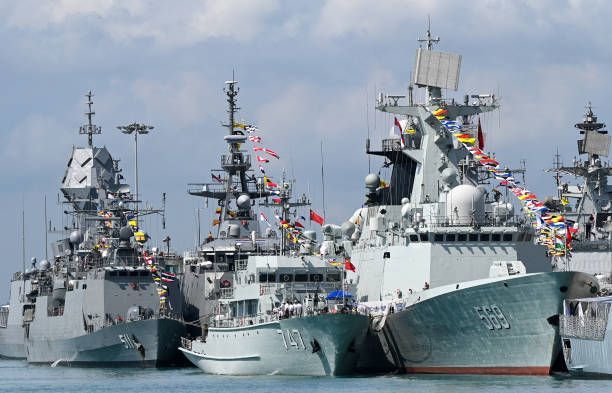
The China threat has become one of the most reliably inflated concepts in American strategic discourse. Mention Beijing in a defense hearing and the room fills with urgency, budget requests and comparisons to the Soviet Union. That urgency is not entirely misplaced. China is a significant and growing military power with genuine capabilities, real strategic ambitions and the economic weight to back both. The problem is not that we take China seriously. The problem is that serious has slipped into alarmist, and alarmist produces bad strategy. China is a formidable regional power with specific and bounded interests in its immediate periphery. It is not equipped - militarily, logistically, institutionally or economically - to challenge the United States for global dominance. Treating it as though it is distorts the actual threat, misallocates resources and produces exactly the kind of strategic confusion that adversaries prefer their opponents to have.
The Logistics Gap Is Not Closing Fast
Global power projection is less about weapons than about the unglamorous infrastructure that keeps weapons operational thousands of miles from home. The United States has spent decades and enormous sums building that infrastructure: aerial refueling tankers, sealift capacity, forward-deployed bases, pre-positioned equipment, and the supply chains and maintenance networks that sustain combat operations for months or years at a time. No other country in the world has built anything approaching this system. The United States can move a carrier strike group to any ocean on earth and keep it there. That capability is not replicated by any competitor.
China's logistical reach, by comparison, is genuinely constrained. Its aerial refueling capability is limited, which restricts the operational range of its most capable aircraft. The PLA Navy has a small number of replenishment vessels and cannot sustain a carrier strike group at sea for extended periods without returning to port. Its single overseas military facility, in Djibouti, provides minimal strategic flexibility and sits in a location that tells you a great deal about China's actual priorities. Djibouti is strategically relevant to the Horn of Africa and maritime trade routes through the Red Sea. It is not the kind of forward presence that enables global power projection. The U.S. Department of Defense's 2023 annual report on the PLA acknowledges China's rapid naval modernization while noting the enduring limitations in its ability to sustain forces far from the Chinese mainland. Those limitations are real and they matter more than the hardware inventory.
Global power projection is less about weapons than about the infrastructure that keeps weapons operational thousands of miles from home. On that measure, no other country is in the same conversation as the United States.
No Combat Experience Is a Real Limitation
Doctrine and hardware tell you what a military is supposed to be able to do. Combat tells you what it actually can do. The U.S. military has been continuously tested in large-scale and complex operations for thirty years - the Gulf War, the Balkans, Iraq twice, Afghanistan, the ongoing global counterterrorism enterprise, and various contingency operations in between. That experience has produced a generation of general and flag officers who have commanded under real pressure, made consequential decisions with incomplete information and adapted when initial plans failed. Joint warfighting, coalition operations, logistics under fire and the practical management of strategic uncertainty are not theoretical concepts for the U.S. military. They are institutional muscle memory.
The PLA has not fought a significant conflict since its 1979 border war with Vietnam, which was brief, costly and widely regarded as a demonstration that Chinese operational capabilities fell short of their reputation. Current senior PLA leadership has no combat experience at all. Andrew Scobell and his colleagues at RAND have documented the significant uncertainties this creates around how Chinese forces would actually perform in a high-tempo, dynamic conflict against a capable adversary. The PLA's rapid modernization has produced impressive hardware. Whether it has produced the institutional learning, tactical adaptability and command culture that modern warfare demands is a different question and one that China cannot answer without fighting a war. That gap between theoretical capability and demonstrated performance is exactly the kind of uncertainty that matters for serious strategic assessment.
The PLA's institutional culture presents structural challenges that hardware modernization does not resolve. Unlike Western militaries, which have worked for decades to develop junior leadership initiative and decentralized decision-making, the PLA operates within a political framework that places a premium on loyalty, party oversight and top-down control. Political commissars maintain authority within military units. Senior appointments reflect political reliability as well as operational competence. The result, as the DoD's annual China reports have consistently noted, is a command culture that tends toward rigidity and risk aversion in ways that could be decisive liabilities in the fast-moving, ambiguous environment of modern warfare. This is not a dismissal of PLA capabilities. It is an honest assessment of a structural constraint that China's leadership is aware of and has been trying to address through its military reforms. Whether those reforms have fundamentally changed the institutional culture is unproven.
Economic Vulnerabilities That a War Would Expose
China's economic strength is real and should not be dismissed. But the specific vulnerabilities in that economy would be acutely exposed in any serious military conflict with the United States. China imports more than 70 percent of its oil, and the majority of that supply transits through the Strait of Malacca - a chokepoint that U.S. naval power could close. The same applies to the broader sea lines of communication that carry the raw materials and components China's manufacturing economy depends on. A sustained naval blockade would not need to sink a single Chinese vessel to impose severe economic pressure. It would simply need to interrupt the flow of seaborne commerce that China's industrial base requires.
China also faces structural demographic and debt challenges that constrain its ability to sustain a high-tempo military conflict. Its workforce is declining as a result of decades of one-child policy effects. Its local government debt burden is substantial and its real estate sector has been under significant stress. These are not immediate military vulnerabilities but they are limits on the economic stamina that a prolonged conflict would demand. By contrast, the United States has secure domestic energy production, a network of allied economies and a financial system that has demonstrated it can absorb the costs of sustained military engagement. China's economy is impressive in peacetime. It has specific structural features that would be serious liabilities in wartime.
Regional Ambitions, Not Global Ideology
The most important distinction between China and the threats the United States has historically organized itself to confront is the nature of Beijing's actual ambitions. Nazi Germany sought to reorganize Europe under German racial dominance. The Soviet Union pursued a global ideological contest and actively worked to export communist revolution across continents. Both of those threats were genuinely global in character because the ideology driving them was universalist - it claimed applicability everywhere and demanded confrontation everywhere. China's strategic goals are fundamentally different in character. They are nationalist rather than universalist and they are primarily focused on the immediate geographic periphery: Taiwan, the South China Sea, the East China Sea, and consolidating influence over neighboring states.
The Belt and Road Initiative, often cited as evidence of Chinese global expansionism, is primarily an economic and diplomatic instrument. It involves construction financing and infrastructure development deals, not military occupation or the export of political systems. China wants trade leverage, diplomatic influence and recognition of its regional preeminence. It does not appear to seek the ideological submission of other populations to Chinese political doctrine. That distinction matters for how the United States should structure its response. A globally ideological adversary requires a different strategic posture than a regionally nationalist one. Conflating the two produces a strategy calibrated for the wrong threat.
My Bottom Line
China deserves serious attention, careful monitoring and robust deterrence in the Indo-Pacific theater where its capabilities and ambitions are genuinely concentrated. The defense relationship with Taiwan, freedom of navigation in the South China Sea, the technology competition and the economic dependencies that create strategic vulnerabilities - all of these are real policy problems that require sustained engagement and resources. None of that requires treating China as a global military juggernaut on the Soviet model. That framing overstates what China can actually do outside its immediate periphery, understates the structural limits it operates under and leads to strategic postures calibrated for a threat that does not match the observable evidence.
The United States remains the only country with genuine global military reach, demonstrated by decades of sustained operations, underpinned by logistics and basing infrastructure that China has not built and cannot build quickly, and backed by a network of capable allies that China's transactional foreign policy has not assembled. Vigilance and realism are exactly the right approach to China. Alarmism dressed as strategic seriousness is not. The former produces effective policy. The latter produces expensive mistakes.
Take China seriously. That means understanding what it actually is - a capable regional power with specific and bounded ambitions - rather than what the most alarming briefing slide says it might become.
References
- U.S. Department of Defense. (2023). Annual Report on Military and Security Developments Involving the People's Republic of China. Office of the Secretary of Defense.
- Erickson, A. S. (2021). Chinese Naval Shipbuilding: An Ambitious and Uncertain Course. Naval Institute Press.
- Scobell, A., et al. (2020). China's Military Decision-Making in Times of Crisis and Conflict. RAND Corporation.
- Liff, A. P. (2019). China and the U.S. alliance system. The China Quarterly, 242, 419-445.
- Office of Naval Intelligence. (2020). PLA Navy Identification Guide. U.S. Navy.
- Gershaneck, K. (2020). Political Warfare: Strategies for Combating China's Plan to "Win Without Fighting." Marine Corps University Press.
- Mearsheimer, J. J. (2001). The Tragedy of Great Power Politics. W.W. Norton. (For the theoretical framework on regional vs. global hegemony.)
Disclaimer: The views expressed in this post are the personal opinions of the author and are offered for educational, commentary and public discourse purposes only. They do not represent the positions of any institution, employer, organization or affiliated entity. Nothing in this post constitutes legal, financial, military or professional advice of any kind. References to government reports, academic scholarship and published analysis are based on publicly available sources cited above and are intended to support analysis and argument. Commentary on foreign policy and national security subjects reflects the author's independent analysis and is protected expression of opinion. Readers are encouraged to consult primary sources and form their own conclusions.