- Is Blue Ocean Strategy Really All That?
- Who It Helps and Who It Mostly Won't
- Blue Ocean Without the Fantasy
- Beyond Efficiency: Value Not Speed
- Blue Ocean Meets the Real World (this post)
We have been building this argument for a while now. Blue Ocean Strategy is a useful lens, not a magic trick. It works when the conditions are right and fails badly when they are not. The framework gives you a way to ask better questions. It does not write the answers for you.
But there is a gap that every one of the previous posts circled without landing on directly.
It is the gap between the strategy session and the actual operation. Between the four-action framework on a whiteboard and the people, processes, vendors and customers who will have to make it real. Between the promise of uncontested market space and the grind of actually delivering value in a way the business can sustain.
That gap is where blue oceans go to die.
And it is the part nobody in a conference room wants to talk about.
The Strategy Canvas Is Not a Business Plan
When Kim and Mauborgne introduced the strategy canvas, they gave managers a visual tool for comparing value curves across competitors and identifying where a company could diverge. It is genuinely useful for seeing patterns that spreadsheets hide. You can look at a canvas and immediately spot where an industry is over-serving attributes customers barely notice and under-serving things they actually care about.
The problem is that too many teams stop there.
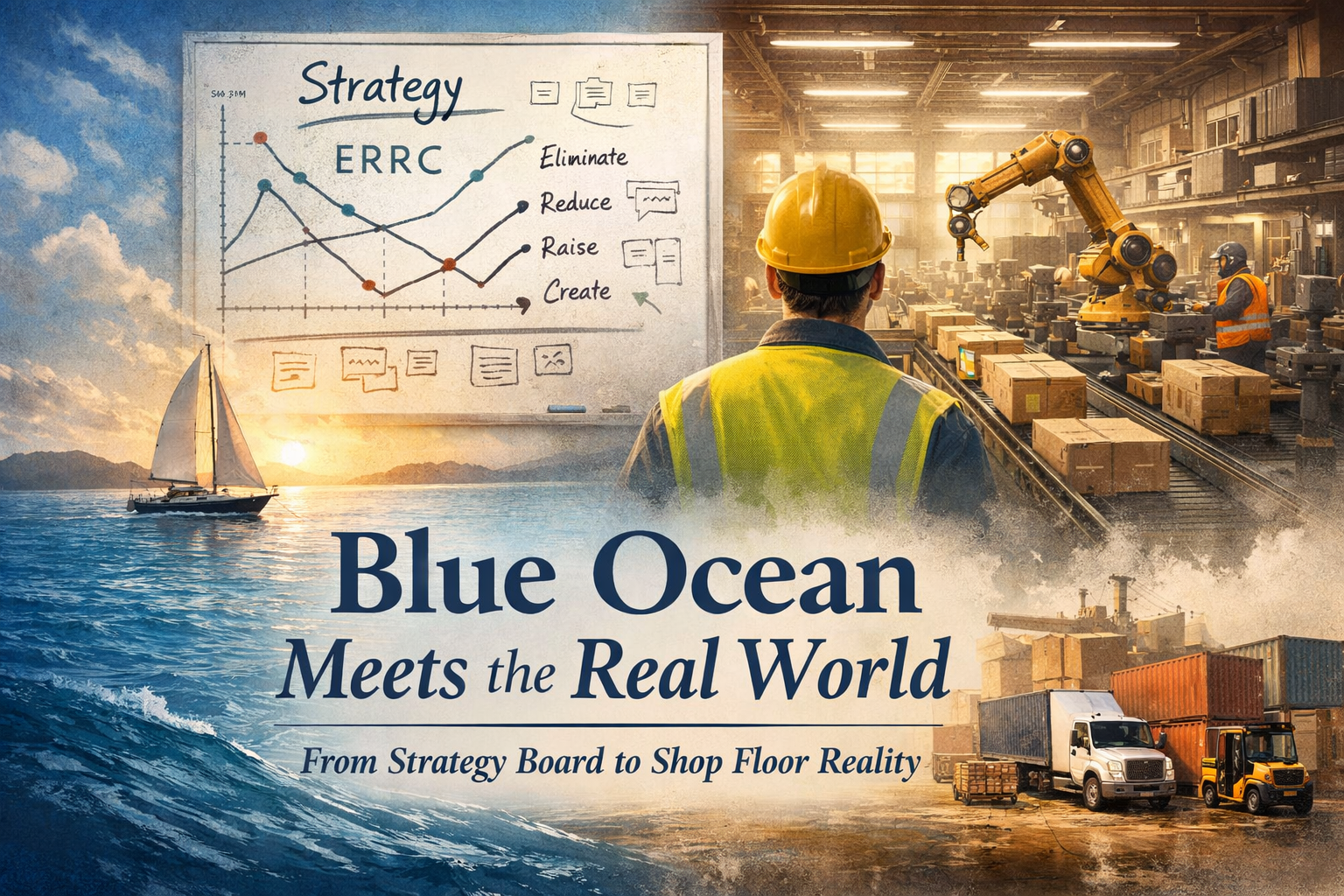
They draw the canvas. They run the ERRC exercise. They get excited about the gap they found. They declare a new strategic direction. Then they go back to their desks and nothing changes because nobody asked the next question: what does it actually cost to deliver this new value curve, and can our current operation do it?
"A strategy canvas tells you where to aim. It does not tell you whether you have the gun, the ammunition or the steadiness to hit the target."
This is the connection point between Blue Ocean thinking and operational discipline. The previous post on value-driven operations made the argument that efficiency without effectiveness is just organized waste. The same logic applies here. A blue ocean move without operational grounding is just a repositioning claim waiting to embarrass you.
Value Innovation Requires Operational Innovation
The phrase Kim and Mauborgne use is "value innovation" and it is the real engine of the whole framework. The idea is that you simultaneously raise buyer value and lower your cost structure by rethinking what you offer and how you offer it. That is not differentiation in the traditional sense. It is a restructuring of what the business actually does.
Here is the part that gets glossed over in most BOS presentations: if you are raising buyer value in one area while reducing cost in another, you are changing your operations. Not your marketing. Your operations. The actual work.
You are probably changing your supply chain. You are probably changing your hiring profile. You are probably changing your training, your quality standards, your delivery model and your service recovery process. You may be changing your technology stack. You are almost certainly changing what your frontline people are expected to do and how they are measured.
Most blue ocean attempts fail not because the idea was wrong but because the organization never restructured the operation to match the new value promise. The offer changed on paper. The business model underneath it did not. That is not a strategy failure. It is an operations failure wearing a strategy costume.
This matters because it changes what the real work of a blue ocean move actually is. It is not the workshop. It is not the canvas. It is the hard organizational work of aligning what the business does with what the business just promised.
The Three Operational Questions BOS Doesn't Ask for You
Every serious blue ocean move eventually runs into three questions that the framework itself leaves for you to answer. I have watched businesses stumble on each of them and the pattern is consistent enough to be worth naming directly.
The first question is whether the new value curve is actually deliverable at scale. A small team can often deliver a premium or differentiated experience through sheer effort and personal attention. The founder is involved in every deal. Quality control is informal but effective because the right people are always in the room. That works until it doesn't. The moment volume increases and the founder steps back, the gap between the promise and the delivery opens up fast. Operational systems, training and process discipline are what close that gap. Without them, scale turns a blue ocean into a reputation problem.
The second question is whether the cost structure actually supports the new model. ERRC is supposed to handle this. Eliminate and reduce create the headroom. Raise and create use it. But the math only works if the eliminations and reductions are real, not theoretical. I have seen companies claim they are eliminating costly steps while quietly maintaining them because the team is not ready to let go or the process was never actually documented well enough to remove cleanly. The savings never materialize. The raises and creates get funded by margin compression instead. That is not value innovation. That is wishful thinking with a framework attached to it.
The third question is whether the organization can actually hold the new position once competitors respond. Earlier posts in this series made the point that blue oceans do not stay blue. Imitation is fast and cheap in most industries. The question is not whether competitors will notice a successful move. They will. The question is whether the business has built enough operational depth that copying the surface of the offer is not the same as replicating the delivery. Process capability, supplier relationships, team expertise and institutional knowledge are harder to copy than a pricing structure or a marketing claim.
The businesses that hold blue ocean positions longest are almost never the ones with the cleverest positioning. They are the ones whose operations got so good at delivering the new value curve that competitors found the economics unattractive to replicate. Operational excellence is the moat. The strategy just points you toward where to dig it.
When the Ocean Meets the Shop Floor
Let me make this concrete. Consider a service business in a fragmented local market. The industry norm is inconsistent quality, weak communication and pricing that varies arbitrarily based on who picks up the phone. A blue ocean move might involve standardizing the offer, guaranteeing a response time, pricing transparently and building a follow-up process that most competitors ignore entirely.
That is a legitimate value curve shift. Customers who avoided the category because of unpredictability now have a reason to buy. Customers who were buying but tolerating frustration now have a reason to stay and refer. The ERRC logic works on paper.
But what does the operation need to look like to actually deliver that?
It needs documented processes for every customer touchpoint. It needs training that goes beyond product knowledge into communication standards and problem resolution. It needs scheduling and dispatch systems that can actually hit the response time guarantee rather than just claim it. It needs a quality check before the job closes and a follow-up that happens every time rather than when someone remembers. It needs pricing tables that are real rather than aspirational so the person taking the call does not have to guess.
None of that is glamorous. None of it shows up on a strategy canvas. But all of it is what separates a blue ocean that holds from a blue ocean that erodes the moment a competitor decides to copy the marketing without understanding the infrastructure behind it.
"The blue ocean is the destination. Operations is the ship. You can draw the map all day long. Without the ship, you are not going anywhere."
Blue Ocean and the Value Discipline Problem
There is a useful concept from Treacy and Wiersema that sits just behind the Blue Ocean conversation and does not get enough credit. Their argument is that companies tend to win by excelling at one of three value disciplines: operational excellence, product leadership or customer intimacy. The trap is trying to be competitive in all three simultaneously. Resources are finite. Attention is finite. Organizations that try to optimize everything usually end up mediocre across the board.
Blue Ocean Strategy does not resolve this tension. It sidesteps it by claiming you can break the value-cost tradeoff entirely through innovation. That is sometimes true. But even when it is true, the business still has to decide which discipline anchors the new model.
A blue ocean move built on operational excellence looks different from one built on customer intimacy. The first leans on process standardization, cost discipline and reliability at scale. The second leans on deep customer knowledge, customization and relationships that competitors cannot easily replicate. Trying to run both simultaneously without the resources to support them is one of the most common ways a genuinely good strategic idea becomes an operational mess.
The practical implication is simple. Before you commit to a blue ocean move, decide which discipline will anchor it. Then build the operation around that discipline first. The other two can be competitive, but they cannot all be excellent at the same time with the same budget and the same team.
What the Previous Posts Were Building Toward
Looking back at this series, there is a progression that I think is worth naming explicitly.
The first post asked whether Blue Ocean is real strategy or just repackaged differentiation advice. The honest answer was both, and the value is in using it as a forcing function rather than a guarantee.
The second post identified which environments give BOS the best odds and which ones are likely to swallow the idea whole. Market structure matters. Regulatory constraints matter. Operational capacity matters.
The third post offered a practical operating system for testing a blue ocean idea without fooling yourself. Kill switches, demand validation and moat design got more attention than the whiteboard exercises.
The fourth post made the case that value has to drive operations, not the other way around. Efficiency divorced from customer value is just organized waste at a faster pace.
This post is the convergence point. Blue ocean thinking and operational discipline are not separate conversations. They are the same conversation at different altitudes. One tells you where to aim. The other tells you whether you can actually get there and stay there once competitors notice the weather has changed.
Strategy without operations is theater. Operations without strategy is a treadmill. The businesses that actually create and hold new market space are the ones that treat the two as inseparable from day one. The canvas and the shop floor have to agree with each other or neither one is telling the truth.
A Practical Note for Smaller Businesses
Most of the classic BOS case studies involve large companies with significant resources, brand recognition and the organizational depth to absorb a failed experiment or two. Cirque du Soleil, Southwest Airlines, Nintendo with the Wii. These are not small roofing companies or independent insurance adjusters or regional service businesses trying to differentiate in a crowded local market.
The framework still applies to smaller operations, but the stakes and the sequencing are different.
For a smaller business, the blue ocean logic is less about inventing an entirely new market category and more about identifying the friction points that keep noncustomers away and eliminating them before competitors do. That is a narrower application but it is a real one. The nonconsumption insight is just as valid at a local scale. The ERRC exercise is just as useful when you are deciding whether to keep offering services your customers do not value or redirect that time and cost toward the things they actually tell you matter.
The operational constraint is more acute for smaller businesses because there is less slack in the system. A large company can absorb the cost of a blue ocean experiment that underperforms. A small business usually cannot. That is why the kill switch concept from the earlier post matters more at smaller scale, not less. Define what success looks like before you start. Define what failure looks like before you start. Then run the smallest version of the idea that can actually give you real data rather than encouraging anecdotes.
My Bottom Line
Blue Ocean Strategy is worth taking seriously as a thinking tool. It is not worth worshipping as a doctrine. The framework gives you a useful set of questions and a visual language for making strategic choices visible. What it does not give you is an operations plan, a cost model, a delivery system or a moat.
Those things have to come from you.
The connection this series has been building toward is this: the best use of Blue Ocean thinking is not to escape competition. It is to identify where your current operation is spending time and money on things that do not create value for buyers, then redirect that capacity toward things that do. That is not revolutionary. It is disciplined. And discipline, consistently applied, is what turns a good idea on a whiteboard into a business that actually performs differently from everyone else in the market.
The ocean does not stay blue forever. But an operation that knows why it is different, builds its processes around that difference and measures honestly whether it is delivering on the promise, that business holds its position longer than one that just found a clever angle and hoped nobody noticed.
Strategy finds the water. Operations builds the boat. You need both or you are just standing on the shore with a very good map.
References
- Kim, W. C. & Mauborgne, R. (2004). Blue Ocean Strategy. Harvard Business Review.
- Kim, W. C. & Mauborgne, R. (2005). Blue Ocean Strategy: How to Create Uncontested Market Space and Make the Competition Irrelevant. Harvard Business School Press.
- Porter, M. E. (1996). What Is Strategy? Harvard Business Review.
- Treacy, M. & Wiersema, F. (1993). Customer Intimacy and Other Value Disciplines. Harvard Business Review.
- Womack, J. P. & Jones, D. T. (2003). Lean Thinking: Banish Waste and Create Wealth in Your Corporation (2nd ed.). Free Press.
- Burke, A., van Stel, A. & Thurik, R. (2009). Blue Ocean versus Competitive Strategy: Theory and Evidence. ERIM Report Series.
- Heizer, J., Render, B. & Munson, C. (2017). Operations Management: Sustainability and Supply Chain Management (12th ed.). Pearson.
Disclaimer: The views expressed in this post are opinions of the author for educational and commentary purposes only. They are not statements of fact about any individual or organization and should not be construed as legal, medical or financial advice. References to public figures and institutions are based on publicly available sources cited in the article. Any resemblance beyond these references is coincidental.