Before anyone gets hysterical, let me say the obvious: racism exists. Bias exists. Teachers are human, which means some of them say dumb things, make unfair assumptions and occasionally act like petty bureaucrats with a seating chart. None of that is in dispute. What I do doubt is the now-familiar move where one article takes a charged issue, pulls a selective statistic from a limited study, wraps it in moral certainty and then lectures every educator in America as though the case has already been settled. That is exactly the problem with a piece titled What Black Girls Are Not Saying Out Loud in Your Classroom (But Need You to Hear). It is written to make the reader feel guilty first and ask questions later.
That is not analysis. That is emotional framing.
What the Statistic Actually Says and What It Does Not
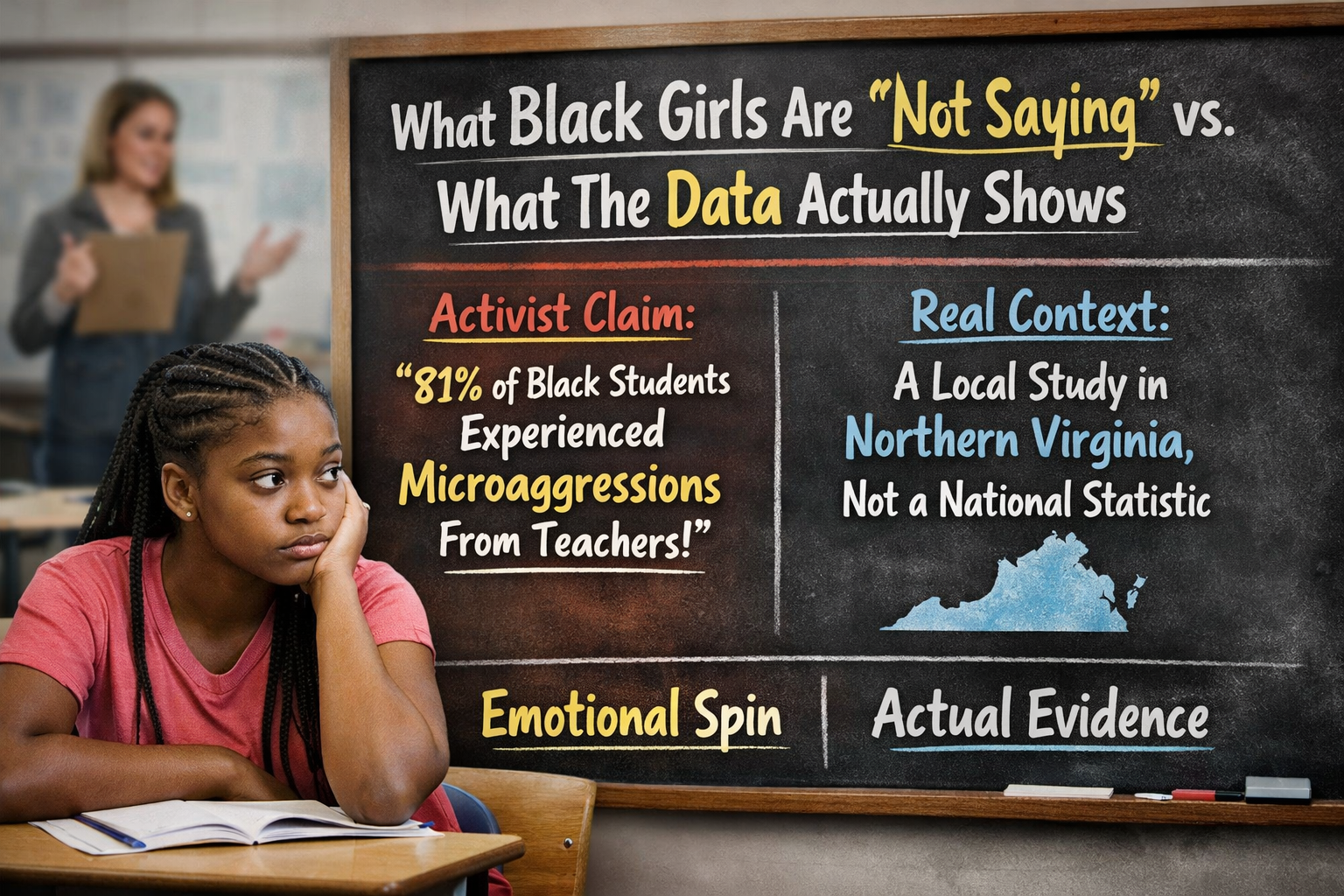
The article's central claim rests on this number: 81 percent of Black students reported that microaggressions occurred in the classroom and more than 50 percent said the perpetrator was their teacher. Those figures are real in the sense that they appear in a published 2024 article in the Journal of Participatory Research Methods. But the context matters considerably more than the activists want to acknowledge.
The study was based on a youth participatory action research project in Northern Virginia. It is not a nationally representative sample of American classrooms. The paper reports that students in the Youth Research Council surveyed 300 students in 2022 and 432 students in 2023. Among respondents who identified as Black or African American, 81 percent said microaggressions occurred in the classroom and more than 50 percent identified teachers as perpetrators. For all respondents overall, the comparable teacher figure was 29 percent.
The article is not inventing the statistic. It is doing something more subtle and more misleading. It is taking a regional advocacy-oriented study and presenting it as though it proves a broad national truth about your classroom. That leap is where skepticism is not only justified but necessary. The study itself explicitly centers a Youth Participatory Action Research framework that prioritizes lived experience and social change. That can be useful for surfacing concerns. It is not the same thing as a nationally representative empirical finding that should be used as a moral indictment against every teacher in the country.
A limited study becomes a universal accusation. A local finding becomes a national moral indictment. Then anyone who asks whether the evidence is strong enough gets treated as though they are denying racism itself. That is a dodge. The number is real. The way it is being deployed is the problem.
The paper behind the 81 percent figure is explicit about what it is doing. It describes the Youth Research Council as bringing together high school students in Northern Virginia to explore the effects of racial microaggressions on their peers. It frames the work as a model of participatory action research whose purpose is to center youth voices and confront injustice through research. That is a legitimate project with a clearly stated advocacy orientation. It does not justify writing as though an average teacher opening a gradebook this morning should assume there is a better-than-even chance she is racially offending Black girls in her classroom. The article takes a contextualized finding and converts it into a universal moral script. That is rhetorical inflation, not careful analysis.
The Evidence That Actually Deserves Attention
Now here is where honesty matters. If the argument were simply that some Black girls experience unfair treatment in schools, there is real evidence for that and it is considerably stronger than the article being criticized here offers.
A 2024 U.S. Government Accountability Office report found that Black girls nationwide receive more frequent and more severe school discipline than other girls. According to the GAO, Black girls made up 15 percent of all girls in public schools in the 2017-18 school year but received almost half of all suspensions and expulsions. The GAO also found that Black girls received harsher punishments than white girls even when the behaviors involved were similar, including for defiance, disrespect and disruption. In every state examined, Black girls were disciplined at higher rates. The same report found that Black girls reported feeling less safe and less connected to school than other groups of girls and more often disagreed that teachers treat students with respect.
That is serious. It deserves sustained attention and a serious policy response.
"Notice the difference between a serious report and an activist essay. The GAO report documents disciplinary disparities with national data and a defined scope. It does not need to guilt-trip the reader because the evidence speaks for itself. When activists overstate weak evidence, they make it easier for critics to dismiss the real problems that have better support."
The Word Itself Does Too Much Work
Part of the analytical problem is the term being deployed. Microaggression can describe anything from an openly racist remark to an awkward misunderstanding to a disagreement over tone, attitude, discipline or classroom norms. Once the category gets that expansive the statistic becomes less useful than it first appears.
If one teacher says something genuinely racist, that belongs in a category of real misconduct requiring real consequences. If another teacher corrects a student, enforces a deadline or tells a student to stop disrupting class and that interaction later gets filtered through a framework that interprets any discomfort as aggression, the data collected is no longer clean. It reflects an elastic concept that can be stretched to accommodate almost any perceived slight. That does not mean every claim under this framework is false. It means the category functions as a political sponge. It absorbs everything. And once it does that, statistics attached to it become less persuasive rather than more, which is precisely the opposite of what serious advocacy requires.
The Article's Real Purpose Is to Moralize, Not to Investigate
The intent is visible in the opening line: before you open your gradebook today, I want you to sit with something. That is not an argument. It is a sermon. The sermon has a predetermined target and the target is the teacher's conscience. The educator is instructed to begin with self-accusation before any evidence specific to her situation has been presented. The piece says that if educators are truly committed to equity they must be willing to look at themselves first.
Self-reflection is genuinely valuable. But what does it mean in practice when paired with a shaky rhetorical foundation? It means the teacher is being encouraged to internalize blame based on generalized suspicion rather than specific evidence. It means ordinary classroom authority, correction or even routine misunderstanding can be retroactively reframed through a preloaded moral narrative. That is not how trust is built between teachers and students. It is precisely how trust gets poisoned.
A healthy school climate requires adults who are fair, observant and genuinely committed to correcting their own blind spots. It does not require adults to accept every politicized framing as established truth. Once teachers feel that every interaction can be retrospectively interpreted as oppression, many will stop being candid, stop engaging naturally and start performing caution rather than building authentic relationships. That outcome helps no one, least of all the students the article claims to be defending.
The Difference Between Alertness to Bias and Learned Grievance
Here is the part that rarely gets said plainly. In some contexts this language can become a crutch. Not always and not everywhere. But sometimes. If every uncomfortable interaction is filtered through a framework of systemic hostility, personal agency starts to erode. The student is no longer encouraged to distinguish between genuine bias, normal conflict, mistaken interpretation and ordinary correction. The teacher is no longer presumed to be acting in good faith unless shown otherwise. The institution is no longer asked to produce specific evidence before accepting sweeping moral claims.
That is not empowerment. That is learned grievance being organized into an educational philosophy. And learned grievance is a destructive organizing principle for education. It cultivates hypervigilance and cynicism. It makes people progressively less capable of separating serious wrongdoing from ordinary human friction. It trains students to see themselves primarily as recipients of hostility rather than as agents in their own development. None of that serves Black girls and none of it reflects what the strongest evidence actually calls for.
Some Black girls experience bias, harsher discipline or diminished respect from adults in schools. National evidence shows those disparities are real in disciplinary outcomes and school climate perceptions. Teachers and administrators should take that seriously, examine it carefully and ensure they are applying standards consistently. But activists should not overstate regional studies or use emotionally loaded framing to imply that broad teacher racism is a settled fact in every classroom. That argument is defensible. The activist formula of limited study plus loaded language plus sweeping moral accusation is not.
My Bottom Line
The article's central statistic is not fabricated but it is being used in a misleading way. The 81 percent and more-than-50-percent figures come from a specific Northern Virginia youth participatory study, not a nationally representative survey of American classrooms. Used honestly that study suggests some students in that setting reported serious problems worth examining. Used the way the article uses it, the study becomes a moral bludgeon against educators in general, which is neither fair nor analytically defensible.
At the same time there is stronger national evidence showing Black girls face harsher school discipline and report weaker feelings of safety and belonging than other girls. That is the part worth taking seriously. It deserves sober attention, policy response and sustained institutional accountability. It does not need rhetorical inflation to be compelling because the documented disparities are compelling on their own.
Racism exists. Bias exists in schools. But not every article built around identity and accusation is automatically trustworthy and skepticism about the quality of evidence is not the same as denying the problem. Some of this writing does what modern ideological advocacy does at its worst: it smuggles certainty into the room before the evidence gets there, then treats any challenge to the certainty as proof of bad faith.
If schools want trust they need fairness and honesty. That means addressing real disparities where strong evidence exists while refusing to let weak evidence dressed in moral urgency substitute for the harder work of getting the facts right.
References
- Call-Cummings, M., Berhe-Abraha, D., Khalid, S., Mendoza, M., Quinonez, A., Salem, K., White, R., Dale, H., Hall, D., Maleki, N., Patil, N., Ratliff, K., Shrestha, S., Shivaram, P., Spenrath, C., Wannarka, C., Wimpye, J., Frazier, J., Gaddis, V., Gooden, M., LaVant, E., Oyadiran, S., Sartor, J., Sedeño, T. & Stovall, D. (2024). Racial Microaggressions in U.S. High Schools: An Illustration of the Full YPAR Process from the Youth Research Council. Journal of Participatory Research Methods.
- U.S. Government Accountability Office. (2024). K-12 Education: Nationally, Black Girls Receive More Frequent and More Severe Discipline in School Than Other Girls (GAO-24-106787).
Disclaimer: The views expressed in this post are the personal opinions of the author and are offered for educational, commentary and public discourse purposes only. They do not represent the positions of any institution, employer, organization or affiliated entity. Nothing in this post constitutes legal, financial, medical or professional advice of any kind. References to public figures, institutions, historical events and current affairs are based on publicly available sources and are intended to support analysis and argument, not to state facts about any individual's character, intent or conduct beyond what the cited sources support. Commentary on religious, political and cultural subjects reflects the author's independent analysis and is protected expression of opinion. Readers are encouraged to consult primary sources and form their own conclusions. Any resemblance to specific individuals or situations beyond those explicitly referenced is coincidental.