Richard Thomalla is not a household name. He should be. He was not Hitler. He was not Himmler. He was not the public face of the Holocaust. He was something in some ways more chilling. He was one of the men who helped make the machinery work.
Thomalla was an SS officer and engineer tied to the construction of the Operation Reinhard death camps, including Belzec, Sobibor and Treblinka. Those were not prisons. They were not detention centers. They were extermination sites built for industrialized murder. When Soviet forces captured Thomalla in 1945, they executed him. No long courtroom drama. No years of appeals. No carefully staged moral theater. Just death.
That fact raises a question that sounds simple until you really sit with it.
Was building the camp enough to warrant execution?
The answer, historically, is yes. The answer, morally, is more complicated. The answer, legally, gets messier the longer you stare at it.
Who Richard Thomalla Was
Thomalla served as an SS-Hauptsturmführer and worked in the SS construction apparatus connected to Operation Reinhard, the Nazi campaign to murder Jews in occupied Poland. The United States Holocaust Memorial Museum identifies the rail deportation system and the killing centers in occupied Poland as central to the implementation of the Final Solution. Belzec, Sobibor and Treblinka were not incidental sites in that system. They were purpose-built engines of annihilation.
People sometimes try to soften the role of builders, planners or administrators by pretending they were just one step removed. But if you build the gas chamber, lay out the camp and design the space where people are funneled to death, you are not standing outside the crime. You are inside it.
That is why the Soviets did not see Thomalla as some peripheral functionary. They saw him as a participant in genocide.
The Camps Were Not Ordinary Installations
Thomalla was not building barracks for soldiers. He was not designing warehouses. He was connected to camps whose very purpose was mass killing. Belzec, Sobibor and Treblinka were key Operation Reinhard killing centers. The broader Holocaust was the systematic murder of six million Jews by Nazi Germany and its collaborators.
That distinction matters because modern people often think in neat categories. We imagine a divide between the man who pulls the trigger and everyone else. History does not always let you have that comfort. Large-scale evil needs systems. Systems need design. Design needs people willing to do the work.
Once you understand that, Thomalla looks less like a mere engineer and more like a technician of death.
Why the Soviets Executed Him
The Soviets in 1945 were not operating with the detached legal posture of a law school seminar. They had come through a war of annihilation. The Eastern Front was soaked in atrocity. Millions of Soviet civilians were dead. Prisoners had been starved. Villages had been burned. SS units were associated with terror, executions and mass murder on a scale almost impossible to grasp.
So when Soviet troops captured an SS officer tied to extermination camps, they were not inclined to give him the benefit of abstraction. Their reasoning was brutal but not mysterious: he was SS, he was connected to death camps, the camps existed to kill civilians, and he helped make them possible. That was enough. Not enough for a modern court perhaps. Not enough for a documentary debate club. But enough for Soviet soldiers and officers in the final convulsions of the war.
Building the Camp Was Seen as Participation in Murder
Many people instinctively ask: hold on, building the camp warranted execution? Even if he did not personally gas anyone? That reaction is understandable because modern legal culture likes direct acts, individual counts and clean chains of proof. We want to know who did what, to whom, and whether intent can be proven beyond doubt. But the Holocaust forced a broader understanding of responsibility. It was not just about the man with the pistol. It was about the bureaucrat, the transporter, the designer, the clerk, the guard and the builder.
Postwar legal developments moved in that direction too. The Demjanjuk prosecution is a good example. German prosecutors pursued him as an accessory to murder at Sobibor not because they could prove he personally killed a specific individual, but because service at a killing center was itself treated as participation in the murder process. Later cases followed similar logic.
If you knowingly help build the death factory, you are part of the death factory.
But Then Comes the Harder Question
Once you accept that, another question hits immediately. What about the trains?
The Holocaust could not have functioned at the scale it did without rail transport. The United States Holocaust Memorial Museum states plainly that the European rail network played a crucial role in implementing the Final Solution. Jews from across German-occupied Europe were deported by rail to the killing centers in occupied Poland. That means the system required timetables, scheduling, routing, railcars, dispatchers, logistics offices and people who kept the tracks and operations moving. Without trains, Belzec, Sobibor and Treblinka do not operate the same way. Maybe they do not operate at all on that scale.
So if building the camp makes a man worthy of execution, then why not execute everyone who knowingly kept the deportation trains running? That is not a cheap gotcha question. It is the right question.
Degrees of Guilt Matter
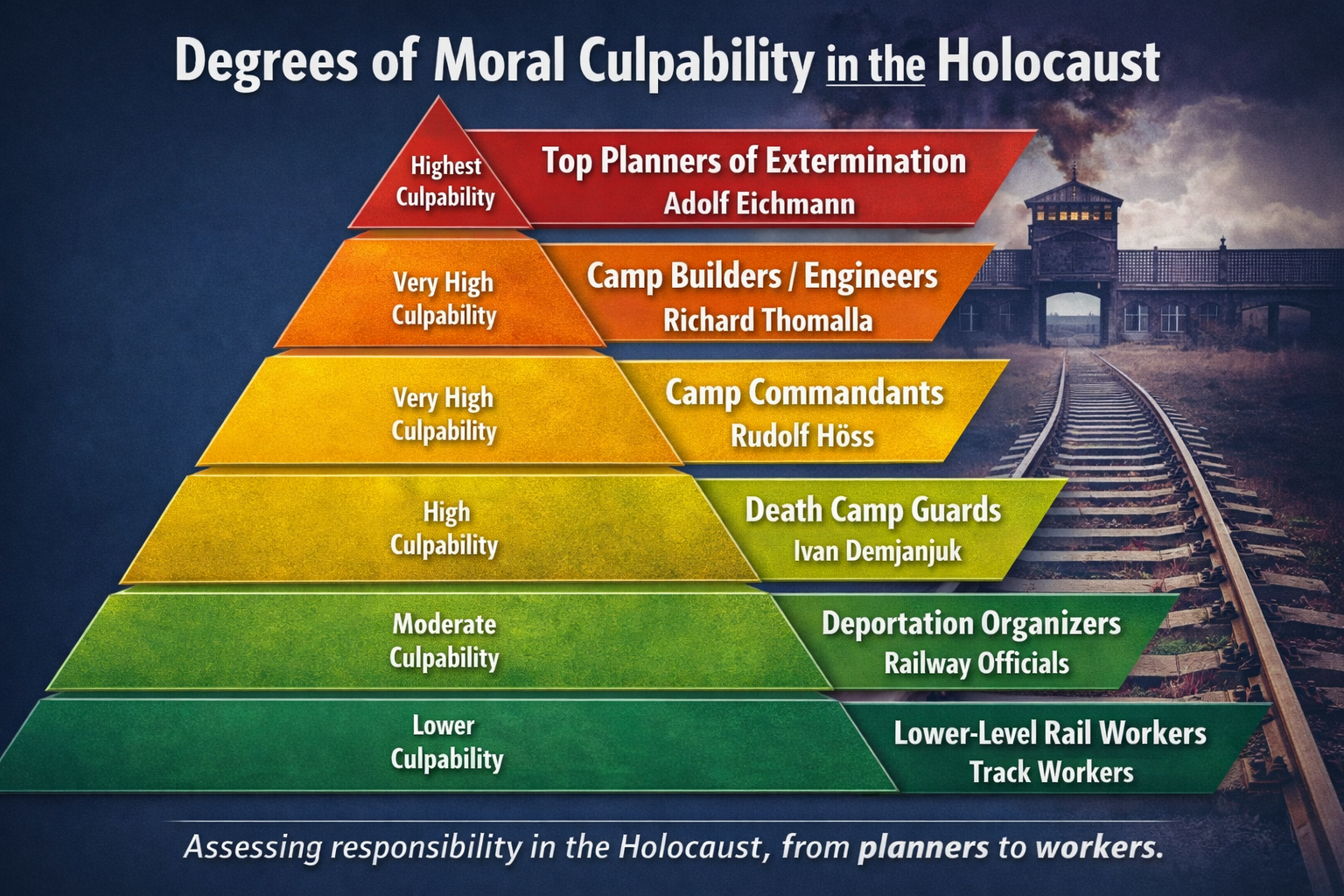
The answer is not that rail workers were innocent. Many were not. The answer is that guilt comes in layers. There is a difference between a top planner of deportations and a low-level worker tightening bolts on track. There is a difference between a railway bureaucrat who knows he is scheduling death transports and a mechanic with limited knowledge and no real power to refuse. There is a difference between Eichmann and a switchman. That does not erase complicity. It forces you to think more carefully about it.
At the top: planners and architects of extermination policy, men like Eichmann. Just below: people who designed, built or directly enabled the killing centers — that is where Thomalla fits. Then: camp commandants and senior staff who administered the killing process. Then: guards and functionaries whose service kept the machinery running. Then: transport organizers and railway officials who knowingly coordinated deportations. Below that: lower-level workers whose knowledge, authority and freedom to refuse may have been far more limited.
That ladder is not perfect, but it is better than pretending everyone was equally guilty or pretending only the trigger-pullers mattered.
The Inconsistency of Postwar Justice
Justice after the war was uneven. Very uneven. Some deeply guilty men were executed quickly. Some were tried years later. Some served prison time. Some testified as witnesses. Some disappeared into ordinary life. Some faced serious punishment only in old age. Some escaped it entirely.
That inconsistency does not prove the minor players were innocent. It proves that postwar justice was shaped by politics, chaos, timing, evidence and geography. Who captured you mattered. When they captured you mattered. What side of Europe you ended up on mattered.
Thomalla was captured by the Soviets at the end of a war that had turned Eastern Europe into a graveyard. That was about the worst possible combination if you were an SS man tied to extermination camps.
Someone else in a related logistical role might later find himself in a courtroom, behind a desk, or never meaningfully punished at all. That is not fairness. That is history.
No, Not Every Rail Worker Should Have Been Executed
Let me be blunt because people often get nervous around this point and start fumbling. No, not every rail worker should have been executed. But it is also true that many people in the rail and transport system were morally closer to the killers than postwar memory often admits. The deportation machine was indispensable. It was not morally sterile because it involved paperwork and scheduling instead of bullets and gas.
That is part of what makes the Holocaust so unsettling. It was not carried out only by frothing sadists in black uniforms. It also relied on organized labor, bureaucracy, engineering, transportation and routine. Ordinary job categories became components in extraordinary evil. People want a clean divide between monster and non-monster. History rarely gives them one.
The Deeper Lesson
The Holocaust was a system. Systems do not run on one kind of person. They need planners, builders, guards, drivers, clerks and obedient functionaries at every level. Some carry more guilt than others. Some deserve far harsher punishment than others. But the machine does not work without many hands.
Richard Thomalla was executed because the Soviets saw him for what he was: not the architect of the Holocaust, but one of the men who helped turn the blueprints of genocide into physical reality. And once you admit that, you are left with a truth many people do not like.
The camps did not build themselves. The trains did not run themselves. The genocide did not organize itself. That is why Thomalla matters. Not because he was the worst of them, but because he exposes how many different kinds of people it takes to make mass murder possible.
Why This Matters
Most people prefer historical villains who are easy to identify. A face. A speech. A uniform. A monster. But the real danger in history is often the system behind the monster. The desk worker. The planner. The builder. The man who can tell himself he is only doing one part of the job.
That is what makes the Thomalla question important. It pushes us past slogans and into the harder territory of shared responsibility, bureaucratic evil and uneven justice. Once you understand that mass crimes depend on layers of participation, you stop asking only who gave the order and start asking who made the order possible.
That is a much more uncomfortable question. It is also the more honest one.
References
- United States Holocaust Memorial Museum. Introduction to the Holocaust.
- United States Holocaust Memorial Museum. German Railways and the Holocaust.
- United States Holocaust Memorial Museum. Deportations to Killing Centers.
- United States Holocaust Memorial Museum. John Demjanjuk: Prosecution of a Nazi Collaborator.
- Holocaust Education and Archive Research Team. The Sobibor Perpetrators.
Disclaimer: The views expressed in this post are the personal opinions of the author and are offered for educational, commentary and public discourse purposes only. They do not represent the positions of any institution, employer, organization or affiliated entity. Nothing in this post constitutes legal, financial, medical or professional advice of any kind. References to public figures, institutions, historical events and current affairs are based on publicly available sources and are intended to support analysis and argument, not to state facts about any individual's character, intent or conduct beyond what the cited sources support. Commentary on religious, political and cultural subjects reflects the author's independent analysis and is protected expression of opinion. Readers are encouraged to consult primary sources and form their own conclusions. Any resemblance to specific individuals or situations beyond those explicitly referenced is coincidental.