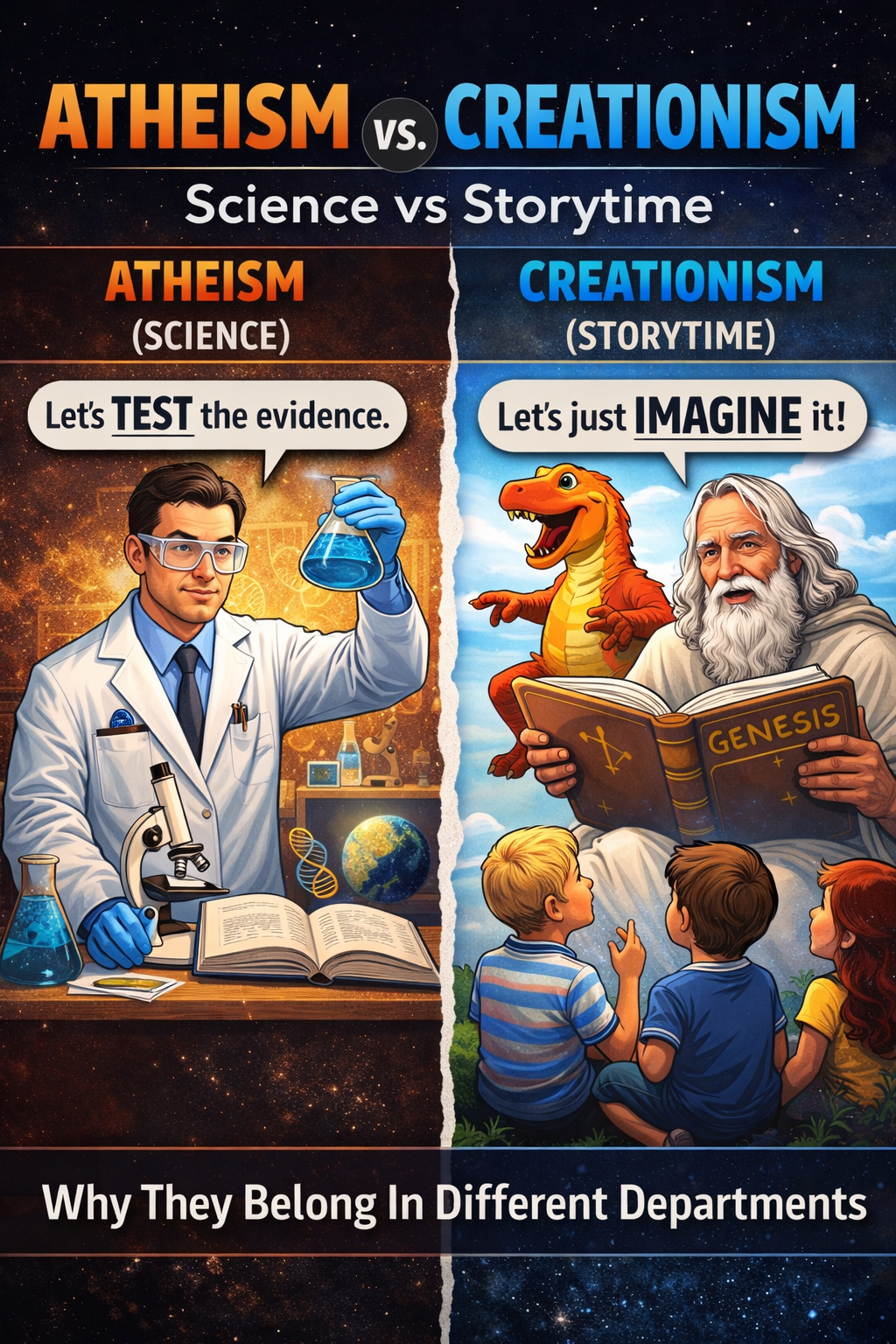
Few debates generate more heat and less clarity than the argument between atheism and creationism. At its core the disagreement is not really about morality, meaning or even belief in God. Those are philosophical and personal questions that humans have argued about for thousands of years without resolution, and they will probably keep arguing about them. The real issue is simpler and more specific: how do we determine what is true about the natural world? Science and creationism give incompatible answers to that question. Not different-but-equally-valid answers. Incompatible ones. And the difference is not a matter of opinion - it is a matter of method.
Science requires that ideas be testable and observable, that evidence be measurable, that predictions be repeatable and that explanations be falsifiable - meaning they can in principle be proven wrong. Creationism begins with a conclusion, interprets observations through that conclusion, relies on revealed narrative and cannot be experimentally tested. Because of that difference, the modern scientific community places creationism not within biology or cosmology but within philosophy, theology or mythology. That classification is not an attack on religion. It is recognition that science and faith operate by different rules and are trying to answer different kinds of questions.
What Atheism Actually Is and What It Is Not
Atheism is regularly misrepresented as a belief system claiming that nothing created everything. That is a rhetorical caricature, not a philosophical definition. Atheism means a lack of belief in gods. It does not automatically claim certainty about the origin of the universe. It does not assert that the universe came from nothing in the way critics sometimes imply. It reflects skepticism toward supernatural explanations that cannot be tested or observed.
Most atheists who think carefully about these questions adopt what philosophers call methodological naturalism - the assumption that natural processes rather than supernatural intervention explain the development of cosmic structures, stars, planets and life. That is not a metaphysical claim that the supernatural definitely does not exist. It is an operational principle: when investigating the natural world, stick to natural explanations because those are the only ones that can be tested. This is the foundation of modern science and it has produced the most reliable body of knowledge about the physical world that human beings have ever accumulated.
Creationism Starts With the Answer
Creationism approaches the same questions differently. Instead of beginning with observation and experimentation, it begins with a revealed narrative. In the Judeo-Christian tradition that narrative is found in the Book of Genesis. But the impulse is not unique to Christianity. Mesopotamian creation myths, Greek cosmogonies, Hindu cosmological cycles, Indigenous origin stories and dozens of other traditions all produced accounts of how existence began. Nearly every human culture has developed one.
Those stories served important functions. They provided identity, meaning and moral frameworks for early civilizations trying to make sense of a world they did not yet have the tools to investigate systematically. That is not a criticism - it is a description of what creation narratives were built for. They were not developed through observation and experimental testing. They were narratives meant to explain existence in a pre-scientific world where the tools for systematic investigation did not yet exist. Studying them for their cultural significance, theological meaning and literary structure is entirely legitimate. Presenting them as scientific explanations of biological origins is a category error.
Beginning in the sixteenth and seventeenth centuries, thinkers like Copernicus, Galileo, Kepler and Newton introduced a fundamentally different approach to investigating nature. Rather than relying on inherited narratives, they used mathematics, observation and experimentation. The frameworks that followed - Newtonian physics, atomic theory, germ theory of disease, evolutionary biology, modern cosmology - succeeded because they produced predictable, testable results. If a scientific explanation fails to match observation, it must be revised or replaced. That accountability is what makes the method work. Creationism has no equivalent mechanism for self-correction because its source text cannot be revised when observations contradict it.
Why Creationism Does Not Qualify as Science
Scientific explanations must be testable, falsifiable and capable of producing predictive models. Creationism meets none of those criteria. The existence of a supernatural creator cannot be tested experimentally. No observation can confirm or falsify divine intent. When any phenomenon can be attributed to an all-powerful supernatural being whose purposes are by definition beyond human investigation, the explanation becomes immune to evidence - which means it is no longer operating as science.
This is not a matter of ideological bias against religion. It is the logical consequence of what scientific methodology requires. Courts have reached the same conclusion through entirely different channels. In Kitzmiller v. Dover Area School District in 2005, a federal court found that intelligent design was essentially rebranded creationism and therefore religious in nature - meaning teaching it as science in public school classrooms violated the constitutional separation of church and state. The ruling was not anti-religious. It drew a clear line between two different kinds of inquiry that religious advocates had been trying to blur for decades.
When any phenomenon can be attributed to an all-powerful supernatural being whose purposes are beyond investigation, the explanation becomes immune to evidence. A claim that cannot be challenged by any possible evidence is not a scientific claim. It is a declaration of faith - and there is nothing wrong with that, as long as nobody pretends otherwise.
Science Does Not Try to Disprove God
One of the most persistent misconceptions in this debate is that science attempts to prove or disprove the existence of God. It does neither. Science studies natural processes. Questions about supernatural beings fall outside the scope of scientific investigation because they cannot be tested using empirical methods. That is a boundary condition of the discipline, not a conclusion about metaphysics.
Many working scientists maintain personal religious beliefs while practicing rigorous scientific inquiry without any apparent conflict. The conflict arises not between science and religion in general but between science and the specific claim that religious narratives about origins should be treated as scientific explanations. Stephen Jay Gould described science and religion as non-overlapping magisteria - separate domains addressing separate questions. Science asks how natural systems operate. Religion and philosophy often ask why existence matters and what humans owe each other. Those are genuinely different questions. The problem comes when one domain insists on colonizing the methods and authority of the other.
Why Creation Stories Persist and Why That Is Not a Problem
Despite the scientific consensus on evolution, cosmology and the age of the universe, creation stories remain culturally powerful. That persistence is not surprising and it is not irrational. These narratives address questions that science does not attempt to answer directly: why does the universe exist at all, what is the purpose of human life, what moral obligations do people have toward one another. Science focuses on how natural systems operate. It has nothing to say about whether existence has meaning, because meaning is not a quantity you can measure.
Because those domains overlap in people's lives the debate between science and religion often becomes emotionally charged in ways that obscure what is actually being argued about. A person who finds comfort, community and ethical orientation in a religious tradition is not making a scientific error. A person who teaches their children that the Earth is six thousand years old and that evolutionary biology is a hoax is making a factual error - and in some cases a legal one if they are doing it in a public school classroom while calling it science. Those are different situations and treating them as the same thing does not help anyone.
My Bottom Line
The debate between atheism and creationism is regularly framed as a battle between belief and disbelief. The deeper issue is methodological. Science relies on testable explanations and empirical evidence. Creationism begins with a theological conclusion and interprets observations through that lens. Because of that difference creationism belongs in philosophy, theology and cultural history - not in biology or physics. That is not a judgment about the value of religious belief. It is a description of what scientific knowledge requires and how it is produced.
Both discussions can coexist. They simply operate according to different rules and answer different questions. The trouble starts when people refuse to acknowledge which room they are standing in.
Calling a creation story a myth does not make it worthless. It makes it honest about what it is. The problem is not myth. The problem is myth dressed in a lab coat.
References
- Dawkins, R. (2006). The God Delusion. Houghton Mifflin.
- Gould, S. J. (1997). Nonoverlapping magisteria. Natural History, 106 (2), 16-22.
- National Academy of Sciences. (2008). Science, Evolution and Creationism. National Academies Press.
- Pennock, R. T. (2001). Intelligent Design Creationism and Its Critics. MIT Press.
Disclaimer: The views expressed in this post are the personal opinions of the author and are offered for educational, commentary and public discourse purposes only. They do not represent the positions of any institution, employer, organization or affiliated entity. Nothing in this post constitutes legal, financial, medical or professional advice of any kind. References to public figures, institutions, historical events and current affairs are based on publicly available sources and are intended to support analysis and argument, not to state facts about any individual's character, intent or conduct beyond what the cited sources support. Commentary on religious, political and cultural subjects reflects the author's independent analysis and is protected expression of opinion. Readers are encouraged to consult primary sources and form their own conclusions. Any resemblance to specific individuals or situations beyond those explicitly referenced is coincidental.