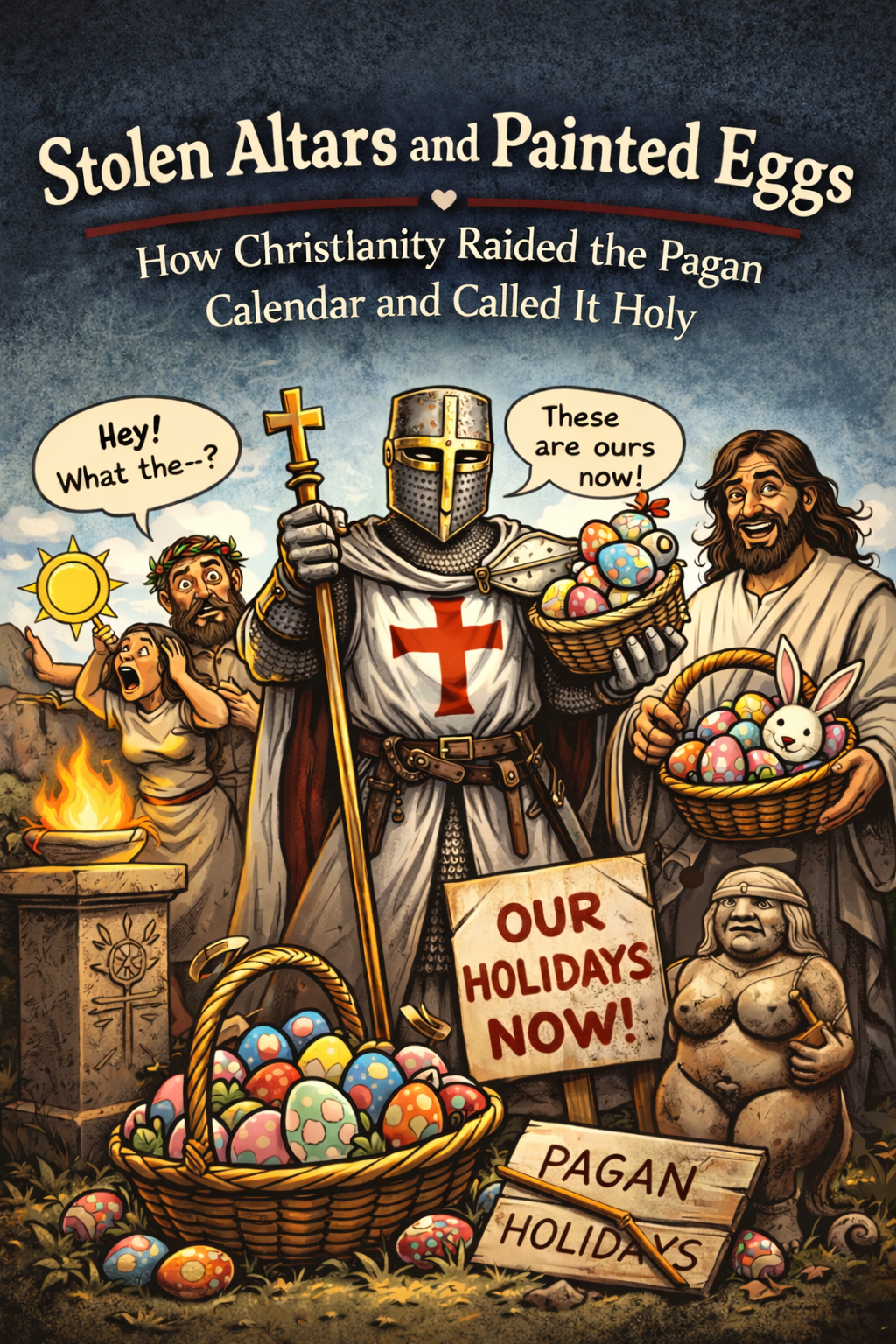
Christianity likes to present itself as the clean break from paganism. Truth arrived, idols fell, darkness retreated, end of story. That is the official version. The historical version is messier, more opportunistic and considerably more revealing. The church did not simply defeat paganism. It absorbed it, repackaged it and then lectured the conquered about spiritual purity. It took feast days people already loved, pasted Christian doctrine on top and called the recycled product sacred. That is not divine originality. That is religious annexation. The pattern shows up all over the Christian calendar. Midwinter festivals became Christmas. Samhain was folded into All Hallows. Imbolc was redirected through St. Brigid. Midsummer was baptized into St. John's Day. And Easter, while tied theologically to the resurrection and historically to Passover, arrived in the English-speaking world with a name of disputed origin and a basket full of symbols that did not come from the Gospels. Christianity did not merely challenge pagan Europe. It harvested it.
The Church Did Not Erase Paganism. It Cannibalized It.
People do not abandon seasonal rituals because a bishop tells them to. They still mark winter, spring, harvest, death and rebirth. They still gather around fires, exchange gifts, decorate with greenery and celebrate the return of life after cold and darkness. A church trying to conquer a continent had two choices: spend centuries fighting every local custom, or absorb those customs and slap Christian branding on them. It chose the second option, and that was not a side effect. It was strategy. Keep the feast, keep the timing, keep the old emotional rhythms. Swap the god, rename the holiday and declare the whole thing redeemed. In plain terms: keep the party, change the label. That is how institutions win. They do not always destroy what came before. Sometimes they steal it carefully and trust future generations not to notice the seams.
Christmas: The Most Obvious Heist in the Calendar
Start with Christmas, because this one is almost too easy. The New Testament never gives a date for the birth of Jesus. Yet the church landed on late December, precisely where the ancient world was already crowded with solstice festivals, Roman celebration and seasonal symbolism. That was not a historical discovery. It was a cultural decision. And once the date was in place, the old customs came rushing in - evergreen decoration, Yule traditions, feast culture, lights against the darkness. The church did not invent the human urge to celebrate light returning in the dead of winter. It hijacked that urge and placed a manger scene in the middle of it. So when Christians talk about Christmas as though it arrived whole from heaven, they are skipping the part where the packaging was assembled from parts that already existed.
The pattern repeats in October. The old Celtic festival of Samhain marked the turning of the year, the thinning of the boundary between worlds and the unease of approaching darkness. Christianity layered All Saints' Day and All Souls' Day onto that same seasonal territory. The old atmosphere never fully disappeared. It just acquired church language on the surface while the original emotional charge stayed in the walls. That is why Halloween still feels half sacred and half feral - it carries the fingerprints of both systems. The church tried to overwrite the older festival. What it produced was a hybrid it later pretended was wholly its own. The same logic applies to Imbolc redirected through St. Brigid's Day and midsummer festivals absorbed into St. John's Day. Christianity did not build a new calendar from revelation. It renovated an existing one and changed the names on the rooms.
Easter Is Not Ishtar, but It Is Absolutely a Blend
This is where people get either too timid or too sloppy, and both failures produce bad arguments. Too timid is pretending Easter has no visible pagan residue at all. Too sloppy is repeating the internet claim that Easter is simply Ishtar worship with Jesus bolted on. The better argument sits between those positions and hits harder because it is actually true. The standard scholarly case does not support a direct line from the Mesopotamian goddess Ishtar to the Christian feast. The linguistic evidence is weak and serious historians do not treat the connection as settled. That meme is overcooked and should be retired.
But look at the holiday people actually celebrate in the English-speaking world and explain with a straight face how it derives cleanly from the resurrection accounts. Colored eggs. Rabbits. Hares. Spring fertility imagery. Seasonal rebirth motifs. None of that comes from the empty tomb. It comes from older spring symbolism that Christianity absorbed, softened and reinterpreted. The egg is an old symbol of fertility and emerging life. The hare has long been linked to spring and abundance. Christianity did not create those associations. It inherited them and later acted as though they naturally belonged beside the story of the crucifixion. They do not. They were attached because the church was managing real populations with real customs it could not simply vaporize. So it folded the symbols in, assigned them new theological adjacency and trusted future generations to stop asking questions.
Easter is not Ishtar worship. Easter is a Christian resurrection feast wrapped in borrowed spring ritual, folk survivals and pagan leftovers that proved too useful or too beloved to throw away. It was never seamless. It was conquest by adaptation.
What the Bunny Has to Do With Golgotha
This is the part that becomes absurd when stated plainly. What exactly does a rabbit carrying painted eggs have to do with the execution and alleged resurrection of a first-century Jewish preacher? Nothing. The connection is not theological. It is not scriptural. It is the residue of absorbed custom dressed in festive packaging and handed down until it felt normal. Tradition survives by becoming familiar enough that nobody asks where it came from. That is how the church managed this particular piece of cultural inheritance - not through argument or revelation but through repetition until the question stopped occurring to people.
Christians occasionally try to assign Christian meaning to the egg retroactively: the hard shell of the tomb, the emerging life of the resurrection. Those readings are inventions after the fact, folk theology working backward from an inherited symbol to a justification. They reveal exactly what the original argument claims - that the church repeatedly took older material, reinterpreted it in Christian terms and then presented the reinterpretation as the natural and original meaning. The egg did not start as a symbol of the resurrection. It was assigned to the resurrection because it was already there and could not be removed without a fight.
This Was Not Just Theology. It Was Power.
The pattern reveals something essential about Christianity as an institution. It did not spread through pure argument or raw revelation alone. It spread through adaptation, absorption and power. It learned how to govern memory. It learned how to stand on top of older rituals while insisting those rituals now meant something else entirely. Empires do this. Political systems do this. Expanding religions do this. But Christianity spent centuries publicly condemning paganism as false, corrupt and demonic while quietly rifling through its calendar for usable parts. That is the hypocrisy worth noticing. Not that it borrowed - every living tradition borrows. But that it borrowed while condemning, absorbed while denouncing and then presented the hybrid result as pristine sacred inheritance untouched by the world it had actually been built from.
Once you admit how much was borrowed, the myth of untouched sacred continuity starts to wobble. If feast days were repurposed, symbols were recycled and local customs were baptized rather than erased, then Christianity stops looking like a pristine heavenly intervention and starts looking like what it often was: a deeply human institution improvising its way to dominance in competition with older ways of life it publicly despised and privately mined. That does not automatically disprove every theological claim. But it does dismantle the smug fiction that Christian tradition arrived whole, pure and uncontaminated from above. It was assembled in history, in conflict and in negotiation with the cultures it was trying to replace.
My Bottom Line
Christianity did not simply crush paganism. It stole from it. Not always crudely, not always completely, but repeatedly and effectively. It took dates, symbols, seasonal rhythms and local customs that already mattered to people, repainted them in Christian colors and claimed the result as sacred inheritance. Christmas is the clearest example. Halloween is another. Easter is the strangest case because the theology is genuinely Jewish and Christian in its core, but the public imagery in English-speaking culture is saturated with spring fertility symbolism that long predates the church's use of it. The better line is not that Easter is Ishtar worship - that is too sloppy to be useful. The better line is that Easter is what happens when a resurrection feast gets wrapped in leftover pagan spring symbolism and handed down as though the blend were natural and always had been. It was never natural. It was constructed. Tradition is not proof and familiarity is not truth. A holiday can feel ancient, sacred and emotionally powerful while still being a stitched-together product of theology, politics and cultural annexation.
Once you see how often the church borrowed what it denounced, you stop confusing inherited ritual with divine authorship. You start seeing the machinery. And the machinery is a lot more interesting than the myth.
References
- Bede. (725 AD). De Temporum Ratione (The Reckoning of Time). Chapter 15 (on the month of Eosturmonath).
- Britannica. (n.d.). Easter. britannica.com.
- Britannica. (n.d.). Christmas. britannica.com.
- Britannica. (n.d.). Halloween. britannica.com.
- Britannica. (n.d.). Imbolc. britannica.com.
- Britannica. (n.d.). Midsummer. britannica.com.
- AFP Fact Check. (n.d.). Easter not derived from name of ancient Mesopotamian goddess. factcheck.afp.com.
- Rogers, N. (2002). Halloween: From Pagan Ritual to Party Night. Oxford University Press.
- Hutton, R. (1996). The Stations of the Sun: A History of the Ritual Year in Britain. Oxford University Press.
Disclaimer: The views expressed in this post are the personal opinions of the author and are offered for educational, commentary and public discourse purposes only. They do not represent the positions of any institution, employer, organization or affiliated entity. Nothing in this post constitutes legal, financial, medical or professional advice of any kind. References to historical sources, encyclopedic entries and fact-checking organizations are based on publicly available sources cited above. This post examines historical patterns in the development of Christian practice and does not make claims about the validity of individual faith or the sincerity of individual believers. Commentary on religious and historical subjects reflects the author's independent analysis and is protected expression of opinion. Readers are encouraged to consult primary sources and form their own conclusions.