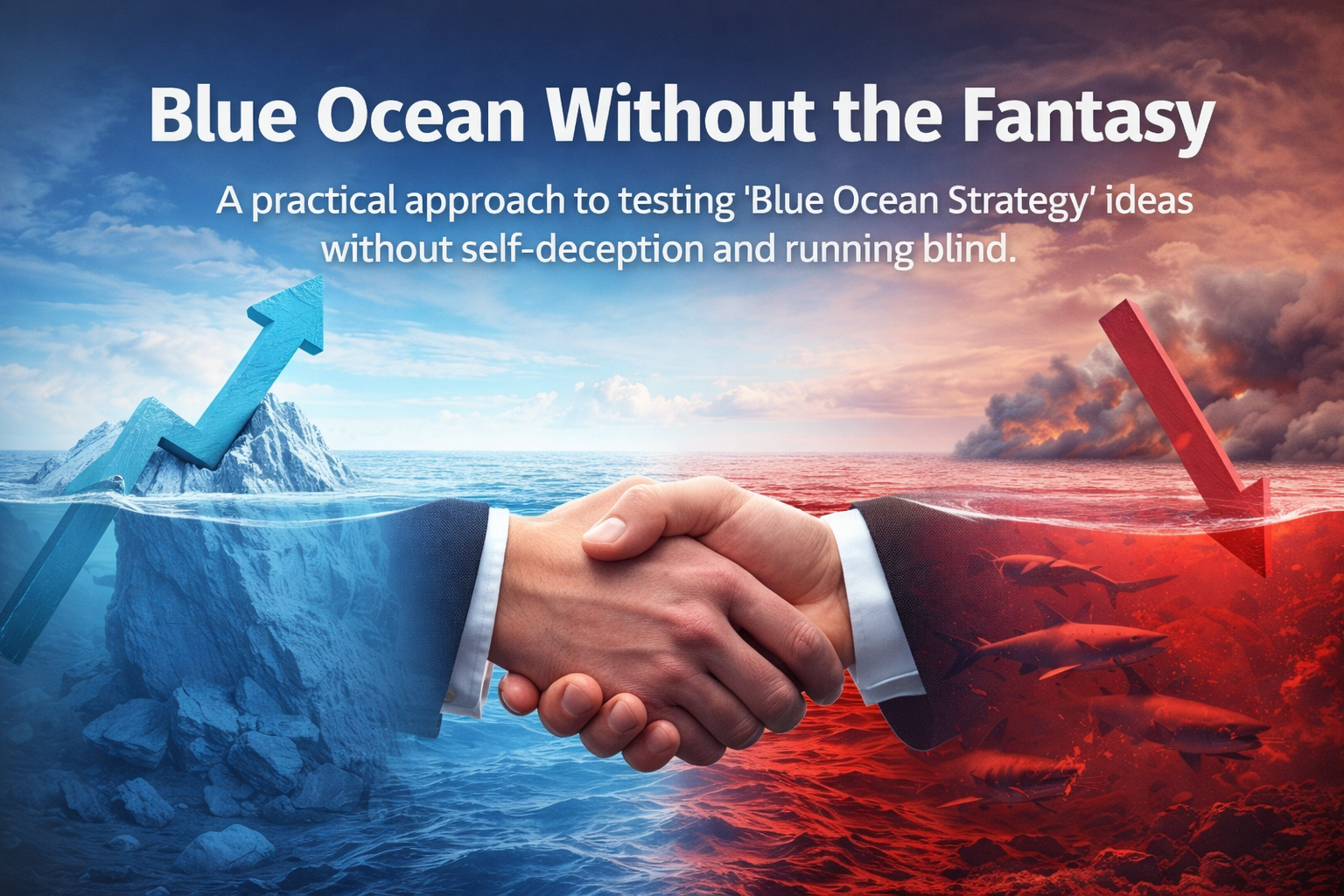
Blue Ocean Strategy is one of the most emotionally seductive business frameworks ever written. Who wouldn't want to stop fighting in a crowded market and build something so different competitors don't matter?
But the ocean doesn't stay blue. Copycats arrive fast, distribution is often controlled by someone else, and execution punishes overconfidence.
So the question isn't "Is Blue Ocean real?" It's: How do you do it without lying to yourself?
Most BOS failures aren't because the idea was stupid. They're because the team skipped the hard parts:
Where Blue Ocean Fails
- Proving demand instead of imagining it
- Building a moat instead of a slogan
- Setting rules for when to pivot or kill the idea
This post is the practical operating system: a repeatable way to test a Blue Ocean move fast, honestly, and grounded in reality.
Start With the Only Question That Matters
Blue Ocean language can hide the real work. Strip it down:
What is the painful "nonconsumption" you're trying to convert?
Not "people might like this." Not "it's innovative." Pain. Friction. Avoidance. "I'm not buying because it's too expensive / too confusing / too risky / too annoying."
That's the core BOS claim from the beginning: create new demand by changing what's offered and how it's delivered.
Rule: If you can't describe the nonconsumption in one sentence, you're not ready to build anything.
Use ERRC, But Force It to Show Its Math
ERRC (Eliminate–Reduce–Raise–Create) is a great tool. But it becomes "pretty thinking" when nobody ties it to operational and financial reality.
Step A: Write your value curve claim in plain English
- We will eliminate___ because buyers don't value it.
- We will reduce___ because it's overbuilt.
- We will raise___ because it drives trust or performance.
- We will create___ because it removes the biggest adoption barrier.
Step B: Add the two numbers people avoid
Cost impact: what ERRC changes in your cost structure — labor, time, materials, overhead.
Buyer payoff: what it saves the buyer (time, risk, hassle) or improves (outcome, confidence).
Rule: If your ERRC grid can't produce numbers, it's not strategy. It's art.
The Swamp Test
"No competition" can mean "no one cares." Before you build, answer three questions:
Swamp Test
- Is there existing spend nearby? If nobody spends money on anything adjacent, you may be inventing a market.
- Is the problem urgent enough to pay to fix?"That would be nice" is not demand.
- Can buyers explain the value without you pitching for 10 minutes? If not, your education costs will eat you.
Rule: If you need heavy education, your customer acquisition cost will be higher than you think. Plan accordingly — or don't do it.
The Moat Test
Imitation is brutal in 2026. Copying is cheap, and a Blue Ocean without a moat is just a temporary gap in a competitor's attention. Your plan needs a moat by design , not as an afterthought. Pick at least one:
Distribution Advantage
Do you control a channel, own an audience, or have partnerships competitors can't replicate quickly? If distribution is controlled by someone else, you may not even get to play.
Switching Costs
Do customers stay because leaving is a pain — integration, process, familiarity, saved history — not just because they "like you"?
Operational Capability
Can you deliver faster, cleaner, or more reliably because of a system you've built — template, modularization, training, process discipline?
Rule: If your moat is "we'll market better," you don't have a moat.
Run the Smallest Test That Can Prove or Kill the Idea
This is where BOS becomes real business instead of motivational posters. Build the smallest real offer that demonstrates:
- People will pay
- At a margin you can live with
- With a sales cycle you can repeat
- And delivery you can sustain
That can be a pilot package, a limited geography, one customer segment, one distribution channel, or one simple bundle. Then — critically — set a kill switch.
Example kill switch criteria:
If we don't get ___ paid customers by ___ date, we pivot the offer or shut it down.
If our CAC exceeds ___ for ___ weeks, we stop scaling.
If delivery time exceeds ___ consistently, we pause and fix operations.
If you don't define failure criteria, you'll "strategize" your way into denial.
This is where Porter's point matters: strategy requires choices and tradeoffs, not endless "trying things."
The Bottom Line
Blue Ocean Strategy is real — but it's not a cheat code. In 2026, "blue" turns red fast. So the move is simple: use BOS as a disciplined experiment framework, not a dream.
- Define the nonconsumption
- Make ERRC show its math
- Run the swamp test
- Build a moat
- Pilot small
- Set a kill switch
That's how you get the upside of Blue Ocean without paying the full price of self-hypnosis.
Most businesses don't fail because the founder is lazy. They fail because the founder fell in love with an idea and refused to measure it honestly. A "Blue Ocean" mindset can either sharpen your thinking and create real growth — or become an expensive brainstorming exercise that burns time, money, and confidence.
If you run the process above, you'll know which one you're doing before you bet the business on it.
References
- Kim, W. C., & Mauborgne, R. (2004). Blue Ocean Strategy. Harvard Business Review.
- Kim, W. C., & Mauborgne, R. (2005). Blue Ocean Strategy: From Theory to Practice. California Management Review.
- Porter, M. E. (1996). What Is Strategy? Harvard Business Review.
- Burke, A., van Stel, A., & Thurik, R. (2009). Blue Ocean versus Competitive Strategy: Theory and Evidence. ERIM Report Series.