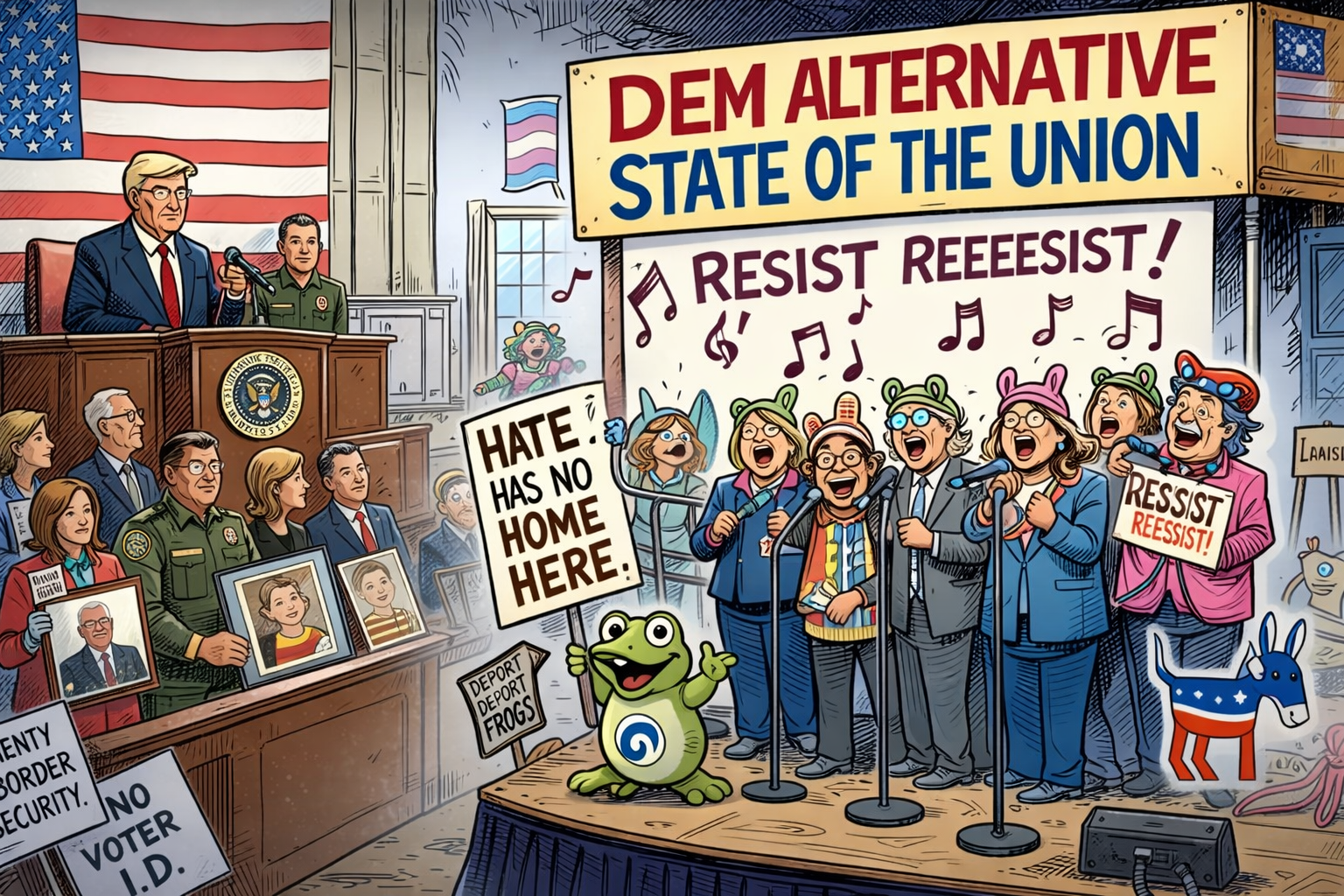
There was a time when a State of the Union was at least treated like a civic moment. You could hate the president, oppose every word of the agenda and still show enough maturity to sit in the chamber, hear the speech and recognize the human beings honored in the room. That time is gone. What we are seeing now is not ordinary opposition. It is performance politics so juvenile, so reflexive and so emotionally warped that many Democrats seem incapable of standing for anything if Donald Trump happens to support it. Not for patriotism. Not for border enforcement. Not for election integrity. Not for parents whose children were murdered. Not even for the basic idea that a nation has a right to know who is here, who is voting and what is being taught or done to its kids.
Instead, too many on the left chose theater. Walkouts. Boycotts. Counterprogramming. Side events. Slogans. Moral posing. It looked less like a political movement and more like a group of angry undergraduates trying to turn a national event into an improv protest. That is not strength. It is not courage. It is not principle. It is contempt - for half the country, for the people in that room and for any issue that does not fit the approved ideological script.
What the Boycott Actually Said
Supporters will say a boycott is a form of protest. Fine. Sometimes it is. But protest is not automatically noble. Sometimes a boycott says less about the speaker and more about the people refusing to listen. What this one said was ugly. It said that hatred of Trump matters more than respect for national institutions. It said that partisan identity now outranks public decency. It said that if a grieving parent is acknowledged by the wrong president, some people would rather walk out than act like adults for ten seconds.
A movement that cannot rise for the families of murdered children is not morally serious. A party that cannot applaud obvious civic goods because they came packaged in the wrong speech has become emotionally captive to its own tribalism. At some point this stops being ideology and starts being pathology. The instinct to perform opposition has overtaken the capacity to govern, and the people who suffer for it are not the activists making the scene. They are the ordinary Americans who need a functioning opposition party and are not getting one.
A party that cannot stand for grieving parents, secured elections, border enforcement, merit and child protection has not lost an argument. It has lost its connection to the people it claims to represent.
The Left Cannot Stand for What Ordinary Americans Still Believe
The real problem is not one speech. The real problem is that the Democratic Party has drifted so far into identity politics and activist neurosis that it now struggles to affirm a long list of things most ordinary Americans consider common sense. One vote, one legal voter, one valid ID and one counted ballot - the chain-of-custody logic that applies to every other serious transaction in American life. A border that actually functions like a border, including deportation of people who are here illegally, especially those who commit crimes. Hiring and promotion based on merit rather than DEI quotas and ideological compliance. Protection of children from irreversible medically questionable interventions pushed in the name of compassion.
These are not fringe positions. They are normal positions held by the majority of Americans across racial and economic lines. The left's only consistent answer has been to call the people who hold them racists, xenophobes, bigots and oppressors. That game is wearing out. People are tired of being insulted for having functioning instincts about how a country is supposed to work.
One Voter, One ID, One Ballot
This issue alone exposes how unserious the modern Democratic Party has become. Americans are expected to show identification to board planes, buy age-restricted products, enter government buildings, complete financial transactions and interact with virtually every bureaucratic system in the country. But when it comes to voting - the core act of citizenship - we are told that asking for identification is somehow sinister, a throwback to Jim Crow, an assault on democracy itself. That argument does not hold up for thirty seconds of honest examination.
Voter ID is not an ism. It is basic chain-of-custody logic applied to elections. If elections matter, verification matters. If ballots count, ballot security counts. If democracy is sacred you do not protect it by pretending that safeguards are offensive. Nobody serious believes the public is too incompetent to obtain identification for every area of life except voting. That talking point insults the very people Democrats claim to defend - the implication being that minority voters specifically are uniquely unable to manage a piece of plastic that they already carry to do everything else in their lives. The left's resistance here is not principled. It reveals that too many Democrats are more interested in keeping the accusation machine running than in defending a standard most people already accept without complaint.
Mail-in voting at scale compounds every verification problem that voter ID is designed to address. When a ballot leaves a controlled polling environment, the security apparatus that makes in-person voting trustworthy disappears. There is no witness, no ID check, no chain of custody from voter to box. Ballot harvesting - the practice of political operatives collecting and returning ballots from entire neighborhoods - became normalized in several states as a direct consequence of removing the voter from the secured environment where the act is supposed to happen. A party committed to election integrity would be concerned about all of this. A party committed to winning by any available margin has different priorities.
The Border and Deportation Are Not Dirty Words
A nation without a functioning border is not a nation in any meaningful sense. Americans are not heartless for wanting immigration law enforced. They are not cruel for wanting deportations carried out. They are not extremists for wanting the government to distinguish between citizens, legal residents, legitimate asylum cases and people who crossed unlawfully and stayed. That is called having a country. It is the minimal condition of national sovereignty and it is what every functional state in the world maintains as a matter of course.
Democrats spent years pretending enforcement itself was the problem. They used euphemisms, legal clutter, media manipulation and endless emotional blackmail to avoid saying the obvious: a government that refuses to control entry eventually stops governing. The public watched overwhelmed cities, stressed public resources, school and health system burdens, housing pressure and a political class more worried about activist approval than national coherence. They reached their own conclusions. The 2024 election results were not ambiguous on this point. Voters in states that had considered themselves reliably Democratic moved sharply on immigration because they could see with their own eyes what the policy had produced.
You can have legal immigration or you can have chaos. You cannot have both forever - and the people who bear the cost of the chaos are never the ones making the policy.
DEI Was Always a Bad Trade
DEI was sold as fairness. In practice it became an industry of coercion, resentment and bureaucratic nonsense. It taught Americans to view each other less as individuals and more as demographic contestants - encouraging institutions to sort, rank, guilt, flatter and divide people according to race, sex, grievance status and ideological compliance. It replaced equal treatment with managed favoritism and called that progress. What it actually delivered was identity-obsessed workplace culture, competence downgraded for activist metrics, political reeducation embedded in professional settings, resentment manufactured across demographic lines and HR bureaucracies operating as ideological enforcement mechanisms.
What Americans wanted was simpler: advancement based on skill and effort, workplaces free from political pressure, equal treatment under institutional rules, and children not taught from age six to organize their identity around race and victimhood. When Democrats signal that they still want the DEI apparatus preserved, they are not defending justice. They are defending a failed regime of elite social engineering that most ordinary people already resent - and that the institutions most invested in it are quietly dismantling because the legal and reputational costs have become unsustainable.
Children Are Not Props for Adult Ideology
A healthy society protects children from adult confusion, political fashion and permanent decisions they cannot possibly understand in full. That should not be controversial. It should be civilization 101. But too many Democrats have allowed activist language to bulldoze common sense. They frame skepticism about sex-change medical interventions for minors as cruelty. They treat caution as hatred. They act as though saying leave children alone is some form of moral defect that must be rooted out of anyone who expresses it.
The public is increasingly unwilling to stay quiet while elites call that compassion. European medical systems - Sweden, Finland, Denmark, the United Kingdom - have reviewed the evidence and moved to restrict or end pediatric transition protocols, citing insufficient evidence of benefit and documented risks of harm. The UK's Cass Review, the most comprehensive independent assessment conducted, found the evidence base for pediatric gender medicine remarkably weak and documented that many referred children had complex underlying conditions not being adequately addressed. None of this has penetrated the American institutional consensus, which continues to label anyone citing it as a bigot. A party that cannot draw a firm line around children and hold it against activist pressure has lost its moral bearings - and a growing number of voters know it.
Too many people on the left no longer merely disagree with conservatives. They despise them. They do not think they are wrong. They think they are beneath contempt. That is why they cannot applaud the wrong family. That is why they cannot affirm the wrong policy even when the public supports it by wide margins. That is why they cannot simply say yes, we should know who votes, or yes, borders matter, or yes, children should be protected from irreversible decisions they cannot fully consent to. To concede any of that would mean admitting that the people they sneer at might be right about something important. And that is the one thing they cannot tolerate. So they boycott, posture and walk out - because serious engagement would require moral humility, and moral humility is in short supply in a movement built on accusation.
Why the Theatrics Matter
Some people will shrug and say politicians act childish - nothing new. But it does matter. Theatrics reveal priorities. They show what people are unwilling to honor even for a moment. They expose what kind of emotion is driving the machine. And what we saw was a political culture so consumed by opposition that it can no longer acknowledge obvious goods if they are attached to the wrong messenger. When a party cannot stand for grieving parents, secure elections, border enforcement, merit and child protection it starts to detach from reality. It becomes a party of ritualized outrage, not governance.
That may excite activists and media panels. It does not inspire trust from ordinary Americans trying to raise kids, pay bills, obey laws and live in a country that makes sense. Those Americans are not asking for miracles. They are asking for order, honesty, seriousness and limits. The modern Democratic Party keeps answering with moral exhibitionism. At some point the voters who have not yet drawn the conclusion that the party cannot be trusted will draw it - not because Republicans are so compelling but because a party that treats every civic moment as an opportunity to perform its contempt eventually exhausts the patience of the people it needs.
Politics teaches the country what is honorable and what is shameful. When one side refuses to honor the innocent, refuses to defend the border, refuses election safeguards, refuses merit and refuses to protect children from ideological excess - voters are not wrong to notice. They are not wrong to remember.
Disclaimer: The views expressed in this post are the personal opinions of the author and are offered for educational, commentary and public discourse purposes only. They do not represent the positions of any institution, employer, organization or affiliated entity. Nothing in this post constitutes legal, financial, medical or professional advice of any kind. References to political events, legislation, medical research and institutional policies are based on publicly available sources and are intended to support analysis and argument. Commentary on political and cultural subjects reflects the author's independent analysis and is protected expression of opinion. Readers are encouraged to consult primary sources and form their own conclusions. Any resemblance to specific individuals or situations beyond those explicitly referenced is coincidental.