I start with a simple ground rule that applies to everything humans claim to know, from physics to politics to theology: nothing in science is proven with 100 percent certainty. We build models, test them, revise them and when we are honest we talk in probabilities. Religion, by contrast, sells certainty. It offers capital-T Truth with a divine stamp: this is revealed, this is inspired, this is different. Christianity in particular often insists it is not just one more spiritual philosophy competing in the market. It claims to be historical fact, anchored by real people, real miracles and real external corroboration.
So let us examine one of the most popular external corroborations Christians lean on: Josephus, the first-century Jewish historian, and the famous line about "James, the brother of Jesus who was called Christ." If that line is solid, Christians get something rare: a non-Christian, near-contemporary name-drop linking Jesus to a known historical event. If that line is shaky, Christianity's outside-the-Bible footing starts to look like every other religion's: internal scripture plus later tradition plus apologetics fighting to keep the story standing.
The Josephus "James" Passage: What It Actually Says
In Antiquities 20.200, Josephus describes a political and religious power move in Jerusalem: the high priest Ananus convenes a council and has certain people condemned. In the standard English translation, Josephus says Ananus brought before the council "the brother of Jesus, who was called Christ, whose name was James," and others, and they were delivered to be stoned. That short clause — "who was called Christ" — is the lightning rod.
If Josephus wrote it, it is a meaningful non-Christian reference to Jesus. If Josephus did not write it — if it was inserted later by Christian scribes — then the "best external evidence" just became a footnote in a copying error. And that matters, because once you strip away the New Testament texts, written by believers, shaped by preaching and transmitted through church hands, Christianity's external anchors are limited and contested. That does not automatically make Jesus a myth, but it absolutely weakens the claim that Christianity is categorically different from other religions that also insist their founders were real and their miracles happened.
Why Three Words Matter So Much
If you are not religious, it can be hard to understand how much weight is placed on tiny phrases. But that is the point. When a worldview depends on contested micro-details, you are not looking at divine clarity. You are looking at human uncertainty — and an institution trying to turn that uncertainty into certainty for you.
Richard Carrier argues that "called Christ" (Greek: tou legomenou Christou ) looks like a marginal note that got pulled into the main text later, rather than something Josephus originally wrote. You do not have to accept Carrier's conclusion to see the broader issue.
Christian apologetics often behaves like a defense team, not like a neutral investigator. And when religion is treated as special knowledge in public life, that apologetic posture gets smuggled into education, politics and law under the label of history or heritage.
The Origen Problem: Why Didn't He Use It?
One of the most pointed arguments in this debate has nothing to do with clever theories. It is a basic common-sense question: if this Josephan line existed in Origen's day, why did he not use it clearly and directly?
Origen, a heavyweight third-century Christian writer, claims in Against Celsus 1.47 that Josephus connected the fall of Jerusalem to the death of James the Just, whom Origen describes as "a brother of Jesus (called Christ)." But the exact punishment-for-killing-James claim Origen attributes to Josephus does not appear in the surviving Josephus manuscripts. That mismatch is widely noted even in mainstream scholarship.
Origen is confident Josephus said certain things about James. Our Josephus text does not match Origen's description on key points. Later, Eusebius in the fourth century is the first major figure who quotes Josephus in a form resembling the later tradition. The chain of custody here runs through Christian hands, Christian libraries and Christian copyists. That is not divine preservation. That is human transmission — exactly like every other religion's texts.
What Schmidt Represents and Why Incentives Matter
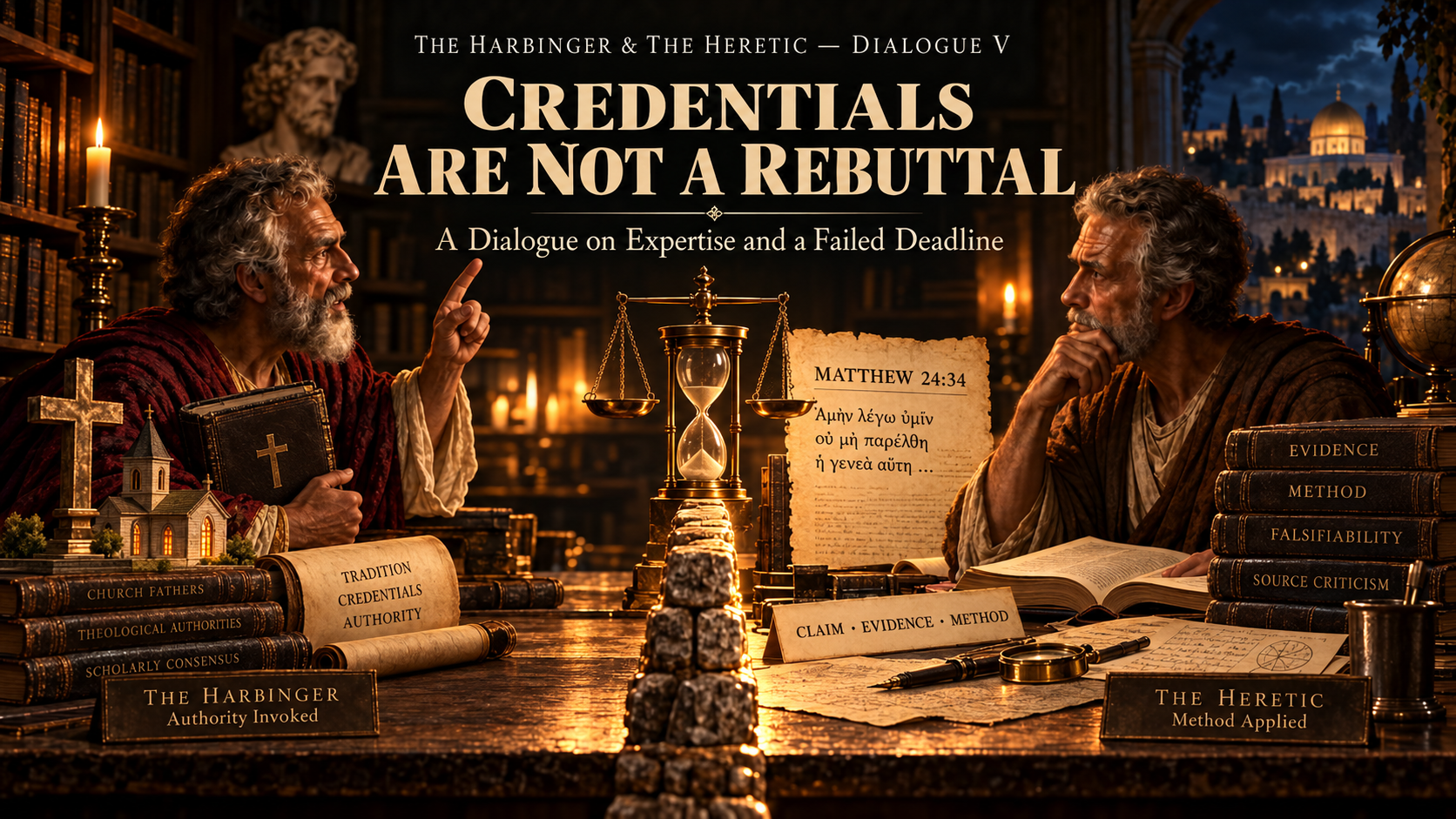
T. C. Schmidt's Oxford Academic chapter on the Josephus James passage offers a defense of authenticity and engages Carrier directly. There are credentialed scholars who disagree with Carrier. It is not honest to pretend Carrier has won the entire field.
But here is the bigger point — one that applies well beyond this specific dispute. When a scholar is writing in a context that is explicitly theological or apologetic, the incentive structure is different. History asks what is most likely true. Apologetics asks how to keep the claim defensible. Those are not the same project. They can overlap sometimes, but they are not interchangeable.
What method is being used — and what outcome is being protected? If the truth depends on protecting a predetermined outcome, it stops being historical inquiry and becomes institutional self-preservation.
The "Called Christ" Phrase: Ordinary Note, Extraordinary Consequences
"Who is called Christ" is a very Christian-sounding identification tag. The New Testament itself uses "called Christ" language, famously in Matthew 1:16. Carrier and others argue this looks exactly like the kind of quick identifier a Christian reader would scribble in a margin, especially if trying to connect Josephus to the Christian narrative. Schmidt counters that the phrase could be distant or skeptical in a non-Christian author's mouth and that the structure of Josephus's sentence has its own logic. Fine. That is the debate.
But step back and notice what Christianity is asking the modern world to accept: public deference, social authority, constitutional privilege and cultural insulation, based on claims that depend on disputing whether three words were marginal ink or authorial ink in a manuscript tradition controlled by Christians. If you are honest about standards of evidence, you cannot call that revelation. You can only call it what it is: fragile historical inference.
Modern Scholarship Is Not Settled — and That Is the Point
Recent peer-reviewed work, including Nicholas List's "The Death of James the Just Revisited" in the Journal of Early Christian Studies , continues to re-examine the James passage. The existence of that paper does not automatically validate Carrier. It validates something simpler: this is still debated.
And if it is still debated in 2024, it should not be preached in public life as if it is a slam-dunk historical foundation for divine truth. If your religion needs contested textual micro-arguments to keep its external support alive, it is not categorically different from other religions whose claims also live or die by interpretive contests over ancient sources.
From "A Historical Jesus" to "Jesus as Presented in the Gospels"
There are two separate questions that people persistently collapse into one. Did some first-century Jewish preacher exist who later became the seed of the Jesus movement? Is Jesus as presented in the Gospels — miracle-working, virgin-born, resurrected, cosmic savior — a historically reliable portrait, or is he a theological construction that accumulated mythic features over time?
Even if you answer yes to the first question, you can still answer no to the second. Carrier pushes hard toward mythicism, further than most mainstream historians will follow. But even without going full mythicist, the Josephus problem still lands. The outside evidence is not strong enough to justify Christianity's claim to special epistemic status in modern society. And once that special status collapses, Christianity becomes what it has always been in the raw historical sense: a religion, one among many, built on texts, tradition, preaching, community identity and institutional reinforcement. Not science. Not knowledge. Not public policy.
The Constitutional Angle Begins With Epistemic Humility
America's constitutional experiment works best when the state does not pick winners in metaphysical debates. You can believe whatever you want. You can worship, pray, evangelize, build churches and live your faith. But the moment religion tries to cash out its claims as public authority — in science classrooms, healthcare policy or state power — it runs headfirst into a basic problem: religion does not meet the evidentiary standards required for secular governance. That is not disrespect. That is category separation.
We have already seen where the alternative leads in education. The Court struck down laws requiring "creation science" to be taught alongside evolution because the purpose was religious endorsement, not secular instruction. The constitutional case this series is building is simple: a secular state can protect religious liberty without granting religious claims authority over secular institutions. The Josephus debate, yes, even this three-words-in-a-manuscript fight, is a perfect illustration of why. This is what evidence looks like when the claim is not anchored in repeatable, independently verifiable reality. It is interpretation, motivated reasoning and institutional pressure — exactly what science was designed to resist.
Why This Matters
If Christianity were truly divinely inspired in a way that sets it apart, it would not need this kind of scaffolding. It would not need fragile textual disputes to prove its founder existed, or apologetic frameworks to keep doubts at bay, or cultural leverage to maintain dominance. The Josephus-James controversy is a reminder that religious certainty is not the same thing as justified confidence.
In a free society, you are allowed to believe. But you are not entitled to have your belief treated as public knowledge — especially when the best external evidence is still debated and may hinge on scribal behavior in Christian-controlled transmission. That is why religion belongs in private conscience and voluntary community, not in science, not in secular lawmaking and not in constitutional privilege.
References
- Carrier, R. (2026, January 6). T.C. Schmidt on James in Josephus: Apologetics vs. History. richardcarrier.info.
- Josephus, F. Antiquities of the Jews, Book 20, passage commonly numbered Ant. 20.200.
- Origen. Against Celsus 1.47 (English trans. at New Advent).
- Eusebius. Church History Book II (English trans. at New Advent / CCEL).
- Schmidt, T. C. "James the Brother of Jesus: Antiquities 20.200." Oxford Academic.
- List, N. (2024). The Death of James the Just Revisited. Journal of Early Christian Studies, 32(1), 17–44.
- Edwards v. Aguillard, 482 U.S. 578 (1987).
- Kennedy v. Bremerton School District, 597 U.S. (2022).
Disclaimer: The views expressed in this post are opinions of the author for educational and commentary purposes only. They are not statements of fact about any individual or organization, and should not be construed as legal, medical, or financial advice. References to public figures and institutions are based on publicly available sources cited in the article. Any resemblance beyond these references is coincidental.