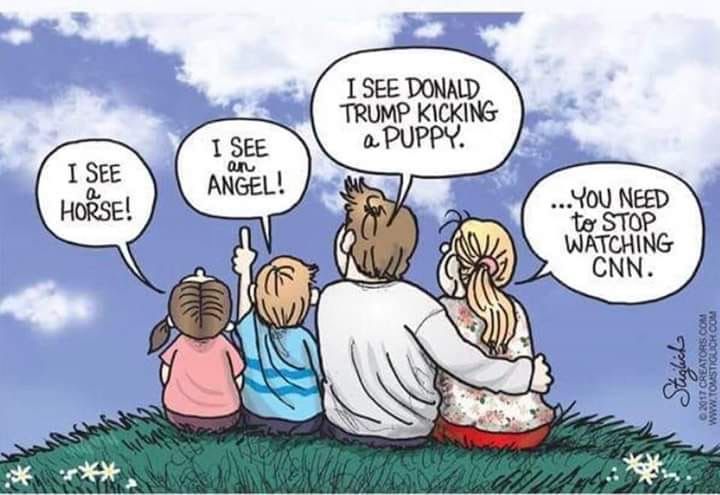
There is a direct line between the language the American left has normalized about Donald Trump and his supporters and the political violence that has followed it, and that same escalation machinery runs through smaller, quieter fights too. "Toxic masculinity" has become one of its favorite tools, a phrase that started as a narrow clinical term and has since curdled into an all-purpose weapon for dismissing, pathologizing and delegitimizing any man whose politics, opinions or manner liberals happen to dislike. That specific idiocy deserves naming up front, because it runs on the exact same mechanism as the larger, more dangerous pattern this piece is actually about. When you call a sitting president Hitler, not as hyperbole in a bad moment but as a sustained, media-amplified, celebrity-endorsed, years-long campaign of rhetorical escalation, you are not just expressing disapproval. You are constructing a moral framework in which violence against him becomes not just understandable but defensible. Hitler had to be stopped. Fascism had to be resisted. Existential threats to democracy required extraordinary measures. That is the argument the left has been making, with increasing intensity and decreasing self-awareness, since the escalator descent in 2015.
They called him a racist, a white nationalist, a fascist, a dictator, a demented narcissist, a corrupt sex abuser, a traitor, a threat to every minority group in America and an enemy of democracy itself. They said the 2020 election, and then the 2024 election, would be the last democratic election in American history if he won. He won twice. The democracy has not ended. But the violence has not stopped either. And the people who spent years building the rhetorical case that Trump represented an unprecedented evil that justified extraordinary resistance have some explaining to do about what they thought that resistance was going to look like in practice.
The Vocabulary of Dehumanization and What It Produces
Words like fascist, Hitler, white supremacist and existential threat are not neutral descriptions. They are moral categorizations that tell the people hearing them how to feel about the target and, implicitly, what responses are proportionate. Fascists got bombed. Hitler got shot at. Existential threats get eliminated. That is what history says. The people deploying this language know that. Some of them are doing it cynically, as a fundraising and mobilization strategy, knowing the rhetoric will not literally produce assassins and calculating that the political benefit outweighs the risk. Others have talked themselves into genuinely believing it, in which case the language reflects their actual assessment of the situation. Both groups have been wrong about the facts, Trump won two elections and the institutions held both times, but the language they deployed did not disappear when their predictions failed. It intensified, because the failure of the catastrophe to arrive gets reinterpreted as evidence that the resistance worked rather than evidence that the threat was overstated.
The assassination attempts against Trump in 2024 did not arrive from nowhere. The man who opened fire at the Butler, Pennsylvania rally had been marinating in a political environment that told him, repeatedly and with institutional credibility behind it, that Trump was a uniquely dangerous figure who represented an existential threat to American democracy. Whether that specific shooter articulated his motives in those exact terms is less important than the cultural environment that normalized the framework. When MSNBC hosts, major newspaper columnists, former presidents and celebrity figures all describe a political opponent using the vocabulary of totalitarianism and genocide, they are not just insulting him. They are giving permission, not explicit, not legal, but moral, to people who take the vocabulary seriously enough to act on it.
Calling someone a racist takes one second. Proving it takes evidence, context, standards and intellectual honesty. One is a weapon. The other is work.
When a political culture decides the weapon is more useful than the work, it should not be surprised by what weapons produce.
How the Language Got This Inflated
There was a time when certain words stopped a room. Racist. Fascist. Hitler. They were not casual labels. They carried moral weight because they described something serious, actual prejudice, actual totalitarianism, actual genocide with actual bodies attached. The problem today is not that these concepts are irrelevant. Real racism still exists. Real authoritarian tendencies deserve real scrutiny. The problem is that the definitions still point to serious conduct while public usage frequently does not.
Nick Haslam's concept creep framework describes the gradual expansion of harm-related terms to cover a wider range of behaviors, extending outward to less severe cases until the term loses its precision. What begins as a serious moral category ends as a tribal password, a signal of tribal loyalty rather than a description anyone can check against evidence.
The escalation happened in stages. First came the casual racism accusations against policy disagreements: opposing illegal immigration became racism, supporting voter ID became racism, questioning affirmative action became racism. When that lost force from overuse, the rhetoric escalated to systemic racism, white supremacy and structural violence. When that lost force, it escalated to fascism, authoritarianism and Hitler comparisons. Each escalation required the previous round to have failed to produce the desired political result, so the accusation got bigger. The result is a political vocabulary that has been sprint-inflated past the point of descriptive usefulness and now functions primarily as a social penalty mechanism. Language that begins as moral description ends as political weaponry, and that transition is exactly what happened to the vocabulary deployed against Trump and his supporters.
This is not an abstract complaint about tone. The specific language deployed against Trump has been specific and sustained. Hillary Clinton called his supporters a basket of deplorables. Joe Biden said MAGA Republicans represented semi-fascism and called Trump supporters a threat to the very soul of the nation. The New York Times ran multiple pieces comparing Trump to Hitler and Mussolini. MSNBC hosts used the word fascist so routinely it stopped registering. Judge Luttig testified before Congress that American democracy was in the most peril it had been since the Civil War. Former Democratic officials publicly discussed whether Trump's election would mean the end of American democracy. Celebrities endorsed the idea that defeating Trump was a moral emergency equivalent to the resistance against Nazi Germany. The people doing this were not fringe actors. They were credentialed, platformed, institutionally backed voices who understood exactly what vocabulary they were deploying and chose it deliberately for its mobilizing power. That mobilizing power does not stop at the ballot box.
When Overuse Produces the Opposite of the Intended Effect
The tragedy of inflated moral language is not just that it fuels violence at the extreme end of the distribution. It is that it destroys the social capacity to recognize actual wrongdoing when it appears. If every Republican is a fascist, the word fascist no longer identifies anyone in particular. If every policy disagreement is racism, the word racism no longer identifies actual prejudice. If Trump is Hitler, then Hitler was just a politician people disagreed with. The comparisons corrupt both directions. They make real historical atrocities sound like ordinary political disputes while simultaneously making ordinary political disputes sound like historical atrocities. The people who most need the vocabulary of moral condemnation to mean something, actual victims of actual racism, actual survivors of actual fascism, are left with a language that has been emptied of force by people who found it useful as a political instrument. That is not just a rhetorical problem. It is a moral failure.
The research bears this out. A Yale-affiliated study published in Science Advances found that moral outrage on social media is reinforced by social feedback: likes and shares reward escalation, so users learn to escalate. A Nature Human Behaviour study found that people routinely overperceive hostility in posts, inferring more rage than the authors reported feeling. The platforms reward outrage, users learn the reward, observers overread the hostility, everyone concludes the other side is more extreme than it is and the vocabulary gets worse. This is not a natural equilibrium. It is a machine that produces escalation as a feature. The political violence at the end of that escalation chain is not an accident. It is a predictable output of a system designed to maximize emotional intensity without regard for accuracy or consequences.
The Toxic Masculinity Myth, and What the Research Actually Shows
The same concept-creep mechanism has done real damage to how Americans talk about gender, and "toxic masculinity" deserves a place on this list right alongside racist, fascist and Hitler. It began as a narrow clinical term, used by psychologists studying men in prison and military settings to describe a specific constellation of traits, suppressed emotion, compulsive dominance, contempt for vulnerability, that produced genuinely destructive outcomes for the men who carried them and the people around them. That was a real, useful, precise concept.
It did not stay that way. Within a decade, "toxic masculinity" had expanded from a description of specific pathological behavior into a phrase popular media and activist commentary increasingly used as a synonym for masculinity itself, treating ordinary traits, stoicism, competitiveness, physical risk-taking, protectiveness, as inherently suspect rather than neutral until misapplied. The same escalation pattern described above repeated itself. A precise clinical term got stretched past the point of descriptive usefulness, and now it functions less as a diagnosis of specific harmful behavior and more as a background insinuation that masculinity, as such, is the problem.
Here is what makes the current version of the claim especially lazy: it is not even what the actual research shows. A 2021 study published in Personality and Social Psychology Bulletin by Sarah DiMuccio and Eric Knowles examined a concept called precarious manhood, the idea that masculinity functions for many men as a status that must be continually earned and defended rather than a fixed identity. Across three separate studies, the researchers found that men who scored higher on masculine insecurity, meaning men anxious about whether they were living up to masculine expectations, were significantly more likely to support politically aggressive policies like enhanced interrogation and expanded military spending, more likely to have voted for Trump in 2016 in areas with higher rates of insecurity-linked search activity, and more likely to have supported Republican House candidates in 2018 under the same pattern. Notably, this relationship did not appear when the researchers ran the same analysis against the 2008 and 2012 elections, meaning it tracks something specific about insecurity interacting with a particular political moment, not masculinity as a stable predictor of aggression across the board.
The predictor was not masculinity. It was doubt about masculinity. A man secure in his own identity did not show the pattern.
Read that finding carefully, because it is the opposite of what "toxic masculinity" as a popular phrase implies. The men most drawn to aggressive political rhetoric were the ones most anxious that they were failing to measure up to a standard, not the ones most confidently living inside it. That is precisely the distinction "toxic masculinity" as a slogan erases, and erasing it is not a minor imprecision. It relocates the actual mechanism, insecurity, somewhere else entirely, onto masculinity as a category, and in doing so makes the term nearly useless for identifying what is actually happening, the exact same failure mode already described above for racist, fascist and Hitler.
None of this means no man behaves badly, the same way none of this means racism or fascism do not exist. It means the word being reached for should describe the conduct precisely enough to be checked against evidence, and the evidence here points toward insecurity, not identity, as the driver. A phrase that cannot make that distinction is not doing diagnostic work. It is doing the same tribal-password work every other inflated pejorative in this piece is doing.
Both Sides Own This Problem
This argument would be intellectually dishonest if it only pointed in one direction, and it does not. The right has its own version of this disease. Communist, groomer, traitor, baby-killer: the mirror-image vocabulary of political demonization flows in both directions and produces the same consequences wherever it lands in the hands of someone unhinged enough to act on it. The argument here is not that the left uniquely invented the politics of dehumanization. The argument is that the specific escalation against Trump, sustained, institutionally amplified, explicitly invoking the vocabulary of Nazism and existential threat, has been unusually intense and unusually consequential, and the people who participated in that escalation have been unusually reluctant to examine their role in what followed. Criticizing conservatives who call Democrats communist groomers is not a contradiction of this argument. It is the same argument applied consistently. Both sides have been using language as a weapon. The weapons produce casualties. The people building the weapons should acknowledge that.
Precision Is the Only Path Back
The answer is not silence. Real authoritarianism deserves the word authoritarianism. Real racism deserves to be called racism. Real fascism, actual suspension of elections, actual political imprisonment, actual state violence against dissent, has a name and should have one. The problem is not that serious words exist. The problem is using them when the conduct described does not meet the standard, because every misuse makes the word less available for the real thing. A belief in racial superiority is not the same as a policy with unequal outcomes. Actual hostility toward gay people is not the same as a legal disagreement about policy. An administration you oppose is not the same as the Third Reich. Those are different things. Treating them as identical does not expand moral awareness. It destroys it.
The path back requires the people most responsible for the current inflation to do something the political culture makes very hard: admit that their vocabulary was disproportionate to the conduct it described, that the escalation produced predictable consequences and that recalibrating is not a retreat from principle but a return to honest analysis. That admission is not coming voluntarily. The incentive structure of social media and partisan media runs entirely in the other direction. But the people watching the violence and wondering where it came from should at least be able to name the mechanism. Language that tells people a figure represents an existential evil equivalent to Adolf Hitler is language that gives permission to the small percentage of the population that will act on moral permissions when they are issued by credible institutional voices. That is not complicated. It is just inconvenient for the people who issued the permissions.
My Bottom Line
A civilization cannot function if every political opponent is Hitler and every election is the last one before the apocalypse. It cannot protect real victims of real prejudice if the vocabulary of condemnation has been spent on policy disagreements. It cannot maintain social trust if the language of public life is understood by everyone to be weaponized rather than descriptive. And it cannot contain political violence if the intellectual framework for that violence, this person is an existential evil who must be stopped by any means necessary, is constructed and maintained by credentialed, institutional voices who then express bewilderment when someone takes the framework seriously.
The words came first. The bullets followed. The people who built the framework with their words do not get to mourn the consequences while maintaining the framework that produced them.
Reclaiming precision in language is not a cosmetic preference. It is the difference between a political culture that can sustain itself and one that is slowly building toward something none of the people who started the fire are prepared to see reach its conclusion.
If the man is literally Hitler, shooting him is the moral thing to do. That is not a fringe conclusion. That is the logical conclusion of the premise. If you do not want people drawing that conclusion, stop issuing the premise. The responsibility is that simple and that uncomfortable.
References
- Brady, W. J., McLoughlin, K., Doan, T. N., & Crockett, M. J. (2021). How social learning amplifies moral outrage expression in online social networks. Science Advances.
- Brady, W. J., et al. (2023). Overperception of moral outrage in online social networks inflates beliefs about intergroup hostility. Nature Human Behaviour.
- Haslam, N. Concept creep framework, as discussed in subsequent review literature. Frontiers in Psychology.
- Cato Institute. (2020). Poll on Political Self-Censorship and Views Americans Are Afraid to Share. cato.org.
- FBI. (2025). FBI Releases 2024 Reported Crimes in the Nation Statistics. fbi.gov. [Hate crime bias motivation data.]
- Pew Research Center. (2023). Views of American Politics, Polarization and Tone of Political Debate. pewresearch.org.
- DiMuccio, S. H., & Knowles, E. D. (2021). Precarious manhood predicts support for aggressive policies and politicians. Personality and Social Psychology Bulletin.
- Merriam-Webster. (2026). Definitions: racism, fascism, authoritarianism. merriam-webster.com.
Disclaimer: The views expressed in this post are the personal opinions of the author and are offered for educational, commentary and public discourse purposes only. They do not represent the positions of any institution, employer, organization or affiliated entity. Nothing in this post constitutes legal, financial, medical or professional advice of any kind. This post discusses political rhetoric and its relationship to political violence as a matter of public concern and does not endorse or excuse violence by any party against any political figure. References to public figures are based on publicly available statements and published sources. Commentary on political language and culture reflects the author's independent analysis and is protected expression of opinion. Readers are encouraged to consult primary sources and form their own conclusions.