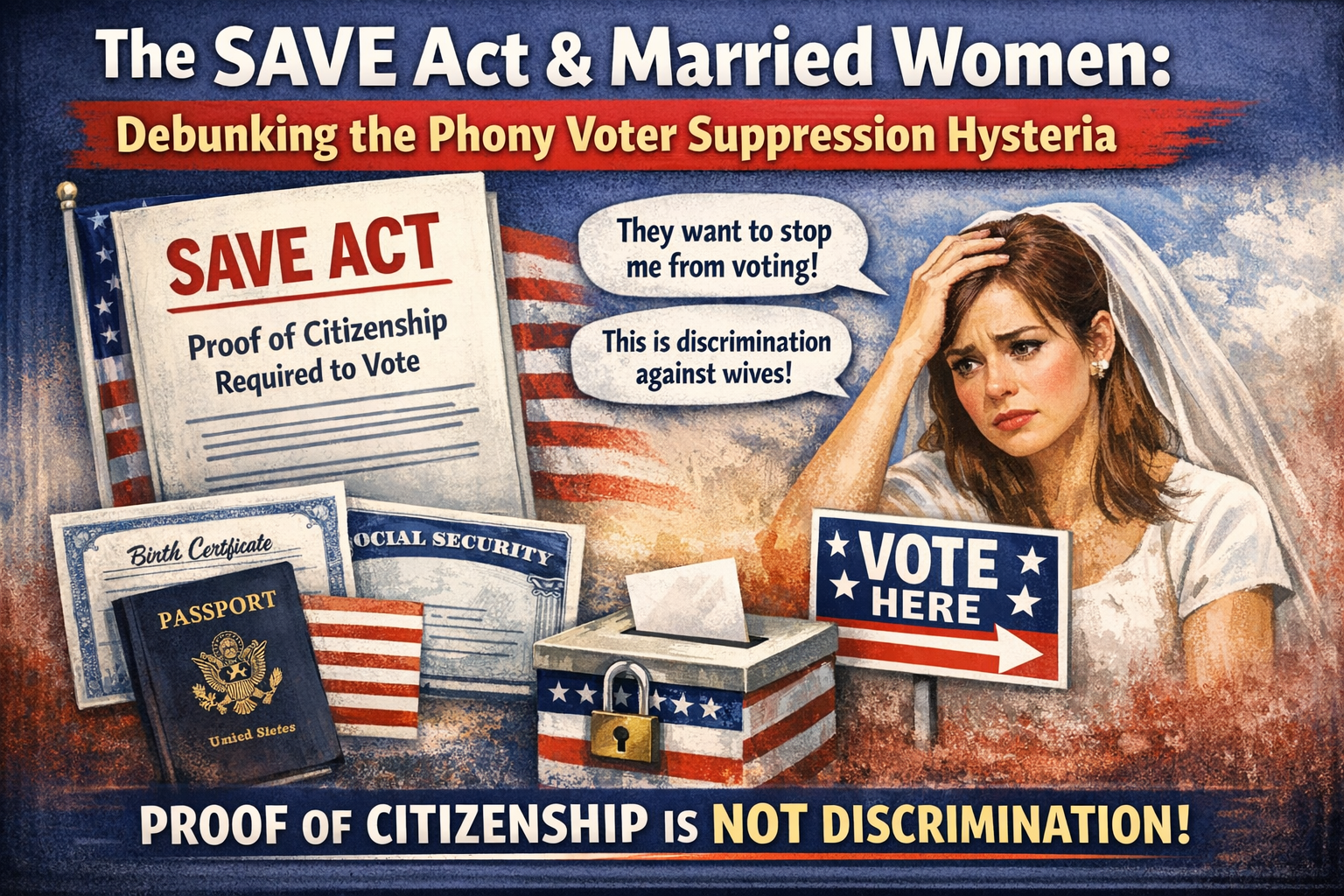
The objection to the SAVE Act that has gotten the most traction is not about the bill's constitutional framework or its enforcement mechanisms or even the practical challenges of implementation. It is about married women. The argument, repeated across social media and sympathetic news coverage, is that women who changed their names at marriage will be disproportionately burdened by documentary proof requirements and that this burden amounts to targeting them.
That argument is political theater. And the people making it know it.
A great many married women who changed their names have already updated the records that matter most. Social Security. Driver's license. Passport. Bank accounts. Tax records. Employment records. That is because adult life requires it. You cannot operate indefinitely under a patchwork of inconsistent identities and then express surprise when a government agency asks for coherence. If a woman changed her name after marriage, updated her license as required by her state, kept her records aligned and retained a certified marriage certificate, the supposed crisis evaporates on contact with reality.
Married women are not being targeted by this bill. They are being rhetorically deployed against it.
What the Argument Actually Does
The married women framing is not designed to defend women. It is designed to make opposition to citizenship verification sound cruel. That is why the objection is always stated emotionally rather than structurally. It presents a sympathetic subject, a woman navigating paperwork after a name change, and asks the audience to feel her inconvenience rather than examine the underlying policy claim.
Colorado's own identity rules already make the governing principle clear. If names differ across documents, additional records showing the chain of name changes are required. The state operates on the assumption that responsible adults maintain a coherent legal identity. That is not a new burden invented by the SAVE Act. That is how legal identity has always worked across every domain that requires it.
"The media's version of this story treats married women as if they are helpless waifs incapable of keeping a certified marriage certificate. That is not compassion. It is condescension dressed up as advocacy."
Millions of women manage far more complicated tasks than document management every year. They run businesses, navigate multi-provider medical systems, file complex tax returns, manage family finances and handle the full administrative weight of modern life. Suggesting that citizenship verification will uniquely overwhelm them does not defend women. It diminishes them.
Bureaucratic Friction Is Not Discrimination
There is a fair version of the implementation concern that deserves an honest answer. The SAVE Act would move federal voter registration away from the current lighter-document model toward documentary proof of citizenship. Today's federal registration process generally relies on a driver's license number or the last four digits of a Social Security number rather than citizenship documents at the point of registration. That is a real change and some citizens may need to locate a certified birth certificate, request a marriage certificate to connect names or navigate a records request. Those are legitimate administrative questions about design and rollout.
But bureaucratic friction is not the same as discrimination and it is not remotely unique to voter registration. A building permit has paperwork costs. A passport application requires certified documentation. A Real ID requires supporting records. A concealed carry permit involves fees and waiting periods. Incorporating a business requires filings across multiple agencies. In none of those cases does the presence of paperwork constitute targeting of any protected class. The passport system in particular requires proof of citizenship, valid photo identification and certified name-change documents when names do not match. The State Department treats that as routine identity verification. Nobody accuses it of sexism.
Once you apply the same logic consistently across government systems, the selective outrage about voter registration becomes visible for what it is. If documentary proof is acceptable for a passport, a Real ID, a professional license or a firearms purchase, the argument that it is uniquely oppressive at the point of voter registration requires an explanation that critics never actually provide. The honest explanation is that they oppose the underlying requirement, not the paperwork burden it creates.
The Grievance Machine at Work
The SAVE Act debate is a clean example of a broader habit in contemporary political argument: the compulsive need to translate neutral administrative rules into identity-based harm narratives. A citizenship verification proposal cannot simply be opposed on procedural or constitutional grounds. It must be repackaged as a plot against women. Everything now has to pass through the grievance machine. If there is a form, it is oppression. If there is a supporting document required, it is systemic cruelty. If there is a deadline, it is exclusion.
This is political infantilization presenting itself as compassion. Instead of engaging the actual policy question, critics manufacture melodrama. Instead of asking whether a state may constitutionally require proof of a legal eligibility condition, they produce slogans about grandmothers, wives and vulnerable communities. Instead of discussing administrative design, they deploy moral blackmail.
A functioning republic cannot be sustained on manipulative framing. Voting is one of the defining acts of citizenship in a constitutional order. The country has every right to debate what standard should govern eligibility verification. Maybe the SAVE Act is the right answer. Maybe it requires better implementation design. Maybe the fallback provisions for applicants without standard documents need strengthening. Those are serious arguments worth making. But "this discriminates against married women" is not a serious argument. It is a dodge, and it works precisely because it sounds humane while avoiding the harder question entirely.
My Bottom Line
The claim that the SAVE Act discriminates against married women is political noise. The bill is facially neutral. It requires documentary proof of citizenship for federal voter registration. It does not single out women. It does not single out marriage. It creates no separate legal burden for wives as wives. What critics are actually objecting to is document management, and their real position is that proof of citizenship should not be required for federal voter registration at all.
That is a defensible position. It should be made directly. Hiding it behind married women is not defense of women. It is the use of women as cover for an argument that cannot survive honest examination.
Once a society loses the ability to distinguish inconvenience from injustice, every civic obligation becomes a grievance and every form becomes evidence of oppression. That habit poisons public life. It teaches citizens to experience ordinary institutional requirements as personal attacks and it reduces real people to props in an ideological argument that was never actually about them.
A country that cannot require proof of a legal qualification without being accused of targeting a protected class is a country that has confused political theater for constitutional analysis.
References
- Colorado Department of Revenue. (2026). Update, Change and Manage Your Name on Your Driver License, Permit or ID Card.
- Library of Congress, Congressional Research Service. (2025, March 31). Safeguard American Voter Eligibility Act (SAVE Act, H.R. 22/S. 128) and Federal Voter Registration Policy and Law (IF12902).
- U.S. Congress. (2025-2026). H.R. 22, SAVE Act.
- U.S. Election Assistance Commission. (2026). Overview of Federal Election Laws.
- U.S. Election Assistance Commission. (2026). Voter Lists: Registration, Confidentiality and Voter List Maintenance.
- U.S. Department of State. (2025). Change or Correct a Passport.
- U.S. Department of State. (2026). Renew Your Passport by Mail.
Disclaimer: The views expressed in this post are the personal opinions of the author and are offered for educational, commentary and public discourse purposes only. They do not represent the positions of any institution, employer, organization or affiliated entity. Nothing in this post constitutes legal, financial, medical or professional advice of any kind. References to public figures, institutions, historical events and current affairs are based on publicly available sources and are intended to support analysis and argument, not to state facts about any individual's character, intent or conduct beyond what the cited sources support. Commentary on religious, political and cultural subjects reflects the author's independent analysis and is protected expression of opinion. Readers are encouraged to consult primary sources and form their own conclusions. Any resemblance to specific individuals or situations beyond those explicitly referenced is coincidental.