Michael Jackson was a brilliant entertainer. Possibly the most gifted popular performer of the twentieth century by any reasonable measure of technical skill, stage presence and cultural reach. I will say that plainly and mean it, because the point of what follows is not to erase the talent. The point is that talent does not erase what the man almost certainly was: a person who abused children, escaped full criminal accountability through the advantages that extraordinary wealth and celebrity provide and whose estate is now funding a $200 million feature film that cuts out every scene that might complicate the mythology it is selling. That film, simply titled Michael, broke opening weekend records when it released in late April 2026. It also cut, by the studio's own admission, the scenes depicting the 1993 search of Neverland Ranch because a clause in a legal settlement made those scenes untenable. The third act was rewritten. Twenty-two days of reshoots were added at roughly $50 million. The result is a biography of a man's life that omits the most significant and contested chapter of that life, produced by an estate with a direct financial interest in omitting it. Paris Jackson, the man's own daughter, called the film filled with inaccuracies and accused it of pandering to a section of her father's fandom that still lives in the fantasy. She had zero involvement in its production. It opened to $217 million worldwide anyway.
Patterns Matter. Settlements Matter. Access Matters.
At some point, repeated accusations matter. This was not one odd rumor or one bitter person attempting to cash in. The trail begins in 1993 with Jordan Chandler and a settlement that cost Jackson somewhere between $23 and $25 million. It runs through the 2003 Bashir documentary that Jackson himself participated in, in which he saw nothing wrong with sharing his bed with children and described it as a loving and beautiful thing. It runs through the 2005 criminal trial, the acquittal, and the subsequent years of accusers who kept coming forward. It runs through Wade Robson and James Safechuck and the Leaving Neverland documentary, which whatever you think of its conclusions represents two adults providing detailed, specific and consistent accounts of sustained abuse beginning in childhood. It runs, as of this month, through a new lawsuit filed by a family alleging Jackson sexually abused four siblings when they were children.
What surrounds all of this is the carefully constructed world that made it possible: Neverland Ranch as a permanent lure for children, an inner circle employed to maintain secrecy, the sleepovers normalized as paternal affection, the enormous power imbalance between a global superstar with unlimited resources and the families of ordinary children who were flattered and overwhelmed by the attention. This is not the profile of one misunderstanding. It is the profile of a system. Systems require intent, resources and patience. Jackson had all three.
The acquittal is not the end of the moral conversation. Wealthy, famous defendants beat cases all the time. Jackson had fame, money, cultural protection and a fan base that treated any accusation as blasphemy. The legal system gets it right most of the time. It does not get it right every time. Anyone who has watched a wealthy person navigate the criminal justice system knows that.
The Acquittal Is Not the End of the Moral Conversation
People love to shelter behind the 2005 acquittal as if the criminal justice system is infallible and verdicts are moral conclusions rather than legal ones. Please. The criminal standard is beyond a reasonable doubt, which is the highest evidentiary bar the legal system uses precisely because it tilts toward acquittal rather than conviction. Rich, famous people beat cases all the time - not because they are innocent but because they can hire the best defense teams, control the narrative in the press, exhaust accusers through years of litigation and surround themselves with character witnesses that juries find compelling. Jackson had all of that and more. He had a fan base that treated any accusation as a personal attack and a cultural industry that had enormous financial interest in his continued viability. The prosecution in 2005 had its own evidentiary problems. None of that is the same as establishing that nothing happened.
The civil system has a lower standard - preponderance of evidence, more likely than not - and Jackson settled the 1993 case rather than fight it in that forum. Settlements in civil litigation are not admissions of guilt. They are also not nothing. A man with Jackson's resources, facing a case he believed he could win, had every rational incentive to fight. He paid instead. The reasons for that choice are available for each person to weigh.
Race, Celebrity and Children
The argument that Jackson was Black and therefore possibly the victim of racial injustice in his treatment by prosecutors and the justice system is worth taking seriously in the abstract. False accusations against Black men are a real and documented phenomenon in American history with specific victims and specific cases. Historical injustice in the treatment of Black defendants is real and matters. None of that carries weight here. The alleged crimes involve children. The moment children enter the equation, historical injustice as a moral discount disappears. You do not answer child abuse allegations by hiding behind race, celebrity or cultural symbolism. You answer them by examining the evidence. The evidence, across thirty years of accusations, patterns, settlements, documented access and the specific testimony of people who were children when the alleged abuse occurred, produces a picture that the acquittal does not erase and that the biopic is spending $200 million not to show you.
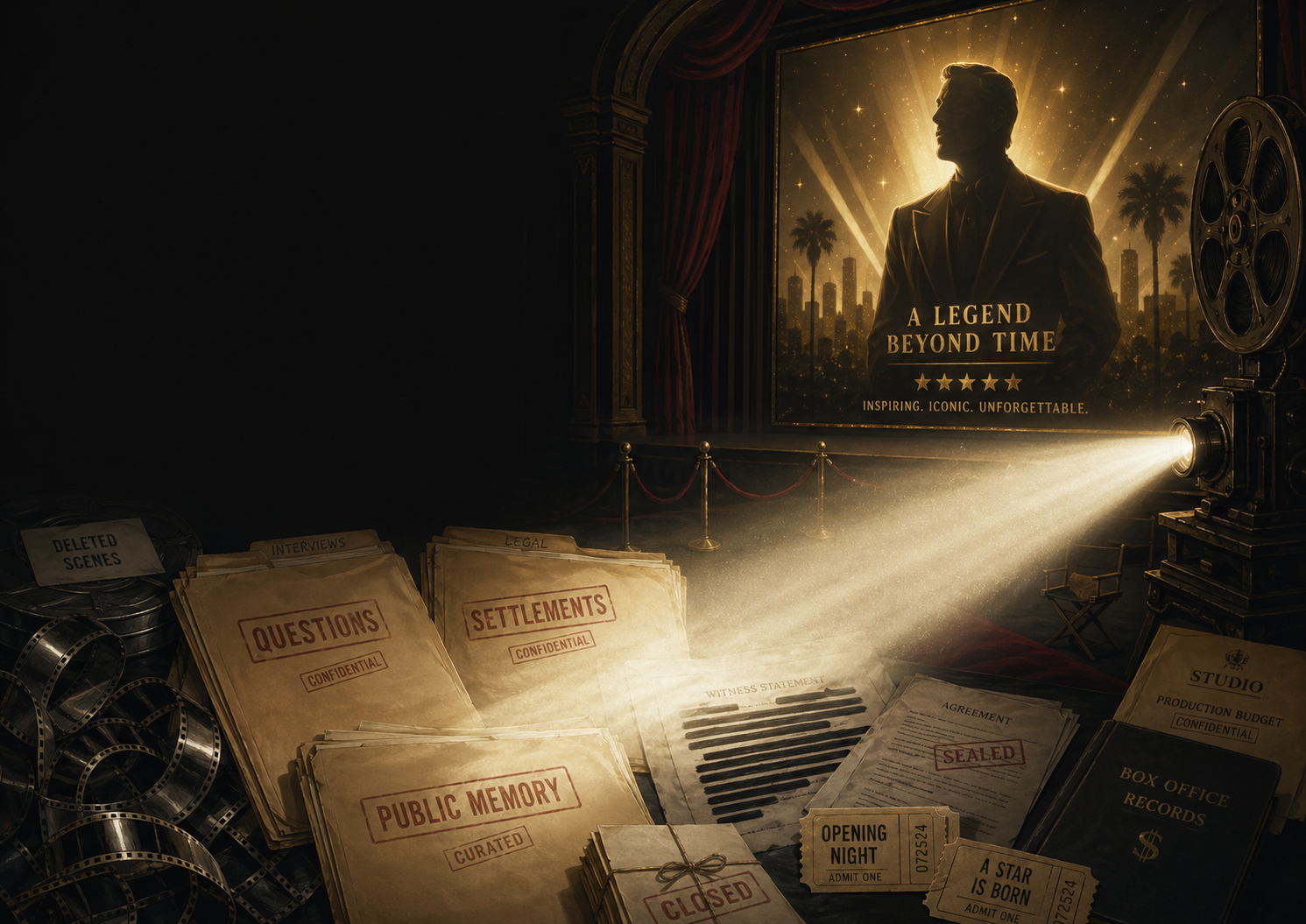
The original cut of Michael apparently included scenes of investigators arriving at Neverland in 1993. Those scenes were removed not because they were inaccurate but because a clause in a legal settlement made including them legally problematic. The studio confirmed this. The Jackson estate funded the reshoots that replaced them. The result is a biographical film in which the subject's most consequential and contested years are either absent or sanitized beyond recognition. Critics from IndieWire, The Guardian, the BBC and RogerEbert.com have all noted the omission directly. The WBUR-FM critic compared ending the film with Jackson's Bad tour to ending an O.J. Simpson biopic with him winning the Heisman Trophy. Paris Jackson, the man's own daughter, publicly disowned the film and said it panders to the section of fandom that still lives in the fantasy. The film's defenders argue it is a celebration of the art, not a trial. That would be more convincing if it were not produced by the estate with the strongest possible interest in the verdict of public memory.
The Art and the Man
The separating-the-art-from-the-artist question is genuinely complicated for most cases and considerably less complicated here. The usual version of that argument involves artists who held views we now find repugnant, or whose private conduct was ugly but separable from the work itself. Jackson's case is different in a specific way: the access that enabled the alleged abuse was constructed in part through the fame the art produced. Neverland existed because of the music. The families who brought their children to Neverland did so because of the music. The power imbalance between Jackson and the children was the direct product of the music and the global celebrity it generated. The art and the alleged conduct are not cleanly separable here the way they might be for a painter whose personal beliefs we now reject or a novelist who was unkind to his wife. They are connected by the mechanism of access. That matters.
I do not separate the art from the allegations here. The music is iconic. Thriller is one of the great pop albums. Jackson's choreography and stage presence had no equal in his era. None of that changes what the man left behind him: a thirty-year trail of accusations involving children, a system designed to facilitate access, settlements that cost tens of millions of dollars, accusers whose accounts were specific and consistent, and a new lawsuit filed the same week his estate's authorized biography hit theaters. That is too much smoke to pretend there was no fire. A $200 million film designed not to show you the smoke is not a celebration. It is a cover story.
My Bottom Line
The Michael biopic broke records because the music is still powerful and nostalgia is a reliable product. None of that makes it honest. An estate-funded, legally sanitized feature film that cuts the scenes depicting the investigation of the man's home because a settlement clause made them inconvenient is not a biography. It is mythology with a production budget. The people buying tickets are entitled to enjoy the performance of the man's nephew and the catalog of songs. They should do so knowing that the film they are watching was shaped not by editorial judgment about what the story required but by legal and financial considerations about what the estate could afford to show them. That is the transaction. It is a very profitable one. It is also, for anyone paying attention, exactly what you would expect from an institution with hundreds of millions of dollars and decades of legal exposure riding on public memory of a man who may have been, alongside his extraordinary gifts, something considerably darker.
Children deserve protection first. Not after the art is acknowledged. Not after the legacy is secured. First. That principle does not have an exception for iconic pop stars, and a film industry that spends $200 million to avoid confronting it is not honoring a man's life. It is protecting an investment.
References
- Wikipedia. (2026). Michael (2026 film) - production history, reshoots and critical reception. en.wikipedia.org.
- TODAY. (2026, April). Why is the Michael Jackson biopic stirring controversy? today.com.
- Variety. (2026, April 7). Original Michael biopic included Neverland investigation scenes later cut due to legal concerns.
- NBC News. (2026). LionsGate confirms abuse allegation scenes removed from Michael due to legal concerns.
- Comscore. (2026, April). Michael opening weekend: $97 million domestic, $217 million worldwide.
- Paris Jackson. (2026). Instagram Story statements on Michael biopic accuracy and estate involvement.
- Reed, K. (2004). Leaving Neverland (2019). Channel 4/HBO documentary. Wade Robson and James Safechuck testimony.
Disclaimer: The views expressed in this post are the personal opinions of the author and are offered for educational, commentary and public discourse purposes only. They do not represent the positions of any institution, employer, organization or affiliated entity. Nothing in this post constitutes legal, financial, medical or professional advice of any kind. References to civil and criminal legal proceedings are based on publicly available records. This post discusses public figures and matters of public record. Commentary on cultural events and public figures reflects the author's independent analysis and is protected expression of opinion. The Jackson estate and its representatives deny the allegations discussed in this post. Readers are encouraged to consult primary sources and form their own conclusions.