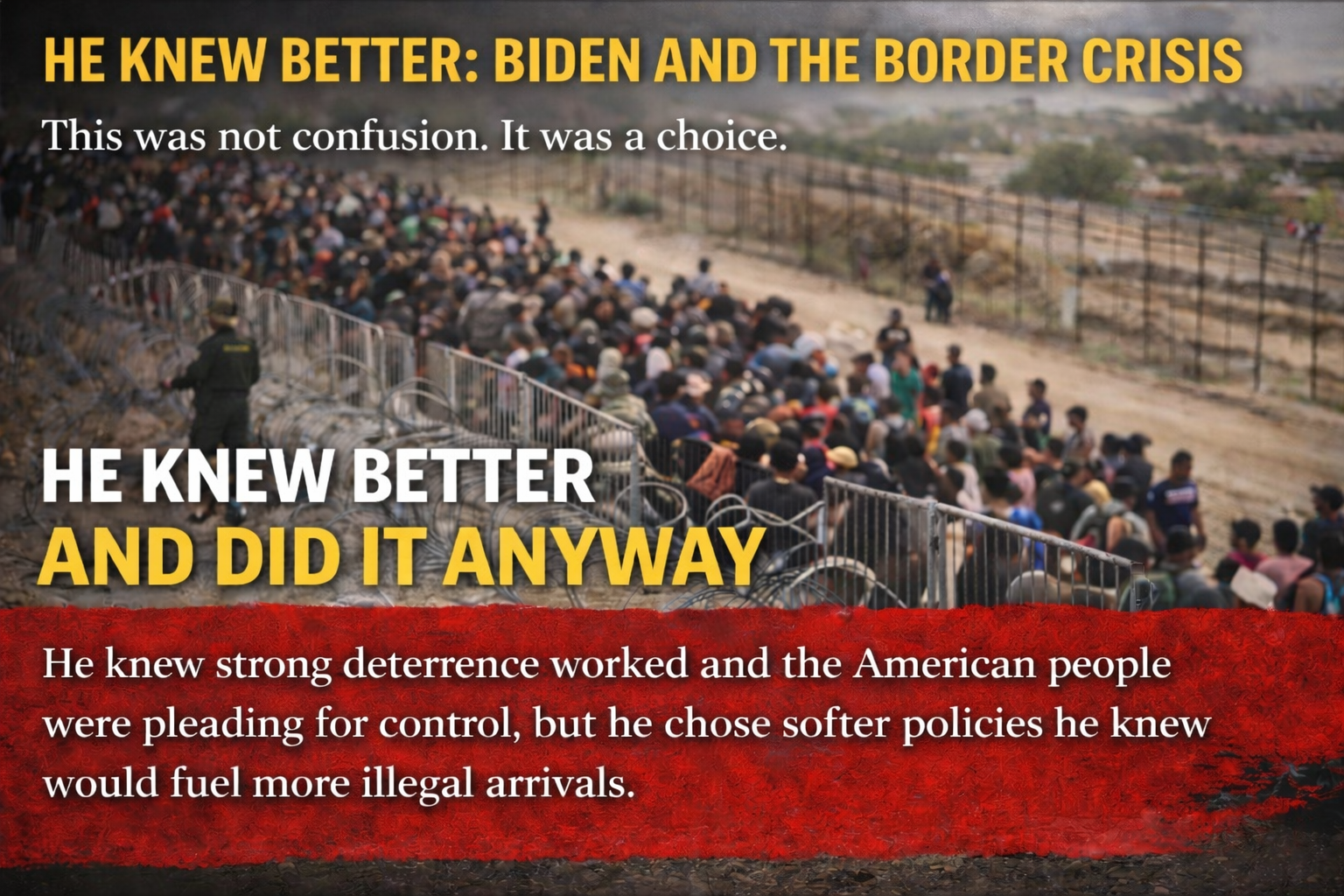
For years, Americans were demanding action at the border. This was not some obscure policy fight buried in think-tank papers. People in border communities were sounding the alarm. Cities across the country were buckling under the strain of mass arrivals. The issue dominated national politics before Biden took office and stayed there throughout his presidency. Southwest border encounters hit historic levels during his term, including roughly 2.48 million in fiscal year 2023 alone. That is the backdrop against which his record has to be judged. And judged against that backdrop, the innocent version of this story does not hold up.
In my opinion, Biden knew better. He knew illegal immigration was already a major national issue. He knew incentives matter. He knew that reversing tougher enforcement signals would be noticed far beyond the border. He knew the country wanted the flow reduced, not managed with nicer language. And in my opinion, he went forward anyway.
The Message From Day One Was Not Ambiguous
On his first day in office, Biden pushed the U.S. Citizenship Act of 2021, which his administration described as a way to restore humanity and American values while creating a new system to manage migration and provide a pathway to citizenship for millions already in the country unlawfully. That tells you a great deal about the governing mindset at the start. The administration was not leading with deterrence. It was leading with humanitarian framing and legalization.
That kind of messaging matters. Governments do not just enforce laws. They send signals. When a new administration advertises a softer philosophical approach, unwinds tougher policies and emphasizes access and processing, people notice. Not just in Washington. Not just in Texas. All over the hemisphere. You do not have to be a political scientist to understand what that does to migration incentives.
This was sold as compassion. It worked like permission. There is a difference between the two, and a president with decades in national politics knows exactly what that difference looks like in practice.
Process Is Not the Same as Control
The Biden administration later tried to build a border system centered on what DHS called safe, orderly and lawful pathways. The 2023 Circumvention of Lawful Pathways rule was explicitly described as a way to discourage irregular migration by steering people into approved channels. On paper, that sounds controlled and humane. In practice, it still rested on the idea that the answer was better management of flows, not a hard restoration of deterrence.
That is where I part company with the people who still defend this record. They talk as though process is the same as control. It is not. If millions of people believe they still have a decent shot of getting into the system, getting released or remaining here for long stretches, then your orderly pathways model is not stopping the magnet. It is reorganizing it.
Southwest border encounters reached roughly 2.48 million in fiscal year 2023 alone - a historic high. Migration Policy Institute, in its review of Biden's record, described the administration as facing record irregular arrivals and noted that the later period saw a significant drop in border encounters only after a tougher mix of restrictions and management tools took hold. That is not a vindication of the early approach. That is a retreat under pressure after years of avoidable damage.
This Was Not Ignorance - It Was Willful Preference
Some people still want to explain the Biden border record as a well-meaning mistake. They say his team underestimated the scale. They say conditions in Latin America were worsening. They say migration pressures were global. Some of that is true. But Biden was not some first-term mayor who stumbled into a problem he had never seen before. He had spent decades in national politics. He knew border enforcement was politically explosive. He knew illegal immigration had been building as a public concern for years. He knew the prior administration had leaned heavily on deterrence because large-scale migration responds to incentives. He knew all of that going in.
So in my opinion, this was not ignorance. It was willful preference. He preferred a softer posture. He preferred the politics of humanity over the politics of enforcement. He preferred reversing his predecessor to preserving deterrence. And the country paid for that preference in a way that was entirely foreseeable to anyone who thought about it honestly for more than five minutes.
The Public Was Not Silent
This is the piece that should not get memory-holed. Americans were not calmly accepting the situation while only a handful of activists complained. The country was demanding relief. Citizens wanted the government to do the most basic thing a sovereign nation is expected to do: control entry and enforce the law. That demand was not hateful. It was not nativist or primitive. It was normal. Even plenty of Americans who favor legal immigration could see the difference between lawful immigration and mass disorder at scale.
They could see that a collapsing border hurts citizens, lawful immigrants and even the migrants being drawn in by false hope and cartel-fed incentives. The people most harmed by a chaotic border are often the migrants themselves - people who paid criminal organizations for passage through dangerous terrain based on a set of signals the administration had sent. Yet for years, the answer to public alarm was spin, euphemisms and process language. That is not compassionate governance. That is a failure of responsibility dressed in compassionate language.
A government that will not say no is not being humane. It is being dishonest - about what it can sustain, about what signals it is sending and about who ultimately bears the cost of that dishonesty.
The Later Crackdown Proves the Earlier Failure
Here is something worth stating plainly because the people defending this record tend to skip over it: the administration's later shift toward tougher restrictions does not rescue Biden's legacy. It condemns it. If the early approach had been working, there would have been no reason to move toward stricter asylum limitations and tougher enforcement language partway through the term. The fact that the administration eventually did exactly that - after sustained public pressure and historic encounter numbers - tells you everything about whether the original approach was realistic.
Migration Policy Institute's own assessment noted the encounter numbers and acknowledged the later period's improvement came from a tougher mix of tools. That is not evidence the administration was right all along and the critics were unfair. It is evidence the administration spent years learning a lesson the public already knew and was trying to communicate: deterrence still matters, and softening it has real-world consequences that do not resolve themselves through better messaging.
Ideology comes first - the administration genuinely wanted to reject an enforcement-first posture and replace it with something that felt more humane, regardless of whether it worked. Coalition pressure comes second - the modern Democratic coalition includes activist and media forces that treat aggressive enforcement as morally suspect even when the public demands it. Elite blindness comes third - too many people in power live in a world of abstractions while ordinary Americans deal with overcrowding, strained services and a government that appears unable to say no. Deliberate choice comes fourth and matters most - in my opinion, Biden knew the risks and chose the softer route because it aligned with his politics and with the people around him. That is not a mistake. That is a decision.
My Bottom Line
Biden did not accidentally wander into this mess. In my opinion, he knew better. He knew illegal immigration was already a burning issue. He knew the country wanted the flow reduced. He knew softer signals would encourage more arrivals. He knew deterrence had a purpose whether he liked it or not. And still, he chose a border posture rooted more in ideology than in realism.
The result was exactly what common sense said it would be: historic pressure on border communities and cities, public backlash that did not subside for years and a late scramble to get tougher after the damage was already done. A serious country can be lawful and decent at the same time. But it cannot stay serious if ideology keeps outranking reality at the most basic level of governance - controlling who enters and under what conditions.
When leaders ignore obvious consequences and then hide behind softer language while the public absorbs the cost, trust collapses. And trust, once collapsed, is far harder to restore than border policy.
That is not leadership. That is a preventable failure with a man attached to it who had every reason to know better and chose otherwise.
References
- Customs and Border Protection. Southwest Land Border Encounters. U.S. Department of Homeland Security.
- Department of Homeland Security. Fact Sheet: Circumvention of Lawful Pathways Final Rule. May 11, 2023.
- Federal Register. Circumvention of Lawful Pathways. May 16, 2023.
- Migration Policy Institute. Biden's Mixed Immigration Legacy: Border Challenges Overshadowed Modernization Advances. December 10, 2024.
- The American Presidency Project. Fact Sheet: President Biden Sends Immigration Bill to Congress as Part of His Commitment to Modernize Our Immigration System. January 20, 2021.
Disclaimer: The views expressed in this post are the personal opinions of the author and are offered for educational, commentary and public discourse purposes only. They do not represent the positions of any institution, employer, organization or affiliated entity. Nothing in this post constitutes legal, financial, medical or professional advice of any kind. References to public figures, institutions, historical events and current affairs are based on publicly available sources and are intended to support analysis and argument, not to state facts about any individual's character, intent or conduct beyond what the cited sources support. Commentary on political and cultural subjects reflects the author's independent analysis and is protected expression of opinion. Readers are encouraged to consult primary sources and form their own conclusions. Any resemblance to specific individuals or situations beyond those explicitly referenced is coincidental.