
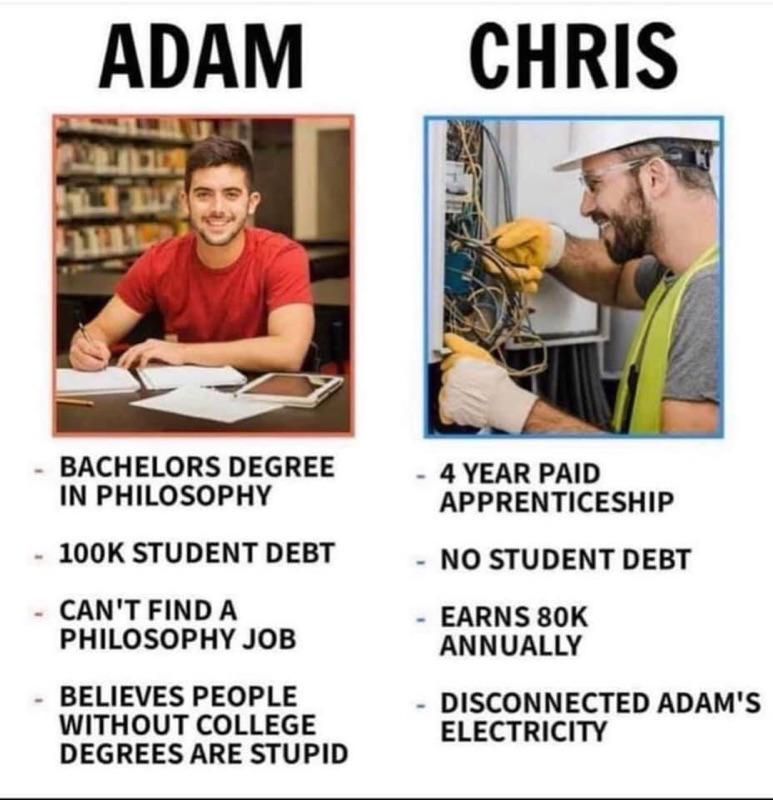
There was a time in America when a young man could graduate high school, walk onto a job site and within a few years be earning enough to support a family, buy a home and eventually start his own business. No college debt. No elite credentials. Just tools, skill and hard work. We called them the trades: plumbing, roofing, HVAC, welding, framing, electrical, mechanics. These jobs did not just build infrastructure. They built the middle class. Over the last thirty years they have been hollowed out, not because Americans got lazy, but because the labor market was flooded with workers operating outside the legal system. Tradesmen were replaced with low-wage labor, often off the books, untaxed, unlicensed and invisible. That is a policy failure. And fixing it requires two things working together: enforcing the immigration laws already on the books and rebuilding the vocational training pipeline that a generation of college-or-bust messaging destroyed.
What the Data Says About Illegal Labor and Wages
The economic distortion illegal immigration has created in low-skill labor markets is documented rather than speculative. Pew Research Center estimated that more than 10.5 million unauthorized immigrants were in the United States as of 2021, with approximately 7.6 million participating in the workforce, the majority concentrated in construction, agriculture, hospitality and service trades. A 2016 report from the Center for Immigration Studies found that in many low-skill job sectors illegal immigrants depress wages and displace American workers, particularly in construction and the building trades. A 2010 Government Accountability Office report on E-Verify cited employer admissions of hiring undocumented workers specifically to avoid taxes, reduce labor costs and evade wage laws.
The downstream consequences are concrete and measurable. Legal contractors cannot compete against crews operating off the books with no insurance, no benefits and no licensing overhead. Wages stagnate across entire trades because the price floor collapses when a parallel workforce operates outside the legal system. Union training pipelines dry up because apprenticeship programs cannot sustain themselves when non-union, undocumented labor consistently undercuts their members on bids. High school graduates look at the trades and see no path forward because the visible labor market tells them the work is not valued, even when the Bureau of Labor Statistics data says otherwise. The problem is not the work. The problem is what decades of enforcement failure have done to the market for it.
According to the Bureau of Labor Statistics 2023 Occupational Outlook Handbook, median annual wages in the skilled trades include elevator installers at $98,600, lineworkers at $82,770, plumbers at $61,550, electricians at $60,240, carpenters at $52,480, HVAC technicians at $51,390 and welders at $48,940. Many of these roles require no college degree, and wages reach six figures with experience, overtime and specialization. The labor is not low-wage by design. It became low-wage by policy failure. Remove the illegal labor that has been undercutting the market for thirty years and these numbers rise further as employers compete for legal workers through the only mechanism available to them: higher pay.
The College Debt Trap That Replaced the Trades
While the trades were being undercut, young Americans were steered toward college as the only respectable path to a productive life. The results of that cultural message, combined with decades of federal subsidies that inflated tuition without improving outcomes, are documented in the numbers. The Federal Reserve reported $1.77 trillion in outstanding student loan debt as of 2023, held by approximately 43.5 million borrowers with an average balance of $37,787 according to the Education Data Initiative. The College Board documented average annual costs of $27,940 for in-state public college and $57,570 for private institutions as of 2022. The Federal Reserve found that roughly one-third of college graduates are working in jobs that do not require a degree.
The calculation being sold to young Americans is false on its face. A student who borrows $150,000 for a four-year degree in a field with limited employment prospects and graduates into a job market that values her credential at $42,000 per year has made a worse economic decision than the classmate who went into a two-year electrician apprenticeship and is earning $60,000 in year three with no debt. The stigma attached to the trades has produced this outcome. It was not inevitable. It was manufactured by a cultural consensus that confused credential accumulation with education and confused education with economic preparation. Trade schools remain underenrolled. Vocational programs in high schools have been disappearing for decades. And the young Americans who would have thrived in those programs are instead taking on debt to pursue degrees they may not need in fields that may not hire them.
The student who borrows $150,000 for a degree that leads to a $42,000 job made a worse economic decision than the classmate who entered an electrician apprenticeship and earned $60,000 in year three with no debt. We built a culture that could not tell the difference. That culture cost a generation of workers their financial future.
Enforcement Is the Law, Not an Extreme Position
Deportation of people who entered the country illegally or overstayed their visas is not a new policy proposal. It is the existing law. Under the Immigration and Nationality Act, individuals present in the country without authorization are subject to removal, and that authority has been exercised at scale by administrations of both parties throughout American history. The Eisenhower administration's 1954 enforcement operation produced over one million removals. The Obama administration deported more than three million people between 2009 and 2016, including 1.7 million interior removals according to Department of Homeland Security Yearbook of Immigration Statistics data. ICE conducted over 267,000 deportations in fiscal year 2019 alone according to the agency's FY2019 Enforcement and Removal Operations Report. What is missing in the current debate is not legal authority. The authority exists and has been exercised repeatedly. What is missing is the political will to use it consistently.
Public opinion on this question is not where the political class pretends it is. A 2023 Rasmussen survey found that 60 percent of voters support deporting illegal immigrants who have not committed other crimes. A 2022 Gallup poll found that 64 percent of Americans consider illegal immigration a critical or important threat. The argument that enforcement is extreme or outside the American mainstream is not supported by the polling. It is supported by the preferences of donors, advocacy organizations and political strategists whose interests diverge from those of working-class voters on both sides of the aisle.
What Happens When the Market Corrects
The argument that illegal immigrants do the work Americans will not do is not an economic observation. It is a rationalization for a policy failure that has persisted for thirty years. The truth is that Americans will do any job that pays fairly and operates legally. Before the mass illegal immigration wave of the 1990s, Americans dominated construction, roofing, agriculture, hospitality and meatpacking. Those jobs still exist. They are now filled in large part by workers paid under the table, with no benefits and no upward path. Remove that labor from the equation and employers face a straightforward choice: raise pay and improve conditions to attract legal workers, or stop operating. Most will raise pay. That is how a market correction works.
The evidence for this is not theoretical. Following an ICE enforcement operation at Mississippi chicken processing plants in 2018 and 2019, documented by the New York Times in 2019, wages for legal workers rose sharply and local residents were hired to fill the vacated positions. The labor did not disappear. It did not move to robots. It became legal again, at wages the market was suddenly willing to pay because the illegal alternative was no longer available. That is the mechanism. Enforcement triggers the market correction that no subsidy or training program can produce on its own.
The Political Class That Sold Out the Trades
The working Americans who built this country's physical infrastructure did not lose the trades because of automation or globalization alone. They lost them because every major institutional interest in Washington found a reason to let it happen. Democrats wanted the political loyalty of a growing immigrant population and the activist energy of open-borders advocacy groups. Republicans wanted the cheap labor that kept construction costs down and donor profits up. Corporate America wanted an unlimited supply of workers with no bargaining power. The higher education industry wanted every young American in a classroom regardless of whether that classroom was the right place for them. The people who paid the price for all of those interests converging were the working-class Americans who found their wages undercut, their training pipelines drained and their cultural path to middle-class prosperity dismissed as a relic.
Both parties talk about the working class. Both parties have spent thirty years building the conditions that undermined it. The trades did not decline because of market forces. They declined because the labor market was deliberately allowed to operate outside the law. Enforcement is not the radical position. Accepting that outcome was.
A Blueprint for Rebuilding
Enforcement creates the market conditions that make the rest of this work. But enforcement alone is not sufficient. The infrastructure for training the next generation of skilled tradespeople has been allowed to atrophy and restoring it requires deliberate policy choices. High schools should bring back vocational programs as a first-choice path rather than a consolation prize, introducing welding, HVAC, digital fabrication and electrical in public schools with the same institutional support given to AP coursework. Federal tax incentives for companies that hire and train citizens through registered apprenticeship programs would rebuild the union training pipelines that decades of wage suppression drained. Mandatory E-Verify with meaningful penalties for employers who hire illegally would eliminate the black market that makes legal contractors uncompetitive. Preference for local contractors on publicly funded projects, conditioned on verified legal hiring and apprenticeship enrollment, would direct federal spending toward the labor market outcomes the policy is designed to produce. And licensing reform that streamlines excessive credential requirements while maintaining genuine safety standards would lower the barrier to entry for young Americans trying to establish themselves in the trades.
None of that works without the enforcement piece. You cannot rebuild a training pipeline for a labor market that remains undercut by workers operating outside the legal system. The market correction has to come first. The investment in training follows from a corrected market. That is the sequence. Getting the sequence right is the difference between a policy that produces outcomes and a policy that produces press releases.
A Direct Message to Young Americans
If you are eighteen and unsure of your future, the cultural message you have been receiving for most of your life has not been doing you any favors. You do not need a hundred thousand dollars in debt to be worth something. You need a skill, a license, a work ethic and access to a labor market that rewards all three. The trades offer a path to six-figure income, genuine independence and the ability to eventually own your own business without spending four years in a classroom studying things you will never use. The only thing preventing more young Americans from taking that path is a combination of cultural stigma and a rigged labor market. The first is being dismantled by economic reality. The second requires enforcement. Both are fixable. The question is whether the political class will get out of the way long enough to let it happen.
My Bottom Line
This is not an argument against immigration. Legal immigration, managed through a system that serves the country's labor needs while protecting wages and working conditions for everyone in the system, is a legitimate and valuable part of the American economy. This is an argument against a lawless labor market that has operated outside those protections for thirty years at the direct expense of working-class Americans who played by the rules and watched the rules stop protecting them. Bringing back the trades means enforcing the law, rebuilding the training infrastructure and telling a generation of young Americans the truth: that building things is honorable, that skilled work is not a consolation prize and that the path to a middle-class life does not require a diploma if it requires a license and a set of tools you know how to use.
Bring back the hammer. Bring back the torch. Bring back the trowel. And bring back the legal labor markets that made the work worth doing.
References
- Pew Research Center. (2021). Facts on unauthorized immigrants in the U.S. pewresearch.org. [10.5 million unauthorized immigrants; 7.6 million in workforce.]
- Camarota, S. A. & Zeigler, K. (2016). The impact of illegal immigration on the wages and employment of black workers. Center for Immigration Studies. cis.org.
- U.S. Government Accountability Office. (2010). E-Verify: Challenges in implementing employment eligibility verification. GAO-10-704T. gao.gov.
- Bureau of Labor Statistics. (2023). Occupational Outlook Handbook. bls.gov. [Median annual wages for all trades cited.]
- Federal Reserve. (2023). Consumer Credit G.19 Release. federalreserve.gov. [$1.77 trillion student loan debt figure.]
- Education Data Initiative. (2023). Student loan debt statistics. educationdata.org. [43.5 million borrowers; $37,787 average balance.]
- College Board. (2022). Trends in college pricing and student aid. collegeboard.org. [$27,940 in-state; $57,570 private annual costs.]
- Federal Reserve. (2021). Underemployment of college graduates. federalreserve.gov. [One-third of graduates in jobs not requiring degrees.]
- U.S. Department of Homeland Security. (2016). Yearbook of Immigration Statistics. dhs.gov. [3 million deportations under Obama administration 2009-2016.]
- U.S. Immigration and Customs Enforcement. (2019). FY2019 Enforcement and Removal Operations Report. ice.gov. [267,000 deportations in FY2019.]
- Rasmussen Reports. (2023). Majority favor deportation of illegal immigrants. rasmussenreports.com. [60% support deportation.]
- Gallup. (2022). Public opinion on immigration. gallup.com. [64% view illegal immigration as critical or important threat.]
- New York Times. (2019). After ICE raids, Mississippi factories look for legal workers. nytimes.com. [Wages rose and locals were hired after ICE enforcement operation.]
Disclaimer: The views expressed in this post are the personal opinions of the author and are offered for educational, commentary and public discourse purposes only. They do not represent the positions of any institution, employer, organization or affiliated entity. Nothing in this post constitutes legal, financial, medical or professional advice of any kind. References to immigration statistics, wage data, enforcement history and polling are based on publicly available sources cited above. Commentary on immigration enforcement, labor markets and education policy reflects the author's independent analysis and is protected expression of opinion. Readers are encouraged to consult primary sources and form their own conclusions.